Railay Viewpoint: A Steep Climb for Sweeping Karst Panoramas
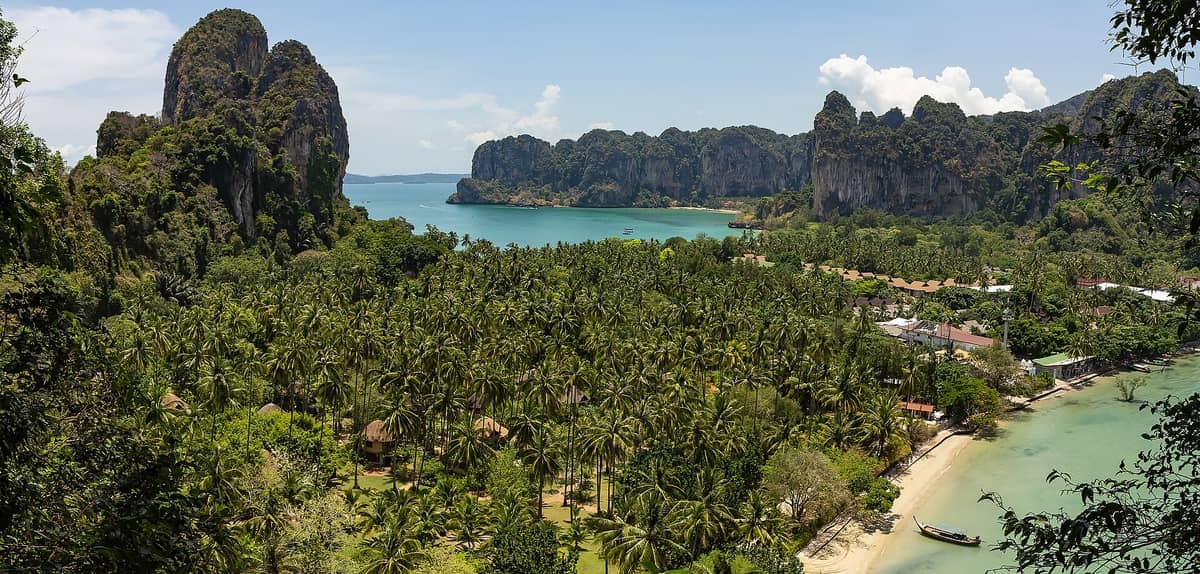
Railay Viewpoint sits atop a forested limestone ridge on the Railay Peninsula, reached by a short but demanding rope-assisted scramble. The payoff is one of Krabi's most dramatic bird's-eye perspectives: a 180-degree sweep of jungle-capped cliffs, the jade-green water between East and West Railay, and, on clear days, the open Andaman Sea beyond.
Quick Facts
- Location
- Railay Peninsula, Krabi Province, Thailand. Trailhead on the path between East Railay and Phra Nang Beach.
- Getting There
- Railay is accessible only by longtail boat from Ao Nang or Krabi Town. From the boat drop at East Railay, follow the footpath south toward Phra Nang — the steep trailhead appears on your left.
- Time Needed
- 45–90 minutes for the round trip; allow extra time to rest and photograph at the top.
- Cost
- No verified entrance fee. Some visitors report an informal collection at the trailhead; bring small change (THB) just in case.
- Best for
- Confident hikers, photographers chasing sunrise light, and anyone wanting a perspective on Railay that goes beyond the beach.
What Railay Viewpoint Actually Is
Railay Viewpoint, sometimes called East Railay Viewpoint, is a natural lookout on the limestone ridge that forms the spine of the Railay Peninsula. It is not a manicured observation deck with railings and signage. It is a raw jungle outcrop, reached by a trail that involves fixed ropes, muddy footholds, and genuine physical effort. The roughly 90-metre elevation gain is compressed into a very short horizontal distance, which is why the climb feels intense even by Thai island standards.
The reward at the top is a panorama that puts everything you have seen at ground level into sudden context. West Railay Beach and its long arc of pale sand stretch out to one side, while the mangrove-fringed shores of East Railay and the channel that connects the peninsula to Ao Nang appear on the other. On clear days, the view extends to open water and distant islands. The karst towers that seem imposing from the beach look almost intimate from this height, their forested tops just below you.
⚠️ What to skip
The trail becomes genuinely dangerous after rain. Limestone turns glassy when wet, and the ropes alone are not enough to prevent a serious fall. If it has rained in the past few hours, wait for the surface to dry or skip the climb entirely.
Getting to the Trailhead
The Railay Peninsula is cut off from the mainland by impassable karst cliffs, so every visitor arrives by longtail boat. Most depart from Ao Nang Beach, where boats run regularly throughout the day. The crossing takes around 10–15 minutes. Boats also operate from Krabi Town, though the journey is longer. There is no road access to Railay whatsoever.
Once you land at East Railay, the route to the viewpoint trailhead is straightforward. Walk south along the main path that connects East Railay to Phra Nang Beach, passing through a narrow band of jungle. The trailhead for the viewpoint is on your left, marked by fixed ropes descending from the tree line. If you reach Phra Nang Cave, you have gone slightly too far. The approach from landing to trailhead takes about ten minutes on flat ground.
The trailhead itself is easy to miss in the middle of the day when shade collapses everything into uniform green. Look for ropes anchored at the base of the slope and other hikers pausing to tighten their shoes. In peak season, a small cluster of people gathering here is usually the clearest sign.
Tickets & tours
Live prices and dates from our booking partner. If you book, we may earn a commission at no extra cost to you.
Island Hopping by Private Longtail Boat from Railay
From 130 €Instant confirmationFree cancellationDaily Cooking Class at Thai Cookery School in Krabi
From 42 €Instant confirmationFree cancellation7 islands speedboat excursion from Krabi
From 41 €Instant confirmationFree cancellationSpeedboat Tour to Hong Island Archipelago from Krabi
From 34 €Instant confirmationFree cancellation
The Climb: What to Expect Underfoot
The ascent is steep from the first step. The trail climbs through dense vegetation, and the fixed ropes begin almost immediately. You will use your hands as much as your feet. The ropes are thick and generally well-anchored, but they can be slippery with humidity and morning dew. Wear closed-toe shoes with grip; flip-flops and sandals are a real liability here.
About halfway up, the vegetation opens slightly and you get a partial view toward the east. This is where many people stop to catch their breath and where the effort starts to feel worth it. The final section is the steepest and requires careful foot placement. The limestone surface has natural texture, but smooth patches appear without warning. Take your time.
At the top, a small rocky platform gives you the full panorama. There is no fence or barrier. The space is limited, so on busy mornings, ten to fifteen people at once makes it feel crowded. The descent uses the same ropes and is, if anything, slightly harder than the climb because you cannot always see your footholds.
💡 Local tip
Wear a small daypack rather than a shoulder bag so both hands stay free on the ropes. Bring at least 500ml of water per person. The climb is short but the heat and humidity are not.
Best Time of Day to Visit
Early morning is the single best time to make this climb. Before 8am, the trail is cool, the light is directional and golden, and the crowd at the top is minimal. The view is sharpest before the midday haze settles over the water. Sounds are different too: the jungle is active with birds and cicadas in the early hours, the distant thump of longtail engines not yet constant.
Midday is the least pleasant window. The heat at the top of an exposed limestone ridge with no shade is punishing between 11am and 2pm. The trail is also at its most trafficked during these hours as day-trippers arrive from Ao Nang. If you are already on Railay and midday is your only option, go slow and carry more water than you think you need.
Late afternoon can be rewarding if the sky is clear. The light turns warm around 4pm and the shadows cast by the karst towers become dramatic. However, afternoon thunderstorms develop quickly in the rainy season (roughly May through October), and the trail should be abandoned at the first sign of rain. Sunset from the viewpoint is theoretically beautiful but the return descent in fading light is a bad idea without a powerful torch.
Photography and What You Will Actually See
The view from Railay Viewpoint is primarily toward the east and southeast. West Railay Beach appears as a long pale stripe with the darker water beyond it. The forested karst walls that surround the peninsula fill the middle ground, and on clear days, you can pick out boats and, further out, the faint outlines of islands on the horizon. The colour of the water shifts noticeably through the day: blue-green in the morning, a flatter turquoise at midday, and briefly rich gold-orange in late afternoon.
For composition, a wide-angle lens or a phone in standard mode captures the full panoramic sweep, while a short telephoto lets you isolate individual karst towers or compress the water behind the beach. Some photographers make the extra scramble toward the lagoon trail, which branches off from the viewpoint and descends steeply to Railay Lagoon. That route is even more demanding, often muddy regardless of weather, and the lagoon itself is tidal, with water levels that vary considerably. It is worth knowing what you are committing to before heading down.
Seasonal Considerations and Weather Honesty
The dry season, roughly December through March, gives the most reliable conditions for this climb. Trails are drier, visibility is better, and the boat crossings from Ao Nang are calmer. The best months to visit Krabi for outdoor activities generally align with this window. During the peak of dry season, particularly December and January, expect the trailhead to be genuinely busy by 9am.
Visiting during the rainy season (May through October) is possible but requires patience and good timing. Mornings are often clear even when afternoons bring heavy rain. If you are travelling in this period, check the rainy season in Krabi and plan the climb for your first clear morning window. The peninsula can feel almost empty during low season, which has its own appeal: no crowd at the top, a quieter walk through the jungle, and a more atmospheric view through scattered cloud.
Who Should Skip This
This is not a gentle walk, and it is worth being clear about that. Anyone with significant knee problems, vertigo, or limited upper-body strength will find the rope sections uncomfortable at best and dangerous at worst. The trail is not accessible for wheelchairs or strollers. Young children can sometimes manage the climb, but only with close adult supervision and only in dry conditions. If your group includes anyone who is not comfortable with scrambling on steep, uneven terrain, it is a better use of your time to explore the beaches and caves below.
Travelers who are primarily beach-focused and not especially drawn to exertion may find that Phra Nang Beach and its cave, which requires no climbing at all, deliver more satisfaction per unit of effort. The viewpoint is genuinely worth it for those who enjoy physical challenges and wide landscape perspectives. For casual visitors, it can feel like a lot of work for a brief reward.
Insider Tips
- Start the climb no later than 7:30am to beat both the heat and the crowd. By 9am on busy days, the narrow trail creates an awkward bottleneck where climbers going up and those coming down have to negotiate around each other on the ropes.
- The ropes are maintained irregularly. Before you commit your full weight to a section, give it a firm tug and check where it is anchored. Most are solid, but occasional fraying or loose fixings appear after heavy rain.
- Bring a dry bag or zip-lock bags for your phone and camera. Humidity alone can fog a lens, and the scrambling position means electronics take knocks more easily than on a regular trail.
- If you want to attempt the continuation to Railay Lagoon, do it on the way down from the viewpoint rather than tacking it on as a separate trip. The junction is easier to spot when you are descending and already familiar with the terrain.
- Longtail boats from Ao Nang begin running early, typically before 8am in high season. An early boat crossing gives you time to reach the trailhead by 7am and be back at the beach before the serious heat sets in around 10am.
Who Is Railay Viewpoint For?
- Confident hikers comfortable with ropes and steep terrain who want a perspective on Railay that no beach walk provides
- Photographers looking for landscape shots of Krabi's karst scenery from elevation, particularly in early morning light
- Repeat visitors to Railay who have already done the beaches and want to add a physical challenge to the itinerary
- Travelers visiting in the dry season (December to March) with clear skies and stable trail conditions
- Anyone combining the viewpoint with the nearby Railay Lagoon for a half-day exploration of the peninsula's interior
Nearby Attractions
Other things to see while in Railay Peninsula:
- East Railay Beach
East Railay Beach is the main arrival point for longtail boats reaching the Railay Peninsula. It is not a swimming beach, but it is the first thing most visitors see — and understanding what it is, and what it is not, shapes the entire Railay experience.
- Phra Nang Beach
Phra Nang Beach sits at the southern tip of Railay Peninsula, hemmed in by sheer limestone cliffs and reachable from the mainland only by longtail boat, or on foot from Railay East. The roughly 450-metre stretch of pale sand, a sea cave shrine, and turquoise water make it one of Krabi Province's most visually striking beaches — though its reputation means it is rarely quiet during peak hours.
- Phra Nang Cave & Princess Shrine
Tucked into the limestone cliffs at the southern tip of Railay Peninsula, Phra Nang Cave holds a shrine to a revered sea-princess spirit, surrounded by hundreds of carved wooden offerings left by local fishermen. The cave sits steps from one of Krabi's most photographed beaches, making it easy to combine a cultural visit with a morning swim or a sunset sit on the sand.
- Railay Lagoon
Railay Lagoon, also known as Princess Lagoon, is a secluded tidal pool carved into the limestone heart of the Railay peninsula. Reaching it requires a steep, rope-assisted scramble that most visitors never attempt, which is exactly why the reward feels so outsized for those who do.
Planning a trip? Discover personalized activities with the Nomado app.