Philip and Patricia Frost Museum of Science: What to Expect Before You Go
The Philip and Patricia Frost Museum of Science is a 250,000-square-foot science complex on Miami's downtown waterfront, combining a multi-level aquarium, a cutting-edge planetarium, and rotating natural history and technology exhibits under one roof. It draws families, curious adults, and school groups in roughly equal measure, and it genuinely earns a half-day of your time.
Quick Facts
- Location
- 1101 Biscayne Blvd, Maurice A. Ferré Park, Downtown Miami, FL 33132
- Getting There
- Museum Park Metromover Station (free automated rail); Metrorail to Government Center then transfer
- Time Needed
- 3 to 5 hours for the full complex; 2 hours if focusing on the aquarium and planetarium only
- Cost
- Paid admission; prices vary by age and date. Check frostscience.org for current date-specific rates. Miami-Dade resident discounts available.
- Best for
- Families with children, science enthusiasts, rainy-day visitors, first-time Miami tourists
- Official website
- www.frostscience.org
What Frost Science Actually Is
The Philip and Patricia Frost Museum of Science, known locally as Frost Science, opened on May 8, 2017 after a ground-breaking in February 2012. It replaced the long-running Miami Museum of Science, which had operated near Vizcaya since 1966 — itself descended from the Junior Museum of Miami, founded in 1949. The new building is not a renovation. It is a purpose-built, 250,000-square-foot complex sitting on four acres within Maurice A. Ferré Park, right on the edge of Biscayne Bay in Downtown Miami.
Three distinct components share the site: a multi-story aquarium, a digital planetarium, and a series of permanent and rotating science exhibits spread across multiple floors. The aquarium alone would justify a dedicated visit in most cities. Add the planetarium and the exhibit halls, and you have one of the more substantive indoor attractions in South Florida. It operates as a Smithsonian Affiliate, which tells you something about the curatorial standards applied here.
💡 Local tip
Buy tickets in advance on frostscience.org. The museum uses timed-entry ticketing for the planetarium and peak weekend slots can sell out. Booking online also lets you compare date-specific pricing before you commit.
The Aquarium: Three Floors, One Ocean
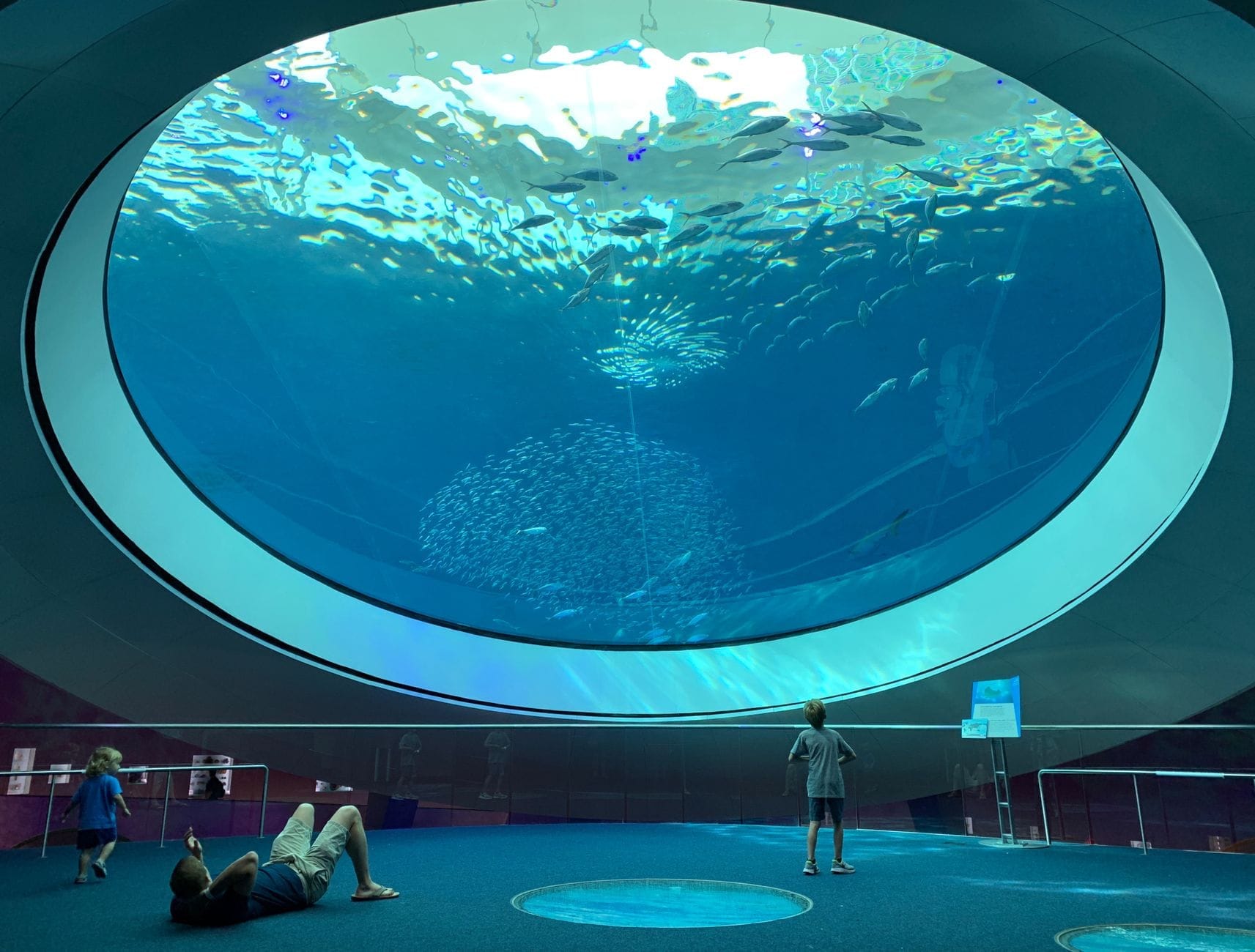
The aquarium is built around a central, three-story Gulf Stream tank holding approximately 500,000 gallons of salt water. You encounter it differently depending on which floor you are on. At the top, you look across the open surface from above, watching sharks and large pelagic fish cut slow arcs. The scale from here is surprisingly hard to read: the animals look manageable until you spot a diver in the tank during a feeding demonstration and realize how large the rays and sandbar sharks actually are.
The middle level brings you face-to-face with the tank through a curved, acrylic lens that bulges slightly toward you. Schools of jacks move in synchronized columns, and the light filtering down from the surface gives the water a shifting, blue-green quality that changes throughout the day as natural light shifts outside. On weekend afternoons, this level gets crowded with children pressing against the glass. Mornings, especially on weekdays, offer a noticeably quieter experience, and the tank feels more immersive when you are not competing with a crowd for space.
The lower level houses the deep-reef section. The lighting is dimmer, the tanks are smaller and more focused, and the fish are the kind you do not see in shallower water: lionfish, grouper, and various species native to Florida's offshore reefs. The contrast between this level and the open-water drama above it is deliberate and works well.
Tickets & tours
Hand-picked options from our booking partner. Prices are indicative; availability and final rates are confirmed when you complete your booking.
Everglades admission ticket with airboat ride and wildlife show
From 24 €Instant confirmationFree cancellationKey West day trip with glass bottom boat ride
From 110 €Instant confirmationFree cancellationEverglades airboat ride with Biscayne Bay boat tour and transportation
From 67 €Instant confirmationFree cancellationGrand Bahama tour with optional Pig Beach visit
From 309 €Instant confirmationFree cancellation
The Planetarium: A Serious Show Space
The Frost Planetarium seats 250 people under a dome that uses a dual digital projection system capable of rendering the full night sky at high resolution. It is not a novelty tourist show. The programming includes both curriculum-aligned educational presentations aimed at school groups and evening shows designed for adult audiences, some with live narration by museum staff. Showtimes rotate throughout the day, and the content changes periodically.
The physical design of the building is worth noting here. The planetarium sphere is partially suspended above the ground, visible from outside as a white dome that hovers over the park. Inside, the reclining seats tilt back at roughly 23.5 degrees, which eliminates neck strain during the full-dome presentations. It is a small detail, but it matters across a 30 to 45-minute show.
ℹ️ Good to know
Planetarium showtimes are scheduled in advance and run at specific hours. Confirm the day's schedule when you arrive, or check it online before your visit, so you can plan the rest of your museum time around it.
The Science Exhibits: What to Prioritize
The permanent exhibits cover Florida's ecosystems, human health and anatomy, physics, and space science. The Everglades-focused section is one of the more thoughtfully executed: it places South Florida's ecology in direct conversation with the urban environment visitors just traveled through to reach the museum. The connection between Biscayne Bay outside the windows and the watershed ecology inside the exhibit is not coincidental.
The exhibit halls for younger children include hands-on stations that hold up well under repeated use: water tables, building challenges, and interactive screens. These areas get genuinely loud by mid-morning on weekends. If you have children under eight, this noise is mostly their doing and they will not care. If you are visiting without children and want a more contemplative experience, plan to be in those sections before 11 a.m. or after 3 p.m.
Rotating special exhibitions cycle through the museum and occasionally add a supplementary ticket cost. The quality varies, but the museum's partnership with Smithsonian Affiliates means traveling exhibitions tend to be well-sourced. Check the current schedule on the official website before your visit. The nearby Pérez Art Museum Miami is directly adjacent in Ferré Park and many visitors combine both in a single day if their interest spans science and contemporary art.
Getting There and Getting Around the Building
The museum sits at 1101 Biscayne Blvd in Maurice A. Ferré Park. The Museum Park Metromover station is steps from the entrance. The Metromover is free to ride and connects to the Metrorail network at Government Center, which in turn links to Miami International Airport via the Orange Line. For most visitors staying in Downtown Miami or Brickell, the Metromover is the cleanest option: it runs frequently and drops you close to the front door.
Rideshare is straightforward — the Biscayne Blvd frontage has space for drop-off and pickup. Driving is possible but parking in the area involves either the onsite paid museum garage or other nearby paid garages and lots. If you are navigating Miami without a car, this is one of the easier major attractions to reach by public transit.
Inside, the building uses a central core with elevators serving all levels. The layout is vertical rather than sprawling, which means you move between floors often. The elevators handle strollers and wheelchairs without issue, and the aquarium levels in particular are fully accessible by elevator with clear sightlines at all tank levels. The building was designed from the ground up to modern accessibility standards.
Timing Your Visit
The museum is open daily from 10 a.m. to 6 p.m. The first hour, from opening to around 11 a.m., is consistently the quietest. School group visits tend to arrive mid-morning and occupy the exhibit halls in clusters. Weekend afternoons, particularly Saturday between noon and 3 p.m., are the peak crowd window: the aquarium observation areas and the children's exhibit spaces become tight.
Miami's summer months bring intense heat and frequent afternoon thunderstorms, which actually works in the museum's favor. On a July afternoon when outdoor temperatures reach 90°F and thunderstorms roll across Biscayne Bay, Frost Science functions as one of the more sensible places to be. The building is fully air-conditioned throughout. For context on planning around Miami's weather, see the guide to visiting Miami in summer.
The museum is open every day of the year from 10 a.m. to 6 p.m., though hours may shift for special evening events. The planetarium occasionally hosts evening programming with modified admission arrangements. Verify current hours on frostscience.org before your visit, particularly around major holidays.
⚠️ What to skip
Ticket prices are date-specific and updated dynamically on the museum's website. Do not rely on third-party listings for current rates. Miami-Dade County residents qualify for reduced admission with valid ID — worth checking if you live locally or are visiting for an extended stay.
Honest Assessment: Who Should Reconsider
The museum is expensive relative to many Miami cultural options, and if you are traveling on a tight budget, you should weigh the full admission cost against your priorities. It is not the kind of place where partial entry is an option: the ticket covers the whole complex, and the value scales with how much of it you actually use.
Adults visiting without children and with no particular interest in science, ecology, or astronomy are likely to feel the price most acutely. The exhibit halls, while well-designed, are oriented toward engagement and education rather than quiet contemplation. If your Miami priorities run toward outdoor and cultural experiences, you might find that Vizcaya Museum and Gardens or a morning at Wynwood Walls better matches your interests.
The museum is also not a short-visit attraction. If you are working through a dense itinerary and can only spare 45 minutes, the aquarium alone does not feel complete in that time, and you will leave having seen only part of what you paid for. Budget at least three hours or adjust expectations accordingly.
Insider Tips
- The Gulf Stream tank feeding demonstrations are scheduled events, not continuous. Ask at the welcome desk or check the day's event board as you enter — timing your aquarium visit around a feeding makes the upper observation level significantly more dramatic.
- Weekday mornings before 11 a.m. are the lowest-crowd window, especially Tuesday through Thursday. If your schedule is flexible, this is the correct time to visit.
- The museum cafe is functional but unremarkable. The restaurants in Brickell City Centre are about a 10-minute rideshare away and offer a much better lunch experience if you want to break your visit, leave for food, and re-enter on the same ticket — confirm the museum's re-entry policy when you buy tickets.
- The rooftop terrace area offers an unobstructed view across Biscayne Bay toward Miami Beach. It is not prominently signposted and many visitors miss it entirely. It is worth the detour, especially in the late afternoon when the light on the water is at its best.
- Miami-Dade public school groups visit heavily on weekday mornings during the academic year (roughly September through May). If you are visiting mid-week in those months, aim for late morning entry after 11 a.m. or the afternoon session to avoid the school group peak.
Who Is Philip and Patricia Frost Museum of Science For?
- Families with children between ages 4 and 14, for whom the aquarium and hands-on exhibits are genuinely absorbing
- Visitors spending a full day in the Downtown Miami cultural corridor alongside the adjacent Pérez Art Museum
- Summer visitors looking for a substantive indoor option during Miami's hottest and rainiest months
- Science, marine biology, or astronomy enthusiasts who want more than a tourist-grade experience
- Travelers combining a first visit to Miami with a compact overview of South Florida's ecosystems and natural history
Nearby Attractions
Other things to see while in Downtown Miami:
- Bayfront Park
Bayfront Park is a free, 32-acre public park on the edge of Biscayne Bay in Downtown Miami, with roots going back to 1896. It offers open lawns, shaded waterfront paths, and sweeping bay views within steps of the Metromover — making it one of the most accessible green spaces in the city.
- Bayside Marketplace
Bayside Marketplace is an open-air shopping and entertainment complex on the edge of Biscayne Bay in Downtown Miami. Free to enter and easy to reach by public transit, it draws a mix of tourists, locals catching live music, and visitors boarding bay cruises. The setting does most of the work.
- Freedom Tower
Standing at 600 Biscayne Boulevard, Freedom Tower at Miami Dade College is one of downtown Miami's most architecturally striking and historically significant buildings. Built in 1925 as the Miami News headquarters, it later served as the federal Cuban Refugee Center, processing hundreds of thousands of Cuban exiles after 1962. Today it functions as a museum, gallery, and cultural institution — a rare place where architecture, immigration history, and civic identity converge in a single tower.
- HistoryMiami Museum
Founded in 1940 and recently rebranded from HistoryMiami Museum to Museum of Miami, this Smithsonian Affiliate in downtown Miami is dedicated to telling roughly 10,000 years of South Florida's layered past. From Tequesta settlements to Caribbean immigration waves, it's one of the major history institutions in the region.