Vizcaya Museum and Gardens: Miami's Most Extraordinary Historic Estate
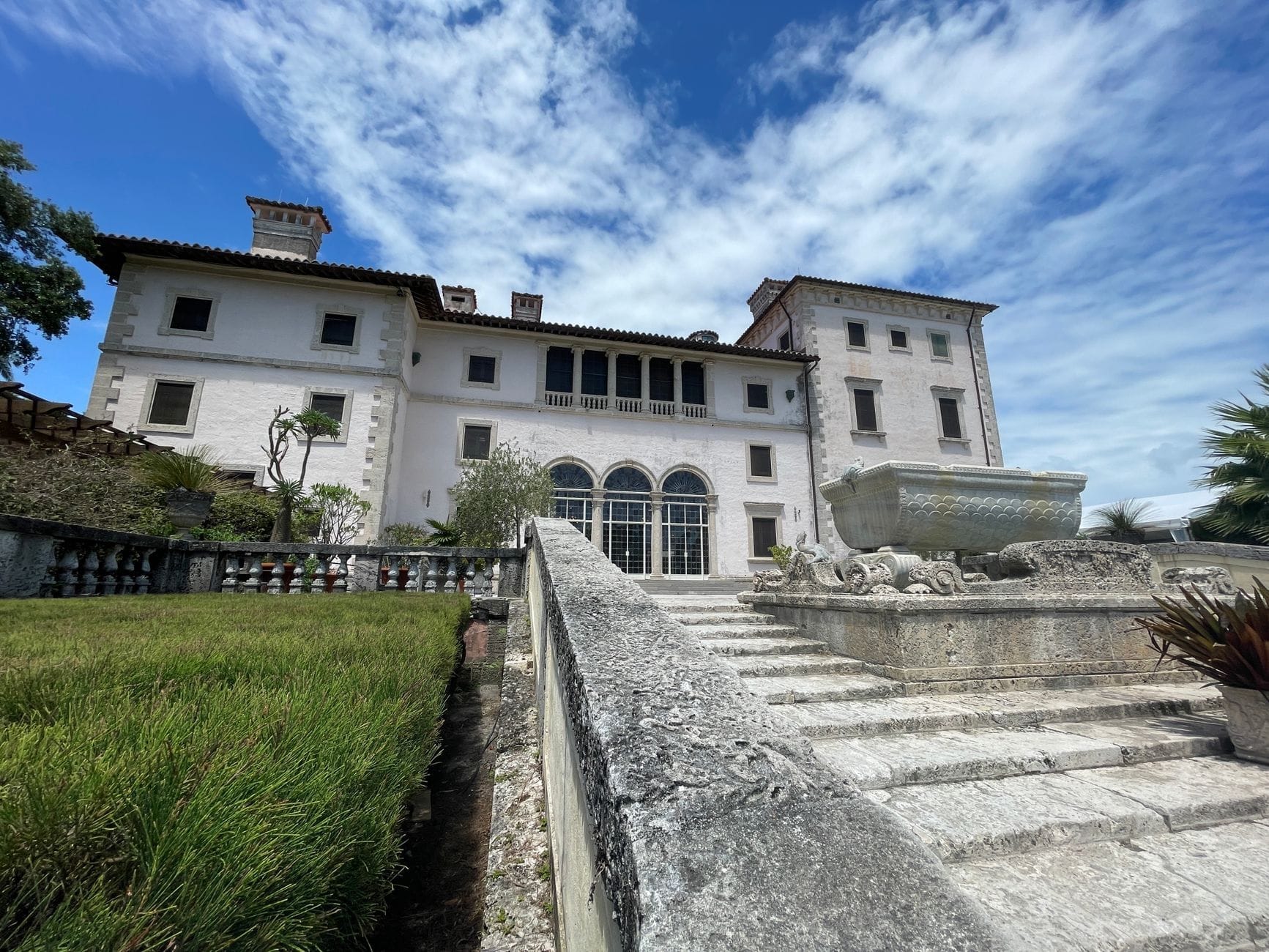
Built between 1914 and 1922 as the winter home of industrialist James Deering, Vizcaya Museum and Gardens is a National Historic Landmark sitting on Biscayne Bay in Miami’s Coconut Grove neighborhood. The 34-room Main House is packed with European antiques and decorative arts, while 10 acres of formal gardens unfold toward the water in a way that feels entirely out of place in subtropical Miami — which is exactly the point.
Quick Facts
- Location
- 3251 South Miami Avenue, Coconut Grove, Miami, FL 33129
- Getting There
- Vizcaya Metrorail Station (approx. 8-min walk)
- Time Needed
- 2.5 to 4 hours
- Cost
- Timed-entry tickets required; check vizcaya.org for current pricing (standard adult admission $20; special tours from $24–$39)
- Best for
- Architecture lovers, history enthusiasts, photographers, and couples
- Official website
- vizcaya.org
What Vizcaya Actually Is
Vizcaya Museum and Gardens is a 1910s Italian Renaissance-style estate that looks like it was airlifted from the Veneto and dropped onto the edge of Biscayne Bay. That dissonance is deliberate. James Deering, vice president of International Harvester and heir to an agricultural machinery fortune, wanted a winter home that would make European aristocracy feel recognizable, even in the Florida subtropics. He hired architect F. Burral Hoffman Jr. and designer Paul Chalfin to achieve exactly that — and they largely succeeded.
The result is a 34-room Main House filled with original furnishings, tapestries, and decorative objects spanning 15th- to 19th-century European styles, all carefully curated to convey centuries of imagined family history that the Deerings never actually had. Surrounding the house, roughly 10 acres of formal Italian and French-influenced gardens descend toward a stone barge breakwater on the bay. It opened to the public as a museum in 1953 and was later designated a National Historic Landmark, recognizing its architectural and cultural significance.
ℹ️ Good to know
Vizcaya is open Wednesday through Monday, 9:30 a.m. to 4:30 p.m. It is closed on Tuesdays and some major holidays including Thanksgiving. Timed-entry tickets must be purchased in advance through the official website. Walk-in availability is limited, especially on weekends.
The Main House: Room by Room, Layer by Layer
Entering the Main House feels immediately theatrical. The reception rooms on the ground floor are arranged to impress sequentially, each transitioning in style from Renaissance to Rococo to Baroque without apology. Stone floors, gilded ceilings, Flemish tapestries, and furniture that was genuinely old when Deering bought it create an atmosphere that's more European country house than American museum. The lighting inside is dim by design, which adds to the atmosphere but can make photography difficult without adjusting your camera settings.
The upper floors contain more intimate rooms — bedrooms, a library, a breakfast room — where the accumulation of objects tells a quieter story about how a wealthy man imagined comfort in the early 20th century. Details accumulate: a painted Venetian ceiling here, French boiserie paneling there, a bathroom fitted with period-appropriate fixtures that would have been considered luxurious even in Europe at the time.
The house also connects directly to the bay-facing loggia and terrace, which is where most visitors instinctively stop and breathe. The view across the water, framed by the stone breakwater barge carved with allegorical figures, is the image you've likely already seen in photos. In person, especially in the golden-hour light of a late afternoon, it earns the attention.
Tickets & tours
Hand-picked options from our booking partner. Prices are indicative; availability and final rates are confirmed when you complete your booking.
Vizcaya Museum and Gardens with transportation
From 76 €Instant confirmationFree cancellationEverglades admission ticket with airboat ride and wildlife show
From 24 €Instant confirmationFree cancellationKey West day trip with glass bottom boat ride
From 110 €Instant confirmationFree cancellationEverglades airboat ride with Biscayne Bay boat tour and transportation
From 67 €Instant confirmationFree cancellation
The Gardens: The Part Most Visitors Underestimate
People tend to allocate most of their time to the Main House and rush through the gardens, which is a mistake. The formal garden complex at Vizcaya is among the most architecturally coherent historic gardens in the southeastern United States. Laid out in a series of terraces, axes, and enclosed garden rooms, it draws on Italian and French garden design traditions and was conceived as an outdoor extension of the house itself, not an afterthought.
The central garden cascade, the garden mounts offering elevated views over the layout, the secret garden tucked behind a hedge wall, and the maze garden each reward slow exploration. Native and exotic plants grow side by side, shaped into formal structures that are maintained with considerable effort given Miami's climate. In summer, the humidity makes the gardens feel almost tropical despite their geometric restraint. In winter and early spring, the air is cooler and the light is sharper, making it the better season for this kind of slow walking.
Wear comfortable shoes. The garden paths include uneven stone surfaces and some steps. Portions of the grounds are shadeless, so a hat and sunscreen are practical necessities between April and October. Early morning on weekdays offers the best combination of soft light, lower temperatures, and minimal crowds.
💡 Local tip
The garden mounts — elevated earthwork features near the center of the formal gardens — offer a top-down view of the geometric layout that makes for the most dramatic garden photographs. Bring a wide-angle lens if you're serious about capturing the scale.
How the Experience Changes by Time of Day
Arriving at opening, around 9:30 a.m., gives you the Main House almost to yourself. The interior rooms are quiet at this hour, and natural light comes in at angles that reveal the textures of the fabrics and stonework more clearly than at midday. Tour groups and school visits tend to arrive mid-morning, filling the first-floor rooms with noise and traffic by 11 a.m.
Midday is the least comfortable time in the gardens from April through September. The heat is direct and the stone surfaces reflect it. If you're visiting in summer, use the midday window to explore the cooler interior rooms and save the gardens for the late afternoon. After about 3 p.m., the light in the gardens softens and the crowd thins. The site closes at 4:30 p.m., so you won't have long, but the last hour on a clear weekday afternoon is often the most pleasant.
Weekends are consistently more crowded than weekdays, particularly Saturday mornings. If your schedule is flexible, a Wednesday or Thursday visit gives you the quietest experience overall.
Historical Context: Why This Place Exists
Construction began in 1914 and finished in 1922. Deering employed roughly 1,000 workers during peak construction, many of them from Miami's local community, including a significant number of Black workers whose labor shaped a property that would later become one of the city's most celebrated landmarks. The Vizcaya Village, a grouping of outbuildings in a vernacular Caribbean-influenced style, housed estate workers and is now part of the museum's interpretive program.
Deering used the estate for only a handful of winters before his death in 1925. The property passed through family hands and survived a major hurricane in 1926 that damaged the gardens significantly. Miami-Dade County eventually acquired it, and it became a public museum in 1953. The National Trust for Historic Preservation recognizes it as one of the country's Distinctive Destinations, acknowledging both its architectural integrity and its ongoing preservation challenges.
Vizcaya sits within the broader context of Coconut Grove, Miami's oldest continuously inhabited neighborhood, which adds further historical depth to the visit. The area's mix of Bahamian settler history, bohemian arts culture, and later gentrification makes it worth spending an afternoon exploring before or after your visit to the estate.
Practical Walkthrough: Getting There and Getting Around
The Vizcaya Metrorail Station on Miami's Metrorail system is the most straightforward public transit option. From the station, it's approximately an 8-minute walk along South Miami Avenue to the museum entrance. On-site parking is available but can fill quickly on weekends. Uber and Lyft drop-offs work well since the entrance is clearly accessible from the main road.
If you're combining Vizcaya with other attractions in the area, the Pérez Art Museum Miami and the Frost Museum of Science are both reachable by Metrorail without a car. Vizcaya's neighborhood also puts you within reach of Brickell for dining after the visit.
Accessibility at Vizcaya is an ongoing practical challenge. As a historic property, the Main House contains areas with stairs, narrow doorways, and uneven surfaces that cannot always be modified without compromising the architectural fabric. The museum has an ADA Coordinator available via email for visitors with specific requirements. Contact them before your visit to understand which areas are accessible and what accommodations are available. The formal gardens have largely stone and gravel paths that can be difficult for wheelchairs and mobility aids.
⚠️ What to skip
Vizcaya does not offer large-scale dining on site. Bring water, especially in summer. The closest full-service restaurant options are a short drive or ride away in Coconut Grove or Brickell. There is a small gift shop near the exit.
Is Vizcaya Worth Your Time?
Honestly, it depends on what you're looking for. If your priority is beaches, nightlife, or contemporary culture, Vizcaya will feel like a detour into a different era — which is exactly what it is. It moves slowly and rewards attention. The ticket price puts it in the mid-range for Miami attractions, and the experience is genuinely unlike anything else in the city.
For visitors working through Miami's broader cultural landscape, Vizcaya pairs well with the Barnacle Historic State Park nearby, another historic property with a very different character, or with the Deering Estate further south, built by Charles Deering, James's brother, and equally worth the effort for history-minded visitors.
First-time visitors to Miami who want to understand the city's layered history beyond the Art Deco story should also consider reading the best museums in Miami guide to plan a logical sequence across the city's cultural institutions.
Insider Tips
- The stone barge breakwater on the bay — one of the most photographed features — is best seen from the upper terrace of the Main House rather than from ground level. Head upstairs before you go outside.
- Wednesday morning is the quietest time to visit. Most school groups arrive Thursday through Friday, and weekends are consistently the most crowded.
- The Vizcaya Village outbuildings, which housed estate workers and reflect Caribbean vernacular architecture, are often skipped by visitors rushing to the main gardens. They're included in admission and offer real architectural contrast worth seeing.
- Photography inside the Main House is permitted for personal use, but the low interior light means you'll need to shoot at high ISO or use a stabilized lens. Flash is not allowed in most rooms.
- If you're visiting during Miami's rainy season (May through October), afternoon thunderstorms can appear with very little warning and the gardens offer minimal shelter. Arriving at opening time and finishing the gardens before noon reduces the risk of being caught outside during a storm.
Who Is Vizcaya Museum and Gardens For?
- Architecture and design enthusiasts who appreciate European Renaissance and Baroque interiors
- Couples looking for a photogenic, unhurried experience away from the beach crowds
- History travelers interested in Gilded Age American wealth and early 20th-century Miami
- Photographers seeking dramatic garden geometry, bay views, and ornate interior details
- Repeat Miami visitors who have done the standard beach and nightlife circuit and want something different
Nearby Attractions
Other things to see while in Coconut Grove:
- Barnacle Historic State Park
Tucked along the bayfront in Coconut Grove, Barnacle Historic State Park preserves the 1891 home of Ralph Middleton Munroe, the oldest house in Miami-Dade County still standing in its original location. At just 5 acres, it rewards visitors with tall hardwood trees, Biscayne Bay views, and guided tours that bring pioneer-era South Florida to life.