Parque Prado: Montevideo's Oldest Urban Park and Its Quiet Pleasures
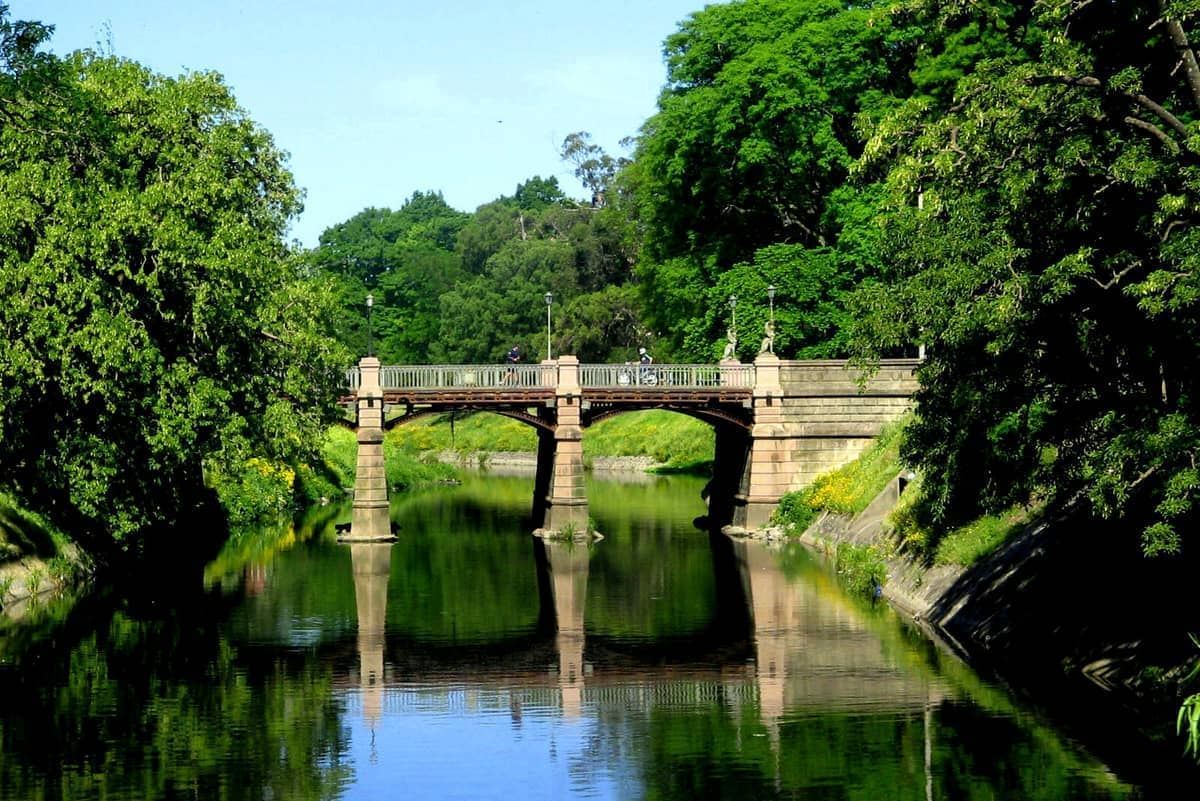
Founded in 1873, Parque Prado spans just over 100 hectares along the Arroyo Miguelete in Montevideo's Prado neighborhood. Free to enter at all hours, it combines historic tree-lined paths, a celebrated rose garden, and broad lawns that serve as a genuine neighborhood park rather than a tourist spectacle.
Quick Facts
- Location
- Prado neighborhood, Montevideo. Bounded by Continuación Castro, Av. Dr. Carlos María de Pena, Av. 19 de Abril, and Lucas Obes.
- Getting There
- Multiple city buses run along Av. Agraciada and Av. 19 de Abril toward the Prado area. Verify current lines with local operators. Taxis and ride-hailing apps also serve the park.
- Time Needed
- 1.5 to 3 hours for a relaxed walk; longer if you picnic or visit the Jardín Botánico nearby.
- Cost
- Free. The park is an open public space with no admission fee.
- Best for
- Families, joggers, picnickers, rose enthusiasts, and anyone wanting a break from the city center.
- Official website
- municipioc.montevideo.gub.uy/node/46
What Parque Prado Actually Is
Parque Prado, formally known as Parque del Prado, is Montevideo's largest urban park and its oldest. It covers just over 100 hectares along the Arroyo Miguelete in the western Prado barrio, declared a National Historic Monument in 1975. Most travelers circle the Rambla, dip into Ciudad Vieja, and never make it here — which is precisely what makes an afternoon in Prado feel like something discovered rather than prescribed.
The park functions as a genuine neighborhood green space. On weekday mornings it belongs to joggers, dog walkers, and elderly residents moving slowly along the shaded paths. On weekends, extended families claim picnic spots beneath the large exotic trees, children run between the wide lawns, and the smell of mate drifts across the grass. There are no entrance barriers, no ticket booths, and no queues.
ℹ️ Good to know
Parque Prado is an unfenced public park that is free to enter and has no ticket controls. No advance booking or ticket is needed. The park is large enough that it never feels crowded, even on sunny weekends.
A Brief History Worth Knowing
The land that became Parque Prado was originally the Quinta del Buen Retiro, a private estate belonging to José de Buschental in the mid-19th century. After Buschental's death in 1870, the property passed to Adolfo del Campo, who made the consequential decision to open it to the public in 1873 under the name 'Prado Oriental.' That date makes it Montevideo's first public park — a fact that gives the place a quiet historical weight most visitors walk past without knowing.
The park's design reflects 19th-century European landscape ideals: naturalistic planting, curved paths following the river's contours, and specimen trees from multiple continents. Over 150 years, those trees have grown to cathedral proportions. Walking beneath them, you are moving through a living record of the city's early ambitions as a modern South American capital.
For context on how the park fits into Montevideo's broader architectural and urban legacy, the Montevideo architecture guide covers the city's 19th and 20th-century planning decisions in detail.
Tickets & tours
Live prices and dates from our booking partner. If you book, we may earn a commission at no extra cost to you.
Guided Tour with Wine Tasting Experience at Bouza Winery
From 68 €Instant confirmationFree cancellationAirport to Hotel or Hotel to Airport Transfer in Montevideo
From 47 €Instant confirmationFree cancellationTasting and Lunch at Bodega Pizzorno in Montevideo
From 115 €Instant confirmationFree cancellationPunta del Este full-day guided tour from Montevideo
From 47 €Instant confirmationFree cancellation
The Rose Garden and Other Highlights
The park's most photographed feature is its rose garden, a formal arrangement of hundreds of varieties that peaks in color and fragrance from October through December and again in March and April. In full bloom, the beds carry a dense, sweet scent that carries on the breeze across the nearby paths. Early morning is the best time to photograph the roses: the light is soft, dew still sits on the petals, and you will likely have the garden largely to yourself before 9 a.m.
Beyond the roses, the park's main pleasures are textural and slow. Paths wind along the Arroyo Miguelete, where ducks and other waterbirds move between the reedy banks. Large specimens of rubber trees, cedars, and palms cast deep shade even in midsummer. There are several open lawns well-suited to picnics, and scattered benches that fill up on afternoons when the temperature is right.
The park also contains a lake, sculptures placed at various points along the paths, and the historic Hotel del Prado nearby on the perimeter. The hotel building itself is architecturally notable and worth a brief look even if you are not staying there.
How the Park Changes Through the Day
Early morning, roughly 6 to 9 a.m., is the park at its most local and most peaceful. The light filters low through the tree canopy, joggers set a steady rhythm along the main paths, and the sounds are almost entirely natural: birds, water, and the occasional distant bus. This is when the park feels most like an extension of the neighborhood rather than a destination.
Midday on a warm day brings families, especially on weekends. Groups set up under trees with thermoses of mate and grills for asado, a pattern you will find across Montevideo's parks on any Sunday that isn't raining. The atmosphere is relaxed and sociable. If you want solitude, arrive before 10 a.m. or stick to the less-used paths closer to the riverbank.
Late afternoon, as the heat softens, the park draws a second wave of visitors: couples, older residents on slow walks, and teenagers who treat the lawns as their living room. The light in the golden hour turns the old trees amber, and the rose garden, if you return to it, looks different entirely from the morning visit. By early evening the park quiets again, and while it has no official closing time, the paths are poorly lit after dark, so an evening visit is not recommended unless you know the layout well.
💡 Local tip
Visit on a weekday morning for the quietest experience, or on a sunny Sunday afternoon to see Montevideo family life at its most relaxed and genuine.
Getting There and Getting Around the Park
The park lies in the Prado neighborhood, northwest of the city center. Several city bus routes run along Avenida Agraciada and Avenida 19 de Abril, which form part of the park's boundary. Because bus routes and numbers in Montevideo change periodically, the safest approach is to confirm the current line with the driver or a local before boarding, or to use a ride-hailing app from your accommodation.
If you are combining the park with other west-side stops, the guide to getting around Montevideo explains the bus system and ride-hailing options in detail.
Once inside, the park is large enough that a full loop of the main paths takes 60 to 90 minutes at a comfortable walking pace. The paths are mostly flat and paved or compacted gravel, suitable for strollers and most walking shoes. The terrain near the river is softer and can be muddy after rain. Official sources do not specify wheelchair-accessible routes or restroom locations, so visitors with specific mobility needs should contact Montevideo's municipal services or go prepared.
Nearby: Jardín Botánico
The Jardín Botánico de Montevideo sits adjacent to Parque Prado and is worth combining into the same visit. The botanical garden has its own formal structure, labeled plant collections, and a different atmosphere from the open parkland — quieter, more enclosed, and particularly beautiful in spring. Together the two spaces can fill a genuinely satisfying half-day without spending a peso.
Weather, Seasons, and When to Go
Montevideo's climate is humid subtropical, with warm summers from December to February (average highs around 26 to 28 degrees Celsius) and mild winters from June to August (average highs around 14 to 15 degrees Celsius). The park receives visitors year-round, but the experience shifts considerably by season.
Spring (September to November) is the best overall window: the rose garden is in its first flush of bloom, temperatures are mild, and the lawns are green after winter rains. Autumn (March to May) is a close second, with falling leaves on the European tree species adding a visual layer that feels slightly surprising this far south. Summer visits are fine in the early morning before midday heat builds. Winter visits are quieter and the light is sharp, but the rose garden will be bare and the park's charm depends more on the tree architecture than on color.
⚠️ What to skip
After heavy rain, the paths near the Arroyo Miguelete can become muddy and some areas may flood briefly. Wear shoes you don't mind getting dirty if visiting in winter or after storms.
Photography Notes
The rose garden offers the park's most immediately photogenic subject, but the most interesting photographic material is the interaction between people and the old tree canopy. Wide-angle shots from low angle capture the scale of the specimen trees well. The riverbank sections have a quieter, slightly melancholic quality, especially in overcast light. Avoid midday in summer when the light is flat and harsh.
On weekends, the family picnic scenes along the main lawn are candid street photography at its most relaxed — people are accustomed to the park being public space and generally pay little attention to a respectful photographer moving through.
Who Might Want to Skip This
Parque Prado is not for visitors whose priority is concentrated cultural sightseeing. If your time in Montevideo is limited to one or two days, the historic core of Ciudad Vieja and the Rambla will give you more per hour. The park rewards slow, unscheduled time. It is also a significant journey from the coastal neighborhoods, so visitors staying in Pocitos or Carrasco who are short on days may find the transit time hard to justify against other options.
If you are visiting in winter and primarily interested in the rose garden, know that the beds will be largely dormant and the visit will depend on appreciating the tree canopy and the historic atmosphere rather than color and fragrance.
Insider Tips
- The rose garden smells strongest in the first hours after sunrise, when the air is cool and still. If you are staying nearby, an early walk before breakfast is worth the effort in October and November.
- Bring your own mate and snacks if you want to experience the park the way Montevideo families do. There are no cafes inside the park perimeter, and the nearest food options are a short walk away on Avenida Agraciada.
- The Arroyo Miguelete path, which runs along the small river inside the park, is far less walked than the main rose garden circuit. It is quieter, greener, and gives a better sense of the park's original 19th-century landscape design.
- For the best tree photographs, visit after a rain when the bark is dark and the light is diffused. The old rubber trees near the center of the park have particularly dramatic root structures at ground level.
- If you are combining this visit with the Jardín Botánico, enter the botanical garden first — it closes earlier than the open park — then move into Parque Prado for the afternoon.
Who Is Parque Prado For?
- Families with children who need space to run and explore without paying for anything
- Joggers and walkers looking for a flat, shaded route away from traffic
- Photographers interested in old-growth trees, rose gardens, and candid park life
- Visitors who want to experience a genuine Montevideo neighborhood rather than a curated tourist site
- Travelers with extra time beyond the standard city center circuit, especially in spring
Nearby Attractions
Combine your visit with:
- Cerro de Montevideo
Standing at 132 metres above sea level, the Cerro de Montevideo is the city's literal high point, crowned by the Fortaleza General Artigas, a 19th-century fortress that once served as watchtower, military prison, and lazaretto. Today it houses a military museum and delivers some of the most expansive views in Uruguay. The visit rewards effort, but requires planning.
- Jardín Botánico de Montevideo
The Museo y Jardín Botánico 'Prof. Atilio Lombardo' is Montevideo's botanical garden and museum, set in the Prado neighborhood. Admission is free, the grounds open daily until 21:00, and the atmosphere shifts noticeably from meditative morning calm to afternoon family strolls. It rewards unhurried visitors with native plant collections, a small natural history museum, and a level of quiet you rarely find this close to the city centre.
- Mercado Agrícola de Montevideo (MAM)
The Mercado Agrícola de Montevideo is a beautifully restored early-20th-century market hall where fresh produce stalls, specialty food vendors, and sit-down restaurants coexist under a soaring iron-and-glass roof. Free to enter and open seven days a week from 9:00 to 22:00, it draws local shoppers in the morning and a gastronomy crowd into the evening hours.
- Museo de la Memoria (MUME)
The Museo de la Memoria (MUME) is Montevideo's dedicated space for confronting Uruguay's dictatorship period and honoring those who resisted it. Housed in a 19th-century country estate, it offers free admission and a sobering, carefully curated experience that rewards visitors willing to engage with difficult history.
Planning a trip? Discover personalized activities with the Nomado app.