Parque Metropolitano Simón Bolívar: Bogotá's Green Heartbeat
Parque Metropolitano Simón Bolívar is Bogotá's most expansive urban park, stretching across the Teusaquillo district with lakes, cycling routes, open-air stages, and enough space to absorb thousands of people on a Sunday without feeling crowded. Entry is free, the atmosphere shifts dramatically by time of day, and on event weekends it transforms into one of Latin America's great outdoor gathering places.
Quick Facts
- Location
- Between Calles 53–64 and Carrera 36 to Avenida Rojas, locality of Teusaquillo, Bogotá, D.C.
- Getting There
- City buses along Avenida Carrera 68 stop near the park. Gate 2 is at Av. Carrera 68 #63–13; Gate 4 at Carrera 60 #57–65.
- Time Needed
- 2–4 hours for a relaxed visit; full day for event weekends
- Cost
- Free entry. Some internal facilities and events charge separately (prices in COP — verify on-site)
- Best for
- Joggers, cyclists, families with children, weekend picnics, live music events
- Official website
- www.idrd.gov.co/parques-y-escenarios/parque-simon-bolivar
What Parque Simón Bolívar Actually Is
Parque Metropolitano Simón Bolívar is not a manicured botanical showcase or a tourist-facing attraction packaged with ticket booths. It is a working urban park on a metropolitan scale, operated by the Instituto Distrital de Recreación y Deporte (IDRD), and it functions as the primary outdoor recreational space for a city of around eight million people. That distinction matters when you are deciding how to spend your time here.
The park occupies a large block in the Teusaquillo area, running roughly between Calles 53 and 64 and from Carrera 36 to Avenida Rojas. Within that footprint you will find interconnected lakes, tree-lined jogging paths, open grass fields large enough to host tens of thousands of people, sports courts, and a major outdoor amphitheater that has staged some of the biggest concerts ever held in Colombia. On a quiet Tuesday morning it can feel almost meditative. On a Sunday afternoon after the Ciclovía, it is one of the most energetic public spaces in South America.
ℹ️ Good to know
Opening hours: daily 5:00 a.m. to 6:00 p.m. Entry is free. Hours may be adjusted temporarily during major events or maintenance — check the IDRD website before visiting on a holiday or festival weekend.
How the Park Changes Through the Day
Arriving at opening time, around 5:00 a.m., means sharing the park primarily with serious runners and cyclists who treat the internal paths as their training circuit. The air at this hour is noticeably cool, often sitting just above 10°C, and a thin mist sometimes hangs over the lakes. The grass holds dew, the bird sounds are distinct, and the paths smell faintly of eucalyptus from the taller trees near the eastern edge. If you want to experience the park as a place of genuine calm, this is the window.
By mid-morning on weekdays, informal exercise groups arrive: bootcamp classes on the grass, yoga sessions near the lake edges, and elderly residents doing stretching routines on the wider paved areas. Food vendors begin setting up near the main gates, selling tinto (black coffee), arepas, and fruit cups. The atmosphere is local and entirely unhurried — you will rarely hear English spoken at this hour.
Weekends are a different proposition entirely. Sunday afternoons after Ciclovía — when Bogotá closes major roads to motor traffic from 7:00 a.m. to 2:00 p.m. — push enormous numbers of people into the park. Families arrive with folding chairs and coolers. Footballs appear on every open field. The lake areas fill with couples. Vendors multiply along the perimeter. The energy is festive but rarely feels unsafe. The sensory experience shifts to cumbia and vallenato drifting from portable speakers, the smell of grilled corn and sausages from mobile stalls, and the particular sound of thousands of people in an outdoor space who are genuinely relaxed.
💡 Local tip
For cycling: Sunday mornings are ideal. Bogotá's Ciclovía routes connect directly to the park perimeter, meaning you can cycle from central neighborhoods along car-free roads and arrive at the park without navigating traffic.
Tickets & tours
Hand-picked options from our booking partner. Prices are indicative; availability and final rates are confirmed when you complete your booking.
Candelaria walking tour
From 35 €Instant confirmationFree cancellationCoffee farm guided tour
From 114 €Instant confirmationFree cancellationZipaquira Salt Cathedral guided tour
From 86 €Instant confirmationFree cancellationBogota full-day bike rental
From 19 €Instant confirmationFree cancellation
The Lakes, Paths, and Physical Layout
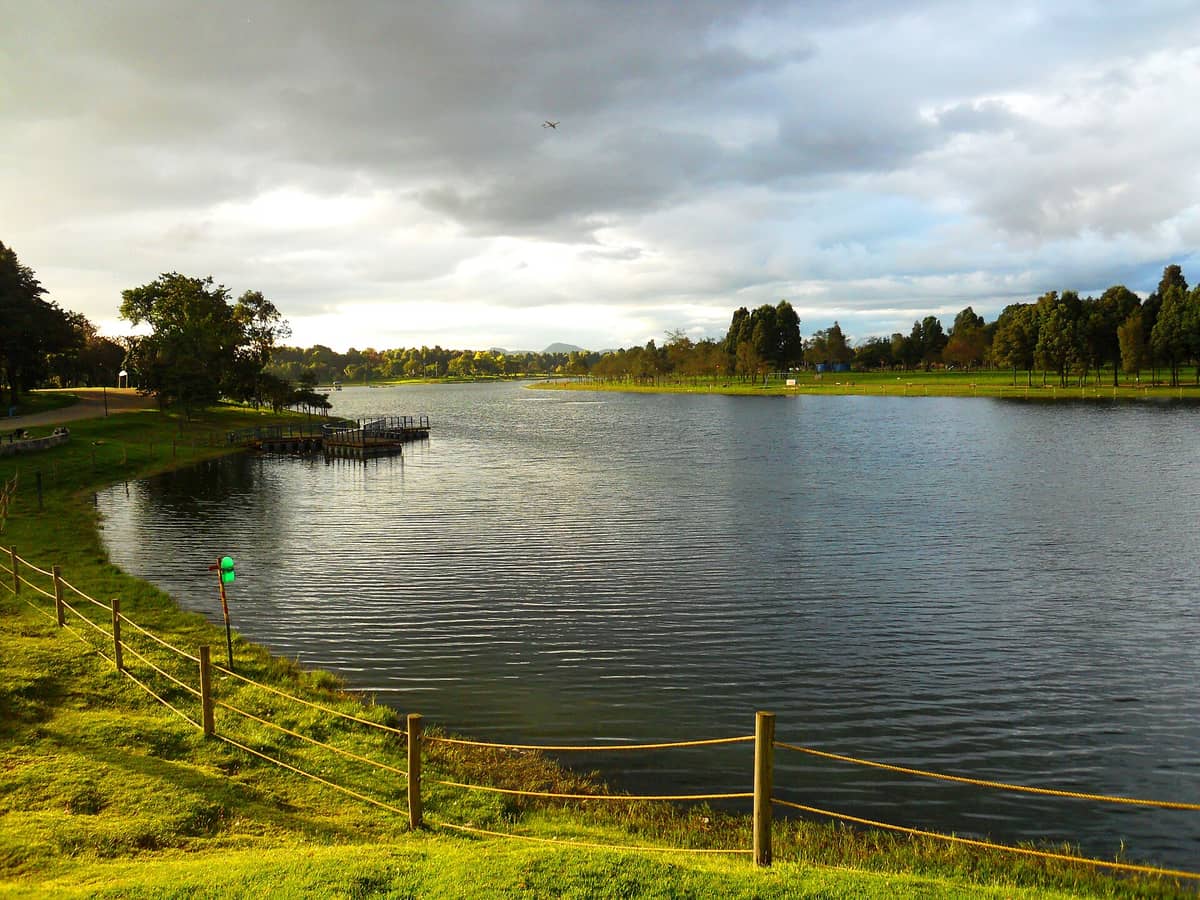
The park's internal lakes are its defining visual feature. They are not decorative ponds but proper urban water bodies that attract waterfowl year-round. The walking paths that circle them are wide enough for cyclists and pedestrians to share without conflict, and several wooden viewing points extend over the water. Early morning light reflecting off the lake surface, with the eastern Andes visible in the background on a clear day, makes this one of the more understated viewpoints in the city — no entrance queue, no ticket.
The open grass fields between the lake areas and the western boundary are where large events are staged. When empty, these feel almost strangely vast for a city park — the scale is closer to a small airfield than to a typical urban green space. This is by design: the park was developed specifically to host mass public gatherings, and that infrastructure shapes its character. Even on non-event days, the open fields are used for kite flying, informal football, and family picnics.
For walkers and joggers, the main loop around the lake and outer perimeter covers several kilometers at a relaxed pace, and there is no single mandatory route — the park rewards wandering. If you want a structured route that extends beyond the park itself, the Bogotá Ciclovía network connects directly to the park on Sundays and public holidays.
Events and Cultural Significance
The outdoor amphitheater inside the park has hosted some of the most significant concerts in Colombian history, including performances by international artists that drew hundreds of thousands of people. The park's capacity for large-scale events is a core part of its identity — it is where Bogotá celebrates publicly, whether that means a national holiday concert, a free cultural festival, or a major sporting event watch party. These events are almost always free or very low cost, reflecting the park's original mandate as a public recreation space for all income levels.
If you are planning a visit around an event, check the IDRD website well in advance. Large concerts typically require earlier gate access and can affect which entrances are open. For context on how Bogotá's wider cultural calendar works, the complete Bogotá activity guide covers major recurring festivals and events across the city.
The park's name honors Simón Bolívar, the Venezuelan-born general who led the independence movements across much of South America in the early 19th century and remains the most symbolically significant figure in Colombian national identity. This is the same figure commemorated at the central Plaza de Bolívar in La Candelaria, but the park carries a different register — less formal, less monumental, more connected to everyday civic life.
Getting There and Practical Logistics
The park has multiple pedestrian entrances. Gate 2 on Avenida Carrera 68 #63–13 is the most convenient for those arriving by bus, as several city routes — including 291, 661, A427, C131, and C156 — stop along Avenida Carrera 68. Gate 4 at Carrera 60 #57–65 is useful for visitors approaching from the south or from Chapinero. There is no single main entrance; the park is porous and entry is genuinely open.
Ride-hailing apps including Uber, Cabify, and Didi all operate in Bogotá and can drop you at any gate address. Traffic around the park can be slow on Sunday mornings during Ciclovía closures, so build extra time into your journey if arriving by car or app. Parking is available in surrounding streets but fills quickly on weekend afternoons.
⚠️ What to skip
Altitude reminder: Parque Simón Bolívar sits at approximately 2,640 meters above sea level. If you have recently arrived in Bogotá, avoid immediately starting a long run or intense cycling session. Shortness of breath is common in the first day or two. Walk first, push later.
For broader guidance on acclimatizing to Bogotá's elevation before physical activity, see the Bogotá altitude guide.
Photography, Accessibility, and What to Bring
Photography conditions are best in the morning hours when the light is low and the eastern Andes appear sharply defined behind the lake. Midday light in Bogotá is harsh due to the high elevation and equatorial sun. If you want images of the park without crowds, aim for a weekday before 8:00 a.m. If you want images of the park as a living social space, Sunday afternoons between 1:00 and 4:00 p.m. provide the most material.
Accessibility along the main paths and around the lakes is reasonable for wheelchair users and visitors with strollers, particularly near Gate 2 on Avenida 68 and Gate 4 on Carrera 60, where paved routes are well maintained. The open field areas and some lakeshore sections involve unpaved or uneven terrain, so plan accordingly. The park has public restrooms near some of the main gates, though conditions vary.
What to bring: layers are essential. Bogotá's temperature can shift by 10°C between morning and early afternoon, and cloud cover arrives unpredictably. A light waterproof jacket is more useful than an umbrella in the park's open areas. Sunscreen is non-negotiable at altitude even on overcast days. Water is available from vendors inside the park on busy days, but carrying your own on quieter mornings is advisable.
Who This Park Is Not For
Travelers with limited time in Bogotá who are prioritizing cultural and historical sites may find the park a low-priority stop. It does not offer the concentrated historical layering of the Museo del Oro or the colonial atmosphere of La Candelaria. Those looking for curated experiences, guided narratives, or indoor exhibits will find little here on a standard visit day.
Visitors who are uncomfortable with unstructured public space — where the crowd sets the pace and there is no official program — may find a quieter Saturday morning underwhelming. The park's value is experiential and social. It rewards patience and observation more than it rewards checking boxes.
Insider Tips
- Gate 2 on Avenida Carrera 68 is the most practical entry point for transit users, but Gate 4 on Carrera 60 tends to be less congested on Sunday afternoons and gets you closer to the lake circuits faster.
- The IDRD posts event schedules on their website and social media channels. A free concert weekend completely changes the park's character — if you want quiet, check the calendar before you go.
- Vendors near Gate 2 sell tinto and fresh fruit from early morning. For a more substantial breakfast, the surrounding Teusaquillo streets have bakeries and small cafés that open by 7:00 a.m.
- On Sundays during Ciclovía hours, arriving by bicycle is significantly faster than arriving by car or ride-hail. The cycle routes approaching from Chapinero and from the north feed directly into the park perimeter.
- If the sky is clear in the morning, position yourself near the lakeside paths facing east. The view of the Andes with the lake in the foreground is worth the early alarm.
Who Is Parque Metropolitano Simón Bolívar For?
- Joggers and cyclists wanting a safe, car-free training route in central Bogotá
- Families with children looking for a free, open outdoor space with room to move
- Travelers visiting on a Sunday who want to experience genuine local weekend culture
- Concert and festival goers when major events are scheduled at the amphitheater
- Anyone who needs a physical reset day between intensive sightseeing
Nearby Attractions
Combine your visit with:
- Cascada La Chorrera
Cascada La Chorrera is Colombia's tallest waterfall, plunging approximately 590 metres through cloud forest on the road to Choachí, less than an hour east of Bogotá. The hike to reach it is a proper half-day commitment, not a gentle stroll, but the payoff is one of the most dramatic natural sights within day-trip distance of the capital.
- Catedral de Sal de Zipaquirá
Carved 180 meters beneath a working salt mine, the Catedral de Sal de Zipaquirá is one of South America's most extraordinary architectural achievements. This guide covers what to expect underground, how to get there from Bogotá, and whether the trip is worth your time.
- Jardín Botánico de Bogotá
The Jardín Botánico de Bogotá José Celestino Mutis is one of Colombia's most important living plant collections, spread across a flat, walkable campus that includes the striking Tropicario greenhouse complex. It is a calm, well-organized space that rewards visitors who enjoy botany, photography, and a break from the city's pace without leaving it.
- Laguna de Guatavita
Laguna de Guatavita is a circular crater lake in the Cundinamarca highlands and one of Colombia's most significant sacred sites. Associated with the Muisca El Dorado ritual, it sits 75 km northeast of Bogotá inside a protected forest reserve managed by CAR. Access is by mandatory guided walk only, making every visit a slow, deliberate encounter with both Andean ecology and pre-Columbian history.