Catedral de Sal de Zipaquirá: Colombia's Underground Cathedral
Carved 180 meters beneath a working salt mine, the Catedral de Sal de Zipaquirá is one of South America's most extraordinary architectural achievements. This guide covers what to expect underground, how to get there from Bogotá, and whether the trip is worth your time.
Quick Facts
- Location
- Carrera 6 Calle 1, Parque de la Sal (Villaveces Park), Zipaquirá, Cundinamarca — approx. 48 km north of Bogotá
- Getting There
- Bus from Portal Norte TransMilenio or Terminal Salitre; tourist train from La Sabana Station on weekends and holidays
- Time Needed
- 3–5 hours including travel from Bogotá; 1.5–2 hours inside the cathedral
- Cost
- From COP 75,000 (nationals) / COP 125,000 (internationals) for basic entry; higher-tier packages available. Prices as of 2026 — verify before visiting.
- Best for
- Architecture enthusiasts, history travelers, curious day-trippers from Bogotá
- Official website
- www.catedraldesal.gov.co
What Is the Catedral de Sal de Zipaquirá?
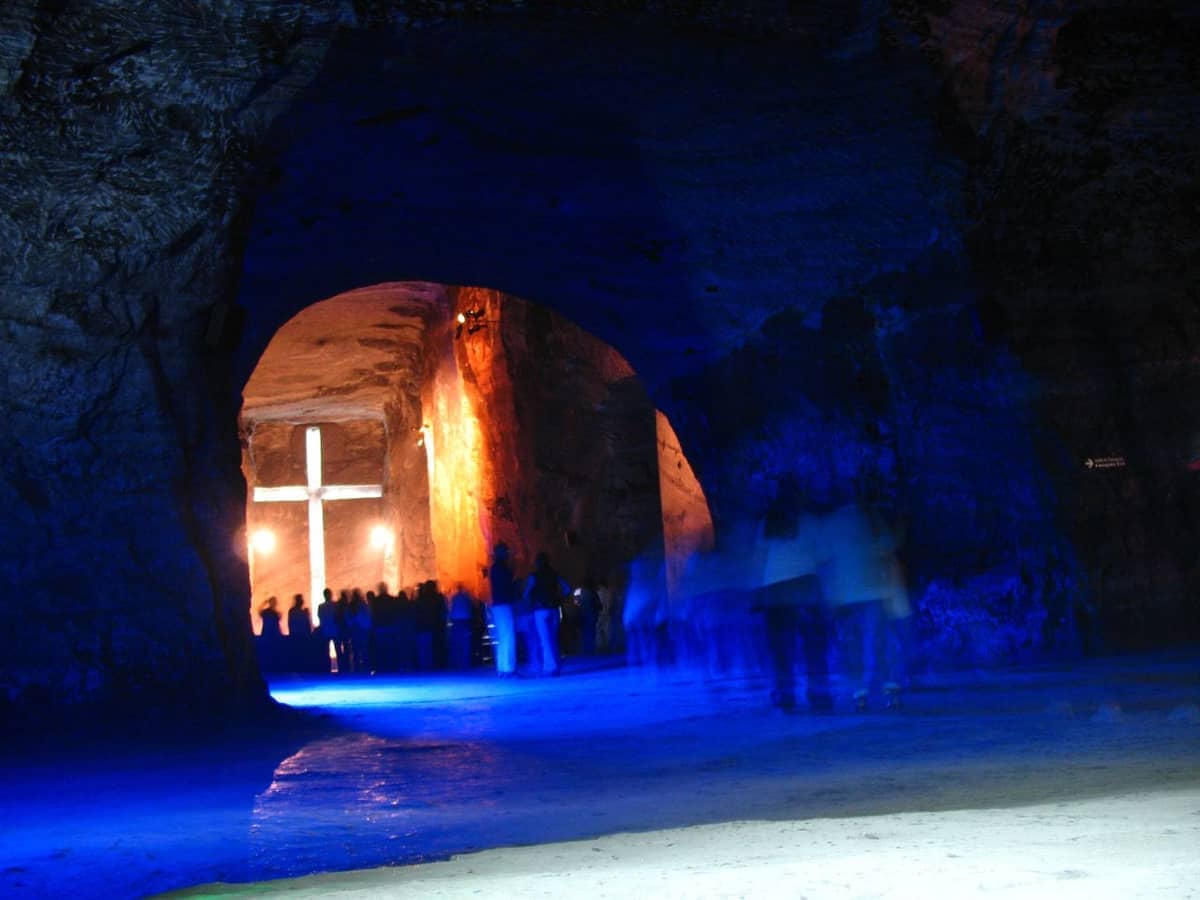
The Catedral de Sal de Zipaquirá is a Roman Catholic cathedral carved out of salt rock beneath the Colombian savanna. It sits approximately 180 meters underground inside a salt mine, reached through a series of descending tunnels lit in deep purples, blues, and whites that play off the crystalline walls. Colombia has formally recognized it as the "Primera Maravilla de Colombia" — the First Wonder of Colombia — and while that kind of designation usually invites skepticism, this one is genuinely hard to argue with.
The cathedral is part of a larger underground complex known as Parque de la Sal, which includes chapels representing the Stations of the Cross, a museum of mining history, and a food and retail area. The visit is structured as a guided or self-guided route through the tunnel system, descending gradually before arriving at the main cathedral space, which is large enough to hold approximately 10,000 people.
ℹ️ Good to know
Opening hours: Daily, 9:00 am to 4:40 pm (last ticket sale 4:40 pm as of July 2026). Hours may extend during Holy Week. Confirm exact times at catedraldesal.gov.co before your visit.
The Experience Underground
The descent begins with a short walk through a wide tunnel cut from salt-rich rock. Within the first few minutes, two things register immediately: the temperature drops noticeably (the underground environment stays cool regardless of the season above), and the smell shifts from fresh air to something mineral and slightly damp. Bring a layer — the main cathedral is around 16°C, and that can feel cold after an hour of standing and looking upward.
The route moves through the Via Crucis section first: fourteen individual chapels along the tunnel walls, each with a relief carved into the salt depicting a Station of the Cross. The craftsmanship ranges from fairly simple to genuinely impressive, and the indirect lighting is thoughtfully done. At this stage, crowds thin out naturally as visitors pause at different points, so even on a busy Saturday, it rarely feels claustrophobic in the side sections.
The main cathedral space, reached after about twenty minutes of walking and descending, is the moment most visitors come for. The scale is unexpected. Three iconic salt columns rise to a domed ceiling, and a large cross is carved into the far wall, backlit with a cool white glow. The acoustics are exceptional: voices, footsteps, and ambient sound behave differently down here, giving the space a sense of gravity that is more than just visual.
💡 Local tip
Photography tip: The cathedral is dimly lit and the contrast between the dark salt walls and the colored backlighting is extreme. A smartphone will struggle. If you care about photos, bring a camera with manual settings or accept that the real experience is better in person than on a screen.
Tickets & tours
Hand-picked options from our booking partner. Prices are indicative; availability and final rates are confirmed when you complete your booking.
Zipaquira Salt Cathedral guided tour
From 86 €Instant confirmationFree cancellationColombian night experience with salsa, bolirana and tejo in Bogota
From 49 €Instant confirmationFree cancellationGuatavita and Zipaquira guided tour
From 115 €Instant confirmationFree cancellationCandelaria walking tour
From 35 €Instant confirmationFree cancellation
History and Cultural Significance
Salt mining in Zipaquirá dates back to pre-Columbian times. The Muisca people, who inhabited the Bogotá savanna before Spanish colonization, traded salt extracted from this region across a wide network. The Spanish recognized the value of the deposits and formalized industrial extraction during the colonial period. For miners working in the tunnels through the 19th and early 20th centuries, carving small shrines and crosses into the salt walls was a form of protection and devotion. These informal carvings became the seed of what is now the cathedral.
The first informal chapel was built by miners in 1932. A more formal underground sanctuary was constructed and opened in 1954, but safety and structural concerns led to its closure in the early 1990s. The current cathedral, the one visitors see today, was purpose-built as an architectural project and opened in 1995. It is a designed space inside a mine, which explains why the layout feels deliberate rather than ad hoc. The engineering required to create a stable structure at this depth inside a salt formation, which is reactive to moisture and pressure, is a significant technical achievement independent of its religious or cultural importance.
For travelers who want to understand the broader context of Colombia's pre-Columbian and colonial history, the Museo del Oro in Bogotá covers Muisca goldwork and culture in depth and pairs well with a Zipaquirá visit as part of a multi-day itinerary.
Getting There from Bogotá
Zipaquirá is about 48 kilometers north of Bogotá's city center. The journey takes roughly 45 minutes to 1.5 hours depending on traffic and method.
By bus: Take TransMilenio to Portal Norte (the northern terminus), then board a bus to Zipaquirá from the adjacent bus terminal. Buses run frequently and are the most affordable option. From the Zipaquirá bus drop-off point, the cathedral is about a 15-minute walk or a short local taxi ride. This is the most common route for independent travelers.
By tourist train: On weekends and public holidays, a tourist train departs from La Sabana Station in central Bogotá and arrives in Zipaquirá. From Zipaquirá station, the walk or taxi to the cathedral is roughly 10 to 15 minutes. Check the official schedule in advance, as services are not daily.
By car or ride-hailing: Take Autopista Norte out of the city, continue past Peaje Los Andes, and follow signs toward Chía and Zipaquirá. Driving time is around 45 minutes outside peak hours, longer in traffic. Parking is available at the site. Ride-hailing to Zipaquirá directly from Bogotá is possible.
💡 Local tip
If you book an organized day tour from Bogotá, transport is typically included and the guide provides historical context at each stop. This is worth considering for first-time visitors who want more than a self-guided walk.
Planning your broader Bogotá visit? The day trips from Bogotá guide covers Zipaquirá alongside other options like Laguna de Guatavita and Salto de Tequendama, which can help you decide how to use a free day.
When to Go and What to Expect at Different Times
Weekday mornings are the best time to visit. Arriving at opening (around 9:00 am) on a Tuesday or Wednesday means you will likely have the main cathedral space to yourself or nearly so for the first thirty minutes. By midday on weekends, the tunnels can become congested, particularly at the Via Crucis chapels where groups stop to listen to guides.
Holy Week (Semana Santa) transforms the experience entirely. The cathedral is one of Colombia's most important religious pilgrimage sites during this period, and services and events are held underground. Crowds are enormous and hours are extended. For travelers who are interested in Colombian religious culture, it is worth the chaos. For travelers who primarily want to see the architecture quietly, it is worth avoiding.
Above ground, Zipaquirá's town center has a well-preserved colonial plaza, a few good local restaurants, and a small handicraft market. Arriving early and visiting the cathedral gives you the afternoon to explore the town before returning to Bogotá. The weather in Zipaquirá (at around 2,650 meters elevation) can be cool and overcast at any time of year, so layering is practical both above and below ground.
If your Bogotá itinerary is still taking shape, the 3-day Bogotá itinerary includes Zipaquirá as a natural day-trip option.
Tickets, Packages, and Practical Logistics
The cathedral operates a tiered pricing system described as "pasaportes" (passport packages). As of 2026, the basic entry for Colombian nationals is COP 75,000 for adults and COP 60,000 for children and seniors. International visitors pay COP 125,000 for adults and COP 110,000 for children and seniors. Higher-tier packages include additional services and areas. All prices are subject to change; verify the current tariff at the official website before your visit.
Tickets can be purchased on-site or through authorized third-party platforms. On busy weekends, buying in advance is advisable to avoid long queues at the entrance. The entire route is circular and takes most visitors between 1.5 and 2 hours, not including time at the museum, restaurant, or retail areas within the complex.
⚠️ What to skip
The descent into the mine is gradual but continuous. If you have significant mobility limitations, steep inclines or uneven surfaces may present challenges. Contact the site directly at catedraldesal.gov.co to confirm current accessibility arrangements before making the trip.
Is It Worth the Trip?
For most visitors to Bogotá with at least two full days, yes. The Catedral de Sal de Zipaquirá delivers something that genuinely cannot be replicated elsewhere: a working cathedral inside a salt mine, at a scale that makes the concept feel real rather than gimmicky. The underground architecture is considered, the lighting design is effective, and the historical layers, from Muisca salt trade to Spanish mining to 20th-century devotion to the 1995 architectural project, give it more depth than a typical attraction.
Who might want to skip it: travelers on a single day in Bogotá who cannot afford half a day in transit; visitors who are uncomfortable in underground or enclosed spaces; and anyone expecting an ancient, naturally formed cave. This is a designed modern structure inside a mine, not a geological wonder. Understanding that distinction before you go prevents disappointment.
For those building a broader Bogotá sightseeing plan, the best museums in Bogotá guide and the Laguna de Guatavita are both worth considering alongside a Zipaquirá visit.
Insider Tips
- Arrive at opening time on a weekday to have the main cathedral nave almost entirely to yourself. The difference between 9:15 am and 11:30 am on a Saturday is dramatic in terms of crowd density.
- The underground temperature holds at around 16°C year-round. A light jacket or fleece is enough, but if you run cold or plan to linger, bring something warmer. Locals often show up in heavy coats and look entirely reasonable.
- The tourist train from La Sabana Station in Bogotá operates on weekends and public holidays. Book in advance if you want the train experience rather than the bus.
- Zipaquirá's central plaza and market area are worth an hour of your time after the cathedral. The colonial architecture is well-preserved and the local arepas and hot chocolate at the plaza-facing cafes are worth a stop before heading back to Bogotá.
- If you are visiting with children, the underground lighting, the carved crosses, and the general drama of the space tend to hold attention better than most history-focused attractions. The route is also short enough that it does not outlast young visitors' patience.
Who Is Catedral de Sal de Zipaquirá For?
- Architecture and engineering enthusiasts who appreciate ambitious structural projects
- History travelers interested in Colombia's pre-Columbian and colonial past
- Families looking for a day trip that combines spectacle with genuine educational content
- Catholic travelers or those interested in religious pilgrimage sites
- First-time Bogotá visitors with at least two days who want to see something beyond the city
Nearby Attractions
Combine your visit with:
- Cascada La Chorrera
Cascada La Chorrera is Colombia's tallest waterfall, plunging approximately 590 metres through cloud forest on the road to Choachí, less than an hour east of Bogotá. The hike to reach it is a proper half-day commitment, not a gentle stroll, but the payoff is one of the most dramatic natural sights within day-trip distance of the capital.
- Jardín Botánico de Bogotá
The Jardín Botánico de Bogotá José Celestino Mutis is one of Colombia's most important living plant collections, spread across a flat, walkable campus that includes the striking Tropicario greenhouse complex. It is a calm, well-organized space that rewards visitors who enjoy botany, photography, and a break from the city's pace without leaving it.
- Laguna de Guatavita
Laguna de Guatavita is a circular crater lake in the Cundinamarca highlands and one of Colombia's most significant sacred sites. Associated with the Muisca El Dorado ritual, it sits 75 km northeast of Bogotá inside a protected forest reserve managed by CAR. Access is by mandatory guided walk only, making every visit a slow, deliberate encounter with both Andean ecology and pre-Columbian history.
- Paloquemao Market
Plaza de Mercado de Paloquemao is one of Bogotá's largest and most atmospheric covered markets, where wholesale vendors, home cooks, and curious travelers all share the same aisles. Open before dawn and free to enter, it offers an unfiltered look at Colombian food culture — from dozens of exotic native fruits to floor-to-ceiling towers of cut flowers.