Parque Lincoln: Polanco's Elegant Neighborhood Park
Opened in 1938 and inaugurated by President Lázaro Cárdenas, Parque Lincoln sits at the heart of Polanco and remains one of Mexico City's most carefully maintained urban green spaces. Free to enter and generally open daily from early morning until late evening, it offers reflection pools, an open-air theater, aviaries, and a landmark clock tower — all within easy walking distance of the neighborhood's best restaurants and galleries.
Quick Facts
- Location
- Av. Emilio Castelar 163, Polanco III Sección, Miguel Hidalgo, Mexico City
- Getting There
- Metro Polanco (Line 7), a few blocks away; Turibus Polanco Circuit stop at Julio Verne / Polanquito
- Time Needed
- 30–90 minutes, depending on pace
- Cost
- Free entry, no tickets required
- Best for
- Morning walks, families, architecture enthusiasts, anyone exploring Polanco on foot
- Official website
- mexicocity.cdmx.gob.mx/venues/parque-lincoln/?lang=en
What Parque Lincoln Is
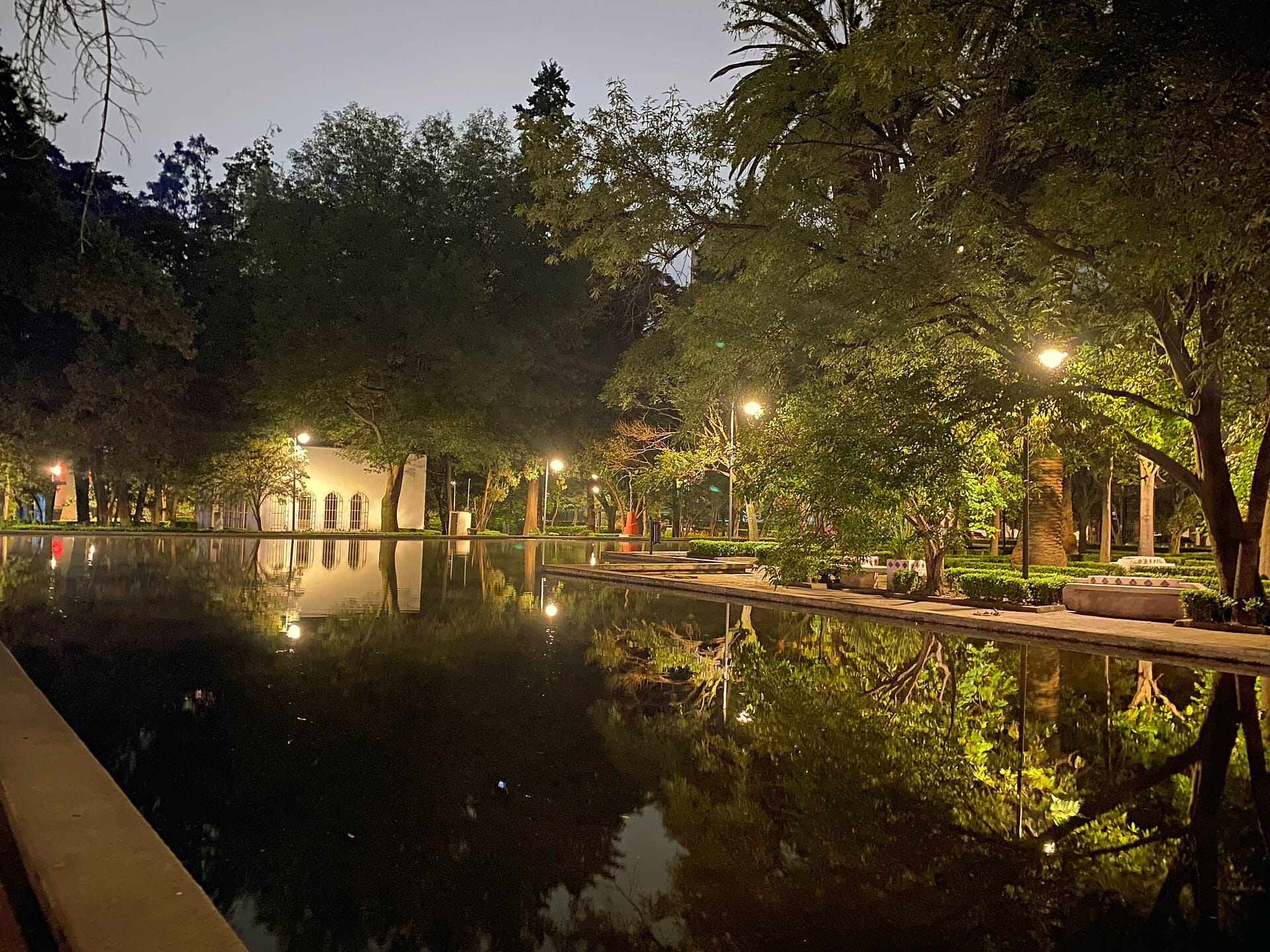
Parque Lincoln is a formal urban park occupying a full city block in Polanco, one of Mexico City's most affluent and architecturally consistent neighborhoods. It is not a sprawling nature reserve or a festival ground — it is a manicured, mid-century civic space with a clear design intention: shaded walkways, geometric reflection pools, clipped hedges, and civic monuments arranged with the kind of symmetry that was fashionable in 1930s Mexican urban planning.
Inaugurated in 1938 by President Lázaro Cárdenas, the park was designed as the social anchor for the newly developed Polanco neighborhood. Architect Enrique Aragón Echegaray shaped its main features — the twin reflection pools, the open-air Ángela Peralta theater, and the clock tower — giving the park a unified aesthetic that still holds today. The clock tower itself was later adopted as the visual symbol for Metro Polanco on Line 7, which tells you something about how central this park is to the neighborhood's identity.
ℹ️ Good to know
Entry is free and the park is generally accessible daily from early morning until late evening. No reservation or ticket is required.
The Monuments: Lincoln, King, and a Diplomatic History
The park's name honors Abraham Lincoln, and the story behind the statue here is more interesting than most tourist plaques suggest. The bronze sculpture, titled "Abraham Lincoln: The Man," is a cast of a work by American sculptor Augustus Saint-Gaudens, originally created in 1887. It was gifted to Mexico City by U.S. President Lyndon B. Johnson in 1966, partly as a gesture of diplomatic goodwill. The choice of Lincoln was deliberate: he was a vocal opponent of the U.S.-Mexican War of 1846–1848, which made him a figure Mexico could honor without ambivalence.
The park also contains a statue of Martin Luther King Jr., making this a rare public space in Latin America where two of the most recognizable figures of American civil rights history stand on the same ground. Together, the monuments give Parque Lincoln a quiet political dimension that most visitors walk past without realizing.
Tickets & tours
Live prices and dates from our booking partner. If you book, we may earn a commission at no extra cost to you.
Puebla and Cholula guided tour from Mexico City with optional lunch
From 43 €Instant confirmationFree cancellationXochimilco, Coyoacan and Frida Kahlo Museum with skip-the-line tickets
From 63 €Instant confirmationFree cancellationMexico City exploration game and tour in Chimalistac
From 10 €Instant confirmationFree cancellationCuernavaca and Taxco Guided Tour with Optional Lunch
From 40 €Instant confirmationFree cancellation
What the Park Looks and Feels Like at Different Hours
Early mornings, roughly 7 to 9 AM, are when the park is at its most local. Polanco residents come to walk dogs, jog the perimeter path, or sit on benches with coffee. The air at this altitude — Mexico City sits at around 2,240 meters above sea level — carries a noticeable chill in the mornings, even in warmer months, and the shade from the park's mature trees makes it feel cooler still. The reflection pools catch the light at low angles, and the sound is mostly birdsong from the small aviaries on the park's edges.
Midday brings a different crowd: nannies with young children, office workers cutting through from nearby embassies, and small groups of tourists making their way between the Museo Soumaya or Museo Jumex and lunch on Avenida Presidente Masaryk. The park never feels overcrowded, but it is lively enough to be interesting. The reflection pools occasionally host model boat regattas on weekends, which draw small clusters of spectators.
By late afternoon, particularly on weekdays, the park quiets again. The Ángela Peralta open-air theater, named for the celebrated 19th-century Mexican soprano, hosts performances on a schedule that varies by season — worth checking locally if you have an evening free. At dusk, the park's lighting turns the pools a warm amber and the whole space takes on a more intimate character.
💡 Local tip
Weekday mornings between 8 and 10 AM offer the most peaceful experience. Weekend afternoons are livelier and better for people-watching, but seating can be limited near the pools.
The Surrounding Area: Why the Park's Location Matters
Parque Lincoln sits in what locals sometimes call "Polanquito," the section of Polanco centered around the park and the streets immediately surrounding it. This stretch is distinct from the high-rise, finance-heavy end of the neighborhood: the buildings here are lower, the pace is slower, and the restaurants on nearby Calle Julio Verne and Calle Oscar Wilde lean toward neighborhood bistros rather than expense-account dining. If you are exploring Polanco on foot, the park works well as a natural midpoint — close enough to both Museo Soumaya and Museo Jumex to serve as a rest stop between the two.
The park is also a short walk from Avenida Presidente Masaryk, the main shopping boulevard of Polanco, where luxury brands, galleries, and good cafes concentrate. But the park itself feels removed from that commercial energy — quieter, greener, and more neighborhood-scaled.
Getting There and Getting Around
Metro Line 7 stops at Metro Polanco, marked on maps by the park's clock tower icon. From the station, the park is a few blocks' walk. The Turibus Polanco Circuit also serves a stop called Julio Verne / Polanquito, which places you directly adjacent to the park's main entrance — useful if you are combining the park with a broader sightseeing loop.
Ride-hailing apps including Uber, Didi, and Cabify all operate in this part of the city, and Polanco is well-served given the density of hotels and restaurants nearby. Traffic around Masaryk can be slow during lunch hours and after 6 PM on weekdays; if you are arriving from Chapultepec or the Reforma corridor, walking through Chapultepec Park's northern edge and into Polanco can actually be faster and more pleasant than sitting in a car.
💡 Local tip
If you are combining Parque Lincoln with Chapultepec Park or the castle, consider entering Polanco on foot from the park's northern gates — it is a pleasant 15-20 minute walk through increasingly upscale streets.
Photography, Weather, and What to Bring
The reflection pools are the park's most photogenic feature. They photograph best in early morning when the surface is calm and the light is directional. By afternoon, foot traffic around the pools and the flat overhead light make for less interesting shots. The clock tower frames well from the south end of the park, and the Saint-Gaudens Lincoln statue benefits from overcast light, which reduces harsh shadows on the bronze.
Dress for Mexico City's altitude regardless of the season. Even on warm afternoons in March or April, temperatures can drop quickly in the shade, and the park has a lot of shade. During the rainy season, roughly May through October, afternoon thunderstorms arrive with little warning and can be heavy. A compact umbrella is worth carrying if you are visiting between June and September. The paved walkways drain well and the park does not flood, but wooden benches get wet and the open theater closes during downpours.
For visitors thinking about how the park fits into a broader Mexico City schedule, it works well as either an opening stop or a mid-afternoon pause. If you are planning a multi-day itinerary, check the 3-day Mexico City itinerary for how Polanco fits alongside the city's other major areas.
Worth Your Time?: Is It Worth Your Time?
Parque Lincoln is not the kind of attraction you visit for a single defining experience. There is no singular view, no famous collection, nothing you would travel to Mexico City specifically to see. What it offers is something harder to find in this city: a pleasant, unhurried green space in a safe, walkable neighborhood, where the design quality is high and the commercial pressure is low.
Travelers who are primarily checking off major sights — the Zócalo, Chapultepec Castle, Frida Kahlo's house — may find the park too low-key to justify a dedicated visit. But if you are spending any meaningful time in Polanco, walking through the park costs nothing and adds context to the neighborhood that no restaurant or shop can provide. It is the kind of place that makes a morning feel well-spent.
For visitors interested in how Mexico City's parks compare across neighborhoods, the free things to do in Mexico City guide covers parks and public spaces across the city alongside other no-cost options.
Insider Tips
- The model boat regattas on the reflection pools happen informally on weekend mornings — there is no fixed schedule, but if you arrive between 10 AM and noon on a Saturday, you have a reasonable chance of seeing one.
- The Ángela Peralta open-air theater hosts free and low-cost performances, particularly in spring and autumn. Ask at the park or check the official CDMX cultural calendar for upcoming events before your visit.
- Calle Julio Verne, running along the park's western edge, has some of the best neighborhood restaurants in Polanco — smaller and less expensive than the Masaryk strip, and popular with locals at lunchtime.
- The park's aviaries are tucked toward the northern end and easy to miss. They are small but well-maintained, and children tend to respond well to them — useful to know if you are visiting with kids.
- Metro Polanco uses the clock tower as its station icon, which makes the park a useful landmark for orientation. If you get lost in Polanco, finding the tower puts you back on the map quickly.
Who Is Parque Lincoln For?
- Travelers exploring Polanco on foot who want a quiet rest stop between museums and restaurants
- Families with young children looking for open space, aviaries, and weekend park activities
- Architecture and urban design enthusiasts interested in 1930s Mexican civic planning
- Visitors who want to see neighborhood Polanco rather than just its commercial face
- Morning walkers and joggers who prefer a calm, shaded park over busier main roads
Nearby Attractions
Other things to see while in Chapultepec & Polanco:
- Avenida Presidente Masaryk
Avenida Presidente Masaryk is Polanco's main commercial artery, a roughly 2.8-kilometer stretch of luxury flagships, design showrooms, and terrace restaurants. Free to walk, open around the clock, and easily reached by Metro Line 7.
- Chapultepec Castle
Chapultepec Castle sits atop Cerro del Chapulín, the only royal castle in continental North America still standing in its original location. Once home to emperors and presidents, it now houses the Museo Nacional de Historia, with sweeping views over Mexico City and rooms preserved from the era of Maximilian I.
- Bosque de Chapultepec
Covering roughly 686 hectares in the heart of Mexico City, Bosque de Chapultepec is far more than a city park. It holds world-class museums, a hilltop castle dating to 1785, a free zoo, and lakes where families rent rowboats on weekends. Entry to the park itself is free, and the depth of what's inside rewards as many hours as you can give it.
- Chapultepec Zoo
The Zoológico de Chapultepec sits inside Bosque de Chapultepec and admits visitors free of charge Tuesday through Sunday. With roughly 2,000 animals across 250-plus species, it draws large local crowds on weekends and offers a well worthwhile morning for families and curious travelers alike.
Planning a trip? Discover personalized activities with the Nomado app.