Parque España: Condesa's Quiet Anchor
Inaugurated in 1921 on the former access road to the old Hipódromo de la Condesa racetrack, Parque España is a semicircular green space between Roma Norte and Condesa. Free, open around the clock, and consistently busy without ever feeling overwhelming, it offers a clear window into everyday neighborhood life in one of Mexico City's most architecturally interesting districts.
Quick Facts
- Location
- Colonia Hipódromo / Roma Norte, Cuauhtémoc, Mexico City (C.P. 06140)
- Getting There
- Metro Sevilla (Line 1), approx. 9-minute walk; Metrobús Álvaro Obregón also nearby
- Time Needed
- 30–60 minutes for a leisurely walk; longer if you plan to sit and read or eat
- Cost
- Free. No admission fee; as an unfenced public park, it is generally accessible at all hours
- Best for
- Morning jogs, people-watching, architecture walks, picnics, dog lovers
What Parque España Is
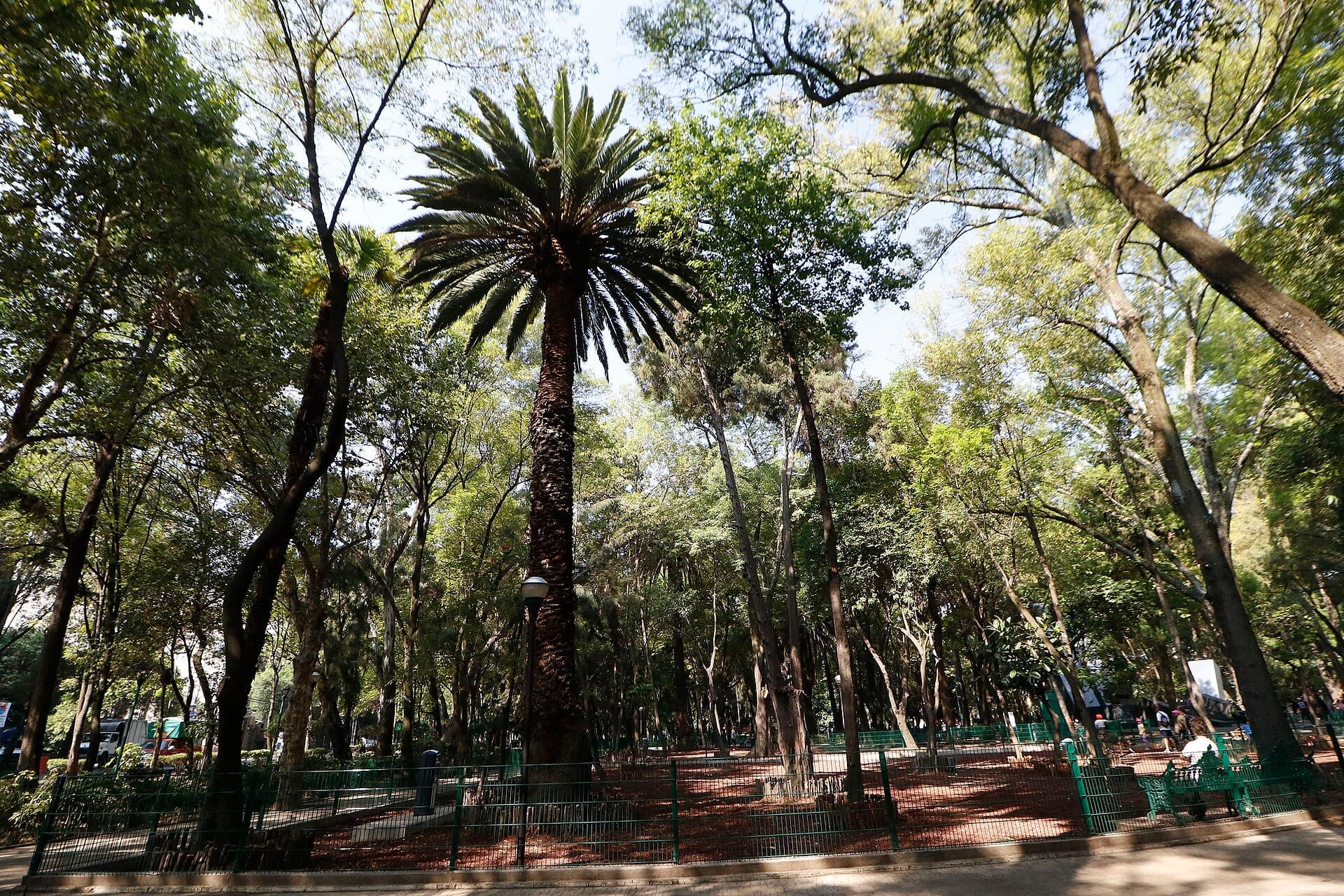
Parque España is a public green space in the Condesa neighborhood of Mexico City, roughly 300 meters long and 140 meters at its widest point. Its semicircular layout follows the former entrance road to the Hipódromo de la Condesa, a racecourse that was subdivided into the neighborhood grid you see today. The park was designed by architect José Luis Cuevas Pietrasanta and inaugurated on September 21, 1921, by municipal president Herminio Pérez Abreu, who planted an ahuehuete tree during the opening ceremony. That ceremonial tree still stands as one of the park's quieter landmarks.
Unlike the more frequently photographed Parque México a few blocks away, Parque España doesn't attract the same volume of tourists. That's part of its appeal. The paths are well-maintained, the tree canopy is mature and dense, and the park functions as a genuine neighborhood commons rather than a curated attraction. Dog walkers, joggers, students eating lunch, and elderly residents playing chess all share the space without any obvious friction.
💡 Local tip
Parque España and Parque México are often treated as a pair by locals. Walk through both in a single outing: they are separated by just a few blocks and together give you the full texture of Condesa's street life and architecture.
How the Park Changes Through the Day
Early mornings are the most atmospheric time to visit. Between 7 and 9 a.m., the light filters through the canopy at a low angle and the air carries the smell of damp earth and cut grass. Joggers move along the curved outer paths and a few dedicated yoga practitioners set up in the wider sections. The city noise from Avenida Nuevo León and Avenida Sonora is present but muffled by the trees, giving the park an unusual sense of calm for such a central location.
By midday on weekdays, the park fills with office workers from the surrounding streets, most of them eating from containers or from the taco and torta vendors stationed near the park's edges. This is when the benches are most occupied and the ambient noise picks up considerably. It's a perfectly pleasant time to be there, but not if you're hoping for quiet reflection.
Weekend afternoons, particularly on Sundays, bring families, larger groups of friends, and considerably more dogs than at any other time. By late afternoon the light softens, the temperature drops a few degrees (the city sits at around 2,240–2,250 meters above sea level, so evenings cool quickly even in warm months), and the park takes on a slower pace. Street food options multiply toward early evening.
ℹ️ Good to know
Mexico City's rainy season runs roughly May through October, with most rain falling in afternoon and evening thunderstorms. If you visit during this period, the park is beautiful in the hour after rain but the paths can be slippery near the denser tree areas. Bring an umbrella in the afternoon.
Tickets & tours
Live prices and dates from our booking partner. If you book, we may earn a commission at no extra cost to you.
Puebla and Cholula guided tour from Mexico City with optional lunch
From 43 €Instant confirmationFree cancellationXochimilco, Coyoacan and Frida Kahlo Museum with skip-the-line tickets
From 63 €Instant confirmationFree cancellationMexico City exploration game and tour in Chimalistac
From 10 €Instant confirmationFree cancellationCuernavaca and Taxco Guided Tour with Optional Lunch
From 40 €Instant confirmationFree cancellation
The Architecture Around the Park
One reason to walk the park's perimeter rather than just cut through the middle is the architecture that lines its edges. The Hipódromo/Condesa area developed primarily in the 1920s and 1930s, and the streets bordering Parque España contain some of the neighborhood's best examples of Art Deco and French-influenced residential design. Many of these buildings have been well-maintained or carefully restored, and their facades, corner balconies, and tiled entrance halls are visible from the street.
This architectural density is what makes the Roma-Condesa area worth more than a single afternoon. The streets between Parque España and Parque México in particular form one of the most coherent early 20th-century streetscapes in the city. Walking slowly and looking up costs nothing.
Photography here works best in the early morning or on overcast days when harsh shadows don't cut across the facades. The park's semicircular geometry means you can frame buildings along a gentle curve, which rewards anyone willing to move around rather than shoot from a fixed position.
Getting There Without Stress
The most straightforward transit option is Metro Sevilla on Line 1 (the pink line), which puts you about a 9-minute walk from the park. Head west from the station along Calle Sonora or continue along Avenida Álvaro Obregón toward Avenida Nuevo León and you'll pass through the transition between Roma Norte and Condesa before arriving at the park's northern edge. The walk itself is worth doing at a slow pace: the street-level restaurants, coffee shops, and corner stores along Álvaro Obregón give you a useful sense of the neighborhood's character before you reach the park.
If you're coming from the historic center or using the Metrobús, the Álvaro Obregón stop on Línea 1 of the Metrobús is also a reasonable option. For broader context on moving around the city, the guide to getting around Mexico City covers transit options in detail, including when it makes sense to use ride-hailing apps versus the Metro.
💡 Local tip
Avoid arriving by car on weekend mornings. Parking around Parque España and the surrounding Condesa streets is limited and competitive. The neighborhood is walkable and well-served by public transport, making a car more of a liability than a convenience.
What to Do in and Around the Park
The park itself requires no itinerary. The curved paths are designed for wandering, and the tree canopy creates a series of natural areas that feel distinct from each other despite the park’s compact footprint of just a few hectares. Find a bench in the interior and you can comfortably spend an hour doing very little. There are areas with more direct sunlight and others that stay shaded throughout the day, which matters in the warmer months of March through May.
The streets immediately surrounding Parque España are among the best for eating and drinking in Condesa. Cafés, lunch spots, and taco stands line Avenida Ámsterdam, Calle Laredo, and the streets feeding onto Avenida Nuevo León. If you plan to continue toward Parque México afterward, the walk along Avenida Ámsterdam (a tree-lined oval road that once formed the racetrack perimeter) is one of the more pleasant short routes in the city. Those interested in the broader food scene nearby can also look at Mexico City's street food options for what's typically available in this part of the city.
Worth Your Time?: Who This Park Is and Isn't For
Parque España is a neighborhood park. It doesn't have a dramatic central feature, a famous monument, or ticketed exhibitions. If you're looking for a specific landmark to check off, this isn't that kind of place. Visitors who come expecting the photogenic formality of a European garden or the scale of Chapultepec will find it understated.
Where it earns its time is as a place to decompress and observe. It fits naturally into a half-day walk through Condesa and Roma Norte. Combined with Parque México nearby and a meal on one of the surrounding streets, it forms a low-effort afternoon that captures how the neighborhood actually functions day to day. Travelers who came to Mexico City to understand the city rather than just photograph it tend to find that kind of afternoon more satisfying than another museum.
For visitors on a tight schedule with only two or three days in the city, Parque España probably shouldn't anchor an itinerary. Check the 3-day Mexico City itinerary for a sense of where it might fit versus higher-priority sites. But if you're staying in Condesa or Roma and the park is nearby, walking through it costs nothing and takes no more than 30 minutes.
Insider Tips
- The ahuehuete tree planted by the municipal president at the park's 1921 inauguration is still present, marked today by a commemorative plaque. These trees are culturally significant in Mexico and often live for centuries. It's worth finding rather than walking past it.
- If you're visiting on a weekday, the lunch hour (roughly 2 to 3:30 p.m.) brings the best street food options to the park's edges. Vendors set up along the Avenida Nuevo León side in particular.
- The park's semicircular geometry means the outer paths along the bordering streets offer better views of the surrounding architecture than the interior paths. Do at least one full perimeter loop.
- Morning light in the dry season (November through April) is consistently cleaner and better for photography than the hazy or overcast conditions more common in the rainy season. Early March is especially good: minimal rain, pleasant temperatures, and strong morning light.
- Condesa is one of Mexico City's denser neighborhoods for outdoor dining. Several restaurants along the streets bordering Parque España have terrace seating that faces into the park. Arrive slightly before the standard 2 p.m. local lunch peak to get a table without waiting.
Who Is Parque España For?
- Travelers staying in Condesa or Roma Norte who want a morning walk without planning
- Architecture enthusiasts doing a self-guided tour of Condesa's 1920s and 1930s building stock
- Families with young children looking for open space and shade in a safe, walkable neighborhood
- Digital nomads or slow travelers who want a reliable outdoor spot to read or work with a coffee from nearby cafés
- Anyone pairing a visit with Parque México to spend a relaxed half-day in the neighborhood
Nearby Attractions
Other things to see while in Roma & Condesa:
- Mercado Roma
Opened in 2014, Mercado Roma transformed the concept of a traditional Mexican market into a multi-level gourmet destination. With free entry, dozens of independent food stalls, craft cocktail bars, and a rooftop terrace, it sits at the center of Roma Norte's culinary identity.
- Museo del Objeto del Objeto (MODO)
Housed in a restored 1906 Art Nouveau mansion on Calle Colima, the Museo del Objeto del Objeto (MODO) is Mexico's first museum dedicated entirely to design, advertising, and material culture. Its collection of over 100,000 everyday objects reframes the things you ignore every day as evidence of how Mexican society thinks, sells, and remembers.
- Parque México
Officially named Parque General San Martín, Parque México is a 3.65-hectare art deco park at the center of the Condesa neighborhood. Free to enter and open around the clock, it draws everyone from morning joggers to weekend families, and sits surrounded by some of the most architecturally striking streets in Mexico City.
Planning a trip? Discover personalized activities with the Nomado app.