Palazzo Donn'Anna: Naples' Hauntingly Unfinished Palace on the Sea
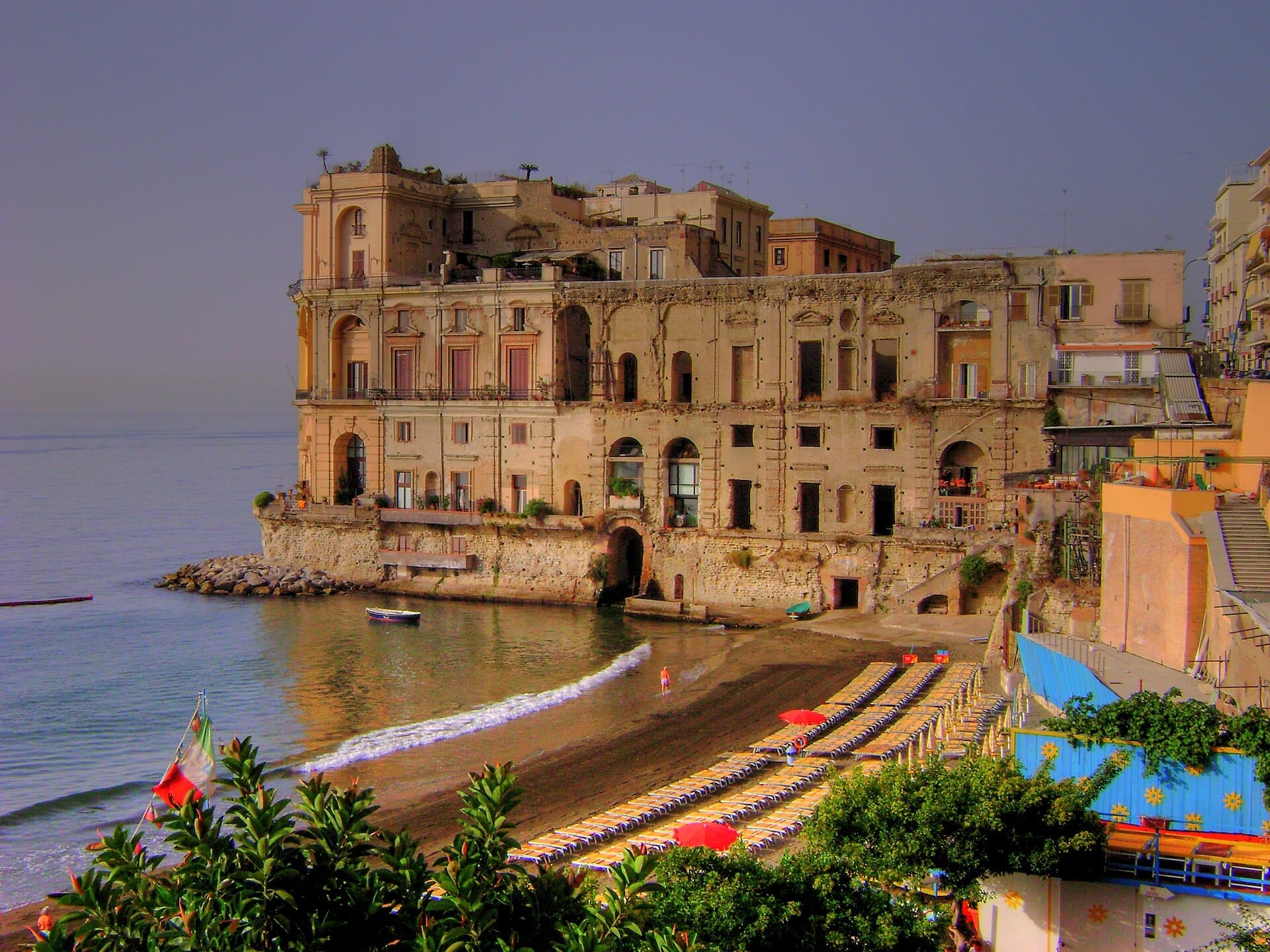
Clinging to a tufa cliff above the Bay of Naples, Palazzo Donn'Anna is one of the city's most atmospheric landmarks. The 17th-century Baroque palace was never completed, and its half-finished facades and sea-level arches have fuelled legend ever since. You can't go inside, but the exterior view from the Posillipo waterfront is one of the most striking architectural sights in southern Italy.
Quick Facts
- Location
- Largo Donn'Anna 9, Posillipo, Naples (80123)
- Getting There
- Bus lines 140, 640, and N2 to Posillipo district
- Time Needed
- 20–40 minutes (exterior only; not open to the public)
- Cost
- Free (exterior viewing)
- Best for
- Architecture lovers, photographers, Posillipo coastal walks
What Is Palazzo Donn'Anna?
Palazzo Donn'Anna is a 17th-century Baroque palace built directly onto a tufa cliff on the Posillipo promontory, with three of its sides rising from the waters of the Bay of Naples. It is large, imposing, and conspicuously unfinished: the upper floors were never completed, and certain wings remain in a permanent state of elegant ruin. The result is a structure that looks simultaneously monumental and abandoned, which is precisely what makes it one of the most visually striking buildings on the Neapolitan coastline.
The palace is a private residence and is not open to the public. There are no tours, no entrance fees, and no interior access. What draws visitors here is the exterior, viewed either from the narrow road that runs past the building or, better, from a boat or the waterfront promenade. If you are approaching Naples by sea, the palace is one of the first memorable silhouettes you will see.
⚠️ What to skip
Palazzo Donn'Anna is closed to the public. Do not attempt to enter the building or the surrounding private grounds. The value here is entirely in the exterior view.
History: A Palace Born from Ambition and Cut Short by Fate
Construction began in 1642, commissioned by Anna Carafa (1607–1644), Princess of Stigliano and wife of Ramiro Núñez de Guzmán, the Spanish Viceroy of Naples. The architect was Cosimo Fanzago, one of the defining figures of Neapolitan Baroque, responsible for several of the city's most distinctive churches and monuments. Fanzago's design called for a grand three-storey residence that would use the cliff itself as its foundation, with sea-level arches allowing boats to pass directly beneath the lower structure.
The project was halted in 1644 when the Spanish court recalled the viceroy to Spain. Anna Carafa died the same year, aged just 37, leaving the palace without its patron, its sponsor, or its purpose. Work stopped and was never resumed. The building has remained in this incomplete state for nearly four centuries, passing through various private owners and partial restorations that preserved the shell without ever finishing the original design.
The site itself has an even older history. Before the Baroque palace, it was occupied by the Villa La Sirena, a Renaissance property that stood on a stretch of coastline long associated with pleasure villas and aristocratic retreats. Local legend also connects the site to Queen Joan of Anjou, the medieval queen of Naples whose complicated reputation made her a figure of popular fascination for centuries. The historical details of this connection are debated, but the legend has persisted and is part of why the palace carries an air of dark romance in Neapolitan folklore.
Tickets & tours
Live prices and dates from our booking partner. If you book, we may earn a commission at no extra cost to you.
Pompeii and Mount Vesuvius tour with transportation
From 110 €Instant confirmationFree cancellationOrigins and legends of Naples walking tour
From 28 €Instant confirmationFree cancellationGuided walking tour of Naples city and Naples underground
From 45 €Instant confirmationFree cancellationMount Vesuvius and Herculaneum tour with transportation
From 100 €Instant confirmationFree cancellation
What You Actually See: The Exterior Up Close
Approaching from the road, the palace rises abruptly from the rock, its warm tufa stonework darkened by salt air and time. The facade facing the street is the most intact, showing Fanzago's characteristic combination of geometric severity and decorative detail. The arches at sea level are the most dramatic feature: open, salt-encrusted, and deep enough that the sound of water amplifies underneath them. On days with even a slight swell, you can hear the bay slapping rhythmically against the stone from some distance away.
The upper levels tell the story of incompletion clearly. Where a finished palazzo would show cornices, window surrounds, and a completed roofline, Palazzo Donn'Anna shows raw edges, exposed masonry, and spaces where rooms were planned but never built. This is not disrepair exactly: it is suspension. The building stopped, rather than fell apart.
The palace also makes more sense when seen from the water. From offshore, the scale of the structure becomes clearer, particularly the way it occupies a full headland with the bay on three sides.
When to Visit and How the Experience Changes by Time of Day
Morning, roughly between 8am and 10am, is when the light hits the facade most directly. The eastern-facing walls catch the low sun and the tufa takes on a warm amber tone that contrasts sharply with the deep green-blue of the bay below. At this hour, foot traffic on the road is light, and the area around the palace is relatively quiet. A few local residents walk past, occasionally a jogger. The absence of crowds makes the scale of the building easier to appreciate.
Late afternoon and the hour before sunset produce the most atmospheric conditions. The light becomes directional, shadows deepen in the arches, and the bay shifts colour. This is when most photographers arrive. The road can get congested with cars at this hour since Posillipo is a residential area with limited parking, so arriving on foot or by bus is strongly advisable.
Midday in summer is the least rewarding time. The light is flat and overhead, the stone looks bleached rather than warm, and the heat radiating from the road makes lingering uncomfortable. If you are visiting in July or August, target early morning or early evening.
💡 Local tip
The narrow road beside the palace gets traffic throughout the day. For the best unobstructed view without vehicles in the frame, arrive before 9am or after 6pm.
Getting There: Posillipo by Bus
Posillipo is not served by the Naples metro, so buses are the practical option. Lines 140, 640, and the night bus N2 all pass through the district. The journey from Chiaia takes around 15 minutes by bus. From the city centre, allow 25 to 35 minutes depending on traffic. Taxis and ride-hailing apps (Free Now and Uber operate in Naples) are a reasonable alternative if you are combining Palazzo Donn'Anna with other Posillipo stops, since you can negotiate multiple viewpoints in one ride.
If you are already exploring the hilltop neighbourhood, note that Parco Virgiliano sits at the far end of the same peninsula and offers the best panoramic views in the area, including the bay, the islands, and on clear days, Vesuvius to the east. Combining both stops into a single Posillipo afternoon is easy and logical.
Photography Notes and Practical Considerations
The palace is on a tight road with no formal viewing area or plaza. Most photographs are taken from the roadside or from a slight elevation on the path that runs above the building. A wide-angle lens is useful given the confined space; getting the full facade in frame from street level requires stepping back as far as the road allows. A longer lens from a boat or from across a small cove gives a cleaner, more complete composition.
The sea-level arches are photogenic at any hour, but they require either a boat or an angle from below the road to capture properly. If you are on foot, you can lean over the low wall along the coastal section of the road to get a partial view of the lower structure and the water beneath.
Accessibility is limited. The surrounding roads are narrow, uneven in places, and have no dedicated pedestrian infrastructure at the point nearest the palace. Visitors with mobility limitations should assess the approach carefully. There is no dedicated parking area.
Fitting Palazzo Donn'Anna Into Your Naples Itinerary
This is not a standalone destination for most travelers. It works best as part of a broader Posillipo exploration or as a stop on a coastal drive. If you are interested in Baroque architecture more deeply, the more accessible examples in the city centre will reward more time: Cappella Sansevero and the Gesù Nuovo church both allow interior access and show Fanzago-era craftsmanship at its most complete. Palazzo Donn'Anna, by contrast, shows what a Baroque ambition looks like when it runs out of time.
For travelers working through a structured Naples visit, the palace fits naturally into a half-day on the western waterfront, combined with the Mergellina harbour and the coastal road toward Posillipo. Check our 3-day Naples itinerary for how to sequence the city's western districts efficiently.
Who Might Want to Skip This
Travelers with limited time and a long list of interior attractions to cover will find this a low-priority stop. The palace cannot be entered, carries no interpretive signage or museum function, and requires a bus or taxi ride from the main tourist areas. If your Naples visit is shorter than two full days, the historic centre and the National Archaeological Museum will repay more attention per hour invested. Palazzo Donn'Anna is for travelers who respond to architectural atmosphere and are willing to spend time simply looking.
Insider Tips
- Approach from the water if possible. Even a short stretch of the coastal boat routes that operate between Mergellina and Pozzuoli passes close enough to give you the seafront view that the road cannot provide.
- The road immediately adjacent to the palace is single-lane with no footpath at the closest point. Walk confidently and stay close to the wall. Traffic moves slowly here but drivers expect pedestrians to give way.
- If you want the clearest photographs, mid-week mornings in spring or autumn are the sweet spot: good light, minimal traffic, and no parked delivery vehicles blocking the facade.
- The tufa cliff the palace sits on is part of the same volcanic geology that shapes much of the Posillipo headland. You can see the layered yellow-grey stone at the base of the arches where it meets the waterline.
- Pair this stop with a coffee or sfogliatella at one of the small bars on Via Posillipo before or after. There are no tourist cafes near the palace itself, which is part of why the area feels authentically residential rather than curated for visitors.
Who Is Palazzo Donn'Anna For?
- Architecture enthusiasts drawn to Baroque design and its Neapolitan expression
- Photographers looking for dramatic light-on-stone coastal compositions
- Travelers who enjoy exploring residential neighbourhoods off the main tourist circuit
- Anyone combining a coastal walk or boat trip along the western Naples waterfront
- History readers interested in the Spanish viceroyalty period and its cultural legacy in southern Italy
Nearby Attractions
Other things to see while in Posillipo:
- Parco Archeologico del Pausilypon & Gaiola
On the dramatic cliffs of Posillipo, the Parco Archeologico del Pausilypon hides a Roman imperial estate entered through a 770-meter tunnel carved into volcanic rock. Just offshore, the Gaiola Underwater Park preserves the submerged remains of the same ancient coastline. Together, they form one of Naples' most atmospheric and least-crowded archaeological experiences.
- Parco Virgiliano (Posillipo)
Perched 150 metres above the Bay of Naples on Posillipo hill, Parco Virgiliano is a 9-hectare public park with sweeping views of Vesuvius, Capri, Ischia, and the Sorrentine coast. It is free to enter, open seven days a week, and far less visited than the city's famous landmarks.
Planning a trip? Discover personalized activities with the Nomado app.