Palacio de la Generalitat: Valencia's Gothic Seat of Power
The Palacio de la Generalitat Valenciana is a late-Gothic palace whose construction began in 1421, sitting at the heart of Valencia's historic centre. It serves as the working headquarters of the regional government while remaining open to visitors by appointment, free of charge. Few buildings in Valencia carry this much accumulated history in such a compact, quietly impressive form.
Quick Facts
- Location
- Carrer dels Cavallers 2, 46001 València (Centro Histórico)
- Getting There
- Multiple bus lines including 2, 4, 5, 5B, 6, 8, 9, 11, 16, 26, 28, 29, 36, 70, 71 and 80 stop nearby on Carrer dels Cavallers and surrounding streets
- Time Needed
- 45–90 minutes for a guided visit
- Cost
- Free admission; prior appointment required
- Best for
- History lovers, architecture enthusiasts, and anyone curious about Valencian political heritage
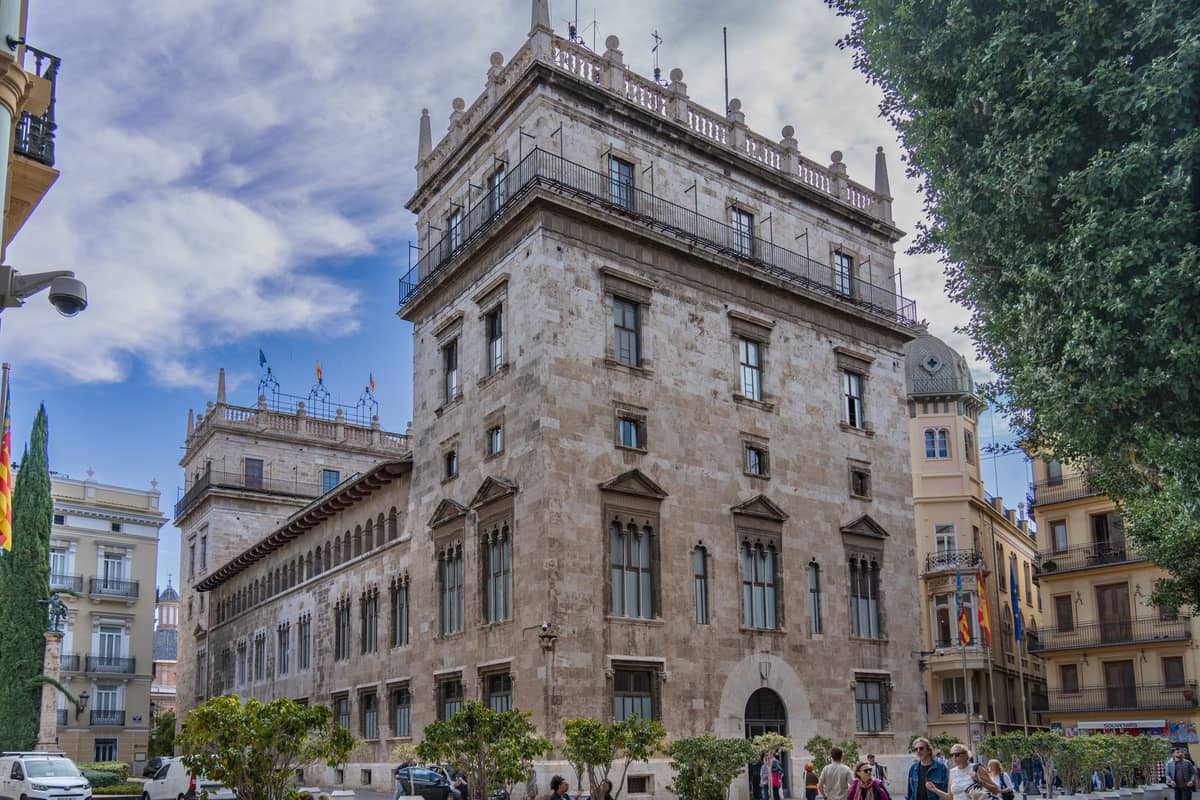
What Is the Palacio de la Generalitat?
The Palau de la Generalitat Valenciana (to use its official Valencian name) is a historic government building in Valencia's old centre. Construction began in 1421, making it a genuine piece of late-Gothic Valencian civic architecture rather than a later pastiche. Unlike many Spanish palaces that were abandoned, converted, or turned into pure museums, this one still houses the Presidència de la Generalitat, the executive office of the Valencian regional government. You are, in essence, walking through a working seat of power that has been occupied for over six centuries.
The building sits on Carrer dels Cavallers, one of the most historically loaded streets in Valencia's centro histórico. The street's name, meaning 'Street of the Knights', signals what this neighbourhood once was: the aristocratic and institutional spine of medieval Valencia. Walking here even before you enter the palace gives you a sense of the concentrated civic weight of this part of the old city.
ℹ️ Good to know
Visits are free but require a prior appointment for a guided tour. The palace is open Monday to Friday, 9:00–14:00. Contact the Generalitat Valenciana in advance to arrange access, especially during busy periods when slots fill quickly.
Architecture: Gothic Foundations, Renaissance Additions
The palace is described consistently as a late-Gothic Valencian building, but the structure you see today is a layered composition built across several centuries. The original 15th-century construction established the Gothic character: pointed arches, stone arcades, and the restrained ornamentation typical of Valencian civic Gothic rather than the more theatrical Gothic of Catalan ecclesiastical buildings.
Renaissance interventions followed in subsequent centuries, adding new wings and decorative elements that soften the austerity of the original fabric without erasing it. The result is not stylistically uniform, and that is precisely what makes it architecturally interesting. You can read the building's biography in its stone: where the carved Gothic tracery gives way to smoother Renaissance mouldings, you are looking at different generations of patrons and builders responding to shifting political fortunes and aesthetic fashions.
The Torre Nova (New Tower), added in the 16th century, is one of the most recognisable elements from the street. For broader context on Valencia's layered architectural heritage, from Moorish foundations through Gothic, Renaissance, and Baroque, see the Valencia architecture guide.
Tickets & tours
Hand-picked options from our booking partner. Prices are indicative; availability and final rates are confirmed when you complete your booking.
Valencia Silk Museum tickets and audio guide
From 7 €Instant confirmationFree cancellationSaint Nicholas Church Entrance Tickets and Audioguide
From 11 €Instant confirmationHistoric Valencia walking tour
From 27 €Instant confirmationFree cancellationNatural thermal springs and Girlfriend Waterfall tour from Valencia
From 89 €Instant confirmationFree cancellation
The Interior: Halls, Frescoes, and Ceremonial Spaces
Access to the interior is the real reason to make the appointment. The public-facing parts of the palace include a series of formal rooms used for official ceremonies and receptions, and several of these spaces are decorated with historic frescoes, coffered ceilings, and period furnishings that cannot be found in any museum because they were never separated from their original context.
The Salón de Cortes is among the most significant interior spaces, referencing the historical Corts Valencianes, the medieval parliament of the Kingdom of Valencia. The room's proportions and surviving decoration give a concrete sense of how political authority was performed in late-medieval and early-modern Iberia. These are not reconstructed interiors. The walls carry real accumulated history rather than curatorial interpretation.
The gardens within the palace complex offer a quieter counterpoint to the formality of the state rooms. Enclosed by the building's wings and accessible during visits, they provide a moment of unexpected calm in the middle of a dense urban historic centre. The citrus trees and the sound of a small fountain here contrast sharply with the noise of Calle Caballeros just outside the gate.
💡 Local tip
Photography policies inside working government buildings can be restrictive and vary by visit. Confirm what is permitted when you arrange your appointment. The exterior on Carrer dels Cavallers is freely photographable at any time.
Historical Context: Why This Building Matters
The Generalitat as an institution predates the palace itself. The Corts Valencianes, Valencia's medieval parliament, established a permanent deputation in the 14th century to manage taxation and finances between parliamentary sessions. This body, the Generalitat, needed a permanent home, and the construction commissioned in 1421 was the answer. The building has therefore been associated with Valencian self-governance for as long as it has existed.
That history is not without turbulence. The abolition of Valencian autonomous institutions following the War of the Spanish Succession in the early 18th century stripped the building of its original governmental function for centuries. Its restoration as the seat of the modern Generalitat Valenciana, re-established under Spain's 1978 constitution and the Valencian Statute of Autonomy, gives the building a contemporary political resonance that adds a layer to any visit. You are not just looking at a historic monument. You are looking at a symbol of institutional continuity that was interrupted and then deliberately recovered.
The palace sits within the centro histórico of Valencia, a compact area where medieval, Gothic, and Baroque buildings stand within walking distance of each other. A visit here pairs naturally with the nearby La Lonja de la Seda, the 15th-century silk exchange and UNESCO World Heritage Site, which was built during roughly the same era and illustrates how Valencia's commercial wealth funded both civic and mercantile architecture simultaneously.
Planning Your Visit: Practical Walkthrough
The appointment requirement is the single most important practical point. The palace is not set up as a drop-in tourist attraction. It is a functioning government building that accommodates visitors within specific windows. Arriving without an arrangement will result in being turned away at the gate. Contact the Generalitat Valenciana's visitor coordination office well in advance, particularly if you are planning to visit during the spring festival season or in July and August when tourist numbers in the city peak.
The official visiting hours are Monday to Friday, 9:00–14:00. This means the palace is completely inaccessible on weekends and public holidays, which is a genuine limitation for travellers on short itineraries. If your Valencia trip runs from Friday to Sunday, you will not be able to visit the interior. Plan accordingly.
Getting there is straightforward. Numerous city bus lines serve the surrounding streets, including lines 2, 4, 5, 5B, 6, 8, 9, 11, 16, 26, 28, 29, 36, 70, 71 and 80, among others. The historic centre is compact and walkable, so most visitors staying in the old city or the Eixample will find it easier to arrive on foot. Carrer dels Cavallers is a pedestrian priority street, which makes the approach calm by Valencia city centre standards.
⚠️ What to skip
The palace is closed on weekends and public holidays. It is also a working government building, meaning unexpected closures for official functions can occur. Confirm your appointment close to the date of your visit.
If you are building a morning itinerary around the historic centre, the Palacio de la Generalitat works well as a first stop before the streets fill up. You can continue afterward to the Cathedral of Valencia and the Basílica de la Virgen de los Desamparados, both a short walk east along Carrer dels Cavallers toward Plaza de la Reina.
The Exterior and the Street: What You Can See Without an Appointment
Even without access to the interior, the exterior on Carrer dels Cavallers rewards a careful look. The facade's stonework, the Gothic arched entrance, and the tower visible above the roofline are all legible from the street. Early mornings, before tour groups begin moving through the old city, Calle Caballeros is unusually quiet for a central historic street. The light on the palace's pale stone at around 9:00 in spring and autumn is particularly clear, with long shadows defining the carved stonework in a way that midday sun flattens completely.
The immediate neighbourhood repays slow walking in either direction. To the west, the street opens toward the Torres de Quart, the massive 15th-century Gothic gate towers that marked the western entrance to the medieval city. To the east, you are heading toward the cathedral quarter and the Plaça de la Reina. In between, you pass a concentration of medieval civil and religious buildings that makes this corridor one of the most historically coherent stretches in the entire city.
If you are combining the palace visit with a broader walking tour of the old city's monuments and churches, the walking tour of Valencia's old city maps a logical route that connects the main Gothic and medieval sites without unnecessary backtracking.
Is It Worth Your Time? An Honest Assessment
The Palacio de la Generalitat is not a visual spectacle in the way that the Ciudad de las Artes y las Ciencias is. It does not have a collection in the way that the Museo de Bellas Artes or the IVAM do. What it offers is something different: the experience of a building that has held a long institutional history spanning six centuries, with a break after the War of the Spanish Succession, with interiors that have never been stripped of their original function and turned into exhibit spaces.
For travellers who enjoy civic history, constitutional architecture, or simply want to understand how Valencia's political identity evolved from a medieval kingdom through centralist suppression to modern regional autonomy, this visit is genuinely worthwhile. For travellers primarily motivated by visual spectacle, outdoor atmosphere, or family-oriented activities, the logistical overhead of making an appointment for a weekday morning visit may not be justified given everything else competing for time in Valencia.
The free admission removes the financial calculation from the equation entirely. The only cost is time and planning.
Insider Tips
- Contact the Generalitat Valenciana's visitor service several weeks ahead during March and April, when Las Fallas draws large crowds to Valencia and administrative staff are often managing additional ceremonial functions at the palace itself.
- The exterior on Carrer dels Cavallers is best photographed in the first two hours after sunrise or in the hour before sunset, when raking light defines the Gothic stonework. Avoid midday in summer when the high sun and harsh shadows flatten the facade.
- Group visits are more commonly accommodated than individual requests on short notice. If you are travelling with others, frame your appointment request as a small group visit to improve your chances of securing a slot.
- Carrer dels Cavallers itself is worth taking slowly before or after your appointment. The buildings lining this street include some of the finest surviving medieval civil architecture in the city, most of which is unmarked and easily missed.
- The palace's gardens, accessible during visits, are one of the few enclosed historic courtyard spaces in the centro histórico that tourists rarely see. They are genuinely peaceful, even in high season, because the appointment-only access keeps visitor numbers low.
Who Is Palacio de la Generalitat For?
- History and architecture enthusiasts with a specific interest in Valencian Gothic and Renaissance civic buildings
- Travellers interested in regional identity, Spanish constitutional history, and the political significance of medieval institutions
- Visitors who have already covered Valencia's main monuments and want to go deeper into the historic centre
- Those building a full morning itinerary through the centro histórico who can combine the palace with La Lonja, the Cathedral, and the surrounding Gothic streets
- Photographers focused on architectural detail and historic urban fabric rather than panoramic views
Nearby Attractions
Other things to see while in Centro Histórico:
- Basílica de la Virgen de los Desamparados
The Real Basílica de Nuestra Señora de los Desamparados stands at the heart of Valencia's historic centre, housing the revered image of the city's patron saint. Built between 1652 and 1667, it is free to enter and open every day, making it one of the most accessible and emotionally resonant stops in the old city.
- Catedral de València
Rising above Plaza de la Reina in Valencia's historic centre, the Cathedral of Valencia is a remarkable layered monument built over seven centuries. From a Romanesque doorway to Gothic vaulting, a Baroque facade, and a relic claimed to be the Holy Grail, this is one of Spain's most architecturally complex and historically loaded churches.
- Centre Cultural La Nau
Housed in the University of Valencia's historic headquarters since the late 15th century, Centre Cultural La Nau is a historic landmark in the old town offering free exhibitions, concerts, and theatre. It rewards visitors who slow down and look closely.
- Centre Arqueològic de l'Almoina
Beneath a quiet plaza steps from Valencia Cathedral lies one of Spain's most compelling urban archaeology sites. The Centre Arqueològic de l'Almoina preserves around 2,500 square metres of Roman, Visigothic, and medieval remains, excavated over two decades and now visible through a striking modern structure.