Palace of Fine Arts: San Francisco's Most Photogenic Landmark
The Palace of Fine Arts is a monumental Beaux-Arts rotunda surrounded by a tranquil lagoon in San Francisco's Marina District. Originally built for the 1915 Panama-Pacific International Exposition, it is one of the few surviving structures from that World's Fair. The outdoor grounds are free to enter at any hour, making it one of the most accessible landmarks in the city.
Quick Facts
- Location
- 3601 Lyon St, Marina District, San Francisco, CA 94123
- Getting There
- Muni bus lines 22, 28, 30, 41, 43, 45
- Time Needed
- 30–90 minutes for grounds; longer for theatre events
- Cost
- Free (outdoor grounds); ticketed theatre events vary
- Best for
- Architecture lovers, photographers, picnickers, couples
- Official website
- palaceoffinearts.com
What the Palace of Fine Arts Actually Is
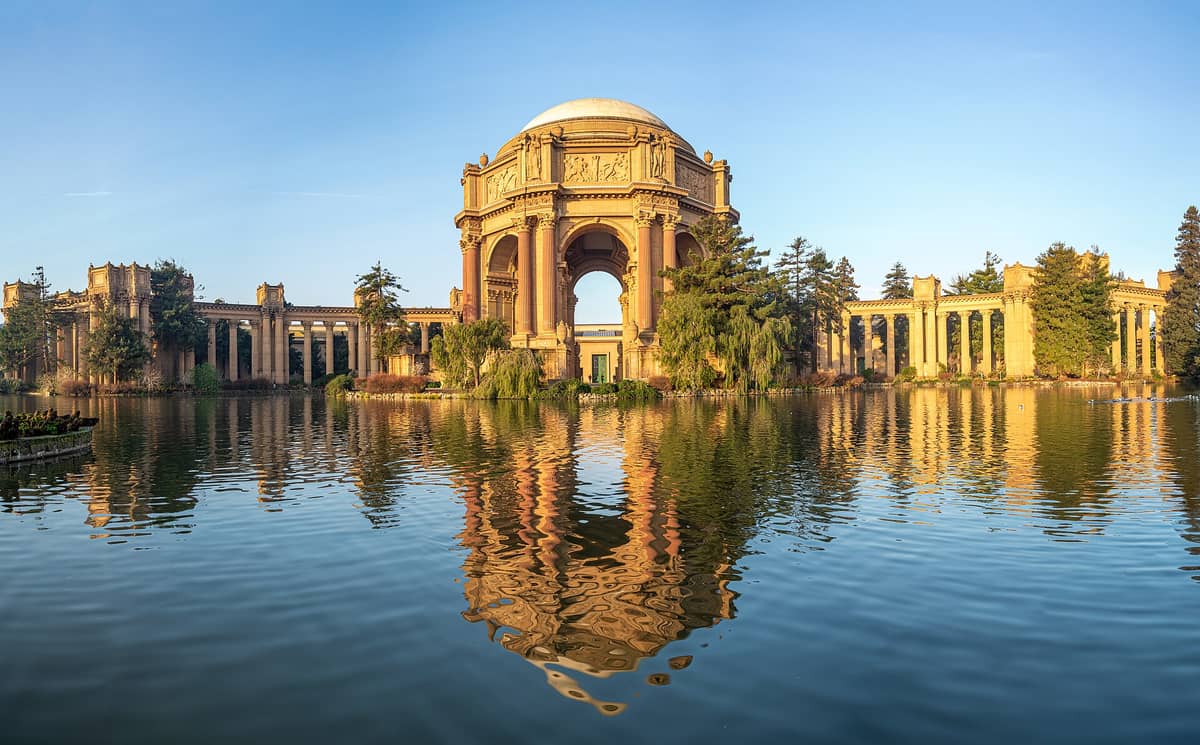
The Palace of Fine Arts is a large Beaux-Arts rotunda, colonnaded walkways, and a landscaped lagoon at 3601 Lyon Street in San Francisco's Marina District. It was designed by architect Bernard Maybeck and built in 1915 as part of the Panama-Pacific International Exposition, a World's Fair organized to celebrate the completion of the Panama Canal and to signal San Francisco's recovery from the catastrophic 1906 earthquake. Of the many grand temporary structures built for that exposition, the Palace of Fine Arts is the only remaining major structure from the fair on this site.
The original structure was built from wood, burlap, and plaster. It was always intended to be temporary, but San Franciscans grew attached to it. The building slowly deteriorated over decades until a major reconstruction in concrete began in 1964 and was completed in 1974. What you see today is that rebuilt version, which closely mirrors the Maybeck original. The interior hall now operates as an approximately 140,000-square-foot event and performance space, and the on-site theatre hosts a year-round program of lectures, performances, and screenings.
ℹ️ Good to know
The outdoor grounds are open 24 hours daily at no cost. The visitor and exhibit center is open 10:00 a.m. to 5:00 p.m. daily. Theatre event hours and tickets vary by event — check palaceoffinearts.com before visiting.
The Architecture Up Close
Maybeck drew on ancient Roman and Greek forms, but the Palace of Fine Arts is not a straightforward copy of either. The central rotunda rises approximately 162 feet and is ringed by Corinthian columns. Along the outer colonnade, weeping maidens carved in relief turn their backs to the viewer, an intentional artistic choice by Maybeck meant to evoke the melancholy of art cut off from spectators. The effect is subtle but unmistakable once you know to look for it.
The color palette matters. The structure is painted in warm earth tones, ochre and terracotta, which shift noticeably under different light conditions. On a foggy morning the building appears muted and ghostly. On a clear afternoon it glows. At dusk, when the stone takes on a deep amber tone against a darkening sky, the effect is genuinely extraordinary. Photographers who visit only in midday miss the most interesting light entirely.
For context on how this structure fits into the city's broader architectural history, the San Francisco architecture guide covers the key movements and landmark buildings worth knowing before you visit.
Tickets & tours
Hand-picked options from our booking partner. Prices are indicative; availability and final rates are confirmed when you complete your booking.
Sonoma and Napa Valley wine tour from San Francisco
From 127 €Instant confirmationFree cancellationGo City | San Francisco Explorer Pass
From 76 €Instant confirmationFree cancellationMuir Woods and Sausalito guided tour with transportation
From 82 €Instant confirmationFree cancellationSan Francisco CityPASS
From 77 €Instant confirmationFree cancellation
The Lagoon and Surrounding Grounds
The lagoon in front of the rotunda is shallow and calm, and it is home to a permanent population of ducks, swans, and geese. The swans are almost comically large and completely unintimidated by visitors. They move around the water's edge and occasionally onto the paths, which surprises people who aren't expecting it. Children in particular respond to this with great enthusiasm.
The grassy area around the lagoon is used differently at different times of day. Early mornings bring joggers from nearby residential streets and dog walkers from the Marina District neighborhood. By mid-morning on weekends, the paths fill with photographers setting up tripods and tourists moving in groups. The lunch hour draws office workers from the surrounding neighborhood. Late afternoon is when couples and small groups settle on the grass with food and blankets, especially on warm days in September and October, which are statistically San Francisco's warmest months.
💡 Local tip
Arrive before 9:00 a.m. on weekdays for the quietest experience and the most flattering light for photography. Weekend mornings after 10:00 a.m. can be crowded, especially when private events are being set up inside the main hall.
How Weather Shapes the Experience
San Francisco's marine climate means the Palace of Fine Arts looks and feels very different depending on when you visit. Summer mornings from June through August frequently bring low fog from the Pacific, and the building can appear almost completely shrouded. The fog typically burns off by early afternoon, but on some summer days it lingers all day. If you visit in summer, plan for layers and don't count on blue skies in the morning.
September and October bring the clearest and warmest conditions the city offers, with average highs in the upper 60s to low 70s Fahrenheit. This is the most reliable window for outdoor visits. Winter visits from November through March can be rewarding for dramatic cloudy skies and near-empty grounds, but temperatures drop into the mid-50s Fahrenheit and light rain is possible. Bring a waterproof layer if visiting outside the dry season.
The best time to visit San Francisco guide breaks down seasonal patterns and crowd levels across the whole city, which is useful for planning a full itinerary around your Palace of Fine Arts visit.
Getting There and Getting Around
The Palace of Fine Arts sits at the eastern edge of the Presidio, just north of the Marina District's main commercial strip on Chestnut Street. It is not directly served by a single dedicated transit stop, but several Muni bus lines stop within a short walk: bus lines 22, 28, 30, 41, 43, and 45 all serve the general area. From downtown, the 30 or 45 on Chestnut Street is the most straightforward option. Rideshare drop-off works well given the open parking area nearby.
The site is very walkable from several nearby attractions. Crissy Field is roughly a ten-minute walk north through the Presidio grounds, and the Marina Green stretches along the waterfront just east of the Palace. The combination of Palace, Crissy Field, and a walk along the Marina Green makes for a practical half-day loop that covers some of the most scenic parts of this side of the city.
If you're combining this with a walk toward the water, the Crissy Field shoreline offers unobstructed views of the Golden Gate Bridge from the north side of the Marina District, about ten minutes on foot from the Palace grounds.
Photography Notes
The classic image of the Palace of Fine Arts is taken from the south side of the lagoon, with the rotunda reflected in still water and the dome centered in the frame. The reflection works best in the early morning when the water is undisturbed by wind and foot traffic. A wide-angle lens or standard zoom handles the full rotunda comfortably from this position.
Less predictable but often more interesting shots come from inside the colonnade, looking out through the columns toward the lagoon, or from directly beneath the rotunda dome looking up, where the painted interior ceiling creates strong geometric patterns. The interior of the rotunda is open-air at ground level, so there are no access restrictions for photography.
💡 Local tip
The colonnade paths face west, so afternoon sun comes directly into them. For shadow-free architecture shots along the colonnade, morning light from the east is cleaner and softer.
Who Will Love This, and Who Might Not
The Palace of Fine Arts rewards visitors who appreciate architecture, light, and a slow pace. If you give it forty-five minutes and walk the full perimeter of the lagoon and colonnade, you leave with a fairly complete picture of what the site offers. There is no permanent exhibit that requires extended engagement; the pleasure is almost entirely visual and atmospheric.
Visitors who need constant stimulation or are working through a tight sightseeing list may find the Palace underwhelming as a stand-alone stop. It works best as part of a longer Marina District walk rather than a destination requiring dedicated transit time from across the city. Travelers who dislike crowds should note that weekend afternoons, particularly in September and October, can get genuinely busy around the lagoon.
The Marina District has a distinct character compared to downtown San Francisco. The Marina District page covers the neighborhood's layout, eating options, and how it connects to the Presidio and waterfront.
Insider Tips
- The inside of the rotunda is open at ground level with no gate or ticket. Walk directly under the dome and look up at the painted ceiling pattern — most visitors circle the lagoon without ever going in.
- Private events including weddings and corporate gatherings are held inside the main hall year-round. If you arrive and the building appears closed or fenced off, it is almost certainly a private event rather than a permanent closure. The lagoon and colonnade remain accessible regardless.
- The ducks and swans near the lagoon path are fed by locals and have no fear of people. Don't bring bread, which is harmful to waterfowl, but do walk slowly along the water's edge for close encounters.
- The Muni 30 bus line runs along Chestnut Street about four blocks south of the Palace and connects directly to downtown San Francisco via North Beach and the Embarcadero. It is the most useful single bus line for visiting this area without a car.
- Fog can make or break a photography trip here. Check a local marine layer forecast the evening before — apps that track San Francisco fog specifically give more accurate morning predictions than general weather services.
Who Is Palace of Fine Arts For?
- Architecture enthusiasts and design students interested in Beaux-Arts and early 20th-century exposition design
- Photographers looking for reflected water, classical columns, and warm stone tones
- Couples and small groups wanting a scenic outdoor space for a picnic or late afternoon walk
- Families with children who enjoy open green space and close-up wildlife near the lagoon
- First-time visitors building a Marina District half-day itinerary combining the waterfront, Crissy Field, and the Presidio
Nearby Attractions
Other things to see while in Marina District:
- Fort Mason Center for Arts & Culture
Perched on San Francisco's northern waterfront, Fort Mason Center for Arts & Culture transforms a former U.S. Army post into one of California's most eclectic cultural campuses. Dozens of resident arts organizations, a beloved farmers market, and sweeping bay views make it far more than a venue — it's a neighborhood institution that rewards a leisurely afternoon.
- Marina Green
A flat, open 74-acre lawn hugging San Francisco Bay in the Marina District, Marina Green draws joggers, kite flyers, picnickers, and bay-watchers year-round. Entry is free, views of the Golden Gate Bridge are unobstructed, and the park connects directly to Crissy Field and Fort Mason.
- Wave Organ
Built in 1986 by artist Peter Richards and stonemason George Gonzales, the Wave Organ is a free outdoor acoustic instrument on a rocky jetty in San Francisco's Marina District. Twenty-five pipes channel bay water to produce sounds that shift with every tide cycle, making it one of the most unusual public artworks on the West Coast.