Fort Mason Center for Arts & Culture: San Francisco's Waterfront Cultural Campus
Perched on San Francisco's northern waterfront, Fort Mason Center for Arts & Culture transforms a former U.S. Army post into one of California's most eclectic cultural campuses. Dozens of resident arts organizations, a beloved farmers market, and sweeping bay views make it far more than a venue — it's a neighborhood institution that rewards a leisurely afternoon.
Quick Facts
- Location
- 2 Marina Boulevard, San Francisco, CA 94123 (Marina District)
- Getting There
- Muni 30-Stockton to Chestnut & Laguna, then walk ~4 blocks; or Muni 28/43-Masonic to Marina Blvd & Laguna St
- Time Needed
- 1.5 to 3 hours for the campus; longer if attending an event
- Cost
- Campus entry free; individual events and exhibitions ticketed separately (prices vary in USD)
- Best for
- Arts lovers, weekend market-goers, families, and anyone who wants bay views without the Fisherman's Wharf crowds
- Official website
- fortmason.org
What Fort Mason Center Actually Is
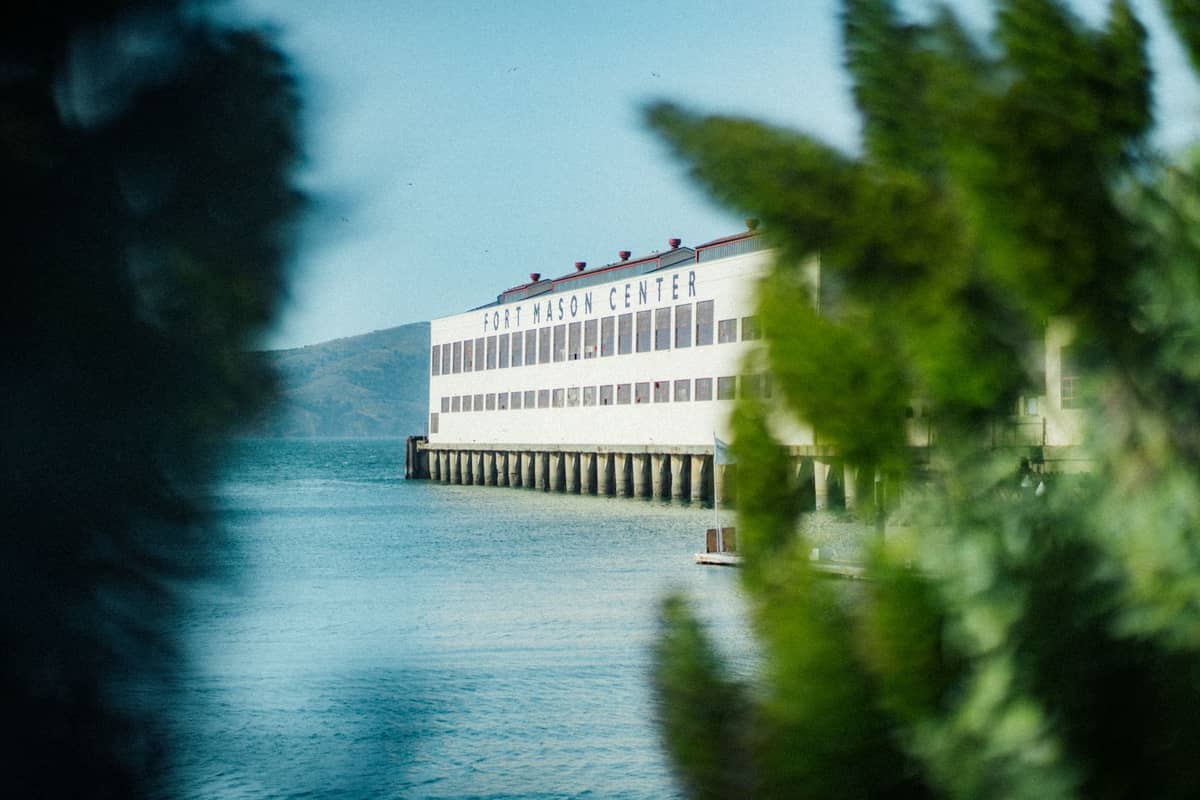
Fort Mason Center for Arts & Culture is a nonprofit cultural campus housed inside a cluster of converted U.S. Army warehouses on San Francisco's northern waterfront. The address — 2 Marina Boulevard — puts it right at the boundary between the Marina District and the Golden Gate National Recreation Area, which means the moment you step off the bus, you're looking at the bay, Alcatraz, and the Marin Headlands all at once.
The campus spans multiple piers and inland buildings organized around an open central courtyard. Buildings A through D each hold a rotating mix of resident arts organizations: small theaters, gallery spaces, community nonprofits, a vegetarian restaurant (Greens, a San Francisco institution since 1979), and pop-up event spaces. The atmosphere is deliberately low-key. There are no ticket booths at the gate, no queue to get onto the grounds, and no souvenir kiosks. You walk in, and the campus unfolds around you.
💡 Local tip
The main Fort Mason Center office in Building A is open daily 9:00 a.m. to 5:00 p.m. Stop in if you need a map or want to know what's on that week. Staff can tell you which buildings are open and whether any evening events require advance tickets.
History: From Army Post to Arts Campus
Fort Mason's transformation is one of the more unusual stories in American urban history. The site served as a U.S. Army post on San Francisco's northern waterfront for generations, functioning as a key embarkation point during World War II, when millions of troops and tons of supplies shipped out from its piers toward the Pacific Theater. At its peak, Fort Mason was one of the busiest military ports in the world.
As the military footprint in San Francisco shrank after the war, the lower fort's warehouses and pier buildings sat largely underused. In 1977, the lower section was repurposed as Fort Mason Center, a nonprofit cultural destination. That same year, the Center formalized its relationship with Golden Gate National Recreation Area (GGNRA), embedding arts programming inside a federally protected parkland. The full name — Fort Mason Center for Arts & Culture — was adopted later to clarify the organization's core mission.
The architecture of the warehouses still shows their industrial origins: thick timber framing, exposed iron hardware, wide loading-bay doors. Walking through the corridors, you pass between a theater rehearsal space and a yoga studio with the same ease you'd move through any working neighborhood. For a broader look at how San Francisco's military and civic history overlap, the San Francisco Maritime National Historical Park at nearby Fisherman's Wharf provides useful context.
Tickets & tours
Hand-picked options from our booking partner. Prices are indicative; availability and final rates are confirmed when you complete your booking.
Sonoma and Napa Valley wine tour from San Francisco
From 127 €Instant confirmationFree cancellationGo City | San Francisco Explorer Pass
From 76 €Instant confirmationFree cancellationMuir Woods and Sausalito guided tour with transportation
From 82 €Instant confirmationFree cancellationSan Francisco CityPASS
From 77 €Instant confirmationFree cancellation
What You'll Find on the Campus
The resident organizations at Fort Mason Center number in the dozens and change over time, but several anchors have been here for years. SFMOMA Artists Gallery operates from the campus, giving access to works by Bay Area artists available for purchase or rental. The Magic Theatre, one of the country's notable regional theaters, has staged world premieres here. The Museo Italo Americano — the only Italian American museum on the West Coast — maintains a gallery space in Building C.
Building A's upper floors are worth walking even if you have no specific event to attend. The corridor windows frame uninterrupted views across the bay toward Angel Island, and on clear mornings the water takes on a particular flat silver quality you don't see from street level. The wide covered walkways between buildings are pleasant in almost any weather, sheltered from the wind that cuts across the open marina in the afternoons.
Greens Restaurant, inside Building A, has been one of San Francisco's standard-bearers for vegetarian cooking since 1979. It is not a casual lunch counter — expect proper service, reservation-level demand on weekends, and prices to match. For something more informal, grab coffee from one of the smaller vendors and take it to the waterfront benches. The views toward Alcatraz Island are unobstructed and impressive, especially in the late afternoon when the light comes from the west.
The Sunday Farmers Market
One of the most practical reasons to visit Fort Mason Center on a weekend is the Sunday farmers market, operated with the California Farmers Markets Association. The Ferry Plaza Farmers Market at the Embarcadero gets more attention, but Fort Mason's Sunday market draws serious produce vendors and ready-to-eat food stalls without quite the same tourist-to-local ratio. Expect California-grown fruit and vegetables, specialty cheeses, prepared foods, and a low-pressure atmosphere where you can actually linger. Market hours are typically 9:30 a.m. to 1:30 p.m.; confirm the current schedule on the Fort Mason website before you plan a trip around it.
How the Experience Changes Through the Day
Early morning at Fort Mason Center — before 9 a.m. — is almost entirely locals. Runners use the path along the waterfront edge of the campus as part of longer routes through the Marina and toward Crissy Field. Dog walkers cut through the courtyard. The light at this hour is cool and flat, and the bay is usually calm enough to reflect the Marin hills clearly. The warehouses are mostly closed, but the outdoor spaces feel like a genuine neighborhood park rather than a cultural attraction.
By mid-morning on a Sunday, the farmers market brings the campus to life. Food smells — stone fruit, fresh bread, something savory frying in oil — mix with the salt air. Families with strollers compete for bench space with people eating directly out of market bags. This is the most photogenic hour: warm light from the east hits the brick warehouse facades, and the bay glitters in the background.
Afternoons can be cool and windy. San Francisco's marine layer often strengthens in the afternoon hours regardless of season, and the waterfront exposure at Fort Mason amplifies this. A light jacket is advisable any time of year. Evening events — theater performances, night markets, community gatherings — tend to run well-attended and are worth planning around. Check the Fort Mason Center events calendar at least a week in advance if you have specific interests.
⚠️ What to skip
Summer afternoons (June through August) can be genuinely cold here. San Francisco's marine layer is strongest in summer, and the exposed waterfront location means wind-chill temperatures in the low 50s°F (around 11°C) are common after 2 p.m. Bring a layer even if the morning felt warm.
Getting There and Practical Logistics
The campus is not served by a dedicated BART or Muni Metro station. From downtown San Francisco, the most direct public transit is the 30-Stockton bus to Chestnut and Laguna, followed by a four-block walk. Alternatively, the 28 or 43-Masonic lines stop at Marina Boulevard and Laguna Street, a short walk from the main entrance. For up-to-date schedules and real-time tracking, use the 511 transit information service or the SFMTA trip planner.
If you're combining Fort Mason Center with a walk along the waterfront — which is the natural way to approach it — Crissy Field extends west from the campus toward the Golden Gate Bridge, and the Marina Green stretches east toward the Palace of Fine Arts. The entire route is flat, paved, and very walkable.
Paid parking is available on-site daily from 7:00 a.m. to midnight, starting at about $5 per hour on non-event days (higher on event days; confirm at fortmason.org). Street parking in the surrounding Marina District is competitive on weekends, particularly during the farmers market. Cycling is practical: the waterfront path is bike-friendly, and the campus has bike parking near the main buildings.
ℹ️ Good to know
Accessibility: Public restrooms are located in Buildings B, C, and D. For specific questions about ramp access, elevator availability, or disabled parking, contact the Fort Mason Center office directly at +1 415-345-7500 before your visit.
Photography and What to Realistically Expect
The combination of industrial warehouse architecture and open waterfront views makes Fort Mason Center a good photography location, but there are some practical limits. The interior of most buildings requires an event ticket to access, so exterior and courtyard shots are the default for casual visitors. The best vantage points are along the pier walkways on the bay-facing side of the campus, where you can frame the warehouse facades against the water and the hills of Marin.
Fog is a serious consideration for photography. On overcast mornings — which are common from June through August — the diffused light is actually flattering for architectural shots, but any hope of capturing the bay in clear blue water conditions depends on timing your visit for September or October, when San Francisco's weather is statistically at its best. The marine layer typically burns off earlier in those months, leaving afternoon skies genuinely clear.
For travelers building a broader itinerary around San Francisco's arts and cultural institutions, the best museums in San Francisco guide provides context on how Fort Mason's resident organizations compare with the city's larger institutions like SFMOMA and the de Young.
Insider Tips
- The farmers market at Fort Mason runs on Sundays (typically 9:30 a.m.–1:30 p.m.; confirm at fortmason.org). Sunday crowds are often lighter than at the famous Ferry Building market, making it a more relaxed way to browse California produce and prepared foods.
- Greens Restaurant is worth a reservation for a weekend brunch, but the real value is sitting by the window with a clear bay view and ordering off the à la carte menu rather than committing to a full multi-course meal on a tight schedule.
- Building C's gallery spaces often have free, drop-in exhibitions from resident organizations like the Museo Italo Americano. These are rarely crowded and offer genuine engagement with Bay Area artistic communities without any ticket purchase required.
- The pier walkway on the north side of the campus extends past the buildings and offers one of the quietest spots in the Marina to sit and watch bay traffic. Bring food from the market and eat here rather than at the picnic tables, which fill up quickly on sunny days.
- Evening events at Fort Mason Center, particularly the periodic Night Markets, are free to enter and draw a mix of locals and visitors in a format that feels nothing like a tourist attraction. Check the events calendar two to three weeks out, as popular events sell out or reach capacity quickly.
Who Is Fort Mason Center for Arts & Culture For?
- Arts and culture travelers who want to experience San Francisco's local creative community rather than its headline institutions
- Food-oriented visitors combining a farmers market visit with a waterfront walk toward Crissy Field or the Marina Green
- Families looking for a low-cost, open-air afternoon with restroom facilities, food options, and enough variety to keep different ages engaged
- Architecture and history enthusiasts interested in adaptive reuse of military infrastructure and the story of San Francisco's post-war transformation
- Photographers targeting industrial-meets-waterfront compositions with bay and Marin Headlands backdrops
Nearby Attractions
Other things to see while in Marina District:
- Marina Green
A flat, open 74-acre lawn hugging San Francisco Bay in the Marina District, Marina Green draws joggers, kite flyers, picnickers, and bay-watchers year-round. Entry is free, views of the Golden Gate Bridge are unobstructed, and the park connects directly to Crissy Field and Fort Mason.
- Palace of Fine Arts
The Palace of Fine Arts is a monumental Beaux-Arts rotunda surrounded by a tranquil lagoon in San Francisco's Marina District. Originally built for the 1915 Panama-Pacific International Exposition, it is one of the few surviving structures from that World's Fair. The outdoor grounds are free to enter at any hour, making it one of the most accessible landmarks in the city.
- Wave Organ
Built in 1986 by artist Peter Richards and stonemason George Gonzales, the Wave Organ is a free outdoor acoustic instrument on a rocky jetty in San Francisco's Marina District. Twenty-five pipes channel bay water to produce sounds that shift with every tide cycle, making it one of the most unusual public artworks on the West Coast.