Wave Organ: San Francisco's Tide-Powered Sound Sculpture
Built in 1986 by artist Peter Richards and stonemason George Gonzales, the Wave Organ is a free outdoor acoustic instrument on a rocky jetty in San Francisco's Marina District. Twenty-five pipes channel bay water to produce sounds that shift with every tide cycle, making it one of the most unusual public artworks on the West Coast.
Quick Facts
- Location
- Marina Small Craft Harbor jetty, near 83 Marina Green Drive, San Francisco, CA 94123
- Getting There
- Muni 30-Stockton or 28-19th Ave to Palace of Fine Arts, then ~10-min walk north to jetty
- Time Needed
- 30–60 minutes; longer if you time it with high tide
- Cost
- Free, no tickets required
- Best for
- Curious travelers, sound art enthusiasts, photographers, and anyone wanting a quiet bay view away from crowds
- Official website
- www.exploratorium.edu/visit/wave-organ
What Is the Wave Organ?
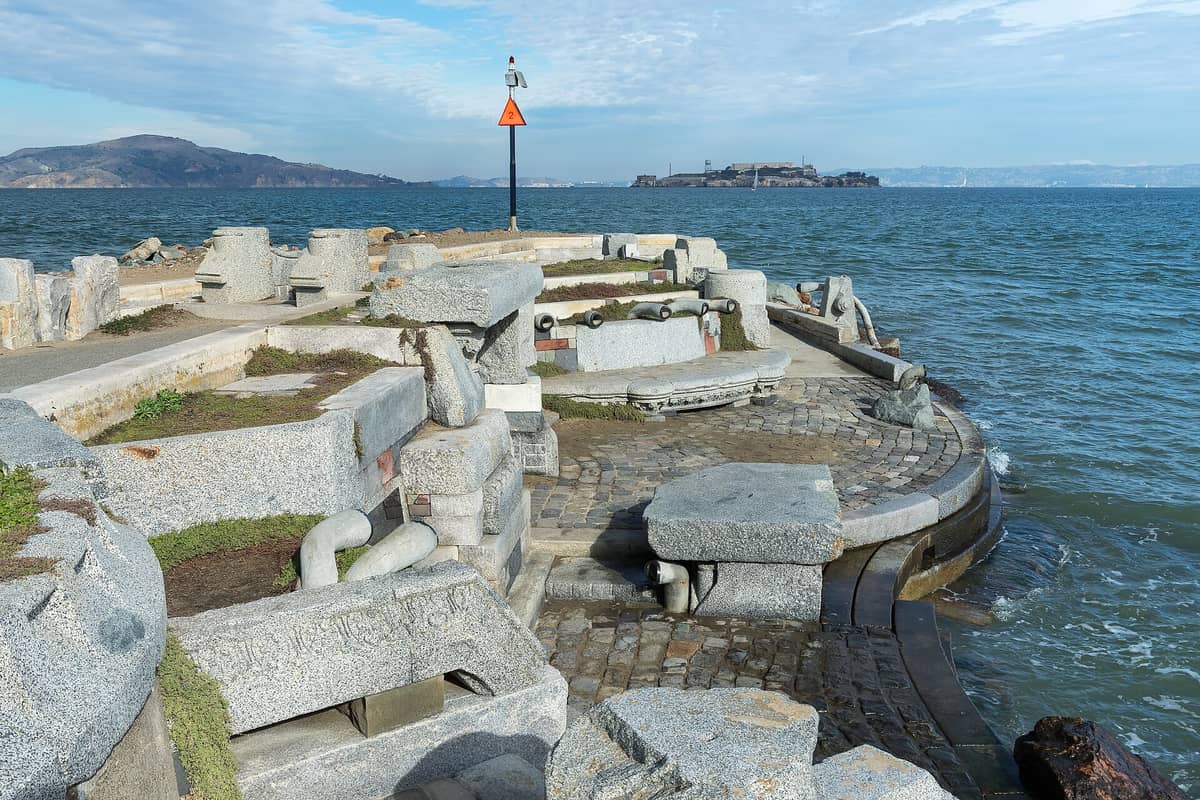
The Wave Organ is an acoustic wave-activated sculpture built in May 1986 on a jetty at the San Francisco Marina Small Craft Harbor. Artist Peter Richards, then artist-in-residence at the Exploratorium, designed it in collaboration with stonemason George Gonzales. The result is a permanent outdoor instrument made of 25 pipes of varying lengths and diameters, each descending into the bay and terminating at different depths. When bay water rises and falls through those pipes, it displaces air in ways that produce sound: low resonant tones, gurgling pulses, rhythmic whooshes, and occasional near-melodic groans.
The stonework surrounding the pipes is not incidental decoration. Gonzales used granite and marble reclaimed from a demolished Victorian cemetery, giving the seating ledges, steps, and pipe housings an aged, ceremonial quality that contrasts sharply with the raw industrial feel of the bay. Sit on one of those marble ledges, place your ear close to a pipe opening, and the scale of what you're hearing shifts entirely: you're essentially listening to the bay breathe.
💡 Local tip
The Wave Organ is loudest and most active at high tide. Check a local tide chart before visiting — low tide can reduce the sounds to near silence. The difference is dramatic.
How It Sounds: Expectations vs. Reality
Visitors sometimes arrive expecting an orchestral experience and leave underwhelmed. The Wave Organ is subtle. At low tide, the pipes emit little more than faint trickles and the occasional deep exhalation. At high tide, and especially during periods of moderate swell, the soundscape becomes genuinely strange: overlapping pulses, low resonant drones from the wider pipes, and erratic gurgles that seem to follow no musical pattern whatsoever. It is environmental sound art, not a concert. The experience rewards patience and attentiveness.
Wind affects the experience considerably. On calm mornings with a rising tide, the sounds carry clearly and the bay surface is still enough that you can hear the relationship between water movement and pipe output. On breezy afternoons, wave noise, wind, and distant traffic from Marina Boulevard compete with the organ's output and reduce its impact. The geometry of the jetty also means that certain pipes are more accessible from the seating areas than others — exploring all 25 takes a short walk around the structure's outer edge.
Tickets & tours
Hand-picked options from our booking partner. Prices are indicative; availability and final rates are confirmed when you complete your booking.
Sonoma and Napa Valley wine tour from San Francisco
From 127 €Instant confirmationFree cancellationGo City | San Francisco Explorer Pass
From 76 €Instant confirmationFree cancellationMuir Woods and Sausalito guided tour with transportation
From 82 €Instant confirmationFree cancellationSan Francisco CityPASS
From 77 €Instant confirmationFree cancellation
The Setting: More Than Just the Pipes
The jetty itself frames one of the more striking bay views in San Francisco. Standing at the tip, you face directly toward Marin County across the water, with the Golden Gate Bridge visible to the northwest and Alcatraz Island sitting mid-bay to the northeast. Sailboats from the marina pass close by, and harbor seals occasionally haul out on nearby buoys. The 360-degree panorama from the end of the jetty is genuinely excellent, and unlike most city viewpoints, there are no crowds competing for the same sightline.
The jetty is about a 10-minute walk from the Palace of Fine Arts, passing the yacht harbor along Marina Green. The walk itself is pleasant: flat, open, and lined with the activity of sailboats being rigged, pelicans resting on dock pylons, and joggers making their way along the bay shore.
The broader Marina District is one of San Francisco's more approachable neighborhoods — low-rise, walkable, with good coffee options on Chestnut Street before or after your visit. It makes the Wave Organ an easy add-on to a half-day exploring the area rather than a standalone trip.
Best Time to Visit
Timing here is everything. High tide produces the most active sound output, so checking a San Francisco Bay tide table is the most important piece of planning you can do. The hour before and the hour after peak high tide is typically the most productive window. Combine that with a calm-weather morning and you have the best possible conditions.
In terms of season, September and October offer the warmest and clearest conditions in San Francisco, with less marine fog than the summer months. June through August can be cold and foggy on the bay, with afternoon winds that make the jetty feel raw despite mild air temperatures. A windproof layer is worth bringing in any season; the jetty is fully exposed and the bay breeze hits without interruption.
Early mornings are quieter than midday. The few other visitors who make it out before 9 AM tend to be locals doing bay walks or photographers working with the low-angle light. By early afternoon, especially on weekends, you'll share the space with more people, though it rarely becomes genuinely crowded.
⚠️ What to skip
During storms or heavy swell events, waves can wash over parts of the jetty. The rocks can be slippery when wet even in calm conditions. Wear shoes with grip, not sandals.
Getting There and Practical Notes
The Wave Organ sits at the tip of the jetty at the San Francisco Marina Small Craft Harbor. The closest address reference is 83 Marina Green Drive, San Francisco, CA 94123, though the organ itself is at the far end of Yacht Road, which extends from the parking area near Marina Green. If you're driving, there is street parking along Marina Boulevard and Marina Green, though it fills on sunny weekends.
By public transit, the Muni 30-Stockton and 28-19th Avenue lines stop near the Palace of Fine Arts, from which the jetty is about a 10-minute walk north through the marina. The route is flat and straightforward. There are no facilities at the Wave Organ itself: no restrooms, no water, no seating beyond the stone ledges built into the sculpture. Plan accordingly.
The Wave Organ is maintained by the Exploratorium, San Francisco's science and art museum located on Pier 15 at the Embarcadero. The two are operated by the same institution but are about 3 miles apart. If you plan to combine both in one day, rideshare or the Muni F-line from Fisherman's Wharf is the most practical option.
Accessibility and Who Should Think Twice
The Wave Organ is not accessible to visitors who use wheelchairs or have significant mobility limitations. The jetty involves an uneven stone path, no guardrails on the outer edges, and some moderate scrambling to reach the seating ledges closest to the pipes. There are no on-site staff, no ramp access, and no accessible restrooms nearby. The Exploratorium's official page does not describe accessible routes to the organ.
Visitors who are primarily interested in sound quality rather than the setting may also find the experience disappointing if they arrive at low tide without checking conditions in advance. The visual experience of the jetty and the bay view is consistent regardless of tide; the acoustic experience is not. If you come expecting a loud, immediately obvious instrument and find only the distant sound of water and wind, that is a tide issue, not a design flaw.
ℹ️ Good to know
The Wave Organ is free and open 24 hours a day. Sunset visits during high tide offer low-angle light on the bay and a quieter atmosphere than midday.
Insider Tips
- Download a San Francisco Bay tide prediction app or check tidesandcurrents.noaa.gov before you go. Arriving at low tide is the single most common reason visitors feel underwhelmed.
- The outermost seating ledges on the bay-facing side of the sculpture produce the clearest sound. Many visitors stay near the entrance and miss the best listening spots entirely.
- If you put your ear directly to the opening of one of the larger-diameter pipes at high tide, the sound shifts from ambient background noise to something surprisingly resonant and close — almost like the inside of a conch shell, but alive.
- The recycled Victorian cemetery marble in the stonework is worth examining up close. You can see the remnants of carved lettering and decorative edges in some of the slabs used as seating and steps.
- Pair this stop with the nearby Crissy Field shoreline walk. The combination gives you over a mile of bay-facing waterfront between the two, with the Golden Gate Bridge growing larger as you head west.
Who Is Wave Organ For?
- Sound art and acoustic curiosity seekers who want something genuinely unlike any other attraction in the city
- Photographers looking for a bay panorama with a foreground subject and minimal foot traffic
- Couples wanting a quiet, uncrowded waterfront stop that doesn't cost anything
- Architecture and public art enthusiasts interested in the Exploratorium's history of experimental outdoor projects
- Travelers building a Marina District half-day that includes the Palace of Fine Arts and Crissy Field
Nearby Attractions
Other things to see while in Marina District:
- Fort Mason Center for Arts & Culture
Perched on San Francisco's northern waterfront, Fort Mason Center for Arts & Culture transforms a former U.S. Army post into one of California's most eclectic cultural campuses. Dozens of resident arts organizations, a beloved farmers market, and sweeping bay views make it far more than a venue — it's a neighborhood institution that rewards a leisurely afternoon.
- Marina Green
A flat, open 74-acre lawn hugging San Francisco Bay in the Marina District, Marina Green draws joggers, kite flyers, picnickers, and bay-watchers year-round. Entry is free, views of the Golden Gate Bridge are unobstructed, and the park connects directly to Crissy Field and Fort Mason.
- Palace of Fine Arts
The Palace of Fine Arts is a monumental Beaux-Arts rotunda surrounded by a tranquil lagoon in San Francisco's Marina District. Originally built for the 1915 Panama-Pacific International Exposition, it is one of the few surviving structures from that World's Fair. The outdoor grounds are free to enter at any hour, making it one of the most accessible landmarks in the city.