Pah Homestead (TSB Wallace Arts Centre): Auckland's Free Italianate Art Villa
Pah Homestead is a beautifully preserved Victorian Italianate villa in Hillsborough that houses one of Australasia's most significant private collections of New Zealand contemporary art. Entry is free, the grounds are open and leafy, and the experience is unhurried in a way that Auckland's central galleries rarely are.
Quick Facts
- Location
- 72 Hillsborough Road, Hillsborough, Auckland 1042
- Getting There
- Bus 27H or 27W to Hillsborough Road; routes 295 and 309X connect via Monte Cecilia Park walkways. Free onsite parking via Delargey Avenue.
- Time Needed
- 1–2 hours
- Cost
- Free entry; koha (donations) appreciated
- Best for
- Art lovers, architecture enthusiasts, quiet weekend mornings
- Official website
- www.artshousetrust.co.nz/hours-location
What Is Pah Homestead?
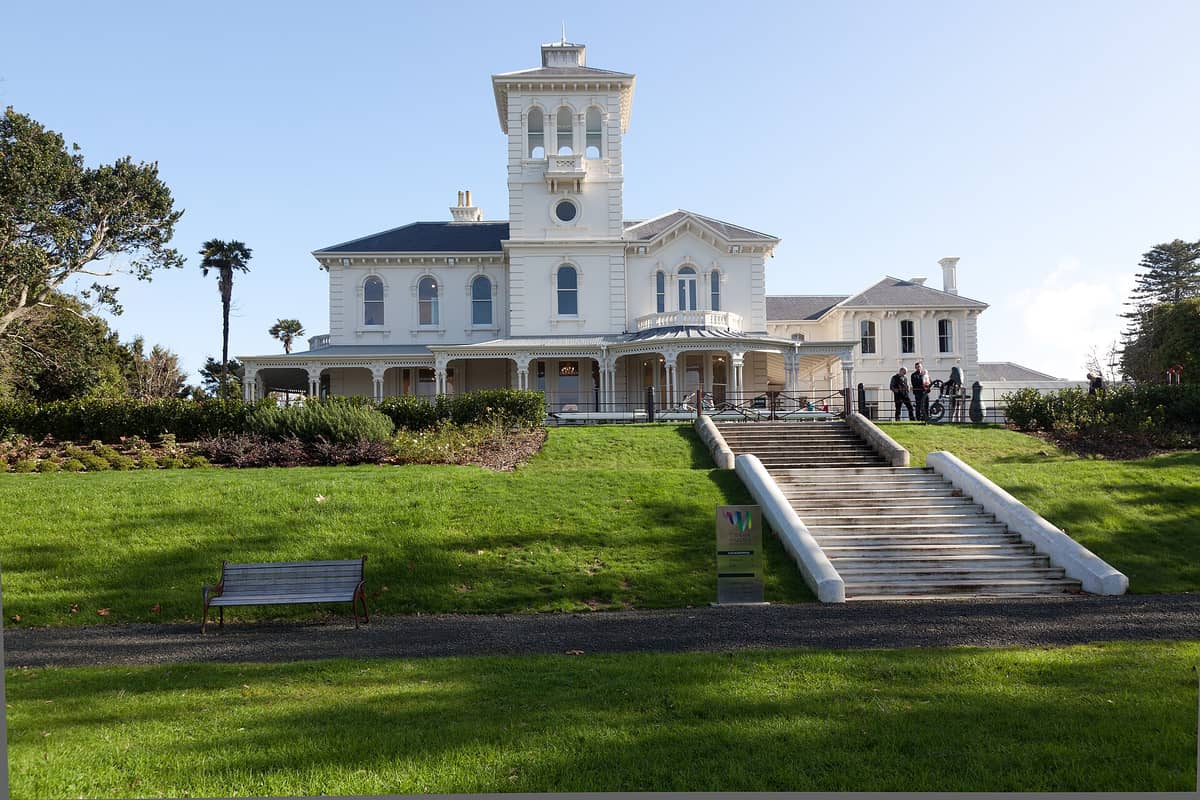
Pah Homestead, also known as the TSB Wallace Arts Centre, sits at 72 Hillsborough Road in Auckland's inner-south suburb of Hillsborough. It is a Victorian Italianate villa built between 1877 and 1879 for businessman James Williamson, designed by architect Edward Mahoney. The building is now managed by the Arts House Trust and serves as the permanent home of the Wallace Arts Collection, one of the most extensive private collections of contemporary New Zealand art in Australasia.
What makes this place genuinely unusual in the Auckland cultural landscape is the combination: a serious, rotating art collection displayed inside a grand historic house, surrounded by parkland, with free entry every week. There is no blockbuster marketing, no queues at a ticket booth, and no gift-shop pressure at the exit. That restraint is part of the appeal.
ℹ️ Good to know
Opening hours: Tuesday–Friday 9 am–3 pm; Saturday–Sunday 8 am–4 pm. Closed Mondays and public holidays. Entry is free; donations are welcomed.
The Building: Italianate Architecture in a Suburban Setting
Edward Mahoney was one of colonial Auckland's most prolific architects, responsible for a range of ecclesiastical and residential commissions across the city. The homestead he designed for Williamson follows the Italianate villa style that was fashionable in New Zealand during the 1870s and 1880s: bracketed eaves, tall narrow windows, and a ground-floor veranda that wraps around the main facade, all rendered in timber and painted in tones that sit naturally against the surrounding garden.
Approaching from Hillsborough Road, the building reveals itself gradually through mature trees. The exterior looks composed and deliberate, the veranda posts casting crisp shadows in the afternoon light. Up close, the timber detailing rewards attention: fretwork brackets, decorative bargeboards, and the proportions of the first-floor balustrade all reflect the care of a commission built to impress.
The interior has been sympathetically adapted to display art without stripping the domestic character of the rooms. Original wooden floors and high ceilings give the galleries a warmth that white-cube commercial spaces cannot replicate. Works hang on walls that also carry the faint history of a family home, and that layering of domestic and cultural use gives the whole experience an intimacy that larger institutions often lose.
Tickets & tours
Live prices and dates from our booking partner. If you book, we may earn a commission at no extra cost to you.
Luggage Storage in Auckland
From 5 €Instant confirmationFree cancellationNew Zealand West Coast discovery tour
From 100 €Instant confirmationFree cancellation13,000ft skydiving experience in Auckland
From 195 €Instant confirmationFree cancellationDiscover Auckland City Tour
From 88 €Instant confirmationFree cancellation
The Wallace Arts Collection: What You Will Actually See
The Wallace Arts Collection is built from the collecting activities of James Wallace, a New Zealand businessman who has spent decades acquiring contemporary New Zealand art. The collection now numbers in the thousands of works, and the homestead displays a rotating selection across its two floors. Because the collection changes regularly, repeat visits are genuinely worthwhile, particularly for anyone interested in tracking the breadth of New Zealand painting, photography, and sculpture.
The works span media and generations: figurative painting alongside abstract canvas, photographic prints, ceramic work, and mixed-media pieces. The selection at any given time tends to reflect the depth of the collection rather than any single curatorial moment, so you are likely to encounter lesser-known artists alongside established names. For visitors with a general interest in New Zealand visual culture, this is one of the most accessible and comprehensive places to develop an understanding of what the country's contemporary art scene actually looks like.
If you want critical context before or after visiting, the Auckland Art Gallery Toi o Tāmaki in the CBD offers a broader survey of New Zealand and international art history, including its permanent Māori and Pacific collections. The two venues complement each other well and serve different purposes.
Visiting by Time of Day: When to Go and What Changes
Saturday mornings between opening and around 10 am are the quietest window of the week. The light in the ground-floor rooms at that hour is soft and even, and you can move through the galleries at your own pace without other visitors crowding the sightlines. The garden surrounding the homestead carries the smell of damp grass and seasonal flowers in the morning, and the birdsong from the surrounding trees is constant.
By midday on weekends, family groups and couples tend to arrive from nearby Monte Cecilia Park, and the atmosphere in the building becomes noticeably more social. This is not a criticism: the homestead handles a moderate crowd well, and the grounds provide space to spread out. But for contemplative viewing of individual works, the morning hours are clearly preferable.
Weekday afternoons are calm. Tuesday through Friday, the gallery closes at 3 pm, so arriving after 2 pm gives you an abbreviated visit. The early-afternoon light on the first floor, which has east and north-facing windows, is particularly good for viewing work that benefits from natural illumination rather than artificial spotlighting.
💡 Local tip
For the best combination of light and quiet, visit Saturday morning between 8 am and 10 am. The garden is at its most pleasant at that hour, and the rooms are rarely crowded before the late-morning influx.
Getting There and Practical Logistics
The homestead is in Hillsborough, a residential suburb roughly 8 km south of the Auckland CBD. Bus routes 27H and 27W stop within a short walk of the site on Hillsborough Road. Routes 295 and 309X connect to the area via Monte Cecilia Park's walkway network, which makes it possible to combine a visit here with a walk through the park. Free onsite parking is available via Delargey Avenue, which runs along the eastern edge of the property.
If you are using public transport from the city centre, check Auckland Transport's journey planner before setting out, as route schedules and stop locations can change. The AT HOP card or a contactless bank card will cover the fare. Driving is the most straightforward option if you are coming from further afield, and the parking situation is genuinely generous by Auckland standards.
For broader guidance on navigating Auckland's public transport network, see the getting around Auckland guide, which covers bus, train, and ferry options across the city.
Accessibility, Practical Details, and What to Bring
Wheelchair access is available throughout the building. Ground-floor entry is via a side gate and ramp, and a lift serves the first floor. Accessible bathrooms are located on the ground floor. No wheelchair is provided onsite, so visitors who require one should bring their own.
There is no cafe inside the homestead, though the broader Monte Cecilia Park grounds include areas suitable for a picnic if you want to extend your visit outdoors. Bring water, particularly in summer, when the walk from the bus stop or through the park in warm weather can be more demanding than expected.
Photography policies can vary by exhibition, so check with staff on arrival if you plan to photograph specific works. The building itself, from the exterior and veranda, is consistently good subject matter and unrestricted.
⚠️ What to skip
The gallery is closed on Mondays and public holidays. Auckland has a number of public holidays that can catch visitors off guard, including Waitangi Day (6 February) and Auckland Anniversary Day (last Monday in January). Check the official site before making a special trip.
Is It Worth the Trip from Central Auckland?
Pah Homestead is not central, and getting there by public transport requires a little planning. That distance is also the reason the experience feels so different from the city's main cultural institutions. There is no noise from the waterfront, no passing foot traffic from a shopping precinct, no pressure to move quickly. The homestead offers something genuinely rare in a city this size: free access to serious art in a considered, quiet setting.
Visitors who are primarily interested in nightlife, harbour views, or major landmark experiences will find this too quiet and too far from the action to justify the trip. But for anyone with a real interest in New Zealand contemporary art, or anyone who simply wants to spend a morning somewhere that moves at a slower pace, the homestead rewards the effort of getting there.
If you are planning a full day of art and culture, consider pairing this with a visit to Auckland War Memorial Museum in the Domain, or exploring the gallery spaces along Parnell for a contrasting take on Auckland's art and heritage offer.
For a broader sense of how Pah Homestead fits into Auckland's cultural calendar, the best museums in Auckland guide covers the full range of options, from the major institutions to smaller specialist collections.
Insider Tips
- The ground-floor rooms closest to the garden-facing veranda receive the best natural light in the morning. Start there before moving to the upper floor, where artificial lighting dominates.
- The collection rotates, and there is no fixed schedule for changes. If you visited six months ago, the display you saw is unlikely to be entirely the same. The Arts House Trust website occasionally notes new exhibitions, but the best approach is to simply return.
- Parking via Delargey Avenue is more straightforward than approaching from Hillsborough Road directly. If you are driving, map the Delargey Avenue entrance specifically to avoid confusion.
- Monte Cecilia Park immediately adjoins the homestead grounds. Arriving via the park on foot, particularly from the bus stop on Hillsborough Road, gives you a more gradual and pleasant approach than walking along the road itself.
- The gallery does not have a cafe, but the Saturday-morning crowd sometimes brings takeaway coffee from nearby Hillsborough Road shops. If you want coffee, pick it up before you arrive rather than expecting anything onsite.
Who Is Pah Homestead For?
- Art lovers looking for depth and breadth in contemporary New Zealand painting and mixed media
- Architecture enthusiasts with an interest in Victorian colonial residential design
- Visitors wanting a genuinely free cultural experience away from the tourist centre
- Couples or solo travellers who prefer unhurried, contemplative spaces over high-footfall attractions
- Repeat Auckland visitors who have covered the main central galleries and want something less obvious
Nearby Attractions
Combine your visit with:
- Auckland Botanic Gardens
Spread across 64 hectares in Manurewa, the Auckland Botanic Gardens offer free entry every day of the year, with themed garden collections, 10 hectares of native forest, and a visitor centre on site. It sits south of the city centre and rewards a longer visit than most people initially plan for.
- Auckland Zoo
Auckland Zoo has been part of the city's fabric since 1922, sitting in the Western Springs precinct with a collection that spans native New Zealand wildlife and international species. This guide covers everything from ticket prices and transit options to the best time of day to arrive and which exhibits deliver the most.
- Bastion Point (Takaparawhau)
Takaparawhau, known widely as Bastion Point, is a grassy headland in Ōrākei where Māori history, colonial conflict, and sweeping Waitematā Harbour views converge. It costs nothing to visit, carries centuries of significance, and rewards visitors who take time to understand what they are standing on.
- Bethells Beach (Te Henga)
Bethells Beach, officially Te Henga (Bethells Beach), is a raw, dramatic stretch of black-sand coastline about 45 minutes west of central Auckland. With rolling dunes, a freshwater lagoon, strong surf, and zero phone coverage, it delivers a genuine wilderness experience rare for a city of 1.6 million people.
Planning a trip? Discover personalized activities with the Nomado app.