Auckland Art Gallery Toi o Tāmaki: What to Expect Before You Visit
Auckland Art Gallery Toi o Tāmaki is New Zealand's largest art gallery, housing more than 18,000 works across historic French-château architecture and a striking contemporary addition. General collection entry is free, and the building itself is as worth examining as anything on the walls.
Quick Facts
- Location
- Corner of Wellesley Street East and Kitchener Street, Auckland CBD (1 Kitchener Street)
- Getting There
- Te Waihorotiu Station (under 10 min walk); CityLink and OuterLink buses stop nearby
- Time Needed
- 1.5 to 3 hours for the permanent collection; longer if a ticketed exhibition is running
- Cost
- Free for the permanent collection; special exhibitions may be ticketed (check individual listings in NZD)
- Best for
- Art lovers, rainy-day visitors, families with curious children, and anyone interested in New Zealand and Pacific art
- Official website
- www.aucklandartgallery.com/home
What Auckland Art Gallery Toi o Tāmaki Actually Is
Auckland Art Gallery Toi o Tāmaki is the largest art gallery in New Zealand, and one of the most visited cultural institutions in the country. Founded in 1888, it has grown from a Victorian civic gallery into a substantial collection spanning New Zealand, Pacific, and international art across over 18,000 works. The name itself is significant: 'Toi o Tāmaki' translates loosely as 'the arts of Tāmaki', grounding the institution in its place and in te reo Māori, one of New Zealand's three official languages.
What you get here is genuinely broad: colonial landscapes painted in the 19th century, contemporary Māori and Pacific works, European old masters, photography, prints, and large-scale installations. The range means the gallery rewards different visitors in different ways. A traveler with two hours will move through the permanent collection without fatigue. Someone with a specific interest in, say, New Zealand portraiture or Pacific tapa cloth could easily spend an entire afternoon going slowly.
💡 Local tip
General collection entry is free. Check the gallery's website before visiting to see whether a ticketed special exhibition is currently open, as these can significantly add to your visit but require separate tickets.
The Building: Two Architectures in Conversation
The gallery occupies two distinct structures that work together more successfully than you might expect from the outside. The original building, constructed in 1887 to house the public library and municipal offices with space set aside for an art gallery, is French Renaissance in character: a pale stone façade, copper-green turrets, and ornate detailing that would not look out of place in a Parisian municipal building. From the street, it reads as a serious Victorian institution designed to signal cultural ambition.
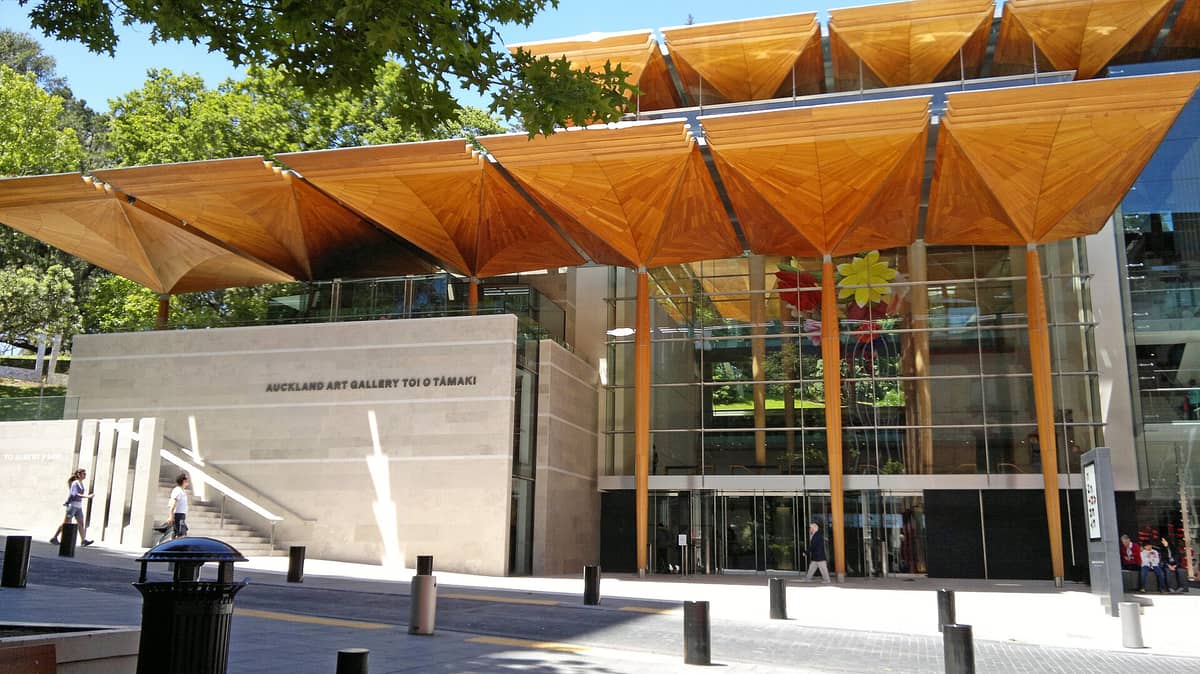
The contemporary addition, completed as part of a major redevelopment and opened in 2011, is a different conversation entirely. Its roof is a forest of kauri-timber cones that reference the native kauri trees of the Tāmaki Makaurau region, with light filtering through the forms into interior galleries. The effect from below, inside the modern atrium, is genuinely arresting: warm timber, diffused natural light, and a sense of organic movement quite unlike the stone certainty of the old wing. Architects Francis-Jones Morehen Thorp (FJMT) and Archimedia won multiple awards for this addition.
The transition between old and new is best experienced by entering from the Kitchener Street entrance, moving through the original lobby with its Victorian detailing, then crossing into the atrium where the kauri ceiling opens above you. It is one of the more interesting architectural sequences in the Auckland CBD.
Tickets & tours
Live prices and dates from our booking partner. If you book, we may earn a commission at no extra cost to you.
Luggage Storage in Auckland
From 5 €Instant confirmationFree cancellation13,000ft skydiving experience in Auckland
From 195 €Instant confirmationFree cancellationDiscover Auckland City Tour
From 88 €Instant confirmationFree cancellationAuckland to Rotorua via Hobbiton movie set tour
From 205 €Instant confirmationFree cancellation
What You Will See in the Collection
The permanent collection is organized across multiple floors and rotates regularly, so the exact configuration changes. That said, certain areas of strength are consistently represented. New Zealand historical painting is particularly well covered: works from the colonial period document the landscape and people of Aotearoa with the visual language of European art, making them both beautiful and, on reflection, culturally complicated. The gallery presents this material with enough context to make it thought-provoking rather than simply decorative.
The Māori and Pacific galleries are among the most important in the building. Taonga Māori (treasured objects) and contemporary Māori art sit alongside works from across the Pacific, giving the collection a regional identity that most major international galleries lack. These rooms tend to be quieter than the European galleries, which makes concentrated looking easier.
The international collection includes European works dating back to the 14th century, though the holdings are not as deep as those of major European or North American institutions. Do not come expecting a Louvre-scale old masters experience. What the Auckland Art Gallery offers is something more specific and in some ways more interesting: a view of art from the edge of the Pacific world. If you're building a broader understanding of Auckland's cultural landscape, the Auckland War Memorial Museum handles natural history and Māori taonga at comparable depth, and the two institutions together give a thorough grounding in New Zealand's cultural identity.
How the Experience Changes by Time of Day
The gallery opens at 10am. If you visit on a weekday morning outside school-holiday periods, you may find it quieter; the Gallery identifies weekend and school-holiday mornings from 10am to noon as busy. The large windows in the contemporary wing mean light shifts noticeably as the morning progresses, and the kauri ceiling catches midmorning sun in a way that is worth pausing to watch.
By midday, especially on weekends, the atrium café fills up and school groups sometimes move through in organized clusters. The noise level rises, but the upper floors remain relatively calm. Early afternoon on weekdays is a useful window: the morning rush of organized visits has cleared, and the post-work crowd has not yet arrived.
Late afternoon, in the hour before the 5pm close, sees another quiet period. The gallery closes at 5pm, so budget your time accordingly if you want to reach upper floors without feeling hurried.
⚠️ What to skip
The gallery is closed on Christmas Day. No other regular closures are listed, but check the official website before visiting during public holidays, as programming and access can change.
Getting There and Getting Around the Building
The gallery sits on the edge of Albert Park, in the upper part of Auckland's CBD. Te Waihorotiu train station is less than a 10-minute walk away, and the CityLink and OuterLink bus services stop nearby on Wellesley Street. The ferry terminal at Waitematā is approximately 15 minutes on foot downhill through the CBD, making it easy to combine a gallery visit with a morning ferry arrival from Devonport or Waiheke Island. If you're walking from the waterfront, the uphill gradient on Queen Street is noticeable but not strenuous.
Inside, the layout is intuitive once you have the floor plan from the information desk near the main entrance. The building uses both lifts and staircases to connect floors, and step-free access is available throughout. The gallery lends wheelchairs and mobility aids free of charge, and service dogs are permitted. If you have specific accessibility requirements, the gallery's website has detailed information.
Bags larger than carry-on size must be checked at the cloak room near the entrance, which is free. Photography of the permanent collection is generally permitted for personal use, but restrictions apply to some special exhibitions and to works where reproduction rights are held by third parties. Look for the photography policy posted at each gallery entrance, or ask staff if in doubt. Natural light in the atrium makes for good architectural photography; a wide-angle lens or smartphone with a panorama mode captures the kauri ceiling best.
Practical Details Worth Knowing
The gallery café in the main atrium serves food and coffee through the day, with indoor and some outdoor seating. It is a reasonable option for a midday break, though prices are typical of a city-centre café. Albert Park, directly adjacent, is a good alternative for a packed lunch or a sit-down in the sun between gallery floors.
The gallery shop sells art books, prints, jewelry, and New Zealand-made gifts. The selection leans thoughtfully curatorial rather than souvenir-generic, and it is genuinely useful if you want to take home something connected to the art you have just seen. For a broader look at Auckland's gallery and museum landscape, the best museums in Auckland guide covers how this institution sits alongside others in the city.
Families with children will find the gallery more welcoming than many art institutions. There are dedicated family activity spaces on some floors during school holidays, and the scale of the building is manageable for children who are not yet gallery veterans. The atrium in particular holds attention: the height, light, and unusual ceiling structure tend to provoke genuine curiosity in younger visitors.
ℹ️ Good to know
If you're traveling on a tight budget, the Auckland Art Gallery is one of the best free things to do in central Auckland. The permanent collection costs nothing and is substantial enough to anchor a half-day without spending a dollar.
Who This Attraction Suits, and Who Might Move On
The gallery works particularly well for travelers who are already interested in art or cultural history, and for anyone looking to understand New Zealand and Pacific art in context. It also suits rainy days in the Auckland CBD: the building is large enough to occupy two to three hours comfortably, and the free admission removes any pressure to justify the decision. If you're putting together a broader Auckland itinerary, it pairs naturally with Albert Park next door and the Auckland War Memorial Museum a short walk through the Domain.
Visitors who are not particularly drawn to visual art, or who are looking for an adrenaline-oriented or highly active experience, will probably find the gallery less compelling. If your Auckland priority list is dominated by beaches, hikes, and outdoor activities, the gallery is worth an hour at most rather than a dedicated half-day. It is also not the right call for travelers who are deeply familiar with major international art institutions and are hoping for a collection of comparable scale, depth, or international fame: this is a serious regional institution, not a world-capital museum, and it makes no claim to be otherwise.
Insider Tips
- The kauri-timber ceiling in the modern atrium is best appreciated from the ground-floor level near the café. Look straight up rather than angling for a photograph immediately: the spatial effect at standing height is more striking than it appears in most photos.
- Free guided tours of the permanent collection run every weekday at 1:30pm and on the first Saturday of the month. Check the gallery's website or ask at the information desk on arrival. These tours are led by staff with detailed knowledge and often cover works that are easy to walk past without context.
- Albert Park shares a boundary wall with the gallery. If you visit on a weekday, the park's upper terraces are often quiet at lunchtime and provide a calm break between gallery floors without leaving the immediate area.
- Special exhibitions at the gallery are sometimes reviewed in advance by New Zealand arts media. Searching for the exhibition name before you visit gives you curatorial context that enriches the experience, particularly for contemporary shows where the brief wall text can be sparse.
- The gallery's collection can be browsed online at aucklandartgallery.com before your visit. Identifying three or four specific works you want to find in person gives even a short visit more focus and makes the experience more memorable.
Who Is Auckland Art Gallery Toi o Tāmaki For?
- Art enthusiasts wanting to engage with New Zealand and Pacific art in serious depth
- Rainy-day visitors looking for a free, substantial indoor experience in the CBD
- Families with children aged 7 and up who respond well to large, architecturally interesting spaces
- Travelers building a cultural itinerary alongside the Auckland War Memorial Museum and Albert Park
- Anyone with an interest in colonial history as seen through visual art and its contemporary reconsideration
Nearby Attractions
Other things to see while in Auckland CBD:
- Albert Park
Albert Park is a free, 24-hour public park at the edge of Auckland's CBD, occupying land once held by colonial barracks. With formal Victorian gardens, mature trees, and a location flanked by the University of Auckland and the Auckland Art Gallery, it rewards a slow wander any time of day.
- Auckland Civic Theatre
The Civic is Auckland's most architecturally dramatic performance venue, a 2,379-seat Moorish fantasy built in 1929 at the corner of Queen and Wellesley Streets. Whether you're catching a touring musical, a film festival screening, or an Auckland Arts Festival production, the building itself is half the experience.
- Auckland Harbour Bridge
The Auckland Harbour Bridge is the city's most recognisable structure, stretching 1.2 km across the Waitematā Harbour since 1959. You can't walk across it, but you can climb over its arch or take a bungy jump from its underside. This guide covers the experience, the history, and how to make the most of your visit.
- Auckland Sky Tower
At 328 metres, the Sky Tower is Auckland's most recognisable landmark — a telecommunications and observation tower in the CBD. This guide covers what you'll actually see from each level, when to go, how much it costs, and whether the experience justifies the ticket price.
Planning a trip? Discover personalized activities with the Nomado app.