Albert Park: Auckland's Historic Heart in the City Centre
Albert Park is a free, 24-hour public park at the edge of Auckland's CBD, occupying land once held by colonial barracks. With formal Victorian gardens, mature trees, and a location flanked by the University of Auckland and the Auckland Art Gallery, it rewards a slow wander any time of day.
Quick Facts
- Location
- 33–43 Princes Street, Auckland CBD. Entrances on Bowen Avenue, Kitchener Street, Princes Street, and Wellesley Street East.
- Getting There
- Britomart Transport Centre (approx. 10-minute walk). Multiple bus routes stop along Queen Street and Wellesley Street.
- Time Needed
- 30–60 minutes for a relaxed wander; longer if you pair it with the Auckland Art Gallery next door.
- Cost
- Free. No admission fee.
- Best for
- Picnics, a midday break from the CBD, history buffs, photography, and students looking for a lunch-hour green space.
What Albert Park Actually Is
Albert Park is a formal public park sitting at the upper edge of Auckland's central business district, sandwiched between the University of Auckland campus and the Auckland Art Gallery on Wellesley Street East. It occupies land known to Māori as Rangipuke, before European colonisation established a military barracks here between 1846 and 1852. That barracks, called Albert Barracks, gave the park its name when the grounds were converted into a public park in the 1880s. Today, remnants of the original barracks wall survive on Alfred Street, making Albert Park one of the few places in the CBD where you can stand next to physical evidence of Auckland's colonial military past.
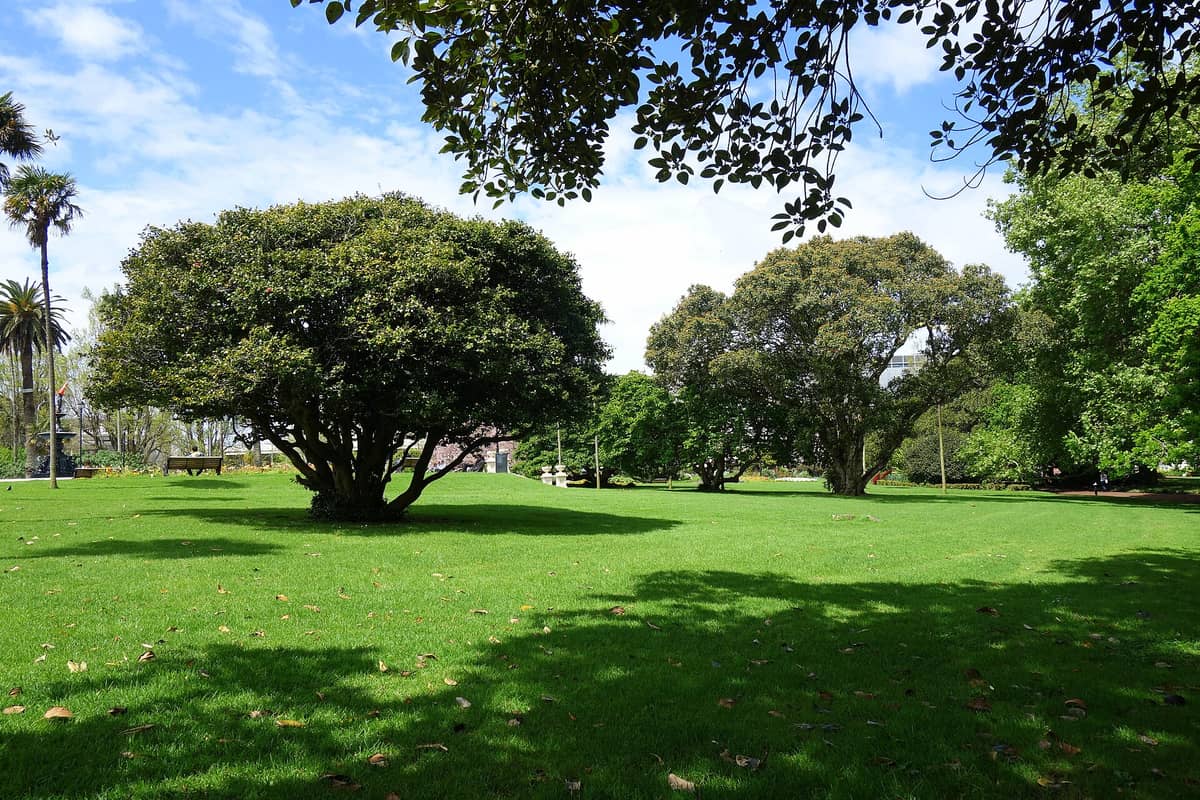
The park covers a modest but well-used area of formal Victorian garden design: clipped flowerbeds, a central fountain, gravel paths, and tall established trees that create genuine canopy shade. It is not a sprawling wilderness, and it does not try to be. What it offers is a contained, well-maintained green space that feels genuinely separate from the concrete and glass surrounding it on every side.
💡 Local tip
If you want to avoid the steeper uphill sections and steps, start your walk from the Princes Street entrance rather than from Wellesley Street East. Auckland Council's official walking notes say this option avoids steps and the steeper uphill sections.
How the Park Changes Through the Day
Early mornings before 8am, Albert Park is quiet to the point of being empty on most days. The fountain trickles, pigeons move across the paths, and the light through the tree canopy is clean and soft. This is the best window for photography, particularly around the central Victorian fountain and the formal beds, before shadows and crowds complicate the composition.
From mid-morning through the lunch hour, the park shifts character entirely. Students from the University of Auckland spread out across the lawns, office workers eat sandwiches on the benches, and the paths fill with people cutting diagonally across the CBD on foot. The energy is low-key but social. You'll hear multiple languages, see people sleeping on the grass, and occasionally encounter someone practising guitar in the shade. This is the park at its most alive.
By late afternoon, the student population thins and the park takes on a calmer tone. On sunny days the flowerbeds catch good warm light, and the park can be genuinely pleasant for sitting. After dark, the park is officially open but feels very different. Lighting is limited, foot traffic drops sharply, and solo visitors may find the ambience less comfortable. This is worth noting if you're planning an evening stroll.
⚠️ What to skip
Albert Park is open 24 hours, but it is not well lit at night. Unaccompanied visitors should assess their own comfort with this. The surrounding streets are central Auckland and not isolated, but the park itself is darker than the roads outside it.
Tickets & tours
Live prices and dates from our booking partner. If you book, we may earn a commission at no extra cost to you.
Luggage Storage in Auckland
From 5 €Instant confirmationFree cancellationNew Zealand West Coast discovery tour
From 100 €Instant confirmationFree cancellation13,000ft skydiving experience in Auckland
From 195 €Instant confirmationFree cancellationDiscover Auckland City Tour
From 88 €Instant confirmationFree cancellation
The Historical Layer: Barracks, Colonial History, and the Land
The Albert Barracks were built between 1846 and 1852, when Auckland was a young colonial settlement and British military presence in the region was a political and practical priority. The barracks occupied a commanding elevated position over what is now the CBD, with sightlines toward the harbour. The land beneath had been known to Māori as Rangipuke, and was part of the broader landscape of Tāmaki Makaurau that held deep significance for mana whenua long before European settlement.
By the 1880s, the barracks had been decommissioned and the grounds redesigned as a Victorian public park. The park was designed through a public competition in 1881. A section of the original stone barracks wall remains on Alfred Street. It is easy to walk past without noticing, but it is worth pausing at: the rough-cut stone is genuinely old in a city that has demolished most of its colonial-era structures.
Albert Park sits directly adjacent to the Auckland Art Gallery, which occupies a French Renaissance building from 1887. The architectural contrast between the gallery's ornate stone facade and the park's formal gardens is striking, and the two sites share a physical and historical boundary that reflects the same Victorian-era civic development push.
What to Actually Look At
The Victorian fountain at the park's centre is the most photographed element and the natural focal point on any visit. Surrounded by carefully maintained seasonal flowerbeds, it is functional and decorative in equal measure. In spring and early summer, the beds are at their peak, with colour that makes the formal Victorian layout feel genuinely intentional rather than dated.
The tree canopy is the park's most underappreciated feature. Several specimens are large and mature, providing heavy shade that genuinely lowers the temperature on hot Auckland summer days (which can reach the low-to-mid 20s°C). The mix of exotic and native species reflects the park's age and the gardening fashions of successive eras.
The barracks wall on Alfred Street deserves a deliberate look. It is not signposted prominently, and many visitors walk past it. The surviving stone wall is part of the barracks built between 1846 and 1852. For anyone with an interest in colonial history, this wall alone justifies a few minutes of the visit.
For context on how Albert Park fits into Auckland's wider collection of historic and natural spaces, the best parks in Auckland guide offers useful comparisons, including larger reserves further from the city centre.
Practical Walkthrough: Getting There and Moving Around
Albert Park is about a 10-minute walk from Britomart Transport Centre, making it easily reachable on foot from most of the CBD. From Britomart, walk up Queen Street toward the university end; the park entrances appear at the top of the hill. Multiple bus routes along Queen Street and Wellesley Street East stop within a few minutes' walk. If you're using Auckland Transport's network, check the AT Journey Planner before travelling, as routes can change. For more detail on navigating the city, the getting around Auckland guide covers bus, train, and ferry options.
The park itself has multiple entrance points: Bowen Avenue, Kitchener Street, Princes Street, and Wellesley Street East. The terrain slopes noticeably, and some routes involve steps. Visitors with mobility considerations should enter from Princes Street, which Auckland Council notes as the option that avoids steps and the steepest uphill sections. Gravel paths are the primary surface throughout, which may be uneven in places.
Albert Park is free to enter and open every day with no set closing time. No ticket booth, no queues, no booking required. You walk in, walk around, and walk out. It functions as a genuine urban park rather than a ticketed attraction.
ℹ️ Good to know
Auckland's weather is changeable year-round. The park is fully exposed in places and has limited shelter if rain arrives quickly. A light jacket or compact umbrella is worth carrying in winter (June–August) when conditions are cool and damp.
Pairing Albert Park with Nearby Attractions
Albert Park's location makes it a natural pairing with several nearby attractions. The Auckland Art Gallery shares a boundary with the park and is worth entering even briefly for its architecture and free access to parts of the collection. The Auckland Civic Theatre is a short walk down Wellesley Street, and offers one of the most unusual interiors in New Zealand if you can catch a tour or performance.
The park also makes a sensible midpoint stop on a walking day that takes in the Auckland Domain to the east or the CBD waterfront to the north. For travellers working through Auckland on a tight schedule, the 3-day Auckland itinerary integrates Albert Park naturally into a city-centre half-day without requiring a separate trip.
Who Should Reconsider
Albert Park is a pleasant city park, not a headline attraction. Travellers with limited time in Auckland who are trying to prioritise between a long list of options should weigh it honestly: it does not compete in scale or spectacle with experiences like a ferry crossing to the Hauraki Gulf islands or a walk up a volcanic cone. It suits people who genuinely enjoy parks, want a quiet place to sit between other activities, or have a specific interest in colonial history.
Visitors expecting dramatic views, unusual wildlife, or a sense of wilderness will not find it here. The park is urban, formal, and relatively compact. It is also not entirely free from the ambient noise of city traffic. If you are looking for a green escape that feels removed from central Auckland, a destination like the Auckland Domain or Cornwall Park offers considerably more room and a more natural atmosphere.
Insider Tips
- The barracks wall on Alfred Street is easy to miss because it is not prominently signed. Look for the surviving stone wall, part of the barracks built between 1846 and 1852.
- The park's best light for photography is in the early morning, before 8am in summer or shortly after sunrise in winter, when the fountain and flowerbeds are unobstructed and the canopy light is even.
- The Auckland Art Gallery shares a boundary with the park and has free access to significant parts of its permanent collection. Combining a wander through Albert Park with an hour in the gallery costs nothing and makes for a genuinely satisfying half-morning.
- If you're catching a lunchtime crowd-free window, arrive before 11am or after 2pm on weekdays. Between noon and 1:30pm during university terms, the park fills quickly with students from the University of Auckland campus immediately adjacent.
- Albert Park is on a hill and the surrounding streets slope considerably. If you're walking up from the waterfront, expect a gradual but sustained uphill on Queen Street. It's not demanding, but worth knowing if you're moving between CBD errands.
Who Is Albert Park For?
- Travellers wanting a free, no-logistics break from the CBD in the middle of a busy day
- History enthusiasts interested in early colonial Auckland and the physical remnants of the 1845 barracks
- Photography walkers looking for Victorian garden compositions and mature tree canopy
- University-area visitors combining the park with the Auckland Art Gallery or a Wellesley Street lunch
- Families with young children who need open grass and paths without an admission fee
Nearby Attractions
Other things to see while in Auckland CBD:
- Auckland Art Gallery Toi o Tāmaki
Auckland Art Gallery Toi o Tāmaki is New Zealand's largest art gallery, housing more than 18,000 works across historic French-château architecture and a striking contemporary addition. General collection entry is free, and the building itself is as worth examining as anything on the walls.
- Auckland Civic Theatre
The Civic is Auckland's most architecturally dramatic performance venue, a 2,379-seat Moorish fantasy built in 1929 at the corner of Queen and Wellesley Streets. Whether you're catching a touring musical, a film festival screening, or an Auckland Arts Festival production, the building itself is half the experience.
- Auckland Harbour Bridge
The Auckland Harbour Bridge is the city's most recognisable structure, stretching 1.2 km across the Waitematā Harbour since 1959. You can't walk across it, but you can climb over its arch or take a bungy jump from its underside. This guide covers the experience, the history, and how to make the most of your visit.
- Auckland Sky Tower
At 328 metres, the Sky Tower is Auckland's most recognisable landmark — a telecommunications and observation tower in the CBD. This guide covers what you'll actually see from each level, when to go, how much it costs, and whether the experience justifies the ticket price.
Planning a trip? Discover personalized activities with the Nomado app.