Padrão dos Descobrimentos: Lisbon's Monument to the Age of Discovery
Standing 52 metres above the Tagus riverbank in Belém, the Padrão dos Descobrimentos is one of Lisbon's most recognisable landmarks. Shaped like the prow of a caravel, it carries 33 carved figures who defined Portugal's Age of Discovery — and its rooftop terrace delivers one of the most dramatic panoramas in the city.
Quick Facts
- Location
- Belém riverfront, Avenida Brasília, Lisbon
- Getting There
- Tram 15 to Belém area; train to Belém station (10 min walk)
- Time Needed
- 45–90 minutes
- Cost
- Paid entry; verify current prices at official website
- Best for
- History enthusiasts, panoramic views, architecture
- Official website
- padraodosdescobrimentos.pt/en/monument-to-the-discoveries
What Is the Padrão dos Descobrimentos?
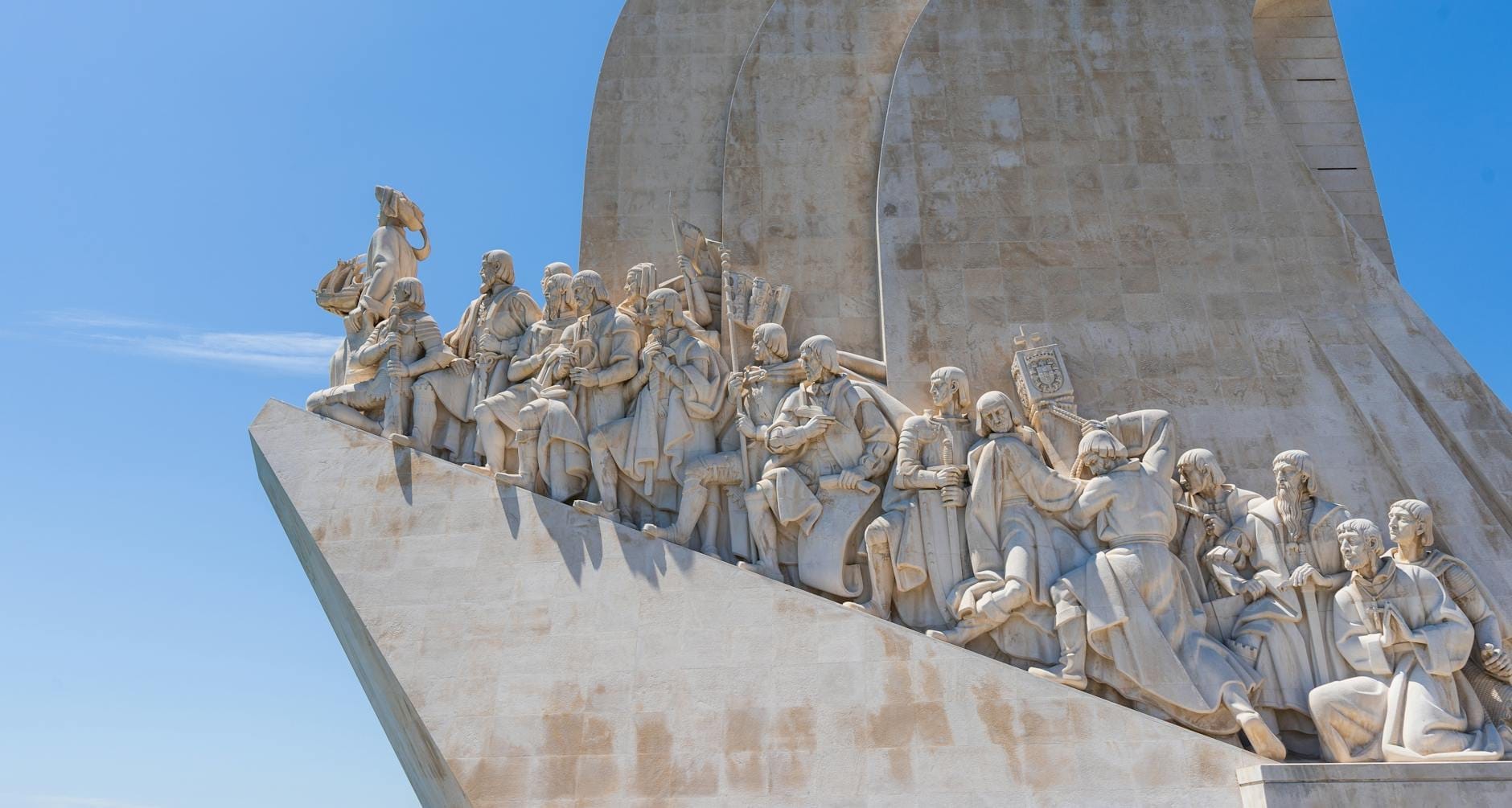
The Padrão dos Descobrimentos — the Monument to the Discoveries — rises 52 metres from the north bank of the Tagus estuary in Belém, one of Lisbon's most historically loaded neighbourhoods. Its form is immediately arresting: a concrete blade shaped like the prow of a 15th-century caravel, with Portugal's most celebrated explorers, cartographers, and scholars cascading down both flanks in carved stone. Prince Henry the Navigator stands at the very tip, looking out, gazing southwest toward the Atlantic as if still scanning the horizon for uncharted coastline.
The monument was first erected as a temporary structure in 1940 for the Portuguese World Exhibition, a grand nationalistic showcase staged under the Salazar regime. The permanent version was inaugurated in 1960 to mark the fifth centenary of Henry the Navigator's death. That political context is worth holding in your mind as you approach — this is not a neutral piece of civic sculpture. It was built to project imperial pride, and the 33 figures it commemorates represent the full apparatus of maritime expansion: navigators, missionaries, astronomers, chroniclers, and artists. Whether you read the monument as a celebration or a reckoning with that history, it demands engagement.
ℹ️ Good to know
Admission includes access to the interior exhibition spaces and the rooftop terrace. Confirm current opening hours and ticket prices directly at padraodosdescobrimentos.pt before visiting, as they are subject to seasonal change.
The 33 Figures and the History They Represent
Walk the full perimeter of the monument before going inside, and take time to identify individual figures. Each face on the two descending ramps was sculpted with distinct features, and the lineup reads like a compressed biography of Portugal's 15th and 16th centuries. Vasco da Gama, who opened the sea route to India in 1498, stands near the prow. Bartolomeu Dias, the first European to round the Cape of Good Hope in 1488, is there too. So is Ferdinand Magellan, the Portuguese navigator who led the first circumnavigation of the globe under Spanish commission.
Less immediately famous but equally significant are the cartographers, chroniclers, and cosmographers included in the group. Pedro Álvares Cabral, credited with the 1500 discovery of Brazil, appears alongside Luís de Camões, the poet whose epic Os Lusíadas transformed the voyages into national mythology. The inclusion of Camões is telling: it signals that the monument is as much about the story Portugal told itself as about the voyages themselves.
The broader historical context of the Age of Discovery is well covered inside the monument and at the nearby Jerónimos Monastery, which was itself funded by spice trade revenues and serves as a visual companion to the monument a few hundred metres inland.
Tickets & tours
Live prices and dates from our booking partner. If you book, we may earn a commission at no extra cost to you.
Guided Tour to Fatima, Batalha, Nazare and Obidos from Lisbon
From 76 €Instant confirmationFree cancellationFaith and Heritage shared tour with Fatima, Batalha and Obidos
From 75 €Instant confirmationFree cancellationSmall group tour to Fatima, Batalha, Nazare and Obidos
From 85 €Instant confirmationFree cancellationMosteiro dos Jeronimos Entrance E-Ticket and Guided Tour
From 32 €Instant confirmationFree cancellation
The Interior: Exhibition Spaces and the Viewing Terrace
Inside the monument's base, rotating exhibitions typically focus on the history of the discoveries, Portuguese cartography, and Belém's role as the launching point for the great voyages. The quality of these exhibitions varies by rotation, so check the official website for what's currently showing. The permanent displays on the ground floor include maps, artefacts, and explanatory panels that provide useful context if you want more than the sculpture gives you from outside.
A lift and staircase take you to the rooftop observation terrace at the top. The view from up here is one of the finest in Lisbon, and it differs meaningfully from the hilltop miradouros on the other side of the city. Instead of looking down over rooftiles and castle walls, you are looking outward: the wide grey-blue mouth of the Tagus, the orange span of the Ponte 25 de Abril in the middle distance, and on clear days the faint outline of the Serra de Arrábida hills to the south. The Cristo Rei statue is visible directly across the water.
If you are planning a full panorama tour of Lisbon's viewpoints, the rooftop here pairs well with the hilltop perspectives at the Miradouro da Graça or the Miradouro da Senhora do Monte for a complete contrast between river-facing and city-facing vistas.
💡 Local tip
Arrive at opening time or in the last hour before closing to use the terrace with fewer people. Midday in summer the terrace can feel crowded and the sun is directly overhead, which flattens photographs. Late afternoon light from the west catches the river beautifully.
The Esplanade and the Compass Rose
Immediately in front of the monument, inlaid into the broad riverside esplanade, is a large compass rose and world map rendered in black and white stone. This 50-metre-wide mosaic was gifted to Portugal by South Africa and marks the routes of the great voyages radiating outward from Lisbon's latitude. It is one of the most photographed features of the entire Belém waterfront, and understandably so: the geometry is striking, and it gives you a useful birds-eye orientation point when you reach the terrace above.
The esplanade itself is wide and pleasant in the early morning before tour groups arrive. The sound at that hour is mostly river water, seagulls, and the distant rattle of tram 15E approaching from the city. A café operates nearby for coffee before you enter. By late morning on a summer weekend, this area becomes genuinely congested — the monument, the Jerónimos Monastery, and the Pastéis de Belém shop all draw large crowds to a compact zone.
Getting There and the Best Time to Visit
From central Lisbon, tram 15 is the most direct public transport option and running west along the riverfront to Belém. Journey time from the Baixa is roughly 30 to 40 minutes depending on traffic. Alternatively, the Cascais suburban train line from Cais do Sodré station reaches Belém in about 10 minutes — the station sits a short walk from the monument and is faster than the tram during peak hours.
Belém is compact and walkable once you arrive. The monument sits steps from the riverbank promenade, with the Jerónimos Monastery behind it and the Belém Tower visible about 1.5 kilometres west along the waterfront. A half-day itinerary covering all three major Belém sites is realistic if you start before 10am.
The best months to visit Belém are May, June, September, and October. Summer (July and August) brings intense heat and very heavy tourist traffic, but extended daylight hours mean you can visit early morning and avoid the worst congestion. Winter visits are quiet and the light on the Tagus in December and January can be extraordinary, though the Lisbon weather occasionally brings rain that limits the terrace experience.
⚠️ What to skip
The rooftop terrace is exposed and offers no shade. In summer, bring sunscreen and water. On rainy or very windy days, access to the terrace may be restricted.
Honest Assessment: Is It Worth Your Time?
The Padrão dos Descobrimentos is not a subtle experience. It is large, symbolic, and designed to make a point. Visitors who engage with its history — who read the figures, think about what the voyages meant and cost, and use the interior exhibitions — will find genuine depth here. Visitors who are looking primarily for architecture in the purely aesthetic sense may find the monument less rewarding than the Jerónimos Monastery a short walk away, which is one of the finest examples of Manueline Gothic architecture in the world.
The rooftop view, however, earns its admission price independently of everything else. The river panorama from the top is different in character from any of Lisbon's hilltop viewpoints, and the sense of standing at the mouth of the Tagus looking toward the Atlantic gives the visit a geographic clarity that is hard to find elsewhere in the city.
Travellers on a tight budget should note that Belém has several worthwhile free or low-cost alternatives nearby. The free things to do in Lisbon guide covers options that may help you prioritise if entrance fees are a constraint.
Insider Tips
- The compass rose mosaic on the esplanade photographs best from the lower section of the monument's ramp rather than from directly beside it — you need height to see its full geometry.
- If the queue for the lift is long, the staircase to the terrace is quick and gives you a better sense of the monument's internal scale.
- Tuesday mornings are noticeably quieter than any weekend day. If your schedule allows a weekday visit, you will have both the esplanade and the terrace substantially to yourself before 10am.
- The mosaic world map in the esplanade was a diplomatic gift from South Africa. Identifying the voyage routes traced across it turns the exterior visit into an impromptu geography lesson that children respond well to.
- From the terrace, bring a telephoto lens or use the zoom on your phone to isolate the Cristo Rei statue directly across the river — the scale relationship between the two monuments from this vantage point is striking.
Who Is Padrão dos Descobrimentos For?
- History and maritime exploration enthusiasts who want to read Lisbon's past in stone
- Photographers looking for river panoramas and wide-angle architectural shots
- Families with older children who can engage with the historical figures and the esplanade map
- First-time Lisbon visitors doing a full Belém half-day alongside the Tower and Jerónimos Monastery
- Travellers interested in the complex legacy of European exploration and empire
Nearby Attractions
Other things to see while in Belém:
- Ajuda National Palace
The Palácio Nacional da Ajuda is Lisbon's only neoclassical royal palace, preserving the private apartments of Portugal's last monarchs almost exactly as they left them in 1910. Less visited than Belém's waterfront monuments, it rewards those who make the short uphill detour with room after room of gilded excess, personal royal objects, and the newly opened Royal Treasury Museum.
- Belém Tower
Rising from the northern bank of the Tagus River, the Torre de Belém is a 16th-century fortress that once guarded Lisbon's harbor and marked the departure point for Portugal's Age of Discovery voyages. A UNESCO World Heritage Site, it remains the most photographed monument in Portugal, combining Manueline architectural splendor with genuine historical weight.
- National Coach Museum
The Museu Nacional dos Coches in Belém holds one of the world's greatest collections of royal coaches and carriages, spanning four centuries of craftsmanship. With over 70 vehicles displayed across two architecturally striking buildings, it rewards both history enthusiasts and casual visitors who simply want to see something extraordinary.
- Jerónimos Monastery
The Mosteiro dos Jerónimos in Belém is the most ambitious architectural achievement of Portugal's Age of Discovery. Built on royal orders in 1501 and carved from honey-colored limestone, its cloister and church represent the high point of Manueline style, blending Gothic structure with maritime imagery in stone. This is where Vasco da Gama is entombed, and where Portugal chose to bury its poets alongside its explorers.
Planning a trip? Discover personalized activities with the Nomado app.