National Coach Museum: Lisbon's Most Spectacular Royal Carriage Collection
The Museu Nacional dos Coches in Belém holds one of the world's greatest collections of royal coaches and carriages, spanning four centuries of craftsmanship. With over 70 vehicles displayed across two architecturally striking buildings, it rewards both history enthusiasts and casual visitors who simply want to see something extraordinary.
Quick Facts
- Location
- Praça Afonso de Albuquerque, Belém, Lisbon
- Getting There
- Tram 15E from Praça da Figueira; buses 714, 728, 729; short walk from Jerónimos Monastery
- Time Needed
- 1.5 to 2.5 hours
- Cost
- €6 single building; €8 combined ticket (both buildings)
- Best for
- History lovers, art and craft enthusiasts, families with older children, architecture fans
What the National Coach Museum Actually Is
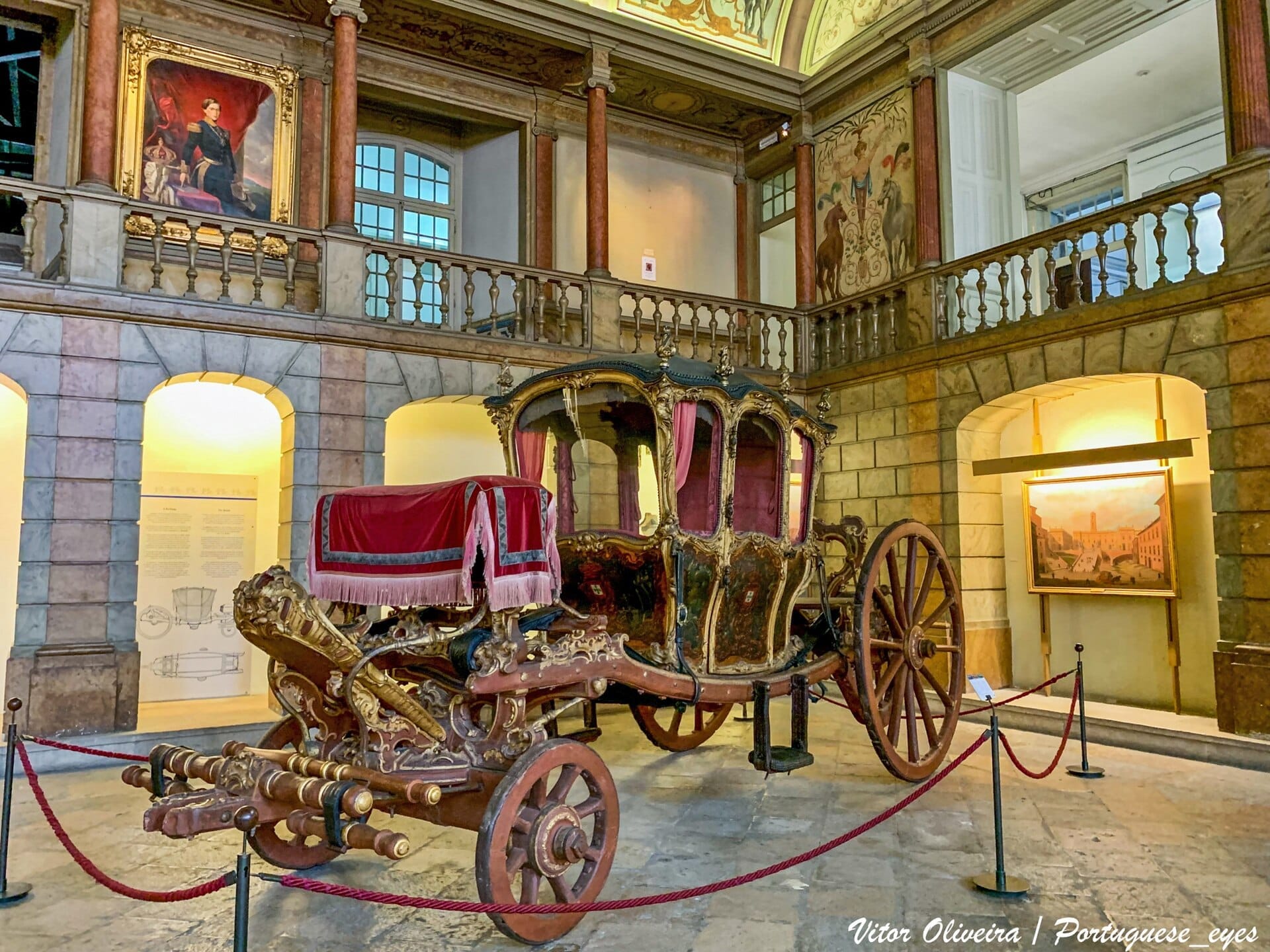
The Museu Nacional dos Coches is widely regarded as the finest collection of royal carriages in the world. That claim is not marketing hyperbole. More than 70 vehicles are on display, ranging from a plain 17th-century riding coach belonging to Philip II of Spain to the gloriously excessive Baroque coaches built for King João V's embassy to Pope Clement XI in 1716. These are not static objects under dusty glass. They fill enormous halls at near eye level, close enough to study every gilded figure, every painted panel, every velvet fold.
The museum occupies two buildings in Belém. The original collection is housed in the former Royal Riding Hall, an 18th-century equestrian space that Queen Amélia converted into a public museum, inaugurated on May 23, 1905. After over a century, the collection outgrew that space. A second, modern building designed by Brazilian Pritzker laureate Paulo Mendes da Rocha opened exactly 110 years later, on May 23, 2015, and now holds the bulk of the displays.
ℹ️ Good to know
The €8 combined ticket covers both the original Royal Riding Hall and the new Mendes da Rocha building. Buy it at either entrance. If you only visit one, the new building holds the most dramatic pieces.
Inside the New Building: Scale, Light, and Craft
The new building is the main event for most visitors. Paulo Mendes da Rocha designed it as an elevated concrete volume set above a public square, which creates an unusual open-air space underneath that connects Belém's riverside promenade to the street. Inside, the main gallery is a single vast hall, deliberately uncluttered, where the coaches are arranged with generous space around each one.
The three Baroque coaches commissioned for the 1716 papal embassy are the centerpieces. Built in Rome under Portuguese commission, each one is a sculptural work: gilded figures burst from every surface, the wheel spokes are carved, the footboards are painted with allegorical scenes. Standing next to them, the sheer weight of decoration becomes almost overwhelming. These are objects designed to project imperial power, and they do so with complete conviction.
Earlier in the collection, a deliberately spare 17th-century coach shows what transport looked like before royal ostentation took hold: no glass in the windows, minimal suspension, wooden wheels. The contrast between that and the 1716 coaches two rows away is one of the most effective curatorial decisions in the museum.
💡 Local tip
Arrive between 10:00 and 11:00 on a weekday for the quietest experience. By midday, coach groups from Jerónimos Monastery filter through, and the hall becomes noticeably more crowded.
Tickets & tours
Live prices and dates from our booking partner. If you book, we may earn a commission at no extra cost to you.
The Original Royal Riding Hall
The original building, the former Royal Riding Hall of the Palace of Belém, sits a short walk from the new structure. This is where Queen Amélia opened the museum to the public in 1905, making it one of the earliest purpose-repurposed royal spaces in Europe. The hall itself is worth seeing: a long, low-ceilinged room with a painted frieze running along the top of the walls, warm with the color of old wood and gilt.
The carriages displayed here tend toward royal ceremony and 19th-century court life. The room is smaller and more intimate than the new building, and on quiet mornings you can hear the faint creak of the old floorboards. It feels less like a museum and more like a space that still carries the memory of horses and courtiers.
Some visitors skip this building if they are short on time. That is understandable, but the atmosphere is genuinely different from the new hall, and the combined ticket makes it a low-cost addition. Give it at least 20 minutes.
How the Experience Changes Through the Day
Belém is one of the busiest tourist corridors in Lisbon. Most visitors arrive between 10:30 and 12:00, combining the museum with the nearby Jerónimos Monastery and the famous pastéis de nata from the original bakery. The museum's morning window, from 10:00 to around 10:45, is noticeably calmer. The light in the new building is controlled and artificial, so time of day does not affect the visual quality inside, but crowd density makes a real difference.
Afternoons from 14:00 onward tend to thin out, particularly Tuesday through Thursday. Weekend afternoons can be just as busy as weekend mornings, so weekday visits are preferable if your schedule allows.
If you are planning a full Belém day, consider starting here before the monastery crowds build. You can then walk to the Jerónimos Monastery and end the morning with a coffee and pastel de nata at the historic bakery nearby.
Getting There and Practical Logistics
The museum is in Belém, roughly 6 kilometers west of central Lisbon. Tram 15E is the most direct public connection from downtown, running from Praça da Figueira through Santos and along the riverside to Belém. The journey takes around 25 to 35 minutes depending on traffic, and the tram runs frequently throughout the day. Buses 714, 728, and 729 also serve the area. If you are coming from the city center with luggage or limited mobility, an Uber or Bolt is a reasonable alternative, typically costing under €10 from Baixa.
The museum is a 10-minute walk from the Belém Tower and roughly 5 minutes from the Jerónimos Monastery entrance. If you are combining multiple Belém sites in one day, this cluster works well on foot: the distances between attractions are short and flat along the riverside.
The museum is open Tuesday to Sunday, 10:00 to 18:00. It is closed on Mondays, January 1st, May 1st, Easter Sunday, and December 25th. Check the official schedule before visiting on public holidays, as Portuguese holidays occasionally affect hours at state museums. Contact: geral@mncoches.dgpc.pt or +351 213 610 850.
⚠️ What to skip
The museum is closed every Monday. This is a common source of frustration for visitors who arrive mid-week expecting it to be open. Plan accordingly, especially if Belém is your main destination for the day.
Cultural and Historical Context
The collection spans the period from the late 16th century through the 19th century, tracing the arc of Portuguese royal power from the height of its Atlantic empire to its final decline before the 1910 Republic. Each coach is essentially a political document: the materials used, the imagery chosen, and the level of ornamentation all reflect the diplomatic ambitions and financial resources of the reign in which it was made.
Belém itself is inseparable from that history. The Padrão dos Descobrimentos stands within walking distance, commemorating the Age of Discovery that funded much of the wealth displayed in these coaches. Understanding the museum as part of that broader Belém landscape, rather than as an isolated collection, adds real depth to the visit.
After the Republic replaced the monarchy in 1910, the riding hall was formally designated a national museum. The decision to preserve and display the collection was not trivial: it represented a deliberate choice to treat material culture as historical evidence rather than discard it as monarchist symbol. That decision now gives Lisbon one of the most unusual and internationally recognized museum collections in Europe.
Photography and Accessibility
Photography without flash is generally permitted throughout the museum. The new building's controlled lighting produces even, warm tones that work well for wide shots of the hall and close-ups of carved details. A standard smartphone camera handles the conditions without difficulty. Tripods are not permitted during regular visiting hours.
The new building was designed from the outset as a publicly accessible civic space. The ground-level public square beneath the building and the main gallery floor are step-free. For specific mobility or accessibility requirements, contact the museum directly before visiting. The original riding hall has older flooring that may be uneven in places.
💡 Local tip
For the best photographs of the 1716 papal embassy coaches, position yourself at the far end of the main hall and shoot with a wide-angle lens. The scale of the room and the density of the vehicles rewards wider framing rather than close-up detail shots.
Insider Tips
- The €8 combined ticket is worth it even if you only spend 20 minutes in the original riding hall. The atmosphere of the old equestrian space is genuinely different from the modern building and rounds out the visit.
- Tuesday mornings are consistently the least crowded visiting window across Belém. If you can visit on a weekday before 11:00, you will often have sections of the main hall almost entirely to yourself.
- Look at the wheel spokes on the 1716 papal embassy coaches. The carving on structural components that would normally be left plain is one of the clearest illustrations of how these objects were designed first as spectacle and second as transport.
- The public square beneath the new Mendes da Rocha building is a useful shortcut between the riverside promenade and the street above. Even if you do not enter the museum, walk through this space to appreciate the architectural concept.
- The museum shop near the exit stocks well-produced publications on Portuguese decorative arts and carriage history. These are hard to find elsewhere and make more thoughtful souvenirs than the typical tourist items sold outside in Belém.
Who Is National Coach Museum For?
- History and art enthusiasts who want to understand Portuguese royal and imperial culture through material objects
- Architecture fans interested in the contrast between the 18th-century riding hall and Paulo Mendes da Rocha's 2015 building
- Families with children aged 10 and older who can engage with the scale and drama of the vehicles
- Visitors doing a full Belém day who want a less physically demanding complement to outdoor monuments
- Photographers looking for dramatic interior subjects with strong composition possibilities
Nearby Attractions
Other things to see while in Belém:
- Ajuda National Palace
The Palácio Nacional da Ajuda is Lisbon's only neoclassical royal palace, preserving the private apartments of Portugal's last monarchs almost exactly as they left them in 1910. Less visited than Belém's waterfront monuments, it rewards those who make the short uphill detour with room after room of gilded excess, personal royal objects, and the newly opened Royal Treasury Museum.
- Belém Tower
Rising from the northern bank of the Tagus River, the Torre de Belém is a 16th-century fortress that once guarded Lisbon's harbor and marked the departure point for Portugal's Age of Discovery voyages. A UNESCO World Heritage Site, it remains the most photographed monument in Portugal, combining Manueline architectural splendor with genuine historical weight.
- Jerónimos Monastery
The Mosteiro dos Jerónimos in Belém is the most ambitious architectural achievement of Portugal's Age of Discovery. Built on royal orders in 1501 and carved from honey-colored limestone, its cloister and church represent the high point of Manueline style, blending Gothic structure with maritime imagery in stone. This is where Vasco da Gama is entombed, and where Portugal chose to bury its poets alongside its explorers.
- MAAT – Museum of Art, Architecture and Technology
MAAT brings together a century-old power station and a wave-shaped contemporary gallery on the banks of the Tagus. The building itself competes with the art inside, and the rooftop offers one of the better river panoramas in Belém without the usual queues.
Planning a trip? Discover personalized activities with the Nomado app.