MAAT – Museum of Art, Architecture and Technology: Belém's Most Architecturally Striking Museum
MAAT brings together a century-old power station and a wave-shaped contemporary gallery on the banks of the Tagus. The building itself competes with the art inside, and the rooftop offers one of the better river panoramas in Belém without the usual queues.
Quick Facts
- Location
- Av. Brasília, Central Tejo, Belém, Lisbon
- Getting There
- Tram 15E to Belém or Doca do Bom Sucesso; train to Belém station (5-min walk)
- Time Needed
- 1.5 to 2.5 hours
- Cost
- €12 adults; €9 reduced (students, seniors); free under 18; check website for latest
- Best for
- Contemporary art lovers, architecture enthusiasts, photography, rainy-day visits
- Official website
- www.maat.pt/en
What MAAT Actually Is
The MAAT – Museum of Art, Architecture and Technology sits on the Tagus riverfront in Belém, occupying two architecturally distinct but connected buildings. One is the former Central Tejo power station, a Edwardian industrial hall built in 1908 that powered Lisbon's electric tram network for decades. The other is the MAAT Gallery, a purpose-built contemporary structure designed by British architect Amanda Levete and inaugurated in October 2016. Together they form a single cultural campus spanning roughly 3,000 square metres of exhibition space and 7,000 square metres of publicly accessible outdoor and rooftop space.
The museum is operated by the EDP Foundation, the cultural arm of Portuguese energy company EDP. That context matters: MAAT's programming is consistently oriented around the relationship between technology, energy, and artistic practice. This isn't a general contemporary art museum with a broad mandate. Its thematic identity is more focused, and visitors who go in understanding that tend to find the experience more rewarding than those expecting a conventional modern art survey.
💡 Local tip
MAAT is open Tuesday to Sunday, 12:00–20:00 (check seasonal variations). It is closed on Mondays, January 1st, May 1st, and December 25th. Arrive before 11:00 on weekday mornings for the quietest conditions.
The Gallery Building: Amanda Levete's River-Hugging Curve
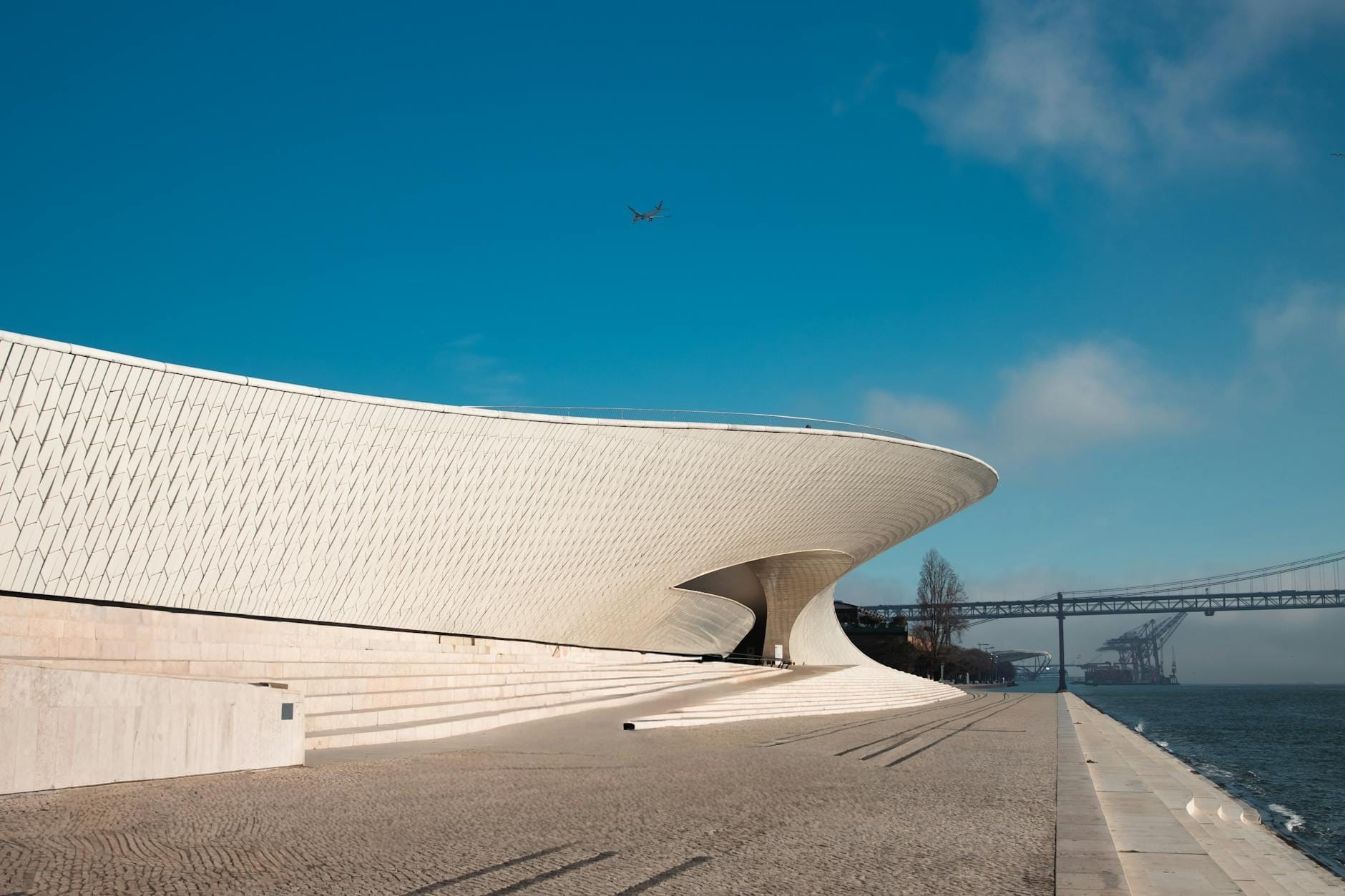
The newer MAAT Gallery building is the one you notice first when approaching from the riverside promenade. Its elliptical form curves low to the ground, clad in approximately 15,000 undulating ceramic tiles that shift from pale cream to warm terracotta depending on the angle of the light. At midday in summer, the facade catches direct sun and the tiles read almost white. In late afternoon, the texture deepens and the building takes on a warmer, more sculptural quality. It is genuinely striking from the waterfront path, particularly against the backdrop of the Tagus.
What makes the structure unusual is that the roof is accessible to the public. A gently sloping walkway rises from ground level and deposits you on top of the building, where a wide terrace offers unobstructed views across the river toward the southern bank and upstream toward the city. This is not a belvedere in the traditional Lisbon sense, and it doesn't have the drama of a hilltop perch, but it provides a clean, low-angle perspective on the Tagus that's quite different from what you get from higher viewpoints.
The MAAT roof connects via a walkway over Av. Brasília to Belém neighborhood and nearby sites, crossing the busy road and train line. This makes the rooftop genuinely useful as a pedestrian connector, not just a viewing platform, and it solves what was previously an awkward crossing situation. It also provides step-free access between the riverfront and the streets above, a practical improvement for visitors with mobility considerations. If you're combining MAAT with a visit to the Jerónimos Monastery or the Belém Tower, the footbridge makes the logistics considerably easier.
Tickets & tours
Live prices and dates from our booking partner. If you book, we may earn a commission at no extra cost to you.
Central Tejo: The Power Station as Exhibition Space
The older part of the complex, MAAT Central, occupies the former Central Tejo power station. The building dates to 1908 and the industrial infrastructure inside, including the original boilers, turbines, and electrical switchgear, has been partially preserved and integrated into the exhibition design. Walking into the main hall for the first time produces a genuine sense of scale: the ceiling height, the exposed brickwork, the ambient sounds of the space carry weight that purpose-built gallery white cubes rarely achieve.
The permanent collection here draws on MAAT's broader archive of Portuguese and international art from the 1960s onward, with particular depth in kinetic art, video installation, and works that directly engage with industrial and technological themes. The building's industrial heritage and the collection's thematic focus reinforce each other effectively. The curatorial logic holds together in a way that feels considered rather than convenient.
One practical note: the industrial building retains some of the thermal characteristics of its original function. In winter it can feel noticeably cool, particularly in the larger hall spaces. In summer the building tends to stay cooler than the outdoor temperature, which is welcome on a hot Belém afternoon. Dress accordingly if you're visiting at either temperature extreme.
Visiting: Time of Day, Crowds, and Flow
MAAT draws a noticeably different crowd from most of Belém's major attractions. Where the Jerónimos Monastery and Belém Tower attract large volumes of international tour groups, MAAT tends toward a younger, more architecturally and artistically literate audience. That's not a claim about quality, just a practical observation about what you'll find inside. Weekend afternoons can get congested, particularly in the newer gallery building, which has a more intimate interior volume than its exterior suggests.
Weekday mornings, particularly Tuesday through Thursday before noon, offer the most comfortable conditions for moving through the exhibitions without crowds. The rooftop is at its photographic best in the hour before sunset, when the western light hits the ceramic tile facade from a useful angle and the Tagus takes on a cooler, more atmospheric tone. That same late-afternoon window is also the most crowded, so the trade-off between light and space is real.
ℹ️ Good to know
Photography is generally permitted in the main gallery spaces without flash, but some temporary exhibitions restrict photography. Check signage at each room entrance. The rooftop and exterior are unrestricted.
MAAT sits at the western end of Belém's main cultural strip. It makes sense to combine it with the Padrão dos Descobrimentos and the Coach Museum, both within a short walk, if you're spending a full day in the district.
Is MAAT Worth the Entry Fee?
The short answer is: it depends on your interest in contemporary art and architecture. At €11 to €12 depending on your residency status, MAAT is priced comparably to other Lisbon museums but offers a smaller permanent collection than institutions like the Gulbenkian. The value calculation shifts if you're genuinely interested in the building itself, in which case the architectural experience alone justifies the price for many visitors.
Travelers who find contemporary art opaque or who are primarily in Belém for the historical monuments may leave underwhelmed. MAAT doesn't try to be everything. Its programming is genuinely rigorous and occasionally challenging. If you responded well to similar institutions like the Tate Modern in London or the Garage Museum in Moscow, the curatorial sensibility here will feel familiar and worthwhile.
If your budget is a constraint, note that the rooftop is accessible without purchasing a gallery ticket. You can walk the footbridge and take in the river view without paying admission. For a fuller picture of how to manage costs across Belém, the free things to do in Lisbon guide covers which parts of the city's cultural infrastructure you can access without spending.
⚠️ What to skip
Adult admission is €12. This distinction exists at the ticket desk, so budget accordingly if you're purchasing on arrival.
Getting There and Practical Logistics
MAAT is located at Av. Brasília, Central Tejo, in the Belém district. The most straightforward transit connection is the number 15E tram from Praça da Figueira in Baixa-Chiado, which runs along the riverside and stops at Belém or Doca do Bom Sucesso, both within a short walk of the museum entrance. Journey time from central Lisbon is roughly 25 to 35 minutes depending on traffic conditions, which can be significant for this tram route during peak hours.
The suburban train from Cais do Sodré station is often faster and more reliable. Belém station is served by the Cascais line, with trains running frequently and the journey taking around 10 minutes. From Belém station it's a 5-minute walk toward the river. Uber and Bolt are both available and offer a direct, predictable option for those coming from neighborhoods not well-served by the tram or rail line.
Belém itself is one of Lisbon's most coherent half-day or full-day districts. The concentration of institutions here is high. For a practical overview of how to sequence a day in the area, the Belém neighborhood guide covers the layout and walking distances between the major sites.
Accessibility and Practical Notes
The footbridge from the MAAT roof to the Belém street level provides step-free access across what was previously a barrier created by the busy riverside road and train line. The gallery buildings themselves are wheelchair accessible, though the older industrial building has some areas where the original floor surfaces are uneven. It's worth checking current conditions with the museum directly if accessibility is a primary concern.
There is a cafe on-site, and the outdoor terrace area along the riverside promenade in front of the museum is a reasonable place to pause between exhibitions. The museum shop stocks architecture and design publications with a Portuguese focus, which is a cut above the typical gift shop selection if that's of interest.
Insider Tips
- The rooftop is accessible without a ticket. If time or budget is limited, walk up for the river view and skip the galleries on this visit.
- The footbridge connects directly to the Belém streets above the road and rail line. Use it when walking between MAAT and the Jerónimos Monastery area to avoid the pedestrian crossing on Av. Brasília.
- Temporary exhibitions at MAAT often rotate every three to four months and are frequently the stronger draw compared to the permanent collection. Check the website before your visit to see what's currently showing.
- The MAAT Gallery building's ceramic tile facade is best photographed from the riverside promenade, roughly 50 metres back, in either morning or late-afternoon light. Midday sun flattens the texture.
- The industrial building retains a cool, slightly damp quality regardless of season. A light layer is worth bringing even in summer.
Who Is MAAT – Museum of Art, Architecture and Technology For?
- Travelers with a genuine interest in contemporary art, architecture, or design
- Architecture enthusiasts who want to see Amanda Levete's work in context
- Visitors combining a full day in Belém across multiple institutions
- Rainy-day visitors needing a worthwhile indoor option in the district
- Photographers looking for an architecturally distinctive subject on the Lisbon waterfront
Nearby Attractions
Other things to see while in Belém:
- Ajuda National Palace
The Palácio Nacional da Ajuda is Lisbon's only neoclassical royal palace, preserving the private apartments of Portugal's last monarchs almost exactly as they left them in 1910. Less visited than Belém's waterfront monuments, it rewards those who make the short uphill detour with room after room of gilded excess, personal royal objects, and the newly opened Royal Treasury Museum.
- Belém Tower
Rising from the northern bank of the Tagus River, the Torre de Belém is a 16th-century fortress that once guarded Lisbon's harbor and marked the departure point for Portugal's Age of Discovery voyages. A UNESCO World Heritage Site, it remains the most photographed monument in Portugal, combining Manueline architectural splendor with genuine historical weight.
- National Coach Museum
The Museu Nacional dos Coches in Belém holds one of the world's greatest collections of royal coaches and carriages, spanning four centuries of craftsmanship. With over 70 vehicles displayed across two architecturally striking buildings, it rewards both history enthusiasts and casual visitors who simply want to see something extraordinary.
- Jerónimos Monastery
The Mosteiro dos Jerónimos in Belém is the most ambitious architectural achievement of Portugal's Age of Discovery. Built on royal orders in 1501 and carved from honey-colored limestone, its cloister and church represent the high point of Manueline style, blending Gothic structure with maritime imagery in stone. This is where Vasco da Gama is entombed, and where Portugal chose to bury its poets alongside its explorers.
Planning a trip? Discover personalized activities with the Nomado app.