Pääsküla Bog: A Real Estonian Bog Inside the City Limits
Pääsküla Bog is a roughly 900-hectare bog and forest nature reserve sitting entirely within Tallinn's city boundaries. A marked nature trail with boardwalk sections crosses remaining open peat areas, surrounding forest, and bog-edge habitats — all free to enter, all year round.
Quick Facts
- Location
- Kraavi tn 65, Nõmme district, Tallinn
- Getting There
- Buses 14, 18, 18A, 30, 119, 191, 256 to Hiiu stop; trains R21/R22 to Männiku jaam; buses 117, 117A, 206 from Männiku jaam
- Time Needed
- 1.5 to 3 hours
- Cost
- Free
- Best for
- Nature walks, photography, escaping the tourist centre
What Pääsküla Bog Actually Is
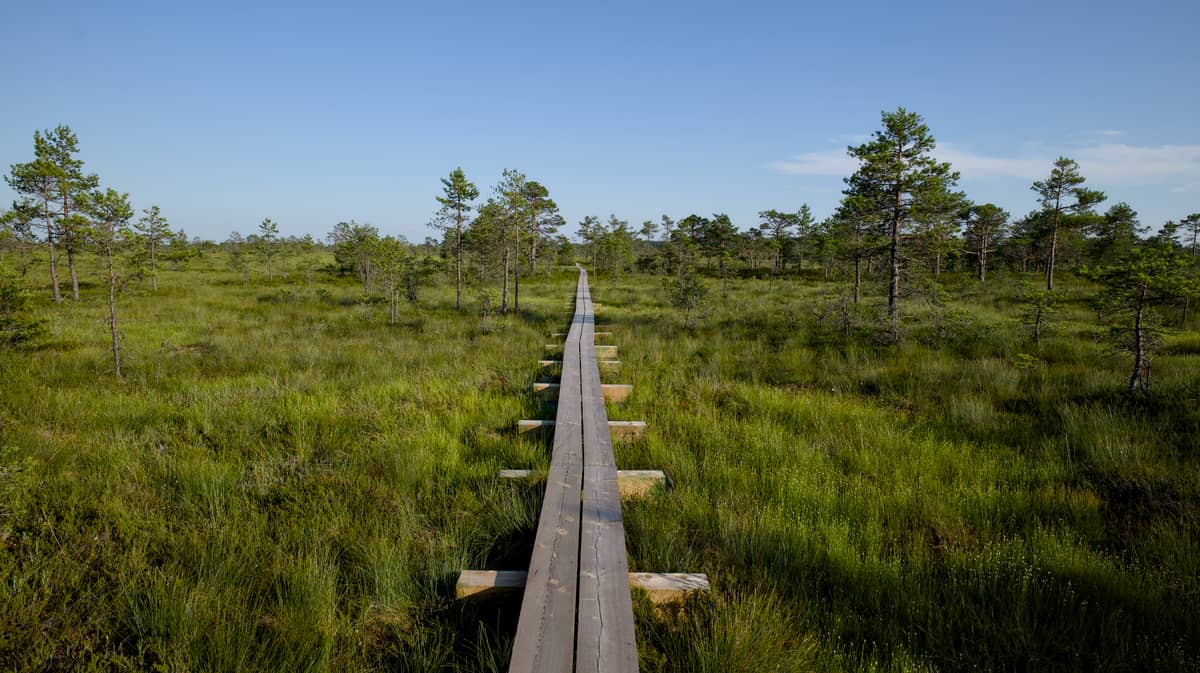
Pääsküla Bog — known locally as Pääsküla raba — is a bog and forest nature reserve covering roughly 900 hectares in the south-western Nõmme district of Tallinn.[2] That makes it one of the largest contiguous green areas inside the city limits of an EU capital.[1] For visitors arriving from the cobblestones and church spires of Old Town, the contrast is disorienting in the best possible way.
A raised bog is a specific ecological formation, not just wet forest. Over thousands of years, sphagnum moss accumulates faster than it decomposes, building a domed peat layer that sits above the surrounding water table. The result is an open, treeless or near-treeless landscape: low scrub pines twisted by nutrient stress, carpets of rust-coloured sphagnum, black peat pools reflecting cloud, and a skyline that opens up in all directions. It looks nothing like a park.
ℹ️ Good to know
The Pääsküla Bog nature trail is open at all times, every day of the year. Admission is free. Nature reserve rules apply: stay on marked paths, no fires, no dogs off-leash.
The Trail: What to Expect Underfoot
The main nature study trail begins near Kraavi tn 65 in the Nõmme area (coordinates 59.370786, 24.682662) and ends near Männiku jaam railway stop on the southern side (coordinates 59.340637, 24.679896).[16] Most visitors complete the full marked route in about 1 to 2.5 hours depending on pace and how long they linger at the open bog sections.[6][8]
Wooden boardwalk planks carry you across the soggiest sections, and this is where the sensory details accumulate. The boards have a slight give underfoot from the peat below. The smell is earthy, faintly sweet from the sphagnum — unlike forest mud, which is sharper. In still weather the only sounds are wind across open ground, the occasional call of a common crane, and the specific hollow knock of a woodpecker somewhere in the peripheral pines.
The trail is generally described as easy and suitable for all ages. However, be aware that some sections run on natural bog ground and the wooden boards can be slippery when wet. There is no confirmed full wheelchair accessibility, so visitors with mobility aids should check current trail conditions in advance. Rubber boots or waterproof hiking shoes are strongly recommended regardless of the forecast — bog edges are wet even in dry spells.
💡 Local tip
Wear waterproof footwear regardless of weather. The peat at trail edges stays saturated year-round, and light trainers will be soaked within minutes of any minor detour.
Tickets & tours
Hand-picked options from our booking partner. Prices are indicative; availability and final rates are confirmed when you complete your booking.
Self-guided Discovery Walk of Tallinn city contrasts beyond the medieval walls
From 26 €Instant confirmationFree cancellationTallinn's art and culture tour with a local
From 62 €Instant confirmationFree cancellationHistorical walking tour of Tallinn with a local
From 599 €Instant confirmationFree cancellationIntroductory walking tour of Tallinn with a local guide
From 109 €Instant confirmationFree cancellation
How the Experience Changes by Season and Time of Day
Summer mornings — roughly 7 to 9 am — are the best window for bird activity. The open bog is prime habitat for species like golden plover, common sandpiper, and various warbler species that use the scrub edges. By mid-morning the bird noise drops and the peat pools catch the light at a lower, softer angle. Midsummer also means extended daylight: in June, Tallinn's sunset is well after 10 pm, which gives late-afternoon walkers a long golden-hour stretch across the bog surface.
Autumn shifts the colour palette dramatically. Sphagnum moss turns from olive-green to deep red and rust. Dwarf birch goes yellow. The sky often clears after September rain systems, producing the kind of saturated, cool light that makes bog landscapes look almost surreal. October visits can mean near-solitude on weekdays.
Winter visits are genuinely worthwhile if conditions are right. A frozen bog with light snow cover becomes a flat white landscape interrupted only by the dark, skeletal silhouettes of the pines. The boardwalk boards turn icy, so extra caution is needed, but the visual payoff is substantial. Spring brings the most unpredictable conditions: snowmelt saturates the ground further, some trail sections may be partially flooded, and the first migratory birds begin arriving from late March.
For a broader look at when to plan outdoor visits to Tallinn, the best time to visit Tallinn guide breaks down seasonal conditions across the city.
Getting There: Public Transport from Central Tallinn
The northern trailhead near Hiiu is served by bus lines 14, 18, 18A, 30, 119, 191, and 256 — all stopping at the Hiiu stop.[16] From central Tallinn the ride usually takes around 25 to 35 minutes depending on traffic. The southern trailhead near Männiku jaam is reachable by buses 117 and 117A, bus 206, or the R21 and R22 suburban train lines.[16] If you want a one-way walk, take the bus north-to-south and train back — the Männiku jaam connection makes this straightforward.
There is limited street parking near the Kraavi street access point for visitors arriving by car, but public transport is reliable and eliminates the one-way-walk logistics problem entirely.
Tallinn's public transport system uses the Ühiskaart smart card, which reduces fares compared to paying cash on board. For full transport options across the city, see the getting around Tallinn guide.
Ecological and Historical Context
Raised bogs like Pääsküla are among Estonia's most ecologically significant habitats, although this particular bog has been largely drained and is now mostly forested.[5] The country has substantial bog coverage and Estonian culture has a long relationship with these landscapes — they appear in folk songs, they were historically used for peat extraction, and they now carry protected status under both Estonian and EU environmental law.[5][11]
Pääsküla Bog specifically sits within the Pääsküla nature reserve, which is managed as part of Tallinn's wider green infrastructure network.[11] The bog plays a role in the city's climate adaptation strategy: it stores carbon, influences local hydrology, and provides an ecological buffer in an urban setting.[11] The GreenTallinn project has highlighted it as a degraded but unique asset undergoing restoration, as much of the bog has been drained and is now forested, which is why staying on marked trails and supporting conservation efforts matters beyond mere trail etiquette.[5]
Estonia's broader natural landscapes, from coastal forests to more remote bogs, are covered in the Tallinn nature guide, which also includes day trip options for those wanting to explore further afield.
Photography and What to Look For
The bog's visual appeal is largely about texture and light rather than dramatic singular subjects. The peat pools are the most photogenic elements: dark, still water reflecting sky, rimmed with sphagnum in shades from pale lime to deep crimson. A wide-angle lens captures the flat expansiveness well; a longer focal length picks out individual cotton-grass stalks or the gnarled form of a stunted bog pine.
Overcast days actually photograph better than full sun here — the diffused light prevents harsh shadows on the low, complex bog surface and brings out the colour range of the mosses. Early morning mist settling over the open sections is a recurring phenomenon in late spring and early autumn, and it turns the bog into something closer to a landscape painting than a nature walk backdrop.
💡 Local tip
Bring a lens cloth. Humidity near bog pools is high enough that front elements fog quickly, especially on cold mornings.
Who Will Enjoy This, and Who Probably Won't
Pääsküla Bog works well for visitors who want a genuine break from the medieval architecture circuit, anyone with a serious interest in birdwatching or botany, families with older children who can handle uneven ground, and photographers looking for moody, non-postcard subjects. It also suits travellers who have already done the standard Tallinn itinerary and want something less curated.
For a contrasting outdoor experience — sea views and summer crowds — Pirita beach is Tallinn's main coastal option. Those interested in designed green space closer to the centre will find more manicured surroundings at Kadriorg Park.
If your visit is limited to one or two days and you are focused on history and architecture, the bog will compete with a lot of higher-density sightseeing. It is worth skipping in that case — it rewards slow, unhurried time. Visitors with very limited mobility should note that while the boardwalk sections are manageable, the trailhead approach and some natural surfaces are not fully accessible, and no specific accessibility certification has been confirmed.
If you are weighing how to structure limited time in the city, the 2-day Tallinn itinerary can help prioritise what fits.
Insider Tips
- Do the trail south-to-north (Männiku jaam to Hiiu) on a clear morning: you walk into the open bog section earlier and get the best light on the peat pools before the angle gets harsh.
- Cotton-grass blooms in late May and early June, turning sections of the open bog white. It is the single most striking visual the bog produces and most visitors miss it entirely by visiting in summer or autumn.
- The bus connection from central Tallinn is reliable but frequency drops in the evenings. Check transport.tallinn.ee for current timetables before planning a late walk, especially in winter when daylight ends before 4 pm.
- The bog is genuinely quieter on weekday mornings — local dog walkers use the forest edges but rarely venture onto the boardwalk sections. Weekend afternoons bring significantly more foot traffic, which affects wildlife sightings.
- If you want to combine the visit with Nõmme's wooden-villa neighbourhood character, walk north from the Hiiu stop through the residential streets before or after the trail — the area has a distinctly different, slower atmosphere from anywhere else in Tallinn.
Who Is Pääsküla Bog For?
- Nature and birdwatching enthusiasts visiting Tallinn
- Photographers looking for atmospheric, non-tourist subjects
- Travellers returning to Tallinn who have already covered the standard sites
- Families with older children comfortable on uneven terrain
- Anyone needing a full mental reset from urban sightseeing
Nearby Attractions
Combine your visit with:
- Aegna Island
Aegna Island sits 14 km off the Tallinn coast in the Bay of Tallinn, reachable in about 30 minutes by boat. The entire island is a protected landscape conservation area, covered in dense forest, glacial boulders, and coastal meadows. Entry to the island is free, making it one of the most rewarding half-day escapes from the city.
- Estonian Open Air Museum
Spread across 72 hectares of coastal forest in Tallinn's Haabersti district, the Estonian Open Air Museum (Eesti Vabaõhumuuseum) reconstructs rural and fishing life from the 18th and 19th centuries. Twelve farmyards, a working tavern, a church, mills, a schoolhouse, a fire station, and net sheds make this Estonia's largest and most immersive open-air history experience.
- Glehn Park
Glehn Park is a free, forested public park in Tallinn's suburban Nõmme district, built around a 19th-century castle by the eccentric Baron Nikolai von Glehn. With natural woodland trails, stone carvings, and a refreshing distance from the Old Town crowds, it rewards visitors who want something genuinely different from the medieval core.
- Jägala Waterfall
Standing 8 metres tall and stretching over 50 metres wide, Jägala Waterfall is Estonia's largest natural waterfall. Located just 25 kilometres east of Tallinn on the Jägala River, it is free to visit year-round and rewards visitors differently in every season, from frozen curtains of ice in winter to a thundering torrent in spring snowmelt.