Orthodox Metropolitan Cathedral of Fira: What to See, Know, and Expect
The Orthodox Metropolitan Cathedral of Fira is Santorini's most prominent religious landmark, originally built in 1827 and rebuilt after the devastating 1956 earthquake. Set steps from the caldera rim in central Fira, it offers whitewashed Cycladic architecture, mosaic-covered walls, and a calm interior decorated with frescoes by local artist Christoforos Asimis. Entry is free.
Quick Facts
- Location
- Central Fira, caldera rim, Santorini
- Getting There
- About 3-minute walk from Fira's main KTEL bus station
- Time Needed
- 20–40 minutes
- Cost
- Free entry (donations welcomed)
- Best for
- Architecture, religious art, quiet pause in a busy town
First Impressions: Finding the Cathedral in Fira's Maze
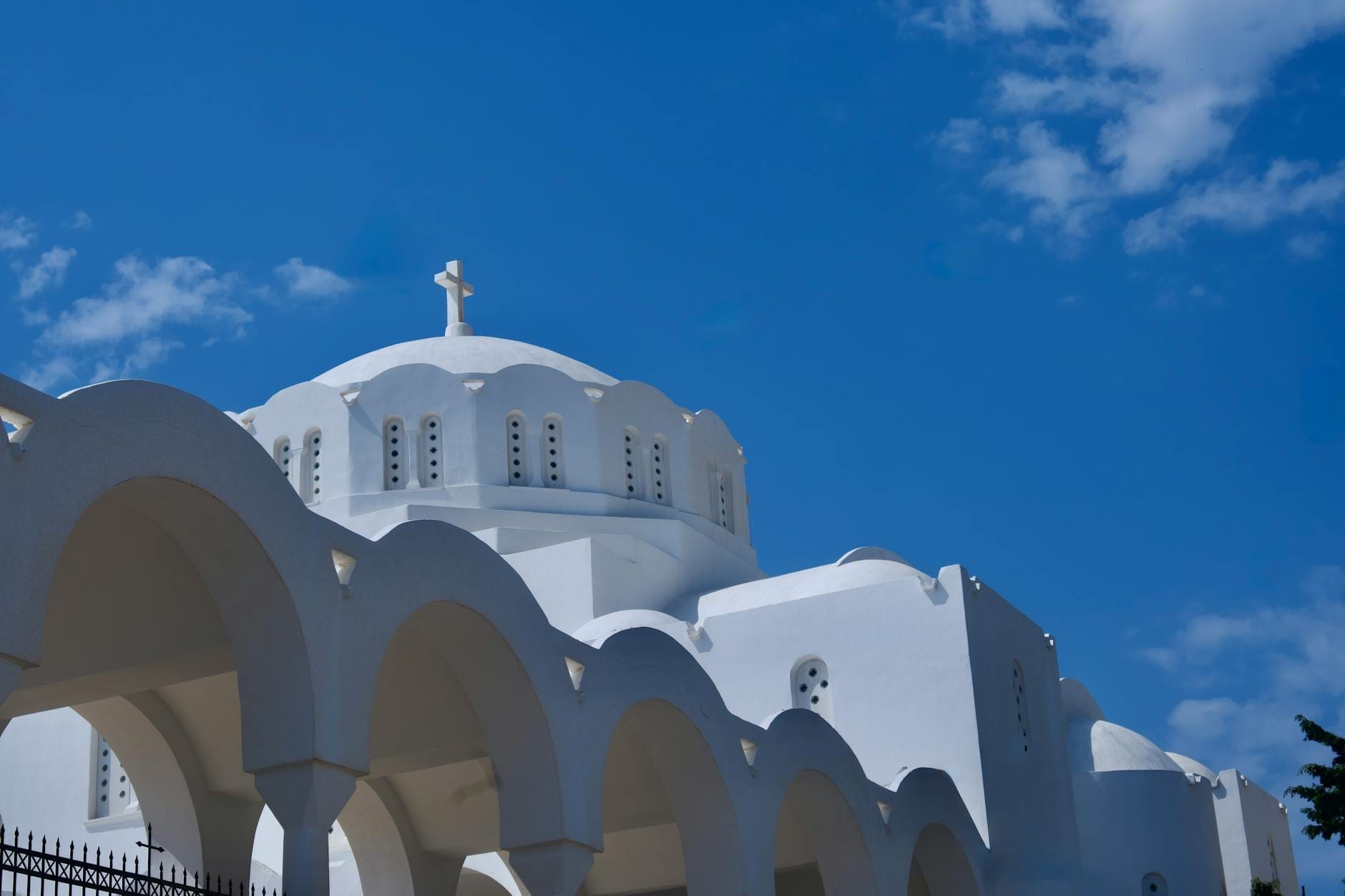
The Orthodox Metropolitan Cathedral of Fira, formally known in Greek as the Ieros Mitropolitikos Naos Hypapantis tou Kyriou, is hard to miss once you know what to look for. Its broad white facade and square bell tower rise above the surrounding rooftops just south of Fira's commercial core, close to the caldera rim. The approach from the main bus station takes only a few minutes on foot, following the main pedestrian spine southward past jewelry shops and cafe terraces.
The building announces itself through scale rather than decoration. Unlike the smaller blue-domed chapels scattered across the island, this is a full metropolitan cathedral with a forecourt wide enough to accommodate wedding parties, religious processions, and, on ordinary mornings, a handful of travelers who stumble upon it while exploring the neighborhood.
💡 Local tip
The cathedral is a working church. Hours are not officially published and can change due to services, religious holidays, or off-season schedules. Aim to visit mid-morning on a weekday for the best chance of finding it open and uncrowded. Confirm locally with your hotel or accommodation.
Architecture and Exterior: Cycladic Form at Cathedral Scale
The exterior is distinctly Cycladic in finish, with whitewashed walls, arched doorways, and a bell tower that stands as a visual anchor for this part of Fira. Rolling arches frame the entrance and side walls, softening what is otherwise a substantial structure. Colourful mosaics are set into the facade, providing a point of visual contrast to the white plaster that defines the rest of the building.
First constructed in 1827, the cathedral carries nearly two centuries of island history, though the structure you see today is largely the result of post-earthquake reconstruction. The earthquake of 1956, which measured about 7.5–7.8 in magnitude and caused widespread damage across Santorini, severely compromised the original building. The restoration that followed preserved the essential form while reinforcing the structure to modern standards.
For context on how the 1956 earthquake reshaped Santorini's built landscape across the island, the Santorini history and ancient ruins guide covers the broader arc of the island's architectural and geological story.
Tickets & tours
Hand-picked options from our booking partner. Prices are indicative; availability and final rates are confirmed when you complete your booking.
Luxury Sunset Cruise in Santorini
From 120 €Free cancellationCruise of the volcanic islands around Santorini
From 45 €Instant confirmationFree cancellationGuided e-bike tour in Santorini
From 90 €Instant confirmationFree cancellationSantorini audio guide with TravelMate app
From 5 €Instant confirmation
Inside the Cathedral: Frescoes, Icons, and Quiet
The interior is where the cathedral moves beyond its postcard-ready exterior. The walls carry frescoes painted by Christoforos Asimis, a local Santorinian artist whose work also appears in other churches across the island. His style draws on the Byzantine iconographic tradition while reflecting a distinctly modern execution: figures are rendered with a warmth that feels less austere than classical Byzantine painting, though the theological program and hierarchical arrangement of saints and scenes follow Orthodox convention closely.
The atmosphere shifts perceptibly once you step inside. The thick walls and high ceiling reduce ambient noise from the street, and the interior is lit partly by natural light filtering through windows and partly by the glow of devotional candles near the icon stands. The smell of incense tends to linger even when no service is taking place. Visitors who enter respectfully and quietly often find it a genuine pause point in a town that does not offer many of those.
Icons displayed throughout the nave include examples with significant local religious importance. The cathedral serves as the seat of the Metropolitan of Thira, Amorgos, and the Islands, giving it institutional weight within the Greek Orthodox Church in the Cyclades, beyond its function as a parish church.
ℹ️ Good to know
Dress code: shoulders and knees should be covered when entering any Orthodox church in Greece. The cathedral is a working place of worship, not a museum. Keep voices low and avoid flash photography near icons or during any ongoing prayers.
How It Changes by Time of Day
Early mornings, before the cruise ship crowds flow up from the old port or the cable car, the area around the cathedral is comparatively quiet. The light at this hour catches the white exterior cleanly, making it the best time for exterior photography without other visitors in frame. The forecourt, which faces partly toward the caldera, allows for a view of the volcanic landscape behind the bell tower if you position yourself carefully.
By mid-morning, tour groups begin moving through the Fira town center and the cathedral may become a scheduled stop. The interior can feel briefly crowded during these windows, though individual visitors can often find a quiet corner or wait a few minutes for the group to move on. Afternoons are busy but manageable. Late afternoon, as light softens, the exterior glows differently and the forecourt empties somewhat as visitors migrate toward caldera-view restaurants.
If you are planning a broader walk through Fira that takes in the caldera views and several landmarks, the Fira town center overview gives useful orientation for structuring your time.
Practical Walkthrough: Getting There and What to Expect
The cathedral sits in the central-southern part of Fira, very close to the Museum of Prehistoric Thera and a short walk from the caldera rim. From the main KTEL bus station, the walk takes roughly three minutes heading south on the main pedestrian street. There is a small private parking area nearby for those arriving by car or scooter.
Visitors arriving by ferry at the old port can reach the cathedral via the Santorini cable car, which deposits passengers at the top of the caldera cliff in Fira, a short walk from the cathedral entrance.
The streets immediately surrounding the cathedral involve some slope and occasional steps, which is consistent with the caldera-edge topography throughout Fira. Visitors with limited mobility or wheelchair users should be aware that there is no published step-free access information from the church or municipality, and the surrounding lanes are uneven cobblestone in places.
While in this part of Fira, the Museum of Prehistoric Thera is immediately adjacent and houses artifacts from the Akrotiri excavations, including gold objects and Minoan-era ceramics. The combination of cathedral and museum makes for a compact, rewarding cultural hour in the same block.
Honest Assessment: Is It Worth Your Time?
The Orthodox Metropolitan Cathedral of Fira is not an architectural revelation on the scale of, say, a Byzantine monument in Thessaloniki. What it offers is something more proportionate to its setting: a well-maintained, historically layered building with genuine artistic interest inside, free entry, and a location that makes it easily combinable with other stops in Fira. For travelers who have seen many Cycladic churches, the exterior will feel familiar. The interior, with Asimis's frescoes, is what distinguishes it.
Travelers primarily focused on caldera views, beaches, or nightlife may find a quick exterior visit sufficient. Those with an interest in Orthodox Christian art, Greek ecclesiastical architecture, or the social history of a Cycladic island community will find more to linger over inside. Anyone who has visited the smaller, more photogenic chapel known for its blue domes in Oia may be surprised to find the metropolitan cathedral offers considerably more interior depth.
For a comparison of Santorini's most photographed religious architecture, the guide to blue-domed churches in Oia explains what makes those chapels distinct and why they dominate travel photography from the island.
⚠️ What to skip
Who should skip this: Travelers on a very short itinerary who are prioritizing the caldera rim walk, sunset viewpoints, or beach time will find the cathedral a lower priority. It is also not suited for anyone who cannot tolerate the uneven cobblestone streets in central Fira due to mobility limitations.
Insider Tips
- Visit between 8:30 and 10:00 in the morning to catch the white exterior in clean morning light and avoid tour group timing. The forecourt is often completely empty at this hour.
- The Museum of Prehistoric Thera shares a block with the cathedral. Pairing both in one 60–90 minute stop is efficient and makes for a genuinely substantive cultural morning before the crowds build.
- If you hear bells ringing during your visit to Fira, the sound almost certainly originates from this bell tower. The timing of bell ringing often signals a service, which means the church may be briefly closed to casual visitors or observance-only mode. Wait 15 minutes and try again.
- Donations via the candle offering near the entrance are a customary way to contribute to the upkeep of the church. A small candle costs very little and is a culturally appropriate gesture if you visit.
- Photography of the interior, particularly the Asimis frescoes, is worth doing with natural light only. Flash alters the colour rendering and disturbs other visitors. A steady hand or a small tripod works better than a phone flash in the dim nave.
Who Is Orthodox Metropolitan Cathedral For?
- Travelers interested in Orthodox Christian art and Byzantine iconographic tradition
- Architecture enthusiasts wanting to understand Cycladic religious building at a larger scale than the typical island chapel
- Visitors who want a calm, free cultural stop in the middle of a busy Fira itinerary
- Those combining a cultural morning with the adjacent Museum of Prehistoric Thera
- Photographers looking for a photogenic white facade with bell tower framing, best shot in early morning light
Nearby Attractions
Other things to see while in Fira:
- Archaeological Museum of Thera
Set in the heart of Fira, the recently renovated Archaeological Museum of Thera brings together centuries of island history under one roof. The star exhibit is the Kore of Thera, a 2.48-metre Archaic statue carved from Naxian marble and hidden from public view for over two decades. For anyone serious about understanding Santorini beyond its postcard image, this is the clearest starting point.
- Fira–Oia Hiking Trail
The Fira–Oia Hiking Trail is Santorini's most rewarding walk: a 10-kilometre path along the caldera rim connecting the island's capital to its most photographed village. Free to walk, open at all hours, and lined with volcanic cliffs, whitewashed chapels, and sweeping Aegean views, it rewards those who go prepared and go early.
- Fira Town Center
Fira is the administrative and social heart of Santorini, built on the rim of the caldera at roughly 260 meters above the Aegean. Free to enter and walkable from multiple directions, it offers caldera views, museums, restaurants, and a cable car connection to the old port — all within a compact, cliff-top layout that rewards early risers and punishes late arrivals in summer.
- Firostefani
Perched on the caldera rim just north of Fira, Firostefani is a small whitewashed village that blends into Santorini's capital while offering noticeably calmer streets and sweeping volcano views. Its name translates literally as 'Crown of Fira,' and the elevated position earns that title. Entry is free, the caldera path is walkable from Fira in under 15 minutes, and the atmosphere is several degrees quieter than either Fira's main drag or Oia's famous sunset strip.