Organ Pipes National Park: Melbourne's Ancient Basalt Canyon
Just 20 km northwest of Melbourne, Organ Pipes National Park protects a dramatic canyon of basalt columns formed by volcanic lava flows around a million years ago. It is one of the most geologically striking landscapes in Victoria, and it costs nothing to visit.
Quick Facts
- Location
- Organ Pipes Road, Keilor North VIC 3036 — about 20 km northwest of Melbourne, just off the Calder Freeway
- Getting There
- Best reached by car via the Calder Freeway. No direct train or tram service; check PTV for bus options from Keilor or Sydenham
- Time Needed
- 1.5 to 2.5 hours for the main walk and canyon viewing
- Cost
- No admission fee listed at time of research (February 2025); verify with Parks Victoria before visiting
- Best for
- Geology enthusiasts, photographers, families with older children, and anyone wanting a nature escape close to Melbourne
What Is Organ Pipes National Park?
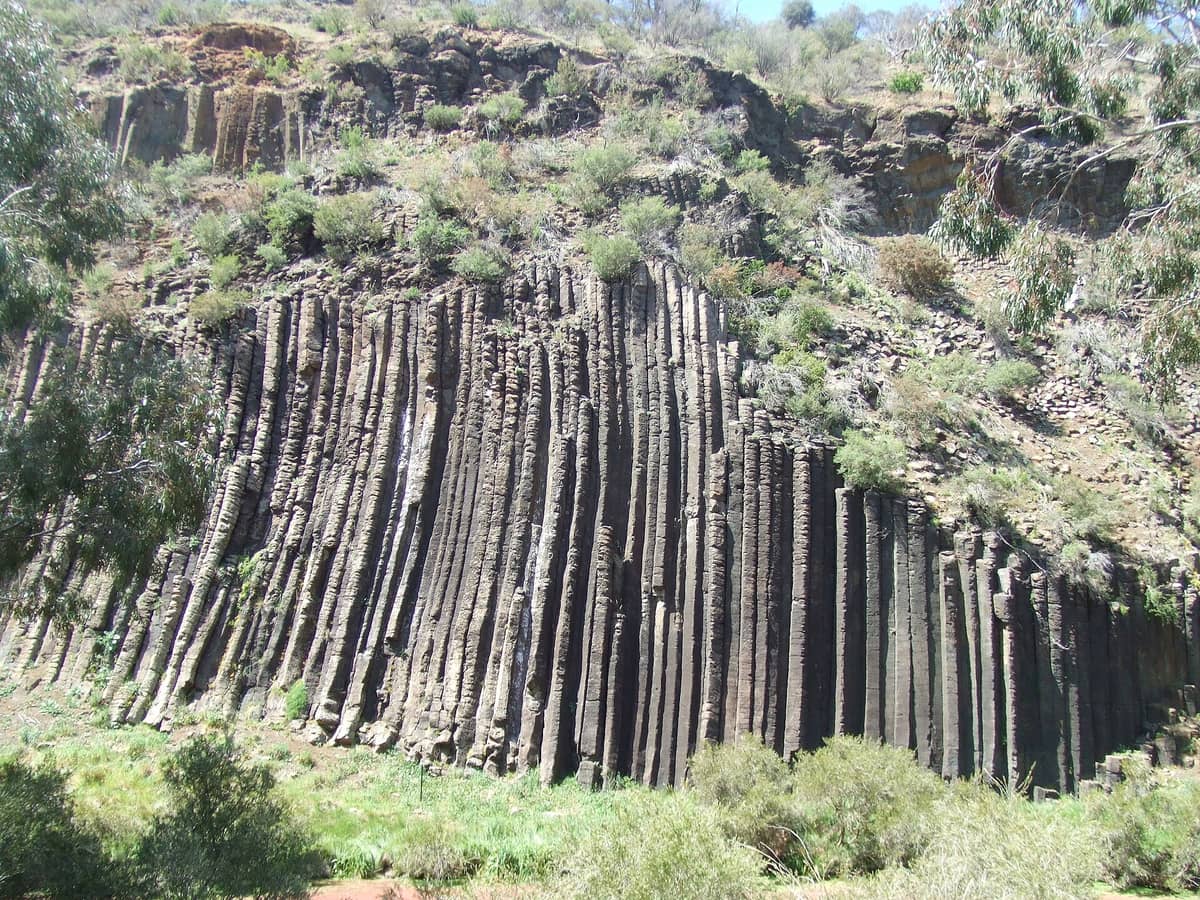
Organ Pipes National Park is a small but geologically extraordinary reserve that protects a basalt canyon carved by Jackson Creek, approximately 20 km northwest of central Melbourne. The park takes its name from its most dramatic feature: a wall of tall, tightly packed basalt columns that bear a striking resemblance to the pipes of a cathedral organ. These columns, which rise to about 20 metres, formed roughly a million years ago as lava flows cooled slowly and contracted into characteristic hexagonal and polygonal shapes. The result is a precision of natural form that feels almost engineered.
The park covers a compact area. It is not a sweeping wilderness. What it offers instead is density: a high concentration of geological interest packed into a short walk, surrounded by a creek-side environment that has been significantly revegetated over recent decades. For a destination so close to a major city, the sense of geological remove is real.
ℹ️ Good to know
Vehicle access to the park is available daily from 8:30 a.m. to 4:30 p.m., extended to 6 p.m. during daylight saving time. Arriving within the first hour after opening on a weekday gives you the best chance of having the canyon largely to yourself.
The Geology: Why These Columns Exist
Understanding what you are looking at makes the visit considerably more rewarding. The basalt here is part of a broader volcanic province that shaped much of western Victoria. When lava cools uniformly from the top and bottom, it shrinks and fractures along stress lines, producing columns with remarkably regular cross-sections. The process is the same one responsible for the famous Giant's Causeway in Northern Ireland and the Devils Postpile in California, though the Organ Pipes operate on a more intimate scale.
Jackson Creek has cut down through successive lava flows over millennia, exposing the columns in cross-section and profile. At the base of the canyon you can see where the creek continues to undercut the formation. Other geological features within the park include the Tessellated Pavement, a flat surface of interlocking polygonal basalt plates visible along the creek bed, and a smaller formation known as the Rosette Rock. Each reflects a slightly different set of cooling conditions within the original lava field.
Visitors with a broader interest in Melbourne's volcanic and natural landscapes may also want to explore the Dandenong Ranges to the east, or consider the full range of parks and gardens around Melbourne for context on how unusual this geological pocket truly is.
Tickets & tours
Live prices and dates from our booking partner. If you book, we may earn a commission at no extra cost to you.
Great Ocean Road reverse itinerary tour from Melbourne
From 77 €Instant confirmationFree cancellationGreat Ocean Road bus tour with a forest walk
From 90 €Instant confirmationFree cancellationYarra Valley Bus Wine Tour including lunch with a glass of wine and chocolate
From 107 €Instant confirmationFree cancellationHidden bars of Melbourne guided tour
From 115 €Instant confirmationFree cancellation
Walking the Canyon: What to Expect
The main path from the carpark descends via a sealed but steep track. Parks Victoria notes gradients reaching 1-in-4 in sections, which is genuinely demanding on the descent and tiring on the return. Wear footwear with grip. The path is not long, but the steepness catches visitors who underestimate it, particularly on warm days or when the surface is damp after rain.
At the base of the canyon, you follow Jackson Creek downstream. The columns themselves become visible gradually as you move around a bend in the creek, and the reveal has a theatrical quality. The scale is best appreciated from the creek floor: the columns stack from ground level to full height with very little debris or interruption, giving the wall a clean, architectural feel. Morning light falls directly into the canyon in summer, picking out the texture of the basalt and catching the surface of the creek. By afternoon, the canyon floor is largely in shade, which flattens the visual contrast but also reduces the heat significantly.
The Tessellated Pavement is worth finding along the creek bed. It is easy to walk over without noticing it, so look down at the flat sections of rock at the water's edge. The patterns, repeated at a much smaller scale than the columns above, make the underlying physics of the lava cooling suddenly tangible.
💡 Local tip
Bring walking poles or take your time on the return climb if you have knee issues. The sealed path is steep enough that the uphill section takes noticeably longer than the descent.
Time of Day and Seasonal Conditions
Summer visits before 10 a.m. are strongly preferable. The canyon traps heat, and by midday in January or February the creek floor can feel stifling. Early mornings also produce better photographic light, with the low sun illuminating the column faces at an angle that brings out the texture of the basalt. In winter, the canyon stays cool throughout the day and the surrounding revegetated scrub takes on a quieter, more stripped-back character.
After heavy rain, Jackson Creek rises and the path sections near the creek bed can be muddy or temporarily impassable. The creek itself is not suitable for wading after rainfall. Check the Parks Victoria website or call ahead following significant rain events. Conversely, the period immediately after rain, when the creek is running clear and the basalt faces are damp and dark, produces some of the most dramatic photographs of the columns.
Spring and autumn tend to offer the most comfortable walking conditions. For broader advice on timing a Melbourne trip, the best time to visit Melbourne guide covers seasonal trade-offs across the region.
Getting There and Practical Logistics
Organ Pipes National Park sits just off the Calder Freeway, about 20 km from the Melbourne CBD. By car, allow extra time for traffic. There is a carpark at the end of Organ Pipes Road, though it is not large. On busy weekend mornings in good weather, the carpark can fill.
Public transport access is limited. The park does not sit on a train or tram line, and direct bus connections from central Melbourne are not straightforward. Most visitors arrive by car, and this is the practical approach for most travelers. If you are combining the park with other destinations northwest of the city, it pairs logically with a drive toward regional Victoria rather than a standalone CBD day trip.
There is no cafe or food service at the park. A picnic area with toilets and an information centre is available near the carpark. The accessible toilet is on site, and the picnic facilities and information centre are reachable without tackling the steep canyon path. However, the main geological feature, the column wall itself, requires navigating the steep sealed path and is not accessible for wheelchair users or visitors with significant mobility limitations.
⚠️ What to skip
There is no phone reception in parts of the canyon. Download any maps or information before you leave the carpark, and let someone know your plans if you are visiting alone.
Photography at the Organ Pipes
The column wall photographs best in morning light during summer, or on overcast days when the diffuse light eliminates the deep shadows that fall across the lower sections of the canyon in direct sunlight. A wide-angle lens captures the full height of the columns in context with the creek below. Getting close and shooting upward along the column faces emphasizes the height and the regularity of the jointing pattern.
The Tessellated Pavement is a strong macro or close-up subject. The repeating polygonal geometry creates natural patterns that read well in square formats. Bring a polarizing filter if shooting the creek surface, particularly after rain when the water picks up colour from the sky above the narrow canyon opening.
Photographers interested in geological and natural subjects around Melbourne may also want to note the Yarra Bend Park for a contrasting, riverine urban-edge environment, or look further afield at Melbourne's best viewpoints for a broader landscape shortlist.
Who This Park Is Not For
Travelers expecting a full-day wilderness experience will find the park too compact. The main walk takes under two hours at a comfortable pace, and there is little else to do once you have seen the columns and the creek formations. Visitors with mobility difficulties should note that the primary geological attraction requires navigating a steep sealed path rated at up to 1-in-4 gradient, with no designated accessible parking on site. The park also has no food or drink facilities beyond the picnic area, so arriving unprepared on a hot day is uncomfortable.
Young children under about seven may find the canyon walk tiring and the geology abstract. Older children who are given some geological context beforehand tend to engage with it well, particularly the Tessellated Pavement, which invites close inspection.
Insider Tips
- Visit on a weekday morning in autumn or spring. Weekend afternoons bring school groups and families, which significantly changes the atmosphere in a small canyon where sound carries.
- The visitor information boards near the carpark are worth reading before descending. They identify the Tessellated Pavement and Rosette Rock by name, which helps you find and recognize them on the walk rather than passing them unknowingly.
- If the carpark is full when you arrive, wait. Cars turn over quickly as most visits are short. Parking on Organ Pipes Road itself is limited and the verge is uneven.
- The creek crossing points are stepping-stone style and can be slippery even when dry. Closed-toe shoes with rubber soles are worth wearing rather than sandals, regardless of the weather forecast.
- Combine the visit with a stop at the nearby Calder Park area or continue northwest along the Calder Freeway if you want to extend the day beyond the park itself, as there is not enough within the park to fill more than a half-day.
Who Is Organ Pipes National Park For?
- Geology enthusiasts and science-minded travelers who want to understand what they are looking at
- Photographers looking for textural, architectural natural subjects within easy reach of Melbourne
- Families with children aged eight and above who can manage a steep sealed path
- Visitors combining a day trip northwest of Melbourne with regional Victoria
- Travelers on a budget who want a genuinely distinctive natural experience at no cost
Nearby Attractions
Combine your visit with:
- 1000 Steps Kokoda Track Memorial Walk
The Kokoda Track Memorial Walk, known locally as the 1000 Steps, climbs through fern-filled forest in the Dandenong Ranges east of Melbourne. Free to visit and reached by train, it combines a genuine physical workout with quiet moments of WWII commemoration.
- Albert Park Lake
Albert Park Lake is a vast freshwater reserve just minutes from Melbourne's CBD, offering a 4.7km walking and cycling path around calm water, sports ovals, and open parkland. Free to enter and accessible by tram, it rewards early morning walkers, cycling families, and anyone wanting to understand how Melbourne uses its open spaces.
- Bells Beach
Bells Beach, in Wadawurrung country and also known by its Traditional Owner name Djarrak, is a 48-hectare coastal reserve near Torquay that holds the distinction of being the world's first declared surfing reserve. With its sheer sandstone cliffs, deep bowl-shaped break, and annual Rip Curl Pro competition, it draws surfers and non-surfers alike for one of Victoria's most dramatic coastal experiences.
- Brighton Beach Bathing Boxes
Lined up along Dendy Street Beach in Brighton, Melbourne's 96 privately owned bathing boxes are one of Victoria's most recognisable sights. Free to view from the public beach, they reward visitors who time their arrival with the morning light or an empty tide. Here is what you actually need to know before making the trip.
Planning a trip? Discover personalized activities with the Nomado app.