Old St Elizabeth Beguinage: Ghent's Quiet 'Holy Corner'
Founded in the 13th century and today home to Roman Catholic, Orthodox, and Protestant congregations, the Old St Elizabeth Beguinage is a rare pocket of medieval-rooted calm inside Ghent's city centre. Free to enter, rich in architectural texture, and largely overlooked by tour groups, it rewards any visitor willing to stray from the main sightseeing circuit.
Quick Facts
- Location
- Sophie Van Akenstraat, 9000 Gent — Prinsenhof neighbourhood
- Getting There
- De Lijn tram/bus network; walk from Korenmarkt or Gravensteen (approx. 10–15 min on foot)
- Time Needed
- 30–60 minutes for a relaxed walk; longer if you attend a service
- Cost
- Free to enter (no ticket required)
- Best for
- History lovers, architecture fans, quiet escapes, photography
- Official website
- elisabethbegijnhof.be/nl
What Is the Old St Elizabeth Beguinage?
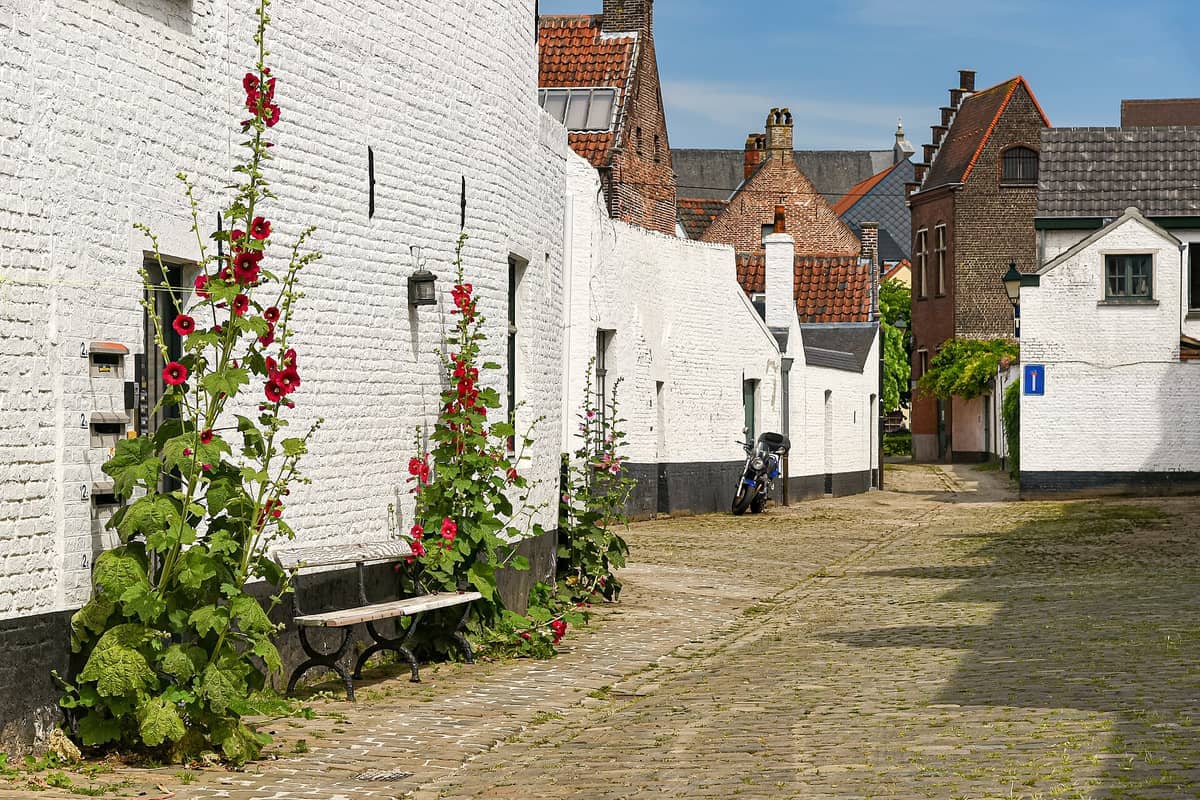
The Old St Elizabeth Beguinage (Dutch: Oud Begijnhof Sint-Elisabeth) sits in the Prinsenhof district of Ghent, a few minutes' walk west of Gravensteen castle. It is not a museum with opening times and ticket desks. It is a living residential quarter on streets that have carried the same cobblestones and gabled silhouettes for centuries, now occupied by private homes and three Christian congregations sharing what was once a single beguine community.
The nickname 'Holy Corner' comes from the unusual concentration of faith communities on one small site: a Roman Catholic church, an Orthodox church, and a Protestant church all coexist here within a few dozen metres of each other. That fact alone makes it quietly remarkable, but the site's deeper interest lies in what it represents about medieval women's religious life in Flanders.
ℹ️ Good to know
The Old St Elizabeth Beguinage is freely accessible as part of the public street network. There are no gates, no entry fees, and no set visiting hours. Dress respectfully if you plan to step inside any of the churches, and expect uneven cobbled surfaces throughout.
A Brief History: From Countess Joanna to 'Holy Corner'
Beguinages were a distinctly Flemish and broader Low Countries institution: semi-monastic communities of laywomen, known as beguines, who lived devoutly without taking permanent religious vows. They were independent, often educated, and economically active, weaving textiles, nursing the sick, and teaching children. At their height, Ghent's beguine communities were among the largest in Europe.
The Old St Elizabeth Beguinage was founded in the 1230s, traditionally associated with Countess Joanna of Constantinople, and the community moved to this 'Het Broek' site in 1242. For more than six centuries, beguines lived, worked, and worshipped here. In 1873–1874 the remaining community transferred to the new Groot Begijnhof at Sint-Amandsberg; the older quarter stayed in the city and is now a mixed residential and church neighbourhood. The whitewashed houses, enclosed garden plots, and chapel spaces accumulated across those generations.
In 1874, the remaining beguine community transferred to the newly built Great St Elizabeth Beguinage at Sint-Amandsberg, on the eastern edge of Ghent. The old beguinage buildings in the city centre were vacated and gradually repurposed. What survived the transition is what you see today: a cluster of historic structures that acquired their 'Holy Corner' identity as the three congregations moved in to fill the ecclesiastical space left behind.
Ghent has three beguinage sites: this older city-centre quarter, Klein Begijnhof Ter Hoyen, and the later Groot Begijnhof at Sint-Amandsberg. For broader context on how this fits into the city's religious and civic heritage, the Prinsenhof neighbourhood guide covers the quarter in which the Old Beguinage sits, a district full of medieval-era streets that rarely appear on first-time itineraries.
Tickets & tours
Hand-picked options from our booking partner. Prices are indicative; availability and final rates are confirmed when you complete your booking.
Historic Ghent city exploration game
From 10 €Instant confirmationFree cancellationBelgian waffle making workshop and beer tasting in Ghent
From 45 €Instant confirmationFree cancellationTaste of Ghent private chocolate walking tour
From 256 €Instant confirmationFree cancellationSips and stories, a private beer tour in Ghent
From 373 €Instant confirmationFree cancellation
What You Actually See: Arriving and Walking the Quarter
Arriving from the direction of Gravensteen, the transition from the tourist-heavy waterfront to the quieter Prinsenhof streets is almost instant. The noise from the canal quays fades, the souvenir-shop density drops, and the architecture shifts from grand civic showpieces to the domestic scale of narrow brick gables and modest doorways.
The beguinage area centres on Sophie Van Akenstraat and the cluster of church buildings that define 'Holy Corner.' The three churches are externally distinct in style and period, reflecting the different eras in which they were established or converted. Walking between them in a short loop, you notice the layering: a medieval foundation underneath, post-Reformation alterations in the middle, and 19th-century additions completing the picture. It is the kind of site where the textures of the walls, worn brickwork, patched stonework, painted timber, do as much storytelling as any information panel.
The streets themselves are cobbled and uneven in places, a reminder that this area was never redeveloped for car traffic or tourism infrastructure. That authenticity is both the site's appeal and its main accessibility limitation. Visitors who rely on wheelchairs or have significant mobility difficulties will find several sections genuinely awkward.
Time of Day: How the Experience Changes
Early morning is the most rewarding time to visit. Before 9am, the surrounding streets carry little pedestrian traffic, the light is low and directional, and the sound environment is entirely local: birds, a resident setting out for work, the occasional bicycle. The churches are closed at this hour, but the external architecture reads most clearly in low-angle morning light, with shadows picking out the stone details.
Midday brings modest footfall, mostly from curious walkers who have already done Gravensteen and are following their instincts westward. The area never becomes crowded in the way that the Graslei or Korenmarkt do, but it loses some of its stillness. Sunday mornings are a different category entirely: if a service is scheduled at any of the three churches, you may arrive to find small congregations gathering, hymn music filtering through closed doors, and a sense of the place being genuinely used rather than preserved for tourism.
💡 Local tip
Check with the individual churches before visiting if you want to attend a service. All three congregations are active, but schedules vary. Entering during an active service requires respectful, quiet behaviour and appropriate clothing.
Late afternoon in summer brings the warmest light and the most photogenic conditions, particularly for the brick facades facing southwest. Autumn is arguably the most atmospheric season: fallen leaves accumulate in the quiet corners of the cobbled lanes, the overcast Belgian sky creates even, shadowless light, and the area has a reflective quality that suits its history.
Photography: What to Capture
The Old St Elizabeth Beguinage is a strong photography location, though not in the obvious panoramic sense. There are no sweeping views here. The rewards come from close observation: the texture of worn cobblestones against old brick, the contrast of a modern doorbell panel on a 17th-century doorframe, the juxtaposition of a painted Orthodox cross against a Flemish gable. For compositional guidance across Ghent's heritage sites, the Ghent photography guide covers light conditions, camera settings, and the best locations by time of day.
Be mindful that this is a residential area. Photographing the street architecture and the church exteriors is entirely appropriate. Pointing a camera through residential windows or doors is not. The people who live here are not exhibits.
Getting There: Navigation and Public Transport
The beguinage is in the Prinsenhof district, a 10 to 15-minute walk from both Gravensteen castle and the Korenmarkt tram hub. De Lijn operates Ghent's tram and bus network; Korenmarkt is a key interchange point for multiple tram lines. From Gent-Sint-Pieters station, Korenmarkt is reachable by De Lijn services, with travel times varying by line and timetable. Check the for current route numbers and ticketing details, as De Lijn line numbers and fares are subject to periodic changes. Check the getting around Ghent guide for current route numbers and ticketing details, as De Lijn line numbers and fares are subject to periodic changes.
Visitors arriving by car should be aware that the Old St Elizabeth Beguinage lies within Ghent's low-emission zone (LEZ). Non-compliant vehicles require prior registration or face automatic fines. Paid parking is available at several locations outside the LEZ boundary, with the city centre walkable from there in under 20 minutes.
⚠️ What to skip
Ghent's low-emission zone covers the historic centre, including the Prinsenhof area where this beguinage is located. If driving, check LEZ regulations in advance at the official Stad Gent portal. Fines are issued automatically via camera.
Honest Assessment: Is It Worth Your Time?
If you are visiting Ghent for just one day and working through the headline sights, the Old St Elizabeth Beguinage probably does not belong at the top of your list. The Ghent Altarpiece in St Bavo's Cathedral, the Gravensteen castle, and the medieval waterfront at Graslei and Korenlei will demand your attention first. The beguinage is a secondary destination that rewards visitors who have already covered the essentials, or who are specifically interested in medieval Flemish history and religious architecture.
That said, it offers something the major sights genuinely cannot: silence. On a weekday morning, you may spend 30 or 40 minutes in the quarter without encountering another tourist. The scale is intimate, the atmosphere is unhurried, and the connection to a specific and unusual strand of medieval social history gives it intellectual weight beyond its modest size.
Visitors expecting a heavily interpreted heritage experience, audio guides, museum panels, a ticketed interior, will be disappointed. This is a living street, not a curated exhibit. The experience depends on your willingness to read physical space attentively and to find meaning in texture and quietness rather than in obvious spectacle.
For travellers combining the beguinage with a wider walk through the Prinsenhof district, the nearby Rabot city gate and the streets of the Patershol neighbourhood make for a coherent half-day itinerary away from the main crowds.
Insider Tips
- Visit on a Sunday morning if your schedule allows: the 'Holy Corner' name becomes genuinely tangible when all three congregations are active simultaneously, with music and voices overlapping from different buildings on the same small street.
- The cobbled lanes of the beguinage connect naturally into the broader Prinsenhof district. Rather than retracing your steps to Gravensteen, walk north or west from the beguinage to discover the quieter residential fabric of this part of the city, which most visitors never reach.
- Autumn and early winter are underrated seasons for this site. The low Belgian light, the absence of summer tourists, and the contemplative atmosphere of the streets align well with the site's history and character.
- If you want to photograph the church facades without parked bicycles in the foreground, arrive before 8am on a weekday. The area is genuinely empty at that hour and the early light is excellent on the brick surfaces.
- The beguinage is a 5-minute walk from the Vrijdagmarkt square, one of Ghent's best outdoor markets. Pairing the two in a single morning makes efficient use of time: the market for atmosphere and food, the beguinage for history and quiet.
Who Is Old St Elizabeth Beguinage For?
- History and heritage travellers with a specific interest in medieval women's religious communities
- Architecture enthusiasts drawn to the texture of authentic, unlisted Flemish domestic building
- Photographers looking for unposed, quiet urban scenes with strong material character
- Return visitors to Ghent who have already covered the major sights and want to go deeper
- Travellers seeking a genuine break from crowds in the middle of a busy city itinerary
Nearby Attractions
Other things to see while in Prinsenhof:
- Rabot City Gate
The Rabot is one of the last surviving city gates of medieval Ghent, a two-towered fortification built over a canal in the Prinsenhof quarter. Free to view year-round, it offers a quiet but striking encounter with late medieval military architecture away from the city's most crowded historic sites.