Rabot City Gate: Ghent's Fortress on the Water
The Rabot is one of the last surviving city gates of medieval Ghent, a two-towered fortification built over a canal in the Prinsenhof quarter. Free to view year-round, it offers a quiet but striking encounter with late medieval military architecture away from the city's most crowded historic sites.
Quick Facts
- Location
- Opgeëistenlaan/Begijnhoflaan area, Rabot quarter, Ghent (9000)
- Getting There
- Tram stop "Rabot" on Begijnhoflaan (De Lijn)
- Time Needed
- 20–40 minutes to explore the exterior and surroundings
- Cost
- Free (exterior viewing); no ticketed interior access under normal circumstances
- Best for
- History enthusiasts, architecture lovers, canal walkers, photographers
- Official website
- visit.gent.be/en/see-do/rabot
What the Rabot Actually Is
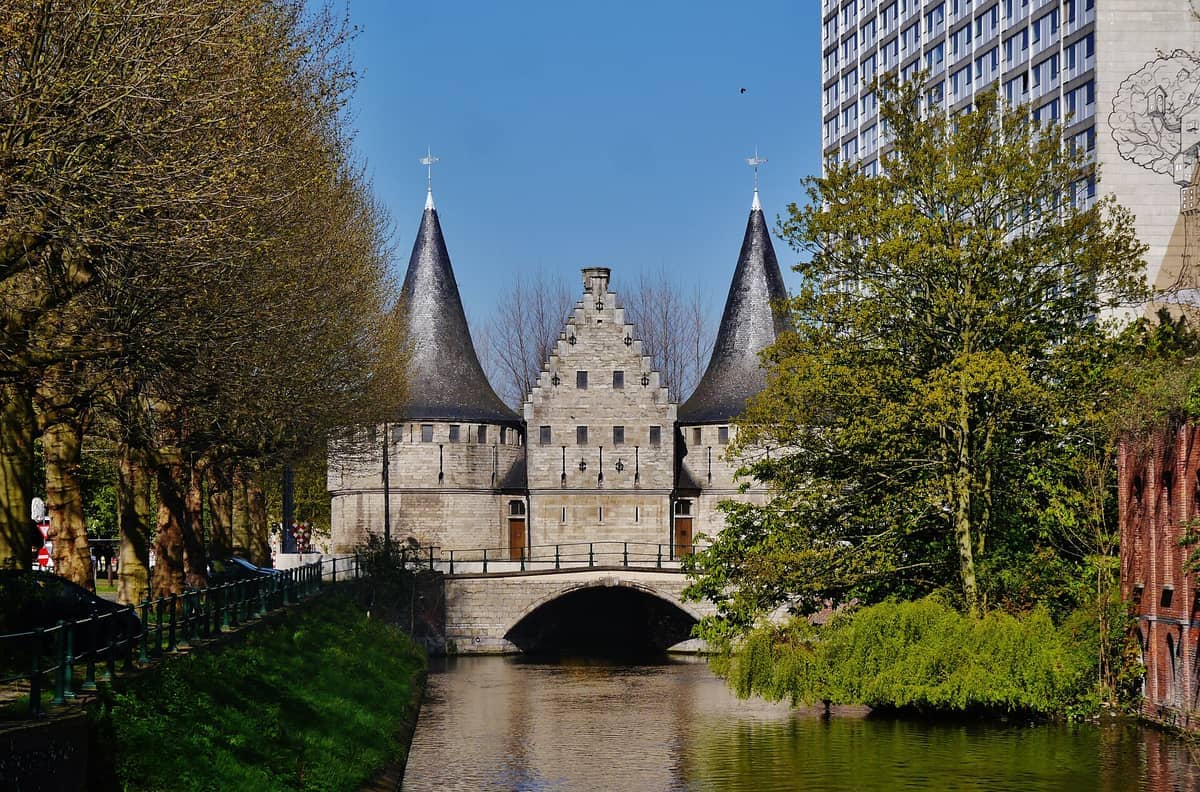
The Rabot City Gate is one of the most architecturally complete surviving medieval city gates in the Low Countries. Unlike the ruined fragments that most Belgian cities retain, Ghent's Rabot still stands largely intact: two cylindrical towers of dark grey stone flanking a central building over a fortified gate passage that spans directly over a canal. The structure is not a museum with a ticket desk and audio guide. It is a working piece of the city's urban fabric, sitting at the edge of a residential quarter, occasionally reflected in the water below it on still mornings.
The name "Rabot" comes from the Dutch word for a type of fortified sluice or water gate, which describes its function precisely. The gate controlled both land and water access into the city, an arrangement that made it a genuinely formidable defensive point. Visiting it requires no planning beyond showing up, but understanding what you are looking at adds considerably to the experience.
ℹ️ Good to know
The Rabot is an outdoor monument with no standard opening hours or admission fee. You can visit any time of day. Interior access is not available under normal circumstances and is only occasionally possible during special heritage events.
History: Built in Defiance After a Defeat
To understand why the Rabot was built the way it was, you need to know what happened in 1488. Maximilian of Austria, future Holy Roman Emperor, used a weak point in Ghent's defences to seize the city during a period of open conflict between the city's powerful guilds and Habsburg authority. After roughly 40 days his army withdrew without having achieved its aims, and the city authorities responded by reinforcing this water gate with two substantial towers as a statement in stone that the city would not be caught unprepared again.
The gate belongs to a tradition of late medieval urban defense architecture in which water was integrated directly into the fortification system. Ghent's network of canals was not just an economic asset but a military one, and the Rabot was designed to control the point where a key canal met the city wall. The three main elements—two flanking towers and a central building over the water passage—created overlapping fields of fire while the sluice mechanism beneath could restrict or flood the approach as needed.
Ghent was one of the largest and wealthiest cities in northern Europe during the medieval period, and the scale and quality of its fortifications reflected that status. The Rabot is one of only a small number of structures that survive from that era of civic power. For more context on how the city's medieval identity shaped its built environment, see the overview of the Prinsenhof quarter, where the Rabot sits alongside other remnants of Ghent's pre-modern urban core.
Tickets & tours
Hand-picked options from our booking partner. Prices are indicative; availability and final rates are confirmed when you complete your booking.
Historic Ghent city exploration game
From 10 €Instant confirmationFree cancellationBelgian waffle making workshop and beer tasting in Ghent
From 45 €Instant confirmationFree cancellationTaste of Ghent private chocolate walking tour
From 256 €Instant confirmationFree cancellationSips and stories, a private beer tour in Ghent
From 373 €Instant confirmationFree cancellation
What You See: Architecture and Setting
Standing in front of the Rabot, the first thing that registers is the scale. The towers are broad and solid rather than elegant, built for resistance rather than display. The stonework is a mix of dark stone and lighter masonry, and the surfaces are weathered in ways that no restoration has entirely smoothed away. Look closely and you can see where later brickwork patches older stone, traces of the different moments in the structure's long life.
The canal beneath the gate passage is narrow and dark in the shadow of the towers, and on quiet mornings the reflections of the stone in the water create a near-mirror image of the structure. The surrounding streets are not particularly scenic, which is part of what makes the Rabot feel genuine rather than preserved. This is a working-class residential neighbourhood, and the gate stands at the edge of it without ceremony, flanked by ordinary apartment buildings and a road that carries regular traffic.
Walk around the structure rather than simply photographing it from the front. The rear elevation, viewed from the far side of the canal, gives a sense of how the gate related to the city's interior, and the angle is less crowded with parked vehicles. The towers have narrow arrow loops and corbelled sections near their tops, details that are easy to miss from the main approach.
When to Visit and How the Experience Changes
Early morning is consistently the best time to visit the Rabot. The canal is calmer, the light from the east catches the stonework at a low angle that emphasises texture and depth, and there is almost no foot traffic. By mid-morning on weekends, a modest number of visitors and cyclists pass through, but the area never reaches anything approaching crowded. On weekday afternoons, the neighbourhood resumes its ordinary rhythm: schoolchildren on bikes, residents returning from the market, delivery vehicles navigating the narrow canal-side streets.
Rain changes the atmosphere considerably. The dark stone absorbs light differently when wet, and the canal surface picks up the grey of the sky rather than reflecting the towers cleanly. This is not a reason to avoid rainy days; it simply produces a different kind of photograph and a different mood. Ghent's maritime climate means overcast conditions are common, and the Rabot looks entirely at home in grey weather.
💡 Local tip
For the clearest water reflections, visit on a calm morning with little wind. Even a light breeze breaks the mirror surface of the canal enough to soften the reflection significantly.
Getting There and Moving On
The Rabot is straightforward to reach by tram. De Lijn operates a stop called "Gent Rabot (Begijnhoflaan)" on Begijnhoflaan, directly adjacent to the gate. From Gent-Sint-Pieters station, take tram line T4 toward Rabot or connect via other city-centre stops; the journey from the station takes roughly 10 to 20 minutes depending on the line and direction. Single tram and bus tickets in Ghent currently cost around €3 and allow unlimited transfers within about one hour, but verify current fares with De Lijn before travel as prices change.
Arriving on foot from Ghent's historic centre takes about 15 to 20 minutes at a comfortable walking pace. The route passes through streets that are less touristic than the waterfront and gives a more realistic sense of the city's residential character. Drivers should note that the Rabot falls within Ghent's low-emission zone (LEZ); non-compliant vehicles generally require registration or a day permit before entering, and enforcement is automated through camera systems.
The Rabot pairs naturally with a broader walk through the Prinsenhof quarter. From the gate, it is a short walk to the Old St. Elizabeth Beguinage, another largely overlooked monument that occupies a different chapter of Ghent's medieval history. Together they make a half-day circuit that stays almost entirely off the main tourist routes.
Photography Notes
The Rabot is one of the more photogenic structures in Ghent for architectural photography, but it demands some thought about position. The standard frontal shot from the canal bank tends to include parked cars and a road sign that are difficult to crop out cleanly. Moving to the left bank and shooting at a slight angle removes most of the visual clutter and includes more of the canal foreground.
A wide-angle lens is useful for capturing all three towers in a single frame without distortion. If you are shooting with a phone, step back further than you think necessary and crop in post rather than using the digital zoom. The texture of the stonework rewards a close-up series as well: the corbelling, the arrow loops, and the joints between the different stone types all photograph well in directional light.
If you are building a photography itinerary around Ghent's medieval architecture, the Ghent photography guide covers timing, angles, and logistics for the city's major architectural subjects, including several that share the Rabot's canal-and-stone combination.
Context: Where the Rabot Fits in Ghent's Larger Story
Ghent's medieval centre contains a remarkable density of historic structures, and it can be difficult to know which ones genuinely warrant attention and which are better appreciated from a passing glance. The Rabot is not in the same category as the Ghent Altarpiece or the Gravensteen castle in terms of artistic or historical significance at an international level. What it offers is different: an encounter with a specific moment of civic resilience, rendered in stone that has been standing for over five centuries, in a neighbourhood that has not been packaged for tourism.
For visitors who find Ghent's central historic area crowded or overly curated, the Rabot provides something more grounded. There are no souvenir shops nearby, no queue to join, and no audio guide telling you what to feel. The structure speaks for itself, provided you know enough about its context to listen.
The Rabot sits within the broader Prinsenhof neighbourhood, which takes its name from the Prinsenhof palace complex where Charles V, Holy Roman Emperor, was born in 1500. The palace itself has largely disappeared, but the quarter retains traces of its historic importance. For a fuller picture of the area, see the Prinsenhof neighbourhood guide.
Insider Tips
- The tram stop is literally named "Gent Rabot (Begijnhoflaan)" after the gate, so navigation is simple even without a map. Take any De Lijn tram or bus that stops at Begijnhoflaan and you are within walking distance of the structure.
- The rear canal-side view, reached by walking around the block rather than standing on the main approach road, gives a cleaner photograph and a better sense of the gate's relationship to the water.
- Ghent occasionally holds heritage open-day events (such as Open Monumentendag in September) during which normally inaccessible historic structures including the Rabot may open for interior visits. Check the Stad Gent events calendar in late summer if this interests you.
- The surrounding Rabot–Blaisantvest neighbourhood has a number of small neighbourhood cafes that are frequented almost entirely by local residents. Stopping for a coffee after the visit gives a more honest picture of the city than the tourist-facing establishments near Gravensteen.
- If you visit on a weekday morning, the light falls from the east and hits the front face of the towers directly between roughly 8am and 10am in summer, producing the warmest and most detailed stonework photographs.
Who Is Rabot City Gate For?
- Architecture and military history enthusiasts who want specificity beyond a castle silhouette
- Photographers building a portfolio of Ghent's medieval waterways and structures
- Walkers combining the Prinsenhof quarter with the historic centre on a half-day loop
- Visitors who prefer uncrowded sites with genuine historic atmosphere over polished tourist experiences
- Travellers with limited time who want a free, no-booking-required stop that adds real texture to a Ghent visit
Nearby Attractions
Other things to see while in Prinsenhof:
- Old St Elizabeth Beguinage
Founded in the 13th century and today home to Roman Catholic, Orthodox, and Protestant congregations, the Old St Elizabeth Beguinage is a rare pocket of medieval-rooted calm inside Ghent's city centre. Free to enter, rich in architectural texture, and largely overlooked by tour groups, it rewards any visitor willing to stray from the main sightseeing circuit.