North Bund Riverside: Shanghai's Other Waterfront (And Why It's Worth Your Time)
The North Bund Riverside is a roughly 2.5 km public promenade along the Huangpu River's north bank in Hongkou District. Free to enter and far less crowded than the Bund opposite, it offers some of Shanghai's most photogenic views of the historic waterfront and Pudong skyline from an angle most visitors never see.
Quick Facts
- Location
- 558–678 Dongdaming Road, Hongkou District, Shanghai (North Bund Riverside Green Space, International Cruise Terminal section)
- Getting There
- Metro Line 12 to International Cruise Terminal Station; 5–10 minute walk to riverside
- Time Needed
- 1–2 hours for the full promenade; 30–60 minutes for a focused viewpoint stop
- Cost
- Free. No ticket required.
- Best for
- Skyline photography, relaxed waterfront walks, early morning exercise, couples at dusk
- Official website
- www.shhk.gov.cn/English/006004/006004003/moreinfond.html
What Is the North Bund Riverside?
The North Bund Riverside Green Space, officially named 北外滩滨江绿地 in Chinese, is a public waterfront park and promenade running along the north bank of the Huangpu River in Hongkou District, Shanghai. The section most visited by tourists, designated as the International Cruise Terminal section, stretches approximately east to west between Gaoyang Road and Liyang Road, with East Daming Road forming the northern boundary.[1] The full riverside corridor extends about 2.5 km, from Gongping Road in the west to Qinhuangdao Road in the east, and covers a total green space area of 64,088 square metres.[1][6]
Admission is free, and the park-managed International Cruise Terminal section operates daily from 06:00 to 22:00.[1] The broader riverside promenade area is widely reported as accessible throughout the day and into the evening, with landscape lighting activated at night.[6][10][14] Hours can vary slightly between sections, so check on-site signage if you plan a late visit.
💡 Local tip
Take Metro Line 12 directly to International Cruise Terminal Station (国际客运中心站). From Exits 2 or 3, the riverside green space is a flat 5–10 minute walk south from the station exit. No taxi or ride-share is needed from this stop.
The View: What You Actually See From Here
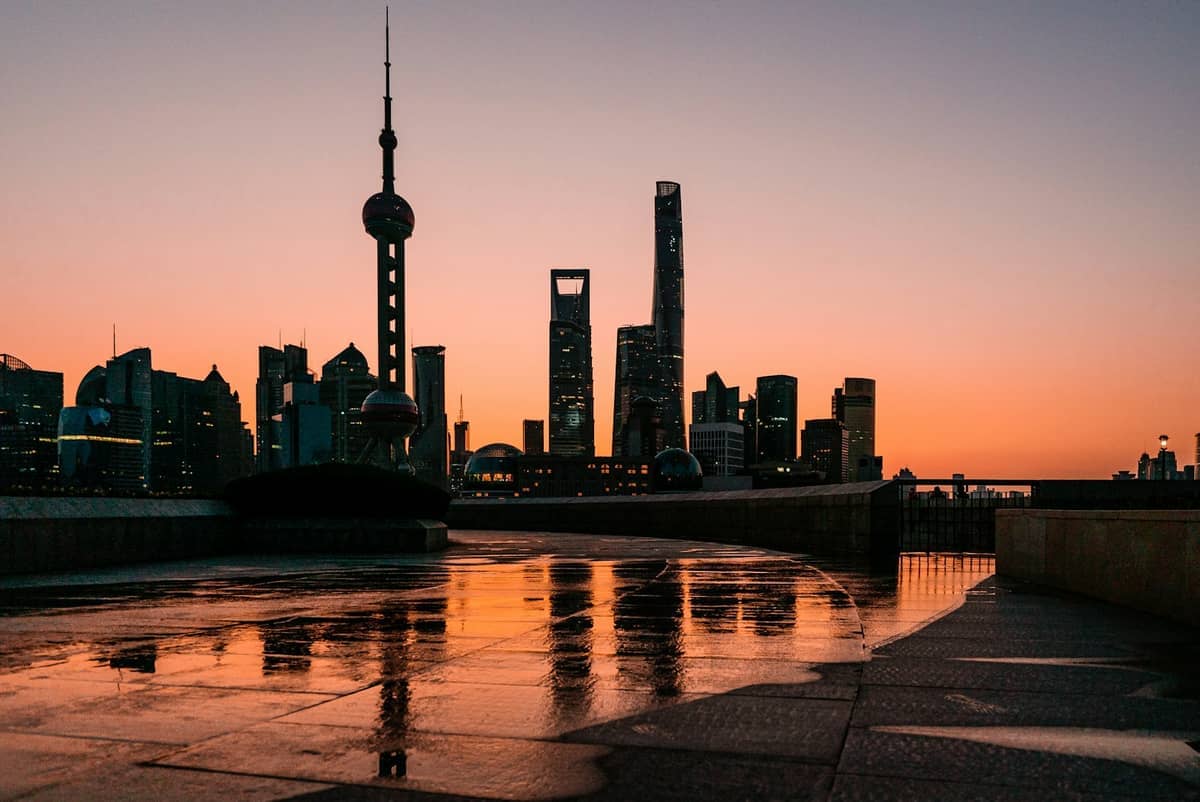
Standing on the North Bund promenade, you look directly south across the Huangpu River toward two of Shanghai's most iconic panoramas at once: the neoclassical stone facades of the Bund on your left, and the glass-and-steel cluster of Lujiazui in Pudong on your right. This is the triangle that defines Shanghai's skyline, and the North Bund is one public vantage point where you can see both banks simultaneously without being inside either of them.
The geometry works in your favor here. From the Bund promenade itself, you face Pudong. From Lujiazui, you face the Bund. But from the North Bund, the river bends just enough to give you a diagonal sightline that captures the Oriental Pearl Tower, the Shanghai Tower, and the older Bund waterfront buildings all in a single frame. It is one of the few spots in the city where a wide-angle lens earns its keep.
The promenade surface is level paved stone, wide enough for cyclists, joggers, and slow-walking tourists to coexist without friction. Wooden deck sections extend slightly over the water at intervals, giving you an unobstructed downward view of the river and the occasional container vessel or river ferry passing below.
Tickets & tours
Hand-picked options from our booking partner. Prices are indicative; availability and final rates are confirmed when you complete your booking.
Shanghai city and Zhujiajiao water town private tour with lunch
From 371 €Instant confirmationFree cancellationShanghai private tour with iconic landmarks of the old and new city
From 284 €Instant confirmationFree cancellationShangai Yuyuan Garden entrance tickets
From 9 €Instant confirmationFree cancellation
Time of Day: How the Experience Changes
Early Morning (06:00–09:00)
This is when the promenade belongs almost entirely to local residents. Older Shanghainese gather in the green space sections for tai chi and group exercise, some with portable speakers playing light instrumental music. The air smells of the river, slightly mineral and faintly industrial, before the midday heat activates the city around it. The Bund and Pudong skyline sit in soft, diffused morning light with frequent low haze over the water, which gives photographs a painterly, slightly ethereal quality. Crowds are minimal and the atmosphere is genuinely calm.
Midday (10:00–15:00)
Foot traffic increases, particularly on weekends, as tour groups and local families move through the area. The light is harsh and high, which flattens architectural detail in photos. In summer, temperatures regularly exceed 32°C with high humidity, making midday the least comfortable time to walk the full 2.5 km stretch. If you are here in June through August, bring water, wear light clothing, and consider limiting your visit to a short focused stop rather than the full promenade. In autumn and spring, midday is perfectly pleasant.
Late Afternoon and Sunset (16:00–19:30)
The golden-hour window here is exceptional. As the sun drops toward the west, warm directional light rakes across the Bund facade and catches the glass towers of Lujiazui in a way that changes color almost by the minute. This is the most popular window for photographers and couples, and the promenade gets noticeably busier from around 17:00 onward on weekends. Arrive by 16:30 to secure a good position on one of the wooden deck sections before the foot traffic peaks.
Evening (19:30 Onward)
Once the Bund and Lujiazui light up fully, the North Bund transforms into something close to a local night-promenade. The landscape lighting along the green space activates, the crowd softens to a steadier stream of walkers, and the reflected lights in the river create a layered visual depth that pure daylight cannot replicate. This is arguably the best time for long-exposure photography if you bring a tripod. The atmosphere is relaxed rather than festive, with less noise and congestion than the Bund side directly opposite.
ℹ️ Good to know
The park-managed International Cruise Terminal section officially closes at 22:00, but the wider riverside promenade is generally accessible beyond that time. If you are planning a late evening visit, walk in from the street-level access points along Dongdaming Road rather than the main park entrance.
Historical and Neighborhood Context
Hongkou District, where the North Bund sits, has one of Shanghai's more layered histories. In the early twentieth century it was home to a significant Japanese residential presence and, from the late 1930s onward, became the designated zone for Jewish refugees fleeing Europe. The district's role as a wartime refuge is documented at the Shanghai Jewish Refugees Museum, located nearby in the district.[14]
The riverfront itself was historically an industrial and port zone. The International Cruise Terminal that gives this section of the promenade its name still functions as an active passenger port, handling cruise liners on the Yangtze River and international itineraries. Large ships are visible from the promenade on departure and arrival days, which adds a genuine working-waterfront energy that contrasts with the more manicured leisure atmosphere of the Lujiazui riverside promenade across the river.
In recent years, Hongkou's North Bund area has been developed as a secondary financial and creative district, with new office towers rising behind the promenade. This is Shanghai's attempt to extend its waterfront economy north of Suzhou Creek, and the construction context means that the backdrop to the north of the promenade is a mix of finished towers and ongoing development.
Photography: Practical Guidance
The North Bund Riverside is listed among the best locations in the city for Bund-skyline photography from an unusual angle. For context on other top shooting locations, see the guide to best photo spots in Shanghai. The key practical consideration here is lens choice: a wide-angle (16–24mm equivalent on full-frame) captures both the Bund facade and the Lujiazui cluster in one frame, while a short telephoto (50–85mm equivalent) compresses the river and pulls the towers closer for more dramatic foreground-to-background relationships.
Tripods are allowed on the promenade and are widely used by visitors at dusk and after dark. The wooden deck sections at river level give the clearest foreground, with the river surface filling the bottom third of a horizontal frame. Avoid the handrail sections if you are shooting at river level, as the metal rail frequently appears in wide-angle frames.
In overcast or foggy conditions, which are common in winter and during the meiyu (plum rain) season in June and early July, the skyline loses contrast but gains atmosphere. Low cloud partially obscures the upper floors of the Shanghai Tower and its neighbors, creating a mood that flat clear-sky days rarely produce.
Getting There and Getting Around
Metro Line 12 to International Cruise Terminal Station (国际客运中心站) is the most direct public transport option. From Exits 2 or 3, walk south toward the river for approximately 5–10 minutes along signposted pedestrian routes. The area around Dongdaming Road connects you to the promenade entrance.[3][6][11]
If you are combining this with a broader exploration of the area, the Hongkou and North Bund neighborhood is compact enough to explore on foot. From the promenade, the Shanghai Jewish Refugees Museum is a short walk north into the district. A ride-hailing app such as Didi Chuxing will also bring you directly to the Dongdaming Road entrance if you prefer not to use the metro.
⚠️ What to skip
Didi Chuxing requires a China-compatible mobile number and a Chinese payment method (WeChat Pay or Alipay). Set this up before you need it, ideally before leaving your hotel.
The full 2.5 km promenade is flat and paved, making it manageable for most mobility levels. Detailed accessibility information (wheelchair ramps, accessible restrooms, tactile paving specifications) is not comprehensively documented in public tourism materials; visitors with specific accessibility requirements should confirm on site or contact Hongkou District tourism services in advance.
Honest Assessment: Is It Worth the Visit?
The North Bund Riverside is genuinely underused by international visitors, which is itself one of its practical advantages. The Bund promenade on the opposite bank handles enormous crowds, particularly on weekends and in the evening, and the experience there can feel more like managing foot traffic than enjoying a waterfront. The North Bund is measurably quieter while offering a view that is, for certain purposes including photography and calm appreciation, arguably superior.
That said, it lacks the architectural drama of walking among the Bund buildings themselves, and it has nothing like the density of nearby attractions that places such as Yu Garden or Xintiandi offer. It is a place for looking outward at Shanghai, not exploring within it. If your time in the city is very limited, combine it with other Hongkou stops rather than treating it as a standalone half-day destination.
Who might want to skip it: visitors whose priority is the Bund's historic architecture close up, travelers with limited mobility who cannot verify accessibility in advance, and anyone visiting solely during a midday summer heatwave without shade tolerance. For everyone else, it earns its place on the itinerary.
Insider Tips
- Weekday mornings between 07:00 and 09:00 give you the promenade almost entirely to yourself. The local tai chi groups add atmosphere without adding congestion, and the soft morning light is forgiving for handheld photography.
- Check the cruise terminal schedule before you visit. When a large vessel is docked or departing, it adds considerable scale and drama to the scene. The ships dwarf everything in the foreground and create a genuinely unusual urban-maritime photograph.
- The section of promenade closest to the International Cruise Terminal station entrance, around the 558–678 Dongdaming Road marker, tends to be slightly less trafficked than the western end near Gongping Road. If you want more space, start here and walk east.[2][3][7][10][11]
- For the clearest Lujiazui skyline view, position yourself at the wooden deck extensions where the river bends slightly. This diagonal sightline puts the Shanghai Tower roughly central in the frame with the Bund stonework visible to the left.
- In winter (December through February), temperatures regularly drop below 5°C and the riverside wind chill makes it feel considerably colder. Dress in more layers than you think you need. The reward is reliably cleaner air and sharper visibility, which produces some of the crispest skyline photographs of any season.
Who Is North Bund Riverside For?
- Photographers looking for a less-crowded alternative angle on the Bund and Lujiazui skyline
- Early risers who want a peaceful waterfront walk before the city fully activates
- Couples seeking a quieter dusk or evening waterfront experience without Bund-level crowds
- Travelers interested in Hongkou's history who are already in the district visiting the Shanghai Jewish Refugees Museum
- Anyone building a half-day North Bund itinerary combining the promenade, riverside green space, and surrounding neighborhood
Nearby Attractions
Other things to see while in Hongkou & North Bund:
- 1933 Old Millfun
Built in 1933 as a municipal slaughterhouse and now reinvented as a design and cultural destination, 1933 Old Millfun is one of Shanghai's most photogenic and architecturally unusual spaces. Entry is free, the building is genuinely extraordinary, and the Hongkou location makes it an easy add-on to a day exploring the North Bund area.
- Shanghai Jewish Refugees Museum
Set inside the historic Ohel Moshe Synagogue in Hongkou District, the Shanghai Jewish Refugees Museum tells one of World War II's most extraordinary stories: how Shanghai became a refuge for roughly 20,000 European Jews when nearly every other door in the world was closed. It is a small museum with an outsized emotional weight.