Swedish Museum of Natural History: Stockholm's Grand Science Institution
The Naturhistoriska riksmuseet holds over 10 million biological, paleontological, and geological specimens inside a monumental 1916 building near Stockholm University. Entry to the permanent exhibitions is free, while Cosmonova, the IMAX dome and planetarium, requires a separate ticket. It rewards curious visitors of any age with genuine depth.
Quick Facts
- Location
- Frescativägen 40, Frescati, Stockholm (near Stockholm University, within Norra Djurgården)
- Getting There
- Metro to Universitetet (Red Line T14), then a short walk; buses also serve the Frescati area
- Time Needed
- 2–4 hours for exhibitions; add 1 hour if you book a Cosmonova show
- Cost
- Free entry to all permanent exhibitions; Cosmonova (IMAX/planetarium) requires a paid ticket — check nrm.se for current prices in SEK
- Best for
- Families, science enthusiasts, rainy-day visits, budget travelers
- Official website
- www.nrm.se
What the Naturhistoriska riksmuseet Actually Is
The Swedish Museum of Natural History, known in Swedish as Naturhistoriska riksmuseet, is one of the largest natural history museums in Scandinavia and one of Stockholm's most substantive institutions. It is not a tourist showpiece built for casual foot traffic. It is a working research museum that also happens to be open to the public, and that distinction shapes the entire experience: the collections are deep, the exhibitions are information-dense, and the building itself conveys a sense of accumulated scientific seriousness.
The museum holds roughly 10 to 11 million specimens across its biological, paleontological, mineralogical, and geological collections. Most of that is in storage, accessible to researchers, but a significant portion is on permanent display. What you see on the public floors represents centuries of Swedish scientific fieldwork, from Arctic expeditions to tropical biodiversity surveys, organized into exhibitions that range from the history of Earth itself to the diversity of life on its surface today.
ℹ️ Good to know
Admission to all permanent exhibitions is free. Cosmonova, the IMAX dome and planetarium attached to the museum, requires a separate paid ticket. Shows book up, especially on weekends and school holidays, so reserve in advance at nrm.se.
History and Architecture: A Building That Earns Its Scale
The museum's origins stretch back to 1739, when the Royal Swedish Academy of Sciences began assembling natural history collections in Stockholm. It was formally established as an independent institution in 1819, making it one of the older natural history museums in Europe. The collections outgrew successive homes until the current building, designed by architect Axel Anderberg, opened on 13 November 1916.
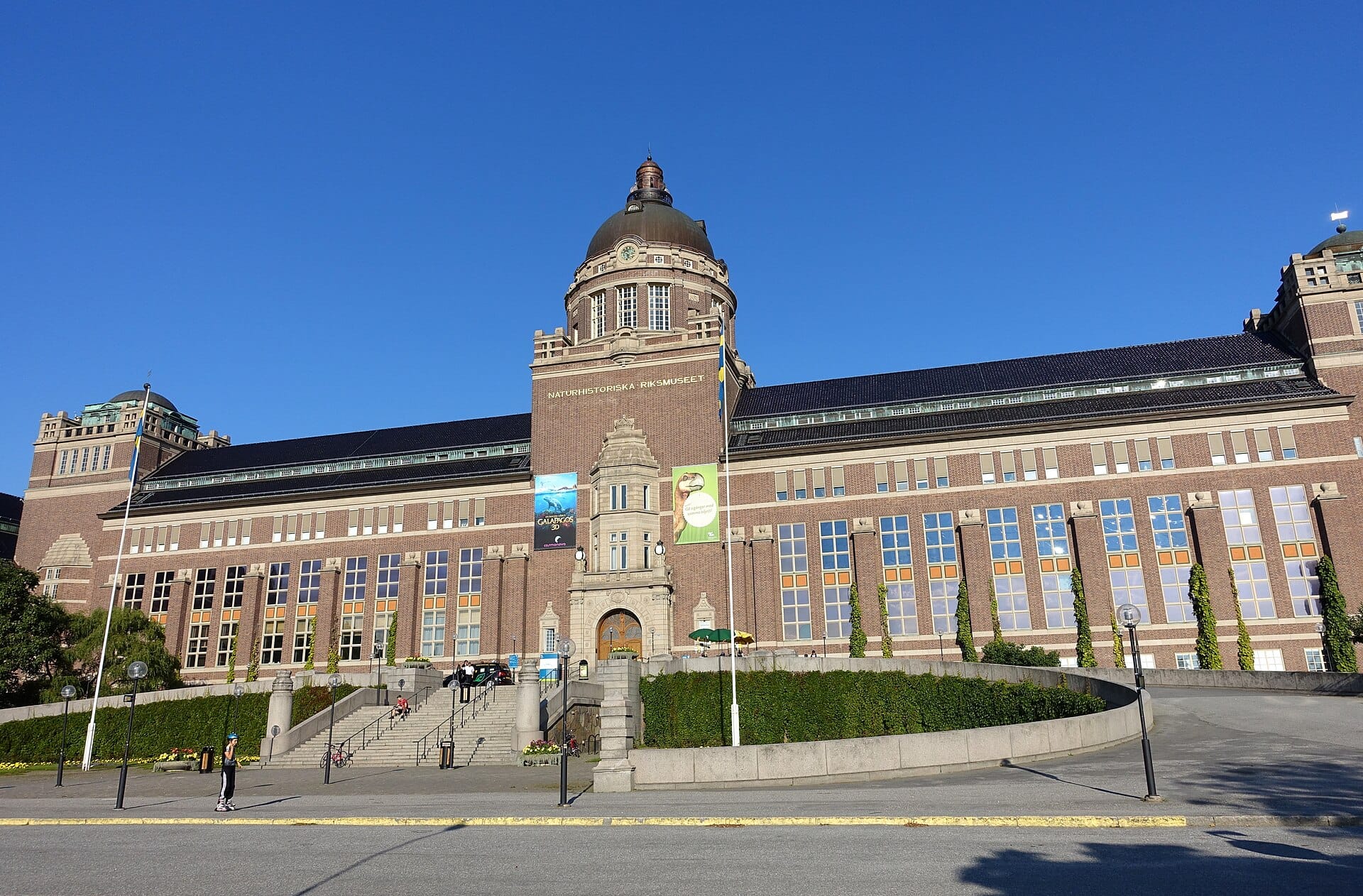
Anderberg's building is a substantial piece of early 20th-century Swedish institutional architecture: a wide symmetrical facade in rendered masonry, with a central dome that signals the Cosmonova inside, flanked by wings that stretch back into the Frescati landscape. The proportions are serious without being cold. Standing at the main entrance, you get the sense of a building designed to outlast its era, which it has.
The location adds context. The museum sits at Frescativägen 40 in the Frescati area, directly adjacent to Stockholm University and within the boundaries of Norra Djurgården, part of the Royal National City Park. That parkland setting means the surrounding grounds are genuinely green and walkable, not a concrete plaza. On mild days, the area between the museum and the university buildings fills with students and strollers, and the quiet is noticeable compared to central Stockholm.
Tickets & tours
Live prices and dates from our booking partner. If you book, we may earn a commission at no extra cost to you.
2-hour archipelago tour on a RIB speedboat
From 122 €Instant confirmationFree cancellationHaunted Stockholm exploration game and tour
From 12 €Instant confirmationFree cancellationFotografiska Stockholm entrance tickets
From 0 €Instant confirmationFree cancellationStockholm: Nature Reserve Hiking Tour with Campfire Lunch
From 102 €Instant confirmationFree cancellation
Visiting the Exhibitions: What You Will Actually See
The permanent exhibitions cover the full arc of natural history, from mineralogy and geology to paleontology, zoology, and ecology. The mineral and rock collections are among the strongest in Scandinavia, and the paleontology halls include fossil material that reflects genuine scientific fieldwork rather than replicas assembled for visual effect. Skeletal mounts of large prehistoric animals occupy central positions in the main halls, providing the kind of scale that photographs do not capture.
The zoology galleries are organized around Swedish and Nordic fauna as well as broader global biodiversity. Taxidermy of Scandinavian megafauna, including elk, bear, and wolves, is presented with enough ecological context to make it genuinely informative rather than merely decorative. Children respond strongly to the large animal displays; adults with any interest in natural science tend to slow down in the invertebrate and entomology sections, where the sheer variety on display is quietly extraordinary.
Exhibition signage is primarily in Swedish, with English translations available in most sections. The depth of information varies by gallery: some areas feel museum-quality in their curation, while others, particularly in older wings, retain the feel of a working collection made accessible rather than a designed visitor experience. That is not a flaw. It contributes to the museum's credibility as a research institution rather than a theme park.
💡 Local tip
If you have children under 10, head directly to the animal halls and the interactive ecology sections on arrival. These areas draw the most engagement and tend to be busier by midday. Early-morning visitors, particularly on weekdays, often have the larger exhibition halls almost entirely to themselves.
Cosmonova: The IMAX Dome and Planetarium
Cosmonova is the museum's dedicated IMAX dome theater and planetarium, and it operates as a separate attraction within the same building. Dome films typically cover natural history, astronomy, and environmental science, shown on a tilted full-dome screen that produces a genuinely immersive experience. Planetarium shows, which vary by season, cover topics from stellar cartography to the history of space exploration.
The quality of Cosmonova screenings is high. The dome format works particularly well for ocean and space content where scale and three-dimensionality matter. Shows are offered in Swedish, with some screenings in English or with English subtitles. Check the schedule on the museum's website before visiting, and book ahead if you are visiting on a weekend or during Swedish school holidays, when Cosmonova seats fill quickly.
Current Cosmonova ticket prices are listed in SEK on the museum's website and should be checked before your visit, as they are updated periodically. The combination of free exhibition access and a paid Cosmonova show makes for a genuinely cost-effective half-day.
When to Visit and How the Experience Changes
The museum opens at 11:00 on weekdays and 10:00 on weekends, and typically closes at 17:00, though opening hours can vary by day and season. Verify the specific calendar on nrm.se before planning your visit, particularly around Swedish public holidays and the summer period when hours sometimes extend.
Weekday mornings are the quietest time to visit. By 10:00 on a Tuesday or Wednesday, the main halls are calm enough that you can spend time in front of individual display cases without competition. School groups tend to arrive mid-morning and dominate the interactive sections through lunch, so if you prefer a more contemplative pace, arriving at opening and working through systematically gives you the best of the collections before the crowds build.
Weekend afternoons are the most crowded, particularly in the free exhibition areas. Cosmonova show times on weekends are frequently sold out for the 12:00 to 15:00 slots. If you plan to combine both the exhibitions and Cosmonova on a Saturday or Sunday, book the Cosmonova show first and structure your exhibition visit around it.
Seasonally, the museum is a natural choice for rainy days in any month. Stockholm's autumn, from September through November, brings plenty of overcast and wet days when outdoor sightseeing loses its appeal. The museum fills a half-day reliably under any weather conditions. In summer, the park setting around the building makes for a pleasant continuation into the grounds after your visit, particularly toward the university gardens.
The museum's location in Norra Djurgården means it fits naturally into a wider day that includes the parklands of Ekoparken or a visit to the nearby Djurgården island, which sits just to the south and holds several of Stockholm's most significant cultural institutions.
Getting There: Transit and Practical Access
The most straightforward route from central Stockholm is the metro's Red Line to Universitetet station. From there, the museum is a short walk through the university campus, following signs toward Frescativägen. The walk takes around 10 minutes and passes through pleasant grounds.
Several bus routes also stop near the museum, with the Frescati area served directly. Check the SL journey planner for current bus numbers, as routing can change. Stockholm's public transport network is managed by Storstockholms Lokaltrafik (SL), and standard SL tickets cover both the metro and connecting buses.
If you are new to Stockholm's public transport system, the guide to getting around Stockholm covers SL ticket options, including the 24-hour and 72-hour passes that offer the best value for visitors making multiple journeys.
ℹ️ Good to know
The museum is accessible by lift and has facilities for visitors with mobility requirements. For specific needs, including adapted entrances and accessible restrooms, check the accessibility section of nrm.se or call +46 (0)8 519 540 00 before your visit.
Is the Museum Worth Your Time? An Honest Assessment
For visitors with a genuine interest in natural history, paleontology, or ecology, the answer is clearly yes. The collections are substantial, the building is architecturally interesting, and the free entry removes any financial risk. You can spend two hours here and feel the visit was well worth the metro ride.
For visitors primarily interested in Stockholm's cultural or historical narrative, this museum competes with stronger options. If your day includes a choice between the Swedish Museum of Natural History and, say, the Vasa Museum or Historiska museet, the latter two are more distinctly Stockholm-specific experiences. The Natural History Museum is a world-class science institution, but its content is not uniquely tied to Swedish history or culture in the way those alternatives are.
Visitors traveling with children who have already done the Vasa Museum and Skansen will find the Natural History Museum a strong third day option, particularly if combined with Cosmonova. For a broader view of what Stockholm's museums offer, the guide to Stockholm's best museums provides useful comparisons.
Visitors who find natural history museums dry or static may not be converted here. The Naturhistoriska riksmuseet is more traditional in presentation than some newer science museums with heavy interactive elements. It rewards patience and curiosity rather than delivering a high-stimulation experience.
Insider Tips
- Book your Cosmonova show online before you arrive, not after seeing the exhibitions. Walk-up availability disappears quickly on weekends and during Swedish school holidays (especially in February, April, and October).
- The museum café and eating facilities are practical but not exceptional. The university campus a short walk away has more varied food options at student-friendly prices, including the main student union building.
- The mineral and gemstone collection, located in the geological wing, is one of the less-visited sections of the museum but holds genuinely striking specimens. It tends to be quiet even when the animal halls are busy.
- On weekday mornings in autumn and winter, the large mammal halls can feel almost private. Arriving at opening on a November Tuesday gives you the skeletal mounts and dioramas with virtually no crowds and excellent light through the tall windows.
- The museum grounds adjoin the university botanical area. If you visit in late spring or early summer, the walk back toward the metro passes flowering plantings that are worth slowing down for.
Who Is Swedish Museum of Natural History For?
- Families with school-age children looking for a substantive, free indoor activity
- Science and natural history enthusiasts who want depth over spectacle
- Budget travelers: free permanent exhibitions make this one of Stockholm's best-value half-days
- Rainy-day visitors needing a full morning or afternoon of indoor content
- Visitors combining a trip to the university area or Norra Djurgården parklands
Nearby Attractions
Combine your visit with:
- Birka Viking Town
Founded around AD 750 on a remote island in Lake Mälaren, Birka was one of Scandinavia's earliest true urban trading centers. Today it survives as part of the UNESCO World Heritage Site Birka and Hovgården, reached only by seasonal boat from Stockholm, where around 2,000 Viking-age graves still dot the surrounding landscape. It is one of the most historically significant half-day excursions available from the Swedish capital.
- Drottningholm Palace
Drottningholm Palace is Sweden's most complete royal domain, a UNESCO World Heritage Site on Lovön island just about 10 km west of Stockholm. The baroque complex includes the palace, a working 18th-century theatre, a Chinese Pavilion, and formal gardens that shift in character across every season.
- Royal National City Park (Ekoparken)
The Royal National City Park, known locally as Ekoparken, is the world's first national urban park and one of Stockholm's most remarkable features. Stretching around 27 km² from Djurgården in the south to Ulriksdal in the north, it wraps around the city in a continuous arc of ancient oak forests, royal palaces, museum islands, and open waterways. Entry is free and the park never closes.
- Hagaparken
Hagaparken is a 144-hectare English landscape park just north of central Stockholm, laid out for King Gustav III in the late 18th century. Free to enter year-round, it offers a rare combination of royal history, open meadows, and waterside walking paths within easy reach of the city. Individual attractions inside the park, including the Butterfly House and royal pavilions, charge their own fees.
Planning a trip? Discover personalized activities with the Nomado app.