Nakazakicho: Osaka's Cafe and Vintage District
Nakazakicho (中崎町) is a pocket of early-Showa-era wooden townhouses in Kita Ward that survived postwar redevelopment intact. Today those old machiya house indie cafes, vintage clothing dealers, and small galleries, making it one of Osaka's most distinct and walkable neighborhoods for an unhurried half-day.
Quick Facts
- Location
- Nakazakinishi, Kita Ward, Osaka (approx. 1 Chome-1 Nakazakinishi, Kita-ku, Osaka 530-0015)
- Getting There
- Nakazakicho Station (Osaka Metro Tanimachi Line) — the district’s main cluster of cafes and vintage shops begins a short walk north of the exits
- Time Needed
- 2–4 hours for a comfortable walk, browsing, and one cafe stop
- Cost
- Free to walk; individual cafes and shops charge their own prices. Budget ¥500–¥1,500 for coffee and a snack
- Best for
- Slow-travel explorers, vintage fashion hunters, cafe-hoppers, photographers
What Nakazakicho Actually Is
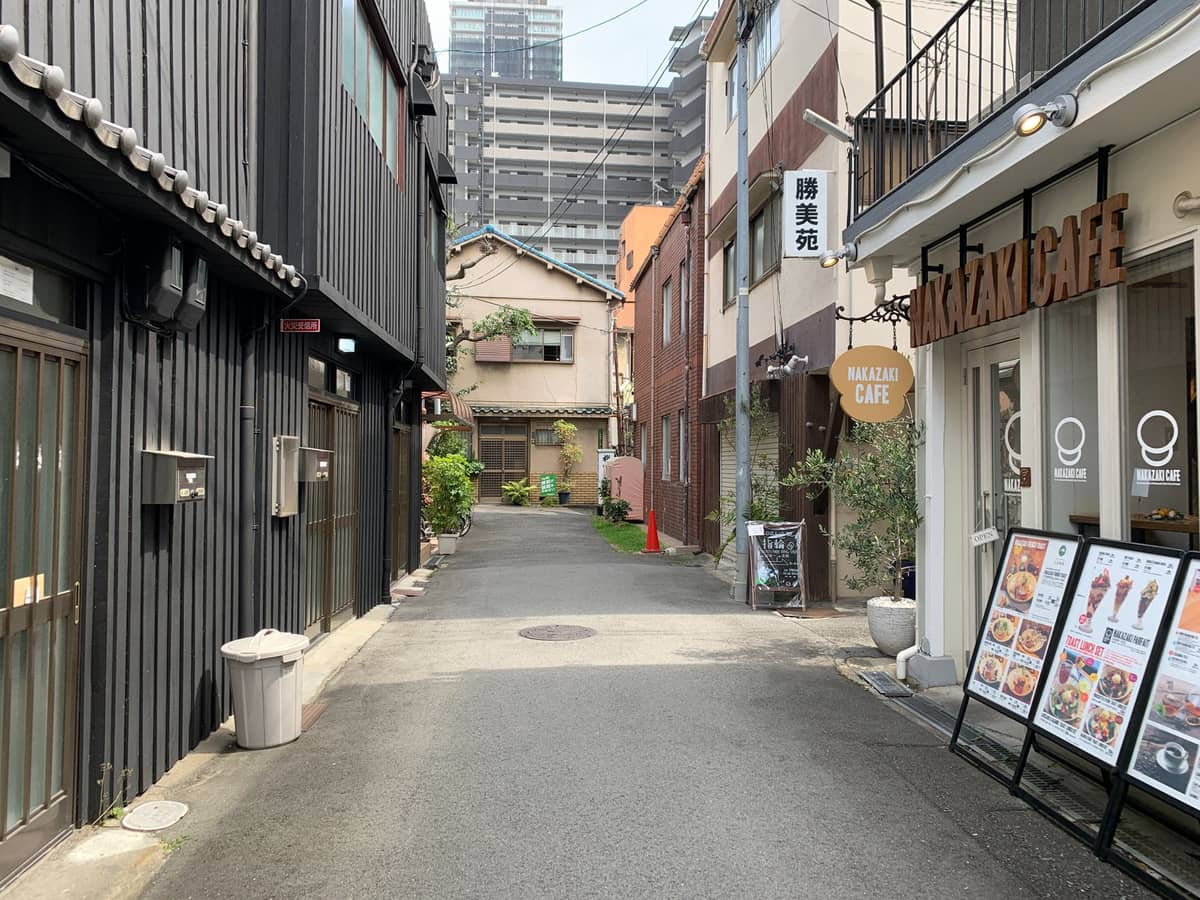
Nakazakicho is not a curated attraction with a ticket booth or an opening time. It is a residential neighborhood in Kita Ward, roughly ten minutes on foot from the enormous Umeda commercial district, and its character comes almost entirely from what was not built here. When postwar redevelopment swept through central Osaka, the dense grid of pre-war machiya (wooden townhouses) in Nakazakicho was largely left alone. Those narrow two-story structures, with their latticed wooden facades and low eaves, became the physical container for everything the neighborhood is today.
Over the past two decades, independent operators moved into the old machiya and converted them into cafes, vintage clothing shops, record stores, handmade accessory studios, and small art spaces. The result is a neighborhood that looks nothing like the rest of Kita Ward and operates on a different pace entirely. Streets are narrow enough that two people with shopping bags have to turn sideways to pass each other, and that compression is part of the appeal.
💡 Local tip
Most shops and cafes in Nakazakicho open around 12:00 and close between 18:00 and 20:00, though individual hours vary by operator. Visiting before noon on weekdays gives you the quietest streets and the best chance of finding seating in smaller cafes without a wait.
The Physical Experience: Streets, Buildings, and Atmosphere
The Tanimachi Line surfaces you directly into the neighborhood at Nakazakicho Station. Within two minutes of the exit, the cityscape changes noticeably. The glass and steel of Umeda gives way to timber-framed buildings where the wood has darkened with age, where planters sit on narrow stoops, and where hand-painted signboards lean against facades rather than hanging from steel brackets. Underfoot, some alleys have irregular stone paving rather than standard urban concrete.
Smell is one of the more reliable signals that you have arrived: fresh-roasted coffee drifts from several of the independent cafes, sometimes mixing with the cedar-and-must scent that old wooden buildings produce on warm days. On cooler autumn mornings, the smell of something baking, often a simple milk bread or castella, finds its way into the alleys from a few of the smaller cafes that do their own baking on-site.
The acoustic texture is also distinct. Nakazakicho is quiet relative to surrounding Osaka. Conversations from open shopfronts, the occasional sound of a record playing inside a store, and bicycle wheels on old paving are the dominant sounds. There is almost no vehicle noise inside the inner lanes. This is not a neighborhood designed for cars.
Tickets & tours
Hand-picked options from our booking partner. Prices are indicative; availability and final rates are confirmed when you complete your booking.
Evening food tour in Kyoto's geisha district Gion
From 163 €Instant confirmationFree cancellationKobe: Mt. Rokko Night View, Kitano Ijinkan, Arima Onsen Full Day Tour
From 47 €Instant confirmationFree cancellationOsaka local food tour in Dotonbori and Shinsekai
From 51 €Instant confirmationFree cancellationGuided day tour from Osaka to Nara Park, Arashiyama and Fushimi Inari
From 59 €Instant confirmationFree cancellation
How the District Changes Through the Day
On weekday mornings before 11:00, Nakazakicho is almost entirely residential. A few coffee shops open early for the neighborhood's own residents, and you will see locals on bicycles and older residents sweeping their stoops. This is the least photogenic window but the most authentic one.
By early afternoon on weekends, foot traffic increases noticeably, with a mix of younger Osaka residents doing vintage shopping and tourists who have made the deliberate trip from the main sightseeing circuit. The narrower alleys can feel genuinely crowded during peak weekend afternoons, particularly in spring (late March to early May) and autumn (October to November), when Osaka's weather draws more people outdoors. If the crowd density bothers you, arriving by 11:30 rather than 13:00 makes a tangible difference.
Late afternoon, roughly 16:00 to 18:00, brings a softer quality of light that drops into the narrow east-west streets. This is generally the most rewarding time for photography, when the low sun catches the texture of the old wooden facades without the harsh overhead contrast of midday. By 19:00, some of the smaller shops are closing, and the neighborhood reverts to its quieter residential character.
Cafes and Vintage Shops: What to Expect
The cafes in Nakazakicho tend to be compact, independently owned, and specific in their identity. Some specialize in single-origin filter coffee and seat perhaps eight people. Others lean toward kissaten-style (old-school Japanese coffee shop) aesthetics, with dark wood, vinyl records, and a slower, more deliberate approach to both the coffee and the service. A few serve simple food, typically sandwiches, curry, or sweets, though Nakazakicho is not primarily a dining destination.
Vintage clothing is the other dominant retail category. The shops here stock a different tier from the mass-market secondhand chains found elsewhere in Osaka. Expect American workwear from the 1950s to 1980s, Japanese brands from the 1970s and 1980s, deadstock denim, and occasional European pieces. Prices reflect the curation: a decent flannel shirt might start at ¥3,000, while desirable pieces from well-known brands fetch considerably more. Browsing without buying is accepted and common.
The neighborhood also has small record shops, handmade jewelry studios, and the occasional gallery space. None of these are large. For context, the Tenjinbashisuji Shopping Street is only a short walk northeast and provides a dramatically different shopping experience: longer, louder, and more commercial. Many visitors pair the two in the same half-day.
Getting There and Practical Navigation
The simplest route is the Osaka Metro Tanimachi Line to Nakazakicho Station. The station is one stop from Higashi-Umeda, and from there Umeda’s main transport hub is a short walk via underground passages and surface streets, making it an easy addition to any itinerary based in Kita Ward. The station exit leads directly into the district's edge, and no additional navigation is required beyond following the visible street character.
If you are coming from the south, from Namba or Shinsaibashi, take the Tanimachi Line northbound to Nakazakicho Station. The journey is around 15 minutes. There is no direct bus route that makes this trip more convenient than the metro.
The neighborhood is compact: the core area of shops and cafes can be crossed on foot in roughly ten minutes if you walk without stopping. Most visitors spend time doubling back through the same alleys multiple times as they spot things they missed. Wear comfortable shoes. The paving in some alleys is uneven, and the best spaces are often down narrow side passages that require a bit of attention to find.
⚠️ What to skip
Accessibility varies significantly by individual shop. Many of the vintage cafes and stores occupy old wooden buildings with steps at the entrance and no interior lift. Wheelchair users and travelers with mobility limitations should be aware that the district itself is navigable on foot, but access into individual venues may be restricted.
Photography in Nakazakicho
Nakazakicho photographs best in late afternoon light on a clear day, particularly in autumn when the narrow streets hold a warm tone. The architectural detail on the machiya facades, latticed windows, aged timber, small planters, hand-lettered signs, rewards close-up work as much as wider street shots. A phone camera is perfectly adequate; the interest is in texture and detail rather than grand scale.
If you are trying to capture the neighborhood without crowds in frame, weekday mornings before shops open give you empty alleys against the architectural backdrop. For a broader Osaka photography itinerary, it is worth comparing this neighborhood with the atmosphere around Hozenji Yokocho in Namba, which offers a different style of old-Osaka atmosphere, typically more atmospheric after dark.
Who This District Suits, and Who It May Disappoint
Nakazakicho works well for travelers who are comfortable with slow, unstructured time: walking without a checklist, sitting with a coffee, browsing without obligation. It rewards patience and a willingness to look closely at small things. If your Osaka itinerary is tight and you are prioritizing major landmarks, this neighborhood may feel like an indulgence that does not deliver enough discrete content to justify a dedicated trip.
Travelers who are primarily interested in Osaka's food scene, major historical sites, or large-scale attractions will find more direct satisfaction at places like Kuromon Ichiba Market or Osaka Castle. Nakazakicho is a complement to those experiences, not a replacement for them.
Families with young children may find the district pleasant for a short walk but will struggle to sustain engagement for more than an hour, as the shops skew toward adult-specific products and the cafes are generally small and not designed for children. Travelers who find vintage clothing and independent coffee culture uninteresting will exhaust the neighborhood's appeal quickly.
ℹ️ Good to know
Rain does not ruin a visit to Nakazakicho, but it narrows the experience. The alleys become slippery, and some of the smaller shops close early or open late on heavy rain days. A light rain on an overcast afternoon does add a certain atmosphere to the old wooden facades, and the cafes become noticeably more appealing on a cold, wet day.
Insider Tips
- Look for the alleys that run perpendicular to the main shopping lanes. Several of the most interesting small shops and a handful of the better cafes are one level removed from the obvious routes, in passages that are easy to miss if you are only following the crowd.
- If you want to eat a full meal nearby before or after visiting, walk ten minutes south toward Nakatsu Station, where a wider range of restaurants and izakaya operate at standard Osaka prices without the tourist markup.
- Card payments are not universally accepted in Nakazakicho's smaller shops and cafes. Carry at least ¥3,000–¥5,000 in cash to avoid being turned away at the register.
- The neighborhood is at its most photogenic in the week or two after a rain, when the wood on the older buildings is still dark with moisture and the small plants on stoops look freshly washed. The air also carries more of the cedar and timber smell in damp conditions.
- Weekday afternoons between 13:00 and 16:00 offer a reasonable balance of open shops and manageable crowds. Sunday afternoons in spring and autumn are when the district gets its closest to genuinely congested.
Who Is Nakazakicho Cafe & Vintage District For?
- Solo travelers who enjoy exploring at their own pace without a fixed agenda
- Vintage clothing enthusiasts looking for curated secondhand pieces beyond mass-market chains
- Coffee specialists seeking small-batch, single-origin or kissaten-style cafes
- Photographers interested in pre-war urban architecture and street texture
- Travelers wanting a counterpoint to Osaka's larger commercial districts on the same day
Nearby Attractions
Combine your visit with:
- Expo '70 Commemorative Park
Built on the grounds of the 1970 Japan World Exposition, Expo '70 Commemorative Park (万博記念公園) in Suita City is one of greater Osaka's largest open spaces. It combines parkland, a traditional Japanese garden, a museum dedicated to the original expo, and the striking Tower of the Sun — an icon of 20th-century Japanese design that still stops visitors in their tracks.
- Kema Sakuranomiya Park
Kema Sakuranomiya Park stretches for several kilometers along the Okawa River in central Osaka, lined with roughly 4,800 cherry trees that draw enormous crowds each spring. It is free to enter, open around the clock, and easily reached from multiple train lines. Outside of cherry blossom season, the park is a quiet, flat riverside corridor used primarily by joggers and cyclists.
- Minoh Falls
Minoh Falls (箕面大滝) sits inside Meiji-no-Mori Minoh Quasi-National Park, north of Osaka city. The trail from Hankyu Minoh Station follows a wooded river gorge for roughly 40 to 45 minutes before delivering you to the falls. Admission is free, and the park and falls area are open 24 hours with no staffed gate.
- Mint Museum Osaka (Japan Mint)
Tucked inside the grounds of Japan Mint's Osaka headquarters in Kita-ku, the Mint Museum offers a free, unhurried look at the full sweep of Japanese coinage history, from ancient cast coins to contemporary commemorative medals. It is one of Osaka's more quietly rewarding museums, and one of the few major attractions in the city that costs nothing to enter.