Expo '70 Commemorative Park: Osaka's Most Unexpected Green Escape
Built on the grounds of the 1970 Japan World Exposition, Expo '70 Commemorative Park (万博記念公園) in Suita City is one of greater Osaka's largest open spaces. It combines parkland, a traditional Japanese garden, a museum dedicated to the original expo, and the striking Tower of the Sun — an icon of 20th-century Japanese design that still stops visitors in their tracks.
Quick Facts
- Location
- 1-1 Senri Expo Park, Suita City, Osaka Prefecture (within Osaka metro area)
- Getting There
- Banpaku-Kinen-Koen Station, Osaka Monorail (direct park access)
- Time Needed
- 2 to 4 hours for a thorough visit; half-day if exploring all gardens and the pavilion
- Cost
- Natural and Cultural Garden: ¥450 (high school students and above), free (junior high and below). EXPO'70 Pavilion: additional ¥500 (high school and above). Verify current pricing before visiting.
- Best for
- Architecture enthusiasts, families with children, picnickers, photographers, Japan history buffs
- Official website
- www.expo70-park.jp/languages/english
What Is Expo '70 Commemorative Park?
Expo '70 Commemorative Park, known in Japanese as 万博記念公園 (Banpaku Kinen Kōen), occupies the former site of the Japan World Exposition 1970 in Suita City, on the northern edge of the Osaka metropolitan area. That exposition was the first World Expo held in Asia, and it drew over 64 million visitors across six months — a staggering figure for its era. The park created in its wake is a deliberate act of preservation: the vast grounds, the ceremonial axis of the original layout, and above all, the Tower of the Sun were kept intact as reminders of what took place here.
Today the park spreads across a wide, largely flat landscape of manicured lawns, seasonal flower fields, a formal Japanese garden, cycling paths, and multiple indoor facilities. It does not feel like a typical urban park squeezed between buildings. There is genuine scale here — enough open sky that the Tower of the Sun reads against it properly, which is exactly how architect Taro Okamoto intended it.
ℹ️ Good to know
Opening hours are 9:30 to 17:00, with last admission at 16:30. The park is closed on Wednesdays (or the following day if Wednesday is a national holiday) and during New Year holidays. Always check the official site before visiting, as closure schedules can shift seasonally.
The Tower of the Sun: The Reason Most People Come
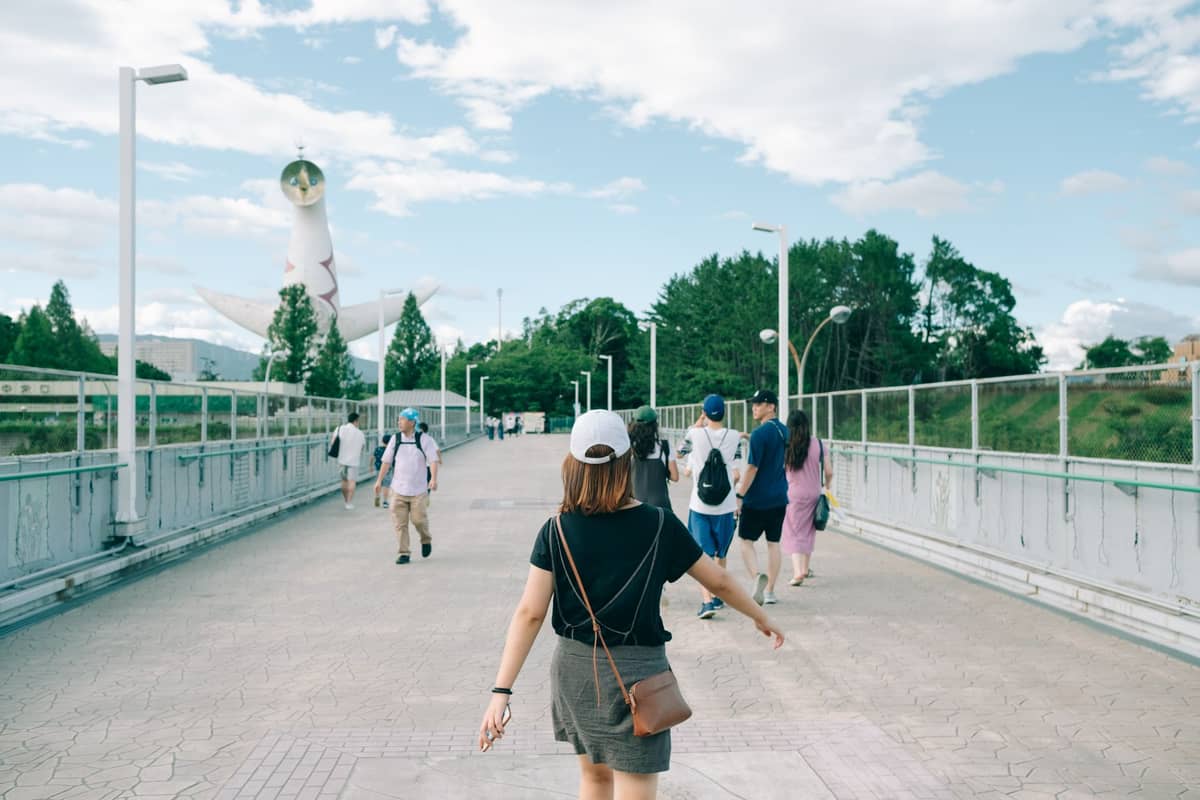
Whatever else brings you to this park, the Tower of the Sun (太陽の塔, Taiyō no Tō) is the gravitational center of the experience. Designed by artist Taro Okamoto as the symbol of Expo '70, it stands roughly 70 meters tall and presents three faces: the Golden Face at the top catching direct sunlight, the Sun Face on the front, and the Black Sun on the back — a darker, more ambiguous motif that Okamoto described as representing the past. The tower was built to sit inside the festival's Theme Pavilion, meaning it literally protruded through the roof of the building. That building is long gone, but the tower remains, and the effect of encountering it without context for the first time is genuinely disorienting in the best possible way.
The interior of the tower was restored and reopened to visitors in 2018, revealing the original Tree of Life installation inside — a sculpture of a tree with 292 creatures representing the evolution of life. Admission to the interior requires an advance reservation and a separate ticket from the park entry fee. If visiting the interior is a priority, book before you travel, as slots fill on peak weekends.
Photographically, the tower reads best in the morning, when light falls on the Sun Face from the southeast and shadows define the facial features clearly. By midday the light flattens. Late afternoon creates interesting rim lighting on the structure but can place the face in partial shadow. For the widest clear shot of the full tower against sky, position yourself on the central lawn along the original expo axis. If you are visiting Osaka for its architectural landmarks, the Umeda Sky Building and the Tower of the Sun make a natural pair — very different in era and intent, but both worth serious attention.
Tickets & tours
Hand-picked options from our booking partner. Prices are indicative; availability and final rates are confirmed when you complete your booking.
Kobe: Mt. Rokko Night View, Kitano Ijinkan, Arima Onsen Full Day Tour
From 47 €Instant confirmationFree cancellationOsaka local food tour in Dotonbori and Shinsekai
From 51 €Instant confirmationFree cancellationGuided day tour from Osaka to Nara Park, Arashiyama and Fushimi Inari
From 59 €Instant confirmationFree cancellationShiga Day Trip with Miho Museum, Lake Biwa and Waterbird Shrine
From 70 €Instant confirmationFree cancellation
The Park Grounds: Seasonal Rhythms and What to Expect
The park's natural character shifts considerably across the year. Spring brings cherry blossoms along the tree-lined pathways and large plantings of tulips and rapeseed flowers in the dedicated flower fields — this is the park's most photogenic and most crowded season. Autumn transforms the Japanese maple plantings into patches of deep red and orange, and crowds return for momiji (autumn leaf) viewing. Summer is warm to hot, with temperatures regularly exceeding 30°C in July and August; the open lawns offer little shade and the humidity can be punishing. Early mornings in summer are manageable and noticeably quieter.
Winter sees the park at its quietest and most austere. The bare trees and quieter paths actually allow you to appreciate the spatial logic of the original expo layout more clearly, without the distraction of seasonal crowds. If your visit coincides with autumn, this pairs naturally with other leaf-viewing spots around Osaka. The autumn in Osaka guide covers the broader seasonal context across the city.
The Japanese Garden inside the park occupies a separate, enclosed section and carries its own admission charge beyond the park entry fee. It is a substantial traditional garden with a central pond, stone lanterns, and carefully maintained plantings — well worth the extra cost if you have the time. Allow at least 45 minutes inside the garden alone.
💡 Local tip
Bring water and sunscreen for summer visits. The central lawns have almost no shade cover, and vending machines are present but spread out. Comfortable walking shoes are more useful than sandals, as paths between areas cover real distance.
EXPO'70 Pavilion: The History of the Exposition
For visitors interested in the exposition itself rather than just the park, the EXPO'70 Pavilion is the core exhibit. Housed inside the park, it documents the 1970 exposition through photographs, artifacts, scale models, and multimedia presentations. The materials are substantial: original signage, uniforms, and pavilion fragments that give a strong sense of how futuristic and optimistic the exposition's vision of the world felt at the time.
Admission to the EXPO'70 Pavilion is ¥500 for high school students and above, on top of the separate park entry fee. Holders of Japanese disability certificates and one accompanying person are admitted free. The pavilion is part of the park's Universal Tourism program, indicating accessibility features are in place — though specific details should be confirmed at the site.
The pavilion is worth an hour of your time even if the 1970 exposition means nothing to you going in. The context it provides for the Tower of the Sun makes the return visit to the structure outside more meaningful. If you are drawn to Japan's postwar modernist culture, this pairs well with a visit to the Tower of the Sun interior tour and the broader exhibition of Taro Okamoto's work represented at the site.
Getting Here and Getting Around
The most direct route to Expo '70 Commemorative Park is the Osaka Monorail to Banpaku-Kinen-Koen Station. The monorail connects with multiple Osaka Metro lines and JR lines, making it accessible from most parts of the city without requiring a car. From central Osaka (Umeda or Namba area), count on roughly 30 to 45 minutes including any transfer, depending on your starting point.
The park is located in Suita City, which is technically a separate municipality from Osaka City, though it sits squarely within the metropolitan area. It is not covered by Osaka Metro day passes, so check whether your transport pass extends to the Osaka Monorail before assuming it does. The Osaka transit guide covers pass options in detail.
Inside the park, distances between areas are genuine — from the main gate to the far end of the Japanese Garden is a meaningful walk. Bicycle rentals are available within the park if you prefer to cover ground more efficiently. The terrain is flat throughout, which helps.
⚠️ What to skip
The park is closed on Wednesdays (with some seasonal exceptions). Arriving on a Wednesday without checking ahead is a common and avoidable mistake. Confirm the schedule on the official website before your visit.
Honest Assessment: Who This Park Is Really For
Expo '70 Commemorative Park is not trying to compete with central Osaka's density of temples, markets, and entertainment. It is a different kind of destination: a large, calm, historically significant landscape that rewards visitors who approach it with some curiosity about Japanese modern history and mid-century design. Families with children will find plenty of open space, play areas, and room to run without fighting crowds on a typical weekday. Photographers and architecture enthusiasts will find the Tower of the Sun endlessly interesting.
Travelers on a very short Osaka itinerary who are primarily interested in food, shopping, and the city's central districts may find the transit time harder to justify. The park is not within walking distance of Dotonbori or Namba, and a round trip costs real time in a city with many competing claims on it. If you are working through a tight 3-day Osaka itinerary, slot this park on a day when you are not also trying to cover the historic center.
Visitors who specifically want extensive traditional garden experiences may find Osaka's other garden options more central to access. That said, if green space is a priority across your trip, the best gardens in Osaka guide will help you compare what is available across the city.
Insider Tips
- The Tower of the Sun interior requires a separate advance reservation — it cannot be booked at the gate on the day. Check the official park website for the reservation system before your trip, especially if visiting on a weekend or during cherry blossom or autumn season.
- Weekday mornings between 10:00 and 12:00 are consistently the quietest period. School groups arrive in organized waves, usually mid-morning on weekdays during term time, but the park is large enough that they rarely affect the whole site at once.
- The park's flower fields are mapped on the official site with seasonal bloom forecasts. Checking which flowers are at peak before you visit significantly changes the visual reward of the trip — some fields are stunning and others are completely bare depending on the month.
- Wednesday closures are suspended during the most popular seasons (April–early May, October–November), so these periods are actually good times to visit if Wednesday is your only available day.
- Combining this park with a visit to the Osaka Museum of Ethnology (Senri Expo Park, same complex) is possible on a single day and makes the transit time more efficient. The museum is a serious institution with extensive collections — factor in extra time if you choose to do both.
Who Is Expo '70 Commemorative Park For?
- Architecture and design enthusiasts drawn to Taro Okamoto's Tower of the Sun and its place in postwar Japanese cultural history
- Families with children who need open space, cycling paths, and room to move without the pressure of urban crowds
- Photographers working on seasonal subjects: cherry blossoms in spring, maple foliage in autumn, and year-round architectural subject matter
- Travelers interested in 20th-century Japan and the cultural moment of the 1970 World Exposition
- Visitors looking for a slower-paced half-day away from central Osaka's dense commercial districts
Nearby Attractions
Combine your visit with:
- Kema Sakuranomiya Park
Kema Sakuranomiya Park stretches for several kilometers along the Okawa River in central Osaka, lined with roughly 4,800 cherry trees that draw enormous crowds each spring. It is free to enter, open around the clock, and easily reached from multiple train lines. Outside of cherry blossom season, the park is a quiet, flat riverside corridor used primarily by joggers and cyclists.
- Minoh Falls
Minoh Falls (箕面大滝) sits inside Meiji-no-Mori Minoh Quasi-National Park, north of Osaka city. The trail from Hankyu Minoh Station follows a wooded river gorge for roughly 40 to 45 minutes before delivering you to the falls. Admission is free, and the park and falls area are open 24 hours with no staffed gate.
- Mint Museum Osaka (Japan Mint)
Tucked inside the grounds of Japan Mint's Osaka headquarters in Kita-ku, the Mint Museum offers a free, unhurried look at the full sweep of Japanese coinage history, from ancient cast coins to contemporary commemorative medals. It is one of Osaka's more quietly rewarding museums, and one of the few major attractions in the city that costs nothing to enter.
- Nagai Botanical Garden
Tucked inside Nagai Park in Higashisumiyoshi Ward, the Osaka Municipal Nagai Botanical Garden is a serious green space where locals outnumber tourists and seasonal plant displays are taken seriously. At 300 yen entry, it offers one of the best value-to-experience ratios of any attraction in the city.