Umeda Sky Building: Osaka's Rooftop Observatory Above the City Grid
The Umeda Sky Building is one of Osaka's most architecturally distinctive structures, connecting two towers at 173 meters via a circular open-air observatory. Whether you visit at noon for clear skyline views or at sunset when the city shifts from gold to neon, the Kuchu Teien (Floating Garden) Observatory delivers an experience that earns its place on a short itinerary.
Quick Facts
- Location
- 1-1-88 Oyodonaka, Kita-ku, Osaka 531-0076 (Umeda/Kita district)
- Getting There
- JR Osaka Station, Hankyu/Hanshin Osaka Umeda Station, or Osaka Metro Umeda Station — approx. 7–10 min walk
- Time Needed
- 1–2 hours for the observatory; add 30–45 min for the lower floors and garden
- Cost
- Adults ¥2,000; children (4–elementary school) ¥500; under 4 free. Osaka Amazing Pass holders: free before 15:00 and 10% off admission after 15:00. Verify current prices before visiting.
- Best for
- Sunset and night views, architecture enthusiasts, couples, photographers
- Official website
- www.skybldg.co.jp/en
What Is the Umeda Sky Building?
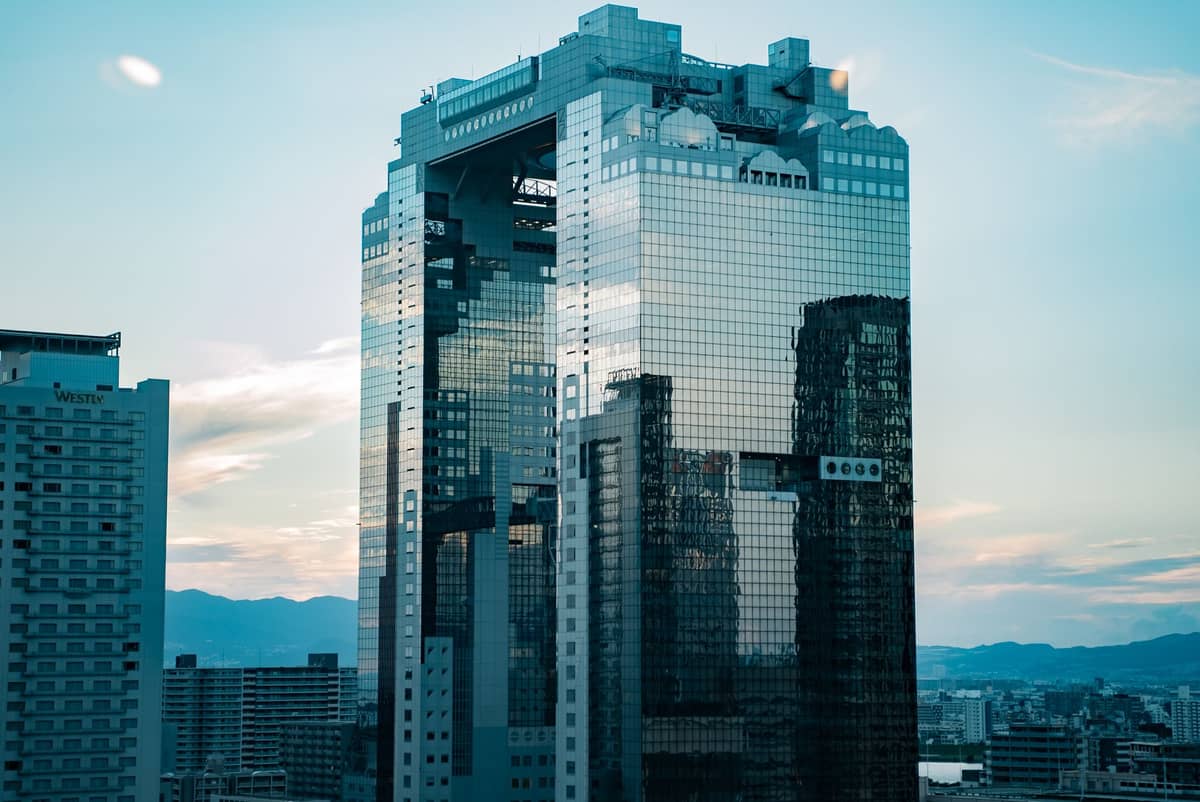
The Umeda Sky Building is a twin-tower high-rise in Osaka's Kita district, completed in 1993 and designed by architect Hiroshi Hara. What makes it structurally unusual is the connection between the two towers: a series of bridges and a circular capsule escalator join them at the upper floors, culminating in the Kuchu Teien Tenbodai, or Floating Garden Observatory, at roughly 173 meters above street level. There is nothing quite like it in Osaka's skyline — most tall buildings in the city are conventional rectangular towers, while this one resembles an enormous gateway arch seen from the street.
The building sits slightly northwest of Osaka Station, past a landscaped approach that includes a small waterfall feature and a basement-level Showa-era market recreation called Takimi-koji. This lower-level area, modeled on market streets from the 1920s and 1930s, provides an interesting contrast to the futuristic frame above it — and it serves as an atmospheric spot for a ramen or okonomiyaki meal before or after the ascent.
💡 Local tip
If you hold an Osaka Amazing Pass, you get free admission to the Kuchu Teien Observatory before 15:00, and a discounted rate after. The pass covers a wide range of city attractions and is worth calculating against your itinerary.
For a broader picture of what the pass covers and whether it makes financial sense for your trip, see the detailed breakdown in our Osaka Amazing Pass guide.
The Ascent: Getting to the Observatory
After purchasing your ticket on the ground floor, you take a conventional elevator to the 39th floor, then transfer to a glass-enclosed escalator that rises diagonally between the two towers through open air. This crossing is where the building's engineering becomes visceral. You can see the sky above you and the ground far below through the glass panels — it is genuinely exhilarating, and some visitors find it unsettling. If you have a significant fear of heights, the escalator section alone may be more than the view from the top is worth.
From the 39th floor escalator arrival, you step out onto an indoor circular gallery at the 40th floor before climbing further to the open-air rooftop ring. The rooftop is exposed to the elements on all sides, protected only by steel mesh fencing that is low-profile enough not to obstruct photography. Wind is a real factor here, particularly in autumn and winter, when temperatures at the top can feel considerably colder than at street level. In summer, the open air is a relief compared to the humid streets below, though midday sun in July and August can be intense.
Tickets & tours
Hand-picked options from our booking partner. Prices are indicative; availability and final rates are confirmed when you complete your booking.
Sake, whisky and cocktail luxury tour in Kyoto
From 130 €Instant confirmationFree cancellationKobe: Mt. Rokko Night View, Kitano Ijinkan, Arima Onsen Full Day Tour
From 47 €Instant confirmationFree cancellationOsaka local food tour in Dotonbori and Shinsekai
From 51 €Instant confirmationFree cancellationGuided day tour from Osaka to Nara Park, Arashiyama and Fushimi Inari
From 59 €Instant confirmationFree cancellation
Views and What You Actually See
On a clear day, the 360-degree view from the rooftop takes in the full spread of Osaka's urban fabric in every direction. To the south, you can trace the city center toward Namba and Tennoji, and on very clear days Mount Rokko and the hills above Kobe are visible to the west. The Osaka Bay coastline sits in the southwest, a gray-blue band beyond the dense residential grid. Directly below, the Umeda district's transport infrastructure — the sprawling rail yards and road interchanges around Osaka Station — reveals itself as a kind of organized chaos that is genuinely easier to appreciate from above than at ground level.
The view changes substantially with weather and time of day. On overcast days, the lower visibility flattens the experience somewhat, though the city's scale is still impressive. Haze is common in summer, and the clarity you might expect on a bright August afternoon is often missing — the clearest views typically occur in autumn and winter, when lower humidity and dry air extend visibility across the metropolitan area. Rain is not a complete dealbreaker since the indoor 40th-floor level still provides a sheltered perspective, but the open rooftop loses much of its appeal.
ℹ️ Good to know
For the best photography conditions, visit on a clear autumn or winter day between late afternoon and dusk. The sky transitions through warm orange tones before the city lights take over, giving you two distinct shots in a single visit.
The Umeda Sky Building is consistently listed among the top vantage points in the city. To compare it with other options, including free observation decks, see our guide to the best views in Osaka.
Sunset and Night: When the Building Is at Its Best
The building opens at 09:30 and last admission is at 22:00, with the observatory closing at 22:30. Most visitors who make the effort to time their visit around sunset find it the most rewarding window. The crowd is present but manageable in the early evening, and the quality of light during the transition from day to night justifies the extra planning. As darkness falls, the city below becomes a grid of orange and white light extending to the horizon, punctuated by the red warning beacons on distant towers.
From around 19:00 in summer and as early as 17:30 in winter, the illumination of the observatory ring itself begins, and the outdoor perimeter glows in a way that makes the building recognizable from other parts of the city. Standing on the rooftop at night, looking down at the Umeda rail yards and across to the Osaka Station City complex, the scale of the city becomes tangible in a way that a map never conveys. This is the version of the visit most people remember.
A word on crowds at peak hours: weekend evenings between 18:00 and 21:00 draw the most visitors, and the circular rooftop can feel congested at the popular westward-facing sections during sunset. Arriving slightly before or after the golden hour peak gives you more space and fewer elbows at the railing. Weekday evenings are noticeably quieter.
Practical Walkthrough: Getting There and Getting In
The Umeda Sky Building is a 7-minute walk from JR Osaka Station and about 9–10 minutes from Hankyu/Hanshin Osaka Umeda Station and Osaka Metro Umeda Station. The route runs northwest from the station complex through a stretch of mid-rise office buildings and a covered walkway section. Signage in English is present along the main route, but the final approach through the landscaped garden zone is easy to miss — look for the towers rising above the surrounding buildings and walk toward them. The building's main entrance is at ground level on the east side.
Tickets are purchased at the ground-floor counter. The process is straightforward, and the staff typically include English-speaking personnel or use a translation tablet system. Payment by IC card (Suica, ICOCA) and credit card is generally accepted, though cash remains reliable for all transactions. If you are using the Osaka Amazing Pass, present it at the counter to receive your complimentary ticket (before 15:00) or 10% off your admission ticket (after 15:00).
The Umeda area is well-served by Osaka's rail network. For a broader overview of how to move around the city efficiently, including IC card options and metro line maps, see our guide on getting around Osaka.
Accessibility, Weather, and What to Bring
Elevator access serves all upper floors of the building, making the indoor sections of the observatory wheelchair accessible. The outdoor rooftop ring, however, involves a stepped access point in some sections, and the open-air nature of the space means mobility aids may limit movement around the full perimeter. The official site should be consulted for specific accessibility details before visiting. Disability discounts apply: adults with qualifying documentation pay ¥1,000; children ages 4 to elementary school pay ¥250, typically with the same half-price discount extended to one accompanying person.
Dress for the rooftop based on the season, not the street. In winter (December through February), temperatures at 173 meters can feel 5 to 8 degrees colder than at ground level with wind chill, and the open ring has no shelter. A jacket that was adequate for a walk in Umeda may not be enough for 30 minutes outdoors up top. Conversely, in summer, the open air and occasional breeze actually make the rooftop more comfortable than the humid streets — but sun protection is necessary in midday hours. There is no significant rain shelter on the outdoor level; check the forecast before committing to an evening visit.
⚠️ What to skip
The glass escalator between the towers is exposed to open air and is the most height-intensive part of the experience. If you have a strong fear of heights or enclosed high spaces, factor this in before purchasing your ticket — there is no alternative route to the top.
The Rest of the Building: What Else Is Here
The Kuchu Teien Observatory is the main draw, but the building's lower floors and surroundings have their own points of interest. The basement level houses Takimi-koji, a recreated Showa-era alley (styled to evoke the 1920s and 1930s) lined with small restaurants serving ramen, okonomiyaki, and other Osaka staples. The aesthetic is deliberately nostalgic, with dim lantern lighting, aged signage, and narrow passageways. It is genuinely atmospheric and a useful option for dinner before heading up for the evening view.
The mid-levels of the building contain office space and are not generally open to visitors. A small garden area at street level on the south side of the building provides a pleasant spot to appreciate the towers from below before or after your ascent. This ground-level perspective is where the architectural ambition of the building reads most clearly — two towers rising separately and then joined at the top as if by a crown.
If the Umeda area interests you beyond the Sky Building, the nearby Nakazakicho cafe district offers a quieter residential neighborhood with independent cafes and vintage shops, about 15 minutes on foot from the building.
Insider Tips
- Visit on a weekday in autumn (October or November) for the best combination of clear air, comfortable temperatures, and smaller crowds. The visibility on crisp autumn days is the best the observatory offers year-round.
- The underground walkway connecting Osaka Station to the surrounding area can be confusing. Exit via the Osaka Station 'North Gate' (Kita Exit) and walk northwest, using the Sky Building's towers as your visual reference once you clear the station complex.
- The glass escalator between towers runs for only a few minutes and cannot be paused. If you want photographs during the crossing, have your camera or phone ready before you step on — fumbling for it mid-ride means you'll miss the shot.
- New Year's Eve brings special extended operating hours, with the observatory open late into the night for fireworks viewing. Advance ticketing is advisable as capacity sells out. Check the official site for the current year's schedule.
- The Takimi-koji basement restaurants do not require an observatory ticket, so you can dine there without going up. This makes it a valid standalone dinner destination in the Umeda area, independent of the view.
Who Is Umeda Sky Building For?
- Photographers who want a 360-degree city panorama with minimal visual obstruction from glass panels
- Couples looking for a sunset or night-time city view that does not require a formal restaurant reservation
- Architecture enthusiasts interested in late-20th-century Japanese structural engineering
- Travelers with the Osaka Amazing Pass who want to maximize free admissions
- First-time visitors to Osaka who want a spatial orientation of the city before exploring at street level
Nearby Attractions
Other things to see while in Umeda (Kita):
- Kids Plaza Osaka
Kids Plaza Osaka, located in Kita-ku near the Umeda area, is Japan's first museum built specifically for children. Across multiple floors of interactive, play-based exhibits, it keeps kids engaged for hours while giving adults genuine insight into how children learn through experience. Whether you have a toddler or a curious ten-year-old, this is one of Osaka's most reliably rewarding family stops.
- Osaka Museum of Housing and Living
The Osaka Museum of Housing and Living (大阪くらしの今昔館) reconstructs full-scale streets and merchant homes from the late Edo period, letting visitors walk through and enter period-accurate interiors. Located on the 8th floor of the Osaka Municipal Housing Information Center in Kita-ku, it offers one of the most tactile history experiences in the city at a modest admission price.
- Osaka Tenmangu Shrine
Founded in 949 CE and dedicated to the Shinto deity of scholarship, Osaka Tenmangu Shrine is a centuries-old and culturally significant shrine in western Japan. Free to enter and just minutes from Minamimorimachi Station, it offers a genuine window into Osaka's spiritual and festive life — most famously as the stage for Tenjin Matsuri, held every July.
- Tenjinbashisuji Shopping Street
Tenjinbashisuji Shopping Street (天神橋筋商店街) runs 2.6 kilometres through Osaka's Kita Ward, connecting hundreds of shops, restaurants, and everyday businesses under a continuous covered arcade. Rooted in Edo-period merchant culture, it remains one of the city's most authentic commercial corridors and a practical alternative to tourist-facing shopping districts.