Osaka Tenmangu Shrine: The Scholar's Shrine at the Heart of the City
Founded in 949 CE and dedicated to the Shinto deity of scholarship, Osaka Tenmangu Shrine is a centuries-old and culturally significant shrine in western Japan. Free to enter and just minutes from Minamimorimachi Station, it offers a genuine window into Osaka's spiritual and festive life — most famously as the stage for Tenjin Matsuri, held every July.
Quick Facts
- Location
- 2-1-8 Tenjinbashi, Kita-ku, Osaka 530-0041
- Getting There
- Minamimorimachi Station (Osaka Metro Tanimachi/Sakaisuji Lines), about 2–5 min walk; or Osaka Tenmangu Station (JR Tozai Line), about 5 min walk
- Time Needed
- 30–60 minutes for the grounds; longer during festivals
- Cost
- Free entry to main grounds. Some special inner areas/exhibitions may charge separately — confirm on-site
- Best for
- History, shrine architecture, cultural festivals, solo travelers, students seeking exam luck
- Official website
- osakatemmangu.or.jp
What Is Osaka Tenmangu Shrine?
Osaka Tenmangu Shrine (大阪天満宮) is a Shinto shrine founded in 949 CE during the Heian period, making it well over a thousand years old. It is dedicated to Sugawara no Michizane, a 9th-century scholar and imperial court official who, after his death, was deified as Tenjin: the Shinto patron deity of learning, scholarship, and academia. Shrines dedicated to Tenjin are found across Japan, but Osaka Tenmangu is widely regarded as a particularly prestigious one.
The shrine has burned and been rebuilt multiple times over its long history, so the current structures are not ancient in the architectural sense. What has survived intact is the ritual practice, the cultural memory, and the community relationship with the shrine — particularly through Tenjin Matsuri, one of Japan's three greatest festivals, which the shrine has hosted for around a thousand years.
ℹ️ Good to know
Visiting around exam season? Japanese students and parents come here in large numbers to pray for academic success, purchasing ema (wooden votive plaques) to write their hopes on and hang near the shrine buildings. The sight of hundreds of these plaques, covered in careful handwriting, is one of the more quietly moving experiences the shrine offers.
The Grounds: What to Expect When You Arrive
The shrine sits at the southern end of Tenjinbashisuji, widely known as Japan's longest covered shopping arcade. Approaching from Minamimorimachi Station along the arcade, the transition from shop awnings and the smell of takoyaki to the stone torii gate and incense smoke happens gradually — there is no dramatic threshold, just a quiet narrowing of focus as the sounds of commerce give way to the low clang of a bell and murmured prayers.
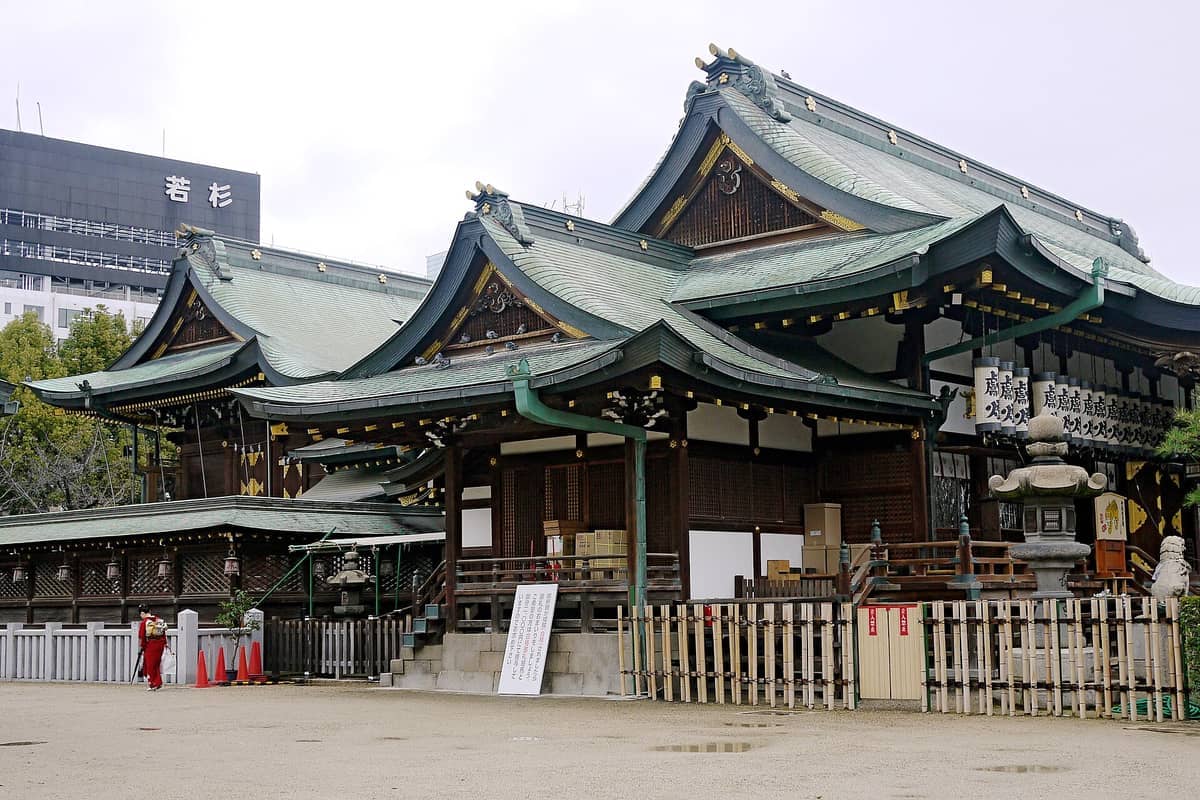
The main precinct is compact but carefully arranged. A large stone torii marks the outer entrance, and the path leads through a courtyard flanked by stone lanterns toward the main hall (honden). The buildings are painted in vermilion and black lacquer, a restrained palette compared to some of Kyoto's more ornate shrines. If you have visited Sumiyoshi Taisha in the south of the city, you will notice a different architectural register here: Osaka Tenmangu feels more civic and ceremonial, shaped by its centuries of urban life rather than ancient forest solitude.
Plum trees (ume) are planted throughout the grounds, a visual reference to Sugawara no Michizane's famous love of plum blossoms. In late February and early March, when these trees flower, the air carries a faint, clean sweetness that contrasts with the incense. It is one of the best times to visit if you are not coming for the summer festival.
💡 Local tip
The grounds are typically open from around 09:00 to 17:00, though the wider precinct may be accessible earlier or later, particularly during festival periods and New Year; confirm hours with the shrine office (tel. 06-6353-0025) if you plan an early morning or late-day visit.
Tickets & tours
Hand-picked options from our booking partner. Prices are indicative; availability and final rates are confirmed when you complete your booking.
Osaka local food tour in Dotonbori and Shinsekai
From 51 €Instant confirmationFree cancellationGuided day tour from Osaka to Nara Park, Arashiyama and Fushimi Inari
From 59 €Instant confirmationFree cancellationShiga Day Trip with Miho Museum, Lake Biwa and Waterbird Shrine
From 70 €Instant confirmationFree cancellationHimeji, Nara and Kobe full-day tour from Osaka
From 76 €Instant confirmationFree cancellation
Time of Day: How the Shrine Changes
Early morning, around 9:00 to 10:00, the shrine sees its quietest foot traffic. Pigeons gather near the stone lanterns. The occasional worshipper stops to clap twice and bow before the honden. The light is low and angled, catching the texture of the unpainted stone paving and the grain of the wooden shrine buildings. For photography, this is the hour that rewards patience.
By midday, particularly on weekends, school groups and visitors move through in loose clusters. The courtyard becomes noticeably louder but never overwhelmingly crowded on ordinary days. The shrine sells small amulets and omikuji (fortune slips) from a counter near the main building; you will often see people reading their fortunes and either tying the paper to the designated rack or tucking it away carefully.
Afternoon brings a second, gentler wave of visitors, many of them older residents who treat the shrine as a regular stop rather than a tourist destination. Watching this local rhythm — the woman who stops, bows briefly, and continues walking without breaking stride — is a reminder that this is a functioning religious site, not a museum exhibit.
Tenjin Matsuri: The Reason Many Visitors Come
If your dates align with late July, the experience of Osaka Tenmangu changes completely. Tenjin Matsuri, held on July 24 and 25 each year, is one of Japan's three most celebrated summer festivals. On these two days, the shrine becomes the departure point for processions involving hundreds of participants in Heian-period court dress, portable shrines (mikoshi), traditional music, and eventually a grand river procession of illuminated boats along the Okawa River.
The July 25 evening, when the boats move along the water and fireworks are launched overhead, draws enormous crowds to the riverbanks. If you are coming specifically for the festival, arrive at the shrine grounds in the morning to see the land procession up close before the crowds thicken. The shrine itself — normally quiet — buzzes with priests in formal white robes conducting preparatory rituals from the early hours.
⚠️ What to skip
During Tenjin Matsuri (July 24–25), expect very large crowds near the shrine and along the Okawa River in the evening. Arrive early if you want access to the procession departure, and plan transit carefully — trains in this area become heavily packed after dark. Check current crowd control measures locally, as routing and access points can vary year to year.
Getting There and Getting Around
The most straightforward approach is from Minamimorimachi Station (Osaka Metro Tanimachi Line and Sakaisuji Line), using Exit 4 or 4-A. From there, walking south along Tenjinbashisuji Shopping Street brings you to the shrine entrance in roughly 2 to 5 minutes. Alternatively, JR Tozai Line users can alight at Osaka Tenmangu Station and reach the shrine on foot in about 5 minutes.
The shrine sits within the broader Umeda district, and is close enough to Osaka's northern commercial core to be combined efficiently with other stops. The Nakanoshima island area, with its historic architecture and riverside parks, is a short walk or transit hop away.
No special footwear is required, but the shrine grounds involve stone-paved paths and some steps near the main buildings. Visitors with mobility concerns should note that barrier-free access information is not prominently posted on major tourism sites; contact the shrine office directly at 06-6353-0025 to confirm current accessibility conditions before visiting.
Photography, Etiquette, and What to Bring
Photography is generally permitted in the outer grounds and along the approach. Exercise discretion near active religious rituals — if a priest is conducting a ceremony at the main altar, step back and lower your camera. This is standard respectful behavior at any functioning shrine in Japan, not a posted rule.
No specific dress code applies for shrine visits in Japan, though neat, inoffensive clothing is appropriate. The grounds are shaded by trees near the ema hanging areas, which provides some relief in summer. July and August in Osaka are genuinely hot and humid, with daytime temperatures often in the low-to-mid 30s°C; bring water and plan your visit for the morning if you are coming in summer outside of festival days.
There is no on-site cafe or food stall within the shrine grounds, but the Tenjinbashisuji arcade immediately adjacent has dozens of options for coffee, noodles, and snacks at all price points.
Who Might Not Enjoy This Shrine
Osaka Tenmangu is a compact, genuine working shrine rather than a grand visual spectacle. Visitors expecting the scale of Kyoto's Fushimi Inari or the forest depth of Sumiyoshi Taisha may find it underwhelming. The main hall is not open for interior viewing, and the buildings, while handsome, are not architecturally exceptional given the site's history of fire and reconstruction.
Travelers with only a day or two in Osaka and a checklist of major sights may find their time better spent elsewhere. But for anyone interested in how religious life is woven into the fabric of Japanese urban neighborhoods, or for visitors who want to experience the city from a less-photographed angle, Osaka Tenmangu rewards a visit. It pairs naturally with a walk through Nakazakicho's backstreets or a browse along Tenjinbashisuji.
Insider Tips
- Late February to early March, when the plum trees in the grounds flower, is a quieter and genuinely beautiful time to visit — far less crowded than cherry blossom season and almost entirely overlooked by tourists.
- If you want to buy an ema (votive plaque) for academic luck, the counter near the main hall sells them year-round. Writing your wish and hanging it alongside the thousands of others left by Japanese students has an atmosphere that no guided tour can manufacture.
- The JR Tozai Line stop is literally named Osaka Tenmangu Station — if you are coming from Kyoto or eastern Osaka on the JR network, this is often the more direct and less congested option than changing onto the Osaka Metro.
- The grounds can get noticeably more solemn and atmospheric in the hour before closing, around 16:00 to 17:00, when most tourist foot traffic has thinned and the light turns gold through the trees.
- For New Year visits (hatsumode), expect very large crowds — this is widely regarded as one of the most visited shrines in Osaka during January 1–3; arrive before 08:00 or after 20:00 if you want to avoid the longest queues.
Who Is Osaka Tenmangu Shrine For?
- Travelers interested in Shinto practice and religious culture beyond the postcard shot
- Students or academics seeking a culturally resonant experience tied to the deity of scholarship
- Visitors in Osaka during late July who want to experience Tenjin Matsuri at its source
- Those combining a shrine visit with a walk along Tenjinbashisuji Shopping Street
- Photographers looking for quiet, early-morning light in an urban shrine setting
Nearby Attractions
Other things to see while in Umeda (Kita):
- Kids Plaza Osaka
Kids Plaza Osaka, located in Kita-ku near the Umeda area, is Japan's first museum built specifically for children. Across multiple floors of interactive, play-based exhibits, it keeps kids engaged for hours while giving adults genuine insight into how children learn through experience. Whether you have a toddler or a curious ten-year-old, this is one of Osaka's most reliably rewarding family stops.
- Osaka Museum of Housing and Living
The Osaka Museum of Housing and Living (大阪くらしの今昔館) reconstructs full-scale streets and merchant homes from the late Edo period, letting visitors walk through and enter period-accurate interiors. Located on the 8th floor of the Osaka Municipal Housing Information Center in Kita-ku, it offers one of the most tactile history experiences in the city at a modest admission price.
- Tenjinbashisuji Shopping Street
Tenjinbashisuji Shopping Street (天神橋筋商店街) runs 2.6 kilometres through Osaka's Kita Ward, connecting hundreds of shops, restaurants, and everyday businesses under a continuous covered arcade. Rooted in Edo-period merchant culture, it remains one of the city's most authentic commercial corridors and a practical alternative to tourist-facing shopping districts.
- Umeda Sky Building
The Umeda Sky Building is one of Osaka's most architecturally distinctive structures, connecting two towers at 173 meters via a circular open-air observatory. Whether you visit at noon for clear skyline views or at sunset when the city shifts from gold to neon, the Kuchu Teien (Floating Garden) Observatory delivers an experience that earns its place on a short itinerary.