Minoh Falls: Osaka's Best Nature Escape, One Train Ride Away
Minoh Falls (箕面大滝) sits inside Meiji-no-Mori Minoh Quasi-National Park, north of Osaka city. The trail from Hankyu Minoh Station follows a wooded river gorge for roughly 40 to 45 minutes before delivering you to the falls. Admission is free, and the park and falls area are open 24 hours with no staffed gate.
Quick Facts
- Location
- Minohkoen, Minoh, Osaka Prefecture (within Meiji-no-Mori Minoh Quasi-National Park)
- Getting There
- Hankyu Minoh Station (Hankyu Minoh Line, terminus); 40–45 min walk to the falls
- Time Needed
- 2–3 hours round trip, including time at the falls
- Cost
- Free (no admission fee); train fare from Osaka city applies
- Best for
- Nature walks, autumn foliage, families, photographers, urban escapees
- Official website
- http://www.mino-park.jp
What Minoh Falls Actually Is
Minoh Falls (箕面大滝) is the centerpiece of Meiji-no-Mori Minoh Quasi-National Park, a protected forest area that begins almost immediately beyond the residential streets north of Osaka city. Within about 30 minutes by train from Umeda, the terrain shifts completely: dense deciduous forest, a clear river running over stepped rocks, and a trail that feels far removed from the urban grid below.
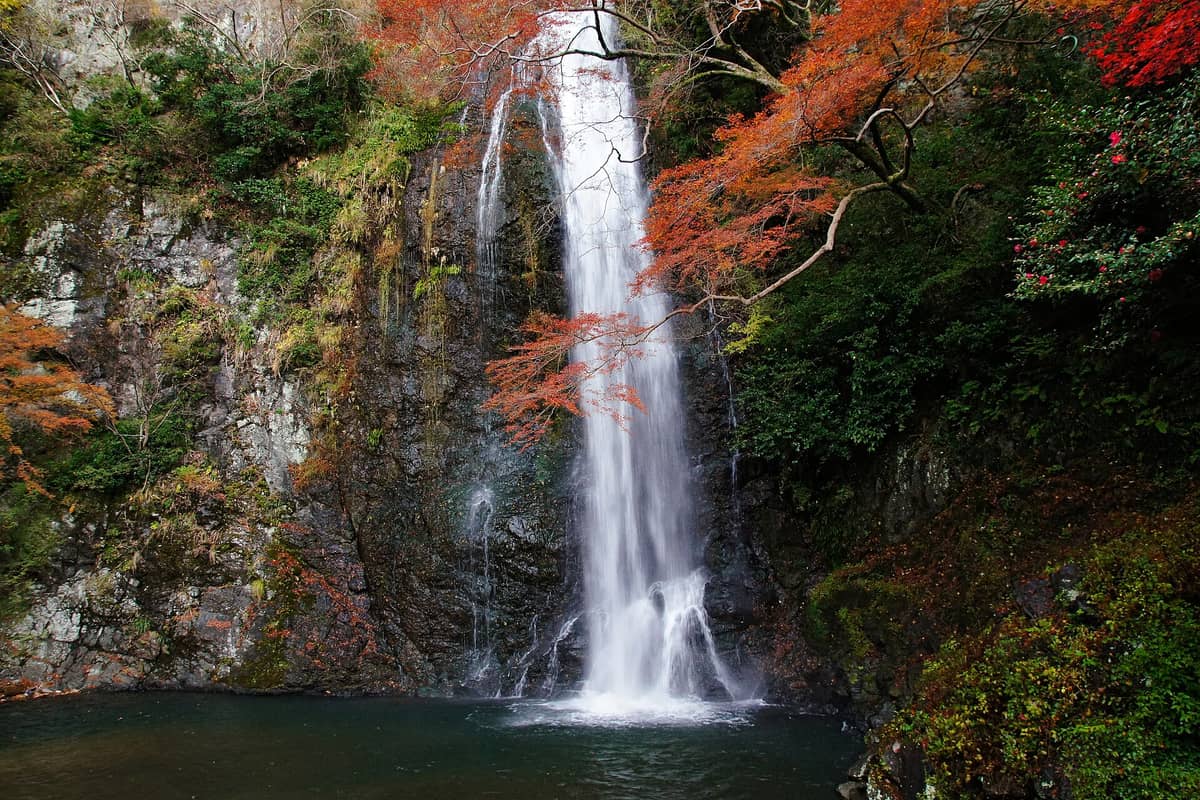
The falls themselves drop in a single curtain over a cliff face into a shallow rocky basin. The surrounding gorge amplifies the sound, so you hear Minoh Falls well before you see it, especially after rain when flow volume increases noticeably. The site is free to enter, open 24 hours around the clock with no staffed gate, and accessible year-round, though sections of the trail may occasionally be closed or detoured for maintenance.
💡 Local tip
The trail from Hankyu Minoh Station to the falls is well-paved for most of its length and clearly signposted in English. Wear comfortable walking shoes rather than sandals, as some sections near the falls are uneven stone and can be slippery when wet.
The Walk: What to Expect on the Trail
The route from Hankyu Minoh Station follows a single main path along the Minoh River. The first 15 minutes pass through a small commercial stretch with shops selling the area's signature snack, maple leaf tempura (crispy fried leaves with a sweet coating). This section is busy on weekends and can feel like a market lane. Once the shops thin out, the trail becomes a proper forest path.
The middle portion runs alongside the river, where you can hear water running below the trail and spot small waterfalls and cascades. The canopy closes in, temperature drops a degree or two compared to the city, and the air carries the smell of damp earth and cedar. On weekday mornings, the only sounds are birdsong and the river. On weekend afternoons, particularly during autumn foliage season, expect steady foot traffic.
The final approach steepens slightly, and the mist from the falls reaches the path before the view opens up. The viewing area is compact, a flat stone platform and surrounding rocks, with the falls rising directly ahead. There are no barriers between visitors and the basin, which gives the spot an unguarded, natural feel compared to more managed tourist waterfalls in Japan.
⚠️ What to skip
The trail is not fully wheelchair-accessible. The surface is mostly paved but includes uneven sections and moderate inclines closer to the falls, and recent detours to reach the basin may involve stairs and narrow unpaved stretches. Wheelchair users should be accompanied and may find the full route difficult without power assistance, per accessibility guidance from Accessible Japan.
Tickets & tours
Hand-picked options from our booking partner. Prices are indicative; availability and final rates are confirmed when you complete your booking.
Kobe: Mt. Rokko Night View, Kitano Ijinkan, Arima Onsen Full Day Tour
From 47 €Instant confirmationFree cancellationOsaka local food tour in Dotonbori and Shinsekai
From 51 €Instant confirmationFree cancellationGuided day tour from Osaka to Nara Park, Arashiyama and Fushimi Inari
From 59 €Instant confirmationFree cancellationShiga Day Trip with Miho Museum, Lake Biwa and Waterbird Shrine
From 70 €Instant confirmationFree cancellation
How the Experience Changes by Season
Autumn, from late October through late November and sometimes into early December, is when Minoh Falls draws its largest crowds. The maples along the gorge turn deep red and orange, and the combination of colored canopy, grey cliff, and white falling water is genuinely striking. This is the one period where arriving early, by 9 AM, makes a real difference. By 11 AM on weekends in peak foliage, the trail near the falls is dense with visitors and the path narrows.
For autumn timing, the Osaka autumn foliage guide covers how Minoh compares with other viewing spots across the city and wider region.
Spring brings fresh green growth and a quieter crowd. Cherry blossoms appear along the lower sections of the trail in late March and early April, though the main draw here is always the waterfall rather than the sakura. Summer is the most physically demanding season: humidity in the gorge is high, the trail stays shaded but the walk back to the station in afternoon sun can feel heavy. The falls run full with summer rain, though, and mist at the base is at its most dramatic.
Winter is the least-visited season and often rewarding for that reason. On cold, clear weekday mornings, the park is nearly empty. Frost can form on the rocks near the basin, and on rare very cold days, parts of the falls can partially freeze, creating ice formations on the cliff face. There is no guarantee of this, but it does happen.
Getting There from Osaka City
Take the Hankyu Takarazuka Line from Osaka-Umeda Station to Ishibashi handai-mae, then transfer to the Hankyu Minoh Line to reach Minoh Station, the terminus. The total journey is around 25–30 minutes and straightforward to navigate, with frequent trains in both directions. IC cards (ICOCA or Suica) work on Hankyu trains, so no separate ticket purchase is needed.
If you are planning the trip around a wider Osaka itinerary, the guide to getting around Osaka explains how IC cards and day passes work across the different rail operators in the city.
From Minoh Station, the path to the falls is clearly marked. Turn left out of the station and follow the river. Signs are posted in English at key junctions, and the route is essentially linear with no route-finding required.
Photography at Minoh Falls
The falls face roughly south, which means direct sunlight hits them in the late morning through early afternoon on clear days. This creates strong contrast and can wash out the detail on the white water. Overcast days are actually preferable for photography: the light is even, colors in the surrounding rock and foliage are richer, and the mist from the falls lifts slightly in cool air. Early morning in autumn, with soft light and colored leaves, is the most consistently useful window.
The viewing area gives limited angle choices. Most shots are taken from the central platform looking directly at the falls. For a slightly different composition, move to the rocks on the left side of the basin to get the falls at a diagonal with the gorge walls behind. A wide-angle lens or the standard camera app on a smartphone captures the full drop comfortably from the platform. There is no elevated viewpoint; you are always looking up at the falls from below.
💡 Local tip
A small neutral density filter or simply shooting on an overcast day allows for slower shutter speeds that render the falling water as a smooth silky curtain rather than frozen droplets. Both effects are valid but look very different, so decide in advance which you prefer.
What Else Is in the Area
The park extends beyond the falls into wider forest hiking trails, but most day visitors turn around at the waterfall and walk back to the station. Along the return route, the shops selling maple leaf tempura are worth trying once: the texture is crisp, the flavor leans sweet, and the novelty is genuine. A bag costs a few hundred yen and is made fresh in front of you in several shops.
Minoh town around the station has a small selection of cafes and restaurants. If you time your return for lunch, there are options ranging from soba noodles to casual set-meal places, concentrated in the streets immediately around the station.
Minoh pairs well with a day that includes other nature or park-oriented spots. The best gardens in Osaka guide covers options at different price points and distances from the city center.
Who Might Not Enjoy This Visit
Minoh Falls requires a 35 to 45-minute walk each direction on a trail with some uneven terrain and elevation gain near the end. Visitors expecting a short stroll to a major landmark may underestimate the commitment. The waterfall itself, while genuinely attractive, is a single feature: there is no visitor center, no interactive exhibit, and no secondary attraction at the site. If you need your nature served with infrastructure and commentary, this may feel underwhelming.
During peak autumn weekends, the trail becomes congested at the far end near the falls, and the atmosphere shifts from tranquil to carnival-like with tour groups and day-trippers. If crowds reduce your enjoyment of natural spaces, choose a weekday or visit outside of October and November.
Insider Tips
- Weekday mornings before 10 AM are reliably quiet regardless of season. If you can travel on a Tuesday or Wednesday, the trail near the falls feels like a different place compared to weekend afternoons.
- The Hankyu One-Day Pass, which mainly promotes access on the Kyoto, Kobe, and Takarazuka lines, also covers the Minoh Line, which can make the round trip effectively free if you are already using it for another destination that day. Verify current pass coverage before purchasing.
- After heavy rainfall, the falls flow significantly fuller and the mist at the base extends much further. If it has rained in the previous 24 hours, the visual payoff is higher than on a dry spell.
- Bring cash. Shops along the trail dealing in maple leaf tempura and small snacks are typically cash-only, and there are no ATMs within the park itself.
- The park contains wild Japanese macaques (snow monkeys). Sightings are not guaranteed but do occur on the upper trail sections. Do not feed them or approach them, as signs throughout the park explicitly warn.
Who Is Minoh Falls For?
- Travelers who want genuine forest and waterfall scenery within a half-day from central Osaka
- Autumn foliage seekers looking for a less crowded alternative to Kyoto's peak spots
- Families with children old enough to walk 3–4 km comfortably on a trail
- Photographers wanting soft-light waterfall shots without the crowds of more famous Japanese falls
- Visitors on tight budgets, as the site is completely free and the train fare is modest
Nearby Attractions
Combine your visit with:
- Expo '70 Commemorative Park
Built on the grounds of the 1970 Japan World Exposition, Expo '70 Commemorative Park (万博記念公園) in Suita City is one of greater Osaka's largest open spaces. It combines parkland, a traditional Japanese garden, a museum dedicated to the original expo, and the striking Tower of the Sun — an icon of 20th-century Japanese design that still stops visitors in their tracks.
- Kema Sakuranomiya Park
Kema Sakuranomiya Park stretches for several kilometers along the Okawa River in central Osaka, lined with roughly 4,800 cherry trees that draw enormous crowds each spring. It is free to enter, open around the clock, and easily reached from multiple train lines. Outside of cherry blossom season, the park is a quiet, flat riverside corridor used primarily by joggers and cyclists.
- Mint Museum Osaka (Japan Mint)
Tucked inside the grounds of Japan Mint's Osaka headquarters in Kita-ku, the Mint Museum offers a free, unhurried look at the full sweep of Japanese coinage history, from ancient cast coins to contemporary commemorative medals. It is one of Osaka's more quietly rewarding museums, and one of the few major attractions in the city that costs nothing to enter.
- Nagai Botanical Garden
Tucked inside Nagai Park in Higashisumiyoshi Ward, the Osaka Municipal Nagai Botanical Garden is a serious green space where locals outnumber tourists and seasonal plant displays are taken seriously. At 300 yen entry, it offers one of the best value-to-experience ratios of any attraction in the city.