Tower of the Sun: Osaka's Most Surreal Monument
Standing 70 meters tall inside Expo '70 Commemorative Park in Suita, the Tower of the Sun is the most visually arresting relic of Japan's postwar optimism. Designed by artist Taro Okamoto for the 1970 World Exposition, it reopened its interior in 2018 and now functions as a full museum that rewards visitors who take time to go inside.
Quick Facts
- Location
- 1-1 Senri Banpaku-koen, Suita-shi, Osaka Prefecture 565-0826
- Getting There
- Osaka Monorail: Banpaku-Kinen-Koen Station, then walk across Chuo Bridge to the central gate
- Time Needed
- 2–3 hours including park grounds; add 1 hour if visiting the Japanese Garden
- Cost
- Tower interior: ¥720 adults / ¥310 children. Park entry (required, separate): ¥260 adults / ¥80 children. Advance reservation recommended.
- Best for
- Architecture lovers, art and design enthusiasts, families with older children, anyone curious about Japan's postwar cultural history
- Official website
- taiyounotou-expo70.jp/en
What Is the Tower of the Sun?
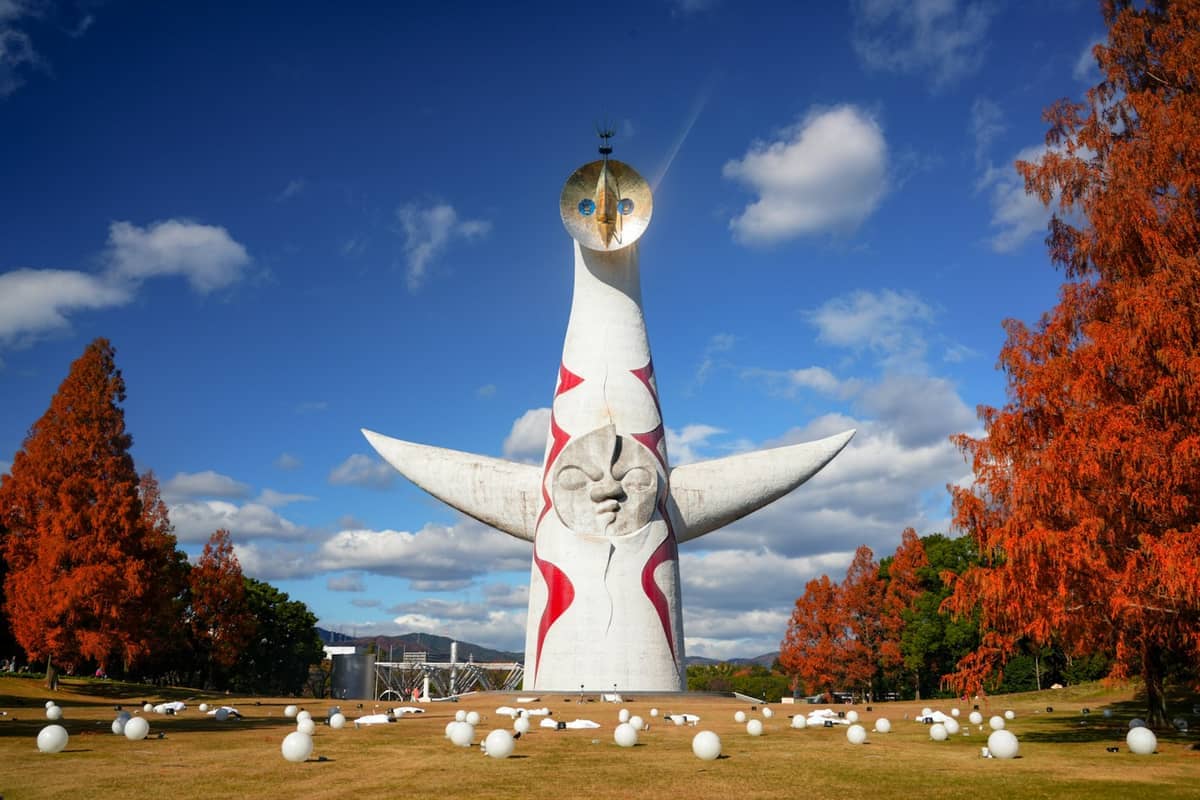
The Tower of the Sun (太陽の塔, Taiyō no Tō) is a 70-meter reinforced concrete sculpture and museum located inside Expo '70 Commemorative Park in Suita, a city that borders northern Osaka. It was designed by Japanese artist Taro Okamoto as the symbolic centerpiece of the Japan World Exposition 1970, known as Expo '70, which drew over 64 million visitors across six months. The tower was never demolished after the exposition closed, and it has stood in the park ever since, becoming one of the most recognized works of 20th-century Japanese art.
The structure has three faces: a golden sun on the front, a black sun on its back, and a glowing face called the Sun of the Future set into the top of the tower's crown. These are not decorative flourishes. Okamoto intended the tower as a philosophical statement, a rejection of the clean rationalism that dominated postwar modernism in favor of something raw, mythological, and unsettling. Standing in front of it for the first time, many visitors find themselves caught between amusement and genuine unease.
ℹ️ Good to know
Tower interior visits require advance reservation. Tickets sell out, especially on weekends and during school holidays. Book through the official Tower of the Sun Museum website before arriving.
The Interior: A Tree of Life Inside a Giant
The tower's interior was closed to the public for decades after Expo '70 ended. It reopened in March 2018 as the Tower of the Sun Museum, and the experience inside is unlike anything else in Osaka. The central feature is the Tree of Life, a massive branching structure rising through the tower's core and containing 183 model organisms representing the evolution of life on Earth. Translucent creatures, articulated fossils, and prehistoric animals climb the branches in dim amber light. The effect is closer to being inside a cathedral than a museum.
Visitors move through the interior via a spiral walkway that ascends around the Tree of Life. The materials are deliberately tactile: rough concrete walls, biological forms in resin and metal, the hum of climate control in the background. The ascent takes roughly 20 to 30 minutes at a relaxed pace. At the top, you reach the tower's arms, where you can look out over Expo '70 Commemorative Park through small windows and get a sense of the tower's scale from within.
Children who are old enough to understand scale will find it genuinely awe-inspiring. Younger children may be startled by the dimness and the strangeness of the figures. The interior involves stairways and no elevator, so visitors with significant mobility limitations should contact the park's call center (0120-1970-89) before booking to confirm what is accessible.
Tickets & tours
Hand-picked options from our booking partner. Prices are indicative; availability and final rates are confirmed when you complete your booking.
Kobe: Mt. Rokko Night View, Kitano Ijinkan, Arima Onsen Full Day Tour
From 47 €Instant confirmationFree cancellationOsaka local food tour in Dotonbori and Shinsekai
From 51 €Instant confirmationFree cancellationGuided day tour from Osaka to Nara Park, Arashiyama and Fushimi Inari
From 59 €Instant confirmationFree cancellationShiga Day Trip with Miho Museum, Lake Biwa and Waterbird Shrine
From 70 €Instant confirmationFree cancellation
The Park Grounds: What to Expect Around the Tower
The tower sits inside Expo '70 Commemorative Park, a large green space covering much of the former exposition site. From Banpaku-Kinen-Koen Station on the Osaka Monorail, you cross Chuo Bridge and walk along a broad promenade toward the central gate. The tower becomes visible as soon as you enter, rising above the tree line with an immediacy that photographs do not quite prepare you for. Common park admission (¥260 for adults) is required for the Natural and Cultural Gardens and Japanese Garden, in addition to the tower interior ticket.
The surrounding park is genuinely pleasant on its own terms, particularly in spring and autumn. The grounds are mostly flat with paved paths, making navigation easy. The Japanese Garden within the park is a separate enclosure with additional entry fees, but it is one of the finer formal gardens in the Osaka area and worth the extra time if you have it. In late March and early April, the park's cherry trees attract significant crowds, particularly on weekends.
Outside the tower itself, the grounds are free to wander once you have paid park admission. There are benches, open lawns, and a handful of food vendors and cafes near the central gate area. Picnicking is common among local families on weekdays. The park covers a large area and you will do considerable walking, so comfortable shoes matter more here than at most Osaka attractions.
Historical Context: Taro Okamoto and the Spirit of 1970
Taro Okamoto (1911–1996) was one of Japan's most prominent avant-garde artists, known for his fierce opposition to aesthetic refinement. His philosophy, sometimes summarized in his own phrase 'art is explosion,' was to create work that was confrontational and alive rather than tasteful. When he was commissioned to create the symbolic monument for Expo '70, he designed something that deliberately clashed with the sleek modernist pavilions surrounding it.
Expo '70 itself was a defining moment for postwar Japan. The country was in the middle of its so-called economic miracle, and the exposition was a global statement of technological ambition. Over 77 nations participated, and the event drew more visitors than any world's fair had before it. The Tower of the Sun was the counterpoint to all of that optimism: ancient-looking, animistic, and fundamentally strange. The tension between the tower and its surroundings was intentional, and it is what makes the structure worth thinking about.
For a broader look at how this site connects to Osaka's cultural landscape, the best museums in Osaka guide puts the Tower of the Sun Museum in context alongside the city's other major cultural institutions.
Practical Walkthrough: Timing Your Visit
The Tower of the Sun Museum is open from 10:00 to 17:00, with last admission at 16:30. It is typically closed on Wednesdays, plus year-end and New Year holidays, though it opens daily during Golden Week (late April to early May) and throughout October and November. Always check the official site before visiting, as closure days can shift when public holidays fall on a Wednesday.
Weekday mornings between 10:00 and noon are the calmest time to visit. By early afternoon on weekends, the approach path from the central gate can fill with school groups and families, and the interior becomes noticeably more crowded. If you visit on a clear autumn day, arrive early to catch the tower in direct morning light, when the gold face catches the sun at its sharpest angle and the surrounding trees are turning color. Summer visits are possible but the park is exposed, and midday temperatures in July and August can exceed 35°C with high humidity, so bring water and plan breaks in the shade.
⚠️ What to skip
In summer (July–August), the open grounds around the tower offer little shade. Bring water, sun protection, and plan to be at the park early or closer to late afternoon to avoid peak heat.
Getting here from central Osaka takes roughly 30 to 40 minutes. Take the Osaka Monorail to Banpaku-Kinen-Koen Station. The monorail connects with several subway and JR lines, including at Senri-Chuo (Osaka Metro Midosuji Line) and Hotarugaike (Hankyu Takarazuka Line). From the station, the walk to the tower takes around 10 minutes across a flat pedestrian bridge. If you are combining this trip with a visit to nearby Minoh, see the Minoh Falls guide for how to structure a northern Osaka day.
Photography and What to Expect Visually
The tower is large enough that a standard smartphone lens will struggle to capture it in full from close range. Walk back toward Chuo Bridge or use the wide lawns to the south of the tower to get the full silhouette with sky behind it. Early morning and late afternoon light is considerably better than midday, when the sky is often blown out and the front face of the tower loses definition. If you are shooting with a wider lens, the reflection pool near the base, when water levels are maintained, offers a clean foreground.
Inside the tower, photography of the Tree of Life is permitted but the low amber lighting makes handheld shots challenging. A phone with a strong night mode will perform better than a basic compact camera in these conditions. The timed entry system means the interior is rarely as overcrowded as popular indoor attractions in central Osaka, which helps when composing interior shots.
Who Should Think Carefully Before Going
Visitors primarily motivated by central Osaka sightseeing should be aware that the tower is not downtown. It is a 30 to 40 minute transit journey from areas like Namba or Umeda, which means it requires a deliberate half-day commitment. If your time in Osaka is limited to two days or fewer, the tower competes with major central attractions that are easier to combine. It is also worth noting that the park itself, while pleasant, is not a high-intensity sightseeing destination. People expecting a packed cultural program or urban energy will find it quieter and more suburban than they might anticipate.
Very young children may find the darkened interior of the tower unsettling rather than exciting. The Tree of Life features some overtly strange biological forms, and the experience is more meditative than playful. Families with children under six should gauge their kids' tolerance for dim, unconventional spaces before committing to the interior ticket.
Insider Tips
- Reserve your tower interior ticket online before you travel, not just before you arrive at the park. Weekend slots fill up days in advance, particularly in October and November when autumn foliage draws larger crowds to the park.
- The back face of the tower, the Black Sun, is less photographed than the front but arguably more striking. Walk around the tower's perimeter after entering the park before heading to the entrance queue.
- If you want the tower against a clear blue sky without crowds in the foreground, arrive at park opening (9:30) on a weekday. The first hour is reliably quiet and the morning light hits the gold face at a clean angle.
- The Osaka Amazing Pass does not include the Tower of the Sun interior. You will pay the park admission and tower ticket separately regardless of which rail or museum pass you carry.
- Combine the visit with the Japanese Garden inside the park, which has a separate entry fee but is one of the most carefully maintained formal gardens in the Osaka area and adds genuine value to the day without requiring extra transit.
Who Is Tower of the Sun For?
- Architecture and design enthusiasts who want to understand Japan's postwar visual culture beyond its traditional forms
- Travelers on a third or return visit to Osaka looking for something beyond the central sightseeing circuit
- Families with children aged 7 and up who will appreciate the scale and strangeness of the Tree of Life interior
- Photographers seeking dramatic, unusual subjects away from the tourist density of Dotonbori and Osaka Castle
- Anyone with an interest in 20th-century world's fairs, expo culture, or the artist Taro Okamoto
Nearby Attractions
Combine your visit with:
- Expo '70 Commemorative Park
Built on the grounds of the 1970 Japan World Exposition, Expo '70 Commemorative Park (万博記念公園) in Suita City is one of greater Osaka's largest open spaces. It combines parkland, a traditional Japanese garden, a museum dedicated to the original expo, and the striking Tower of the Sun — an icon of 20th-century Japanese design that still stops visitors in their tracks.
- Kema Sakuranomiya Park
Kema Sakuranomiya Park stretches for several kilometers along the Okawa River in central Osaka, lined with roughly 4,800 cherry trees that draw enormous crowds each spring. It is free to enter, open around the clock, and easily reached from multiple train lines. Outside of cherry blossom season, the park is a quiet, flat riverside corridor used primarily by joggers and cyclists.
- Minoh Falls
Minoh Falls (箕面大滝) sits inside Meiji-no-Mori Minoh Quasi-National Park, north of Osaka city. The trail from Hankyu Minoh Station follows a wooded river gorge for roughly 40 to 45 minutes before delivering you to the falls. Admission is free, and the park and falls area are open 24 hours with no staffed gate.
- Mint Museum Osaka (Japan Mint)
Tucked inside the grounds of Japan Mint's Osaka headquarters in Kita-ku, the Mint Museum offers a free, unhurried look at the full sweep of Japanese coinage history, from ancient cast coins to contemporary commemorative medals. It is one of Osaka's more quietly rewarding museums, and one of the few major attractions in the city that costs nothing to enter.