Nakano Broadway: Tokyo's Best Kept Otaku Shopping Complex
Nakano Broadway is a multi-story shopping complex in Nakano, Tokyo, packed with anime figures, vintage manga, retro games, and subculture goods. It draws serious collectors alongside curious visitors, and unlike Akihabara, it still feels like a place locals actually use.
Quick Facts
- Location
- 5-52-15 Nakano, Nakano-ku, Tokyo 164-0001
- Getting There
- Nakano Station (JR Chūō Line / JR Chūō-Sōbu Line / Tokyo Metro Tōzai Line), North Exit, 5-min walk
- Time Needed
- 1.5 to 3 hours, longer for serious collectors
- Cost
- Free entry; spending depends entirely on what you buy
- Best for
- Anime and manga fans, collectors, anyone curious about Japanese subculture
- Official website
- nakano-broadway.com
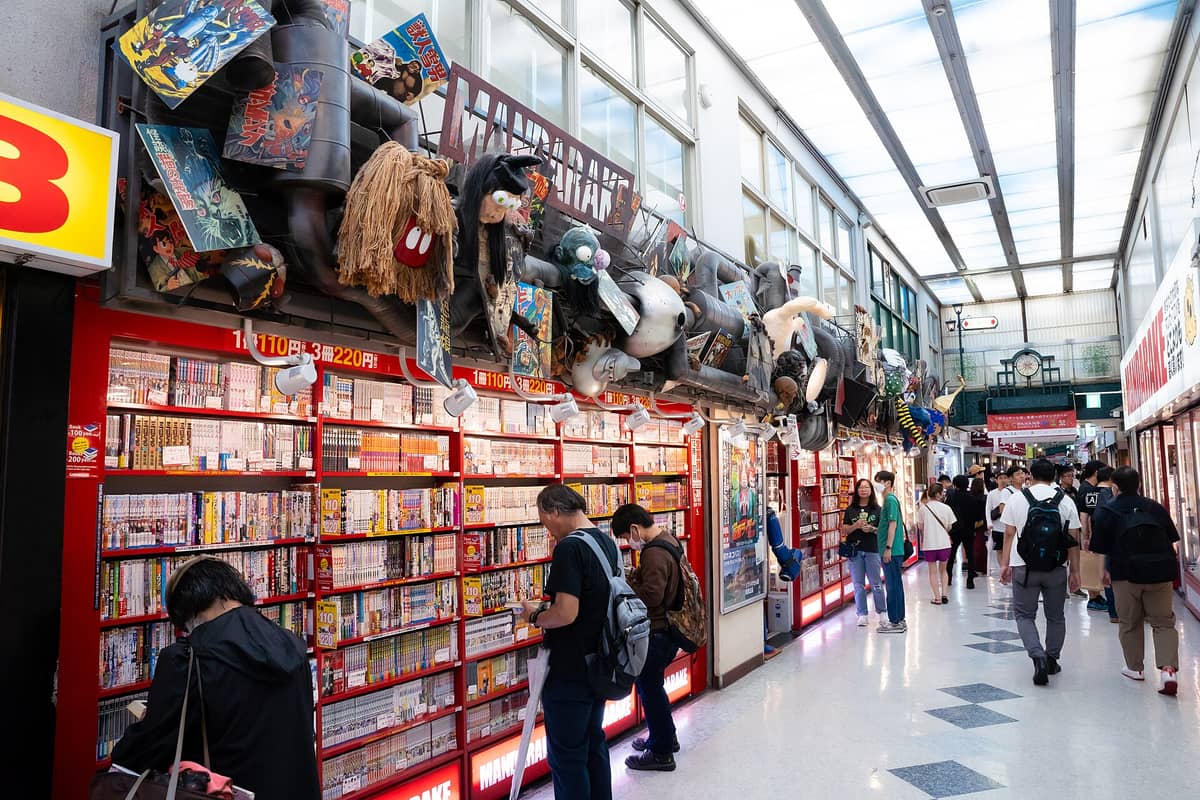
What Nakano Broadway Actually Is
Nakano Broadway (中野ブロードウェイ) is a four-story shopping complex dating from the 1960s, located at the northern end of the covered Nakano Sun Mall arcade. What began as a general retail and residential building gradually transformed into the city's most concentrated hub for otaku goods, secondhand collectibles, and pop-culture merchandise. Today the complex houses dozens of specialty shops, with Mandarake, a major used manga and figure reseller, operating multiple distinct outlets spread across different floors. Each Mandarake branch focuses on a specific category: one handles vintage manga volumes, another deals in action figures, a third stocks idol merchandise, and so on.
The building is not polished or designed for tourism. Corridors are narrow, signage is mostly in Japanese, and the overall atmosphere is closer to an indoor market than a modern shopping mall. That roughness is precisely why it has retained a loyal local customer base and why it feels meaningfully different from more commercialized otaku districts in the city.
💡 Local tip
Most shops open around 11:00 or 12:00, not 10:00. Arriving before noon on weekdays means a quieter building, but some stalls will still be setting up. The sweet spot for browsing with reasonable space is a weekday between 11:30 and 14:00.
Getting There: The Approach Matters
Nakano Station is served by the JR Chūō Line and the Tokyo Metro Tōzai Line, placing it roughly 5 minutes west of Shinjuku by train. Use the North Exit and you will immediately enter the Nakano Sun Mall, a long covered arcade lined with ordinary shops: a drugstore, a supermarket, a few cafes, a 100-yen chain. This is a working neighborhood shopping street, not a tourist zone, and the contrast it sets up before you reach Broadway is part of what makes the destination feel earned.
Walk the full length of Sun Mall and Nakano Broadway appears at the far end. There is no dramatic entrance, just a slightly wider set of doors and a small indoor atrium. First-time visitors sometimes walk straight past it. If you are planning a broader day in this part of the city, it pairs naturally with a stop in Shinjuku, just one stop east, where you can eat and explore before or after.
Tickets & tours
Hand-picked options from our booking partner. Prices are indicative; availability and final rates are confirmed when you complete your booking.
Tsukiji Fish Market Walking Food Tour
From 40 €Instant confirmationFree cancellationMt.Fuji,Owakudani, Hakone Cruise & Ropeway, Oshino Hakkai 1-Day Trip
From 54 €Instant confirmationFree cancellationTour to Mt. Fuji Area, Oshino Hakkai and Kawaguchi Lake from Tokyo
From 57 €Instant confirmationFree cancellationNikko UNESCO Shrine and Nature View 1-Day Tour from Tokyo
From 78 €Instant confirmationFree cancellation
Inside the Building: Floor by Floor
The ground floor holds the most general retail: convenience goods, a few clothing outlets, and some food stalls. It also contains what amounts to the complex's informal information desk, which is simply the security counter near the main elevators. Pick up a floor map here if you can find one, though they are not always available in English.
Floors two through four are where the subculture shops cluster. The layout is genuinely labyrinthine, with branching corridors, low ceilings, and shop fronts crammed with display cases. Mandarake's individual branches are marked with their own signage, but navigating between them requires some patience. Vintage anime cels, boxed Famicom cartridges, doujinshi (self-published manga), rare trading cards, idol photobooks, and resin figures at every price point all occupy different corners. Prices are clearly marked on almost everything, and the shops are generally organized by category within each branch, so browsing is manageable once you understand the layout.
Above the retail floors, the upper parts of the building contain residential apartments, a fact that contributes to the slightly unusual atmosphere. This was built as a mixed-use complex and has remained one, which partly explains why it never underwent the kind of renovation that would strip away its character.
ℹ️ Good to know
The two elevators are slow and often full on weekends. The staircases are functional and often faster. Note that the larger elevator does not stop at the third floor, so use the smaller elevator or stairs to reach it.
How the Experience Changes by Time and Day
On weekday mornings, the building is genuinely quiet. Shop owners are arranging stock, display cases are being wiped down, and the hum of fluorescent lighting is more noticeable than any crowd noise. This is the best time to take your time with display cases, ask staff questions (some shops have staff with basic English), and get a proper look at individual items without someone at your elbow.
Weekend afternoons are a different situation. Teenagers in cosplay clothing, collectors carrying tote bags from other shops, and visitors with guidebooks all converge in corridors that were never designed for large volumes of foot traffic. The energy is high and the sense of discovery is genuine, but moving between shops takes longer and some of the smaller branches feel genuinely claustrophobic. If crowds bother you, Saturday after 14:00 is the time to avoid.
The building closes most shops by 20:00, and the atmosphere in the final hour before closing is relaxed in a different way: staff are more available for questions, and some shops discount certain items toward the end of the day, though this is not guaranteed.
Historical and Cultural Context
The transformation of Nakano Broadway from a general 1966 retail and residential complex into a center for subculture goods happened gradually from the 1980s onward, as secondhand bookshops and specialty collectors began occupying vacant units. Mandarake opened its flagship operation here in 1987 and expanded to multiple floors over the following decades. The complex has never had the infrastructure investment that characterizes, say, the newer developments around Akihabara, and that lack of renovation is precisely what preserved its original character.
The district of Nakano itself has a long history as a middle-class residential neighborhood, home to longtime Tokyo residents rather than commuters or tourists. Broadway exists within that fabric, which is why the ground floor supermarket sees as much traffic as the collector shops above it. The contrast between the ordinary and the obsessive is not incidental: it is the defining quality of the place.
Visitors interested in the broader landscape of Tokyo's subculture districts can find useful context in a Tokyo anime and manga guide that covers the full range of neighborhoods and shops relevant to this world.
What to Buy, What to Expect to Spend
Entry is free. Spending depends entirely on what you are looking for and how deep into the rabbit hole you go. Casual visitors often spend nothing beyond a drink from the vending machines. Serious collectors can spend tens of thousands of yen on rare figures, limited-edition manga volumes, or vintage animation cels in good condition.
Prices at Mandarake branches are marked and generally fair for the used goods market. Some items are significantly cheaper than you would pay in a new-goods shop; others, particularly rare or graded collectibles, are priced at a premium that reflects genuine scarcity. Bargaining is not a feature of shopping here, so what you see on the tag is what you pay.
Cash is accepted everywhere. Card acceptance has improved at some Mandarake branches in recent years, but it is not universal across all shops in the complex. Bring yen to avoid any issues.
⚠️ What to skip
Some display cases contain items marked as adult-only (18+). These sections are typically labeled and partitioned, but they exist and are not hidden. If you are visiting with children, it is worth being aware of this.
Practical Notes: Accessibility, Photography, and What to Bring
Nakano Broadway was constructed in the 1960s and was not built to contemporary accessibility standards. The two elevators serve most floors, but the larger one skips the third floor. Corridor widths in some sections are narrow enough that a standard wheelchair would struggle to pass display racks and other customers simultaneously. Restrooms are present on all floors but few are fully wheelchair accessible, according to published accessibility reviews. Visitors with mobility requirements should factor this in carefully before prioritizing this stop.
Photography inside individual shops is generally not permitted. The atrium areas and corridors between shops are usually fine for photos, but check for signage at each shop entrance. Staff are typically clear about this without being aggressive.
The building can feel warm in summer and cool in winter, partly because interior temperature management in an older building like this is inconsistent. Comfortable, layered clothing is practical. Bags and backpacks are allowed but large ones become awkward in narrow corridors during busy periods.
Who Might Not Enjoy This
Nakano Broadway is not designed for passive tourism. If you have no interest in anime, manga, retro games, or Japanese subculture, the appeal diminishes quickly. The building itself has no architectural distinction and offers no views or sensory experiences beyond what the shops themselves provide. Travelers looking for a broad Tokyo experience would find their time better spent in a neighborhood with more varied offerings.
Visitors who are primarily interested in contemporary Japanese art or design might find more of interest at places like the Mori Art Museum or the 21_21 Design Sight rather than here.
Insider Tips
- Each Mandarake branch specializes in a different category. Look for the small printed category signs near each entrance rather than wandering every floor hoping to find what you want. Staff at the information area near the main elevator can sometimes point you to the right branch if you know what you are looking for.
- The complex has a small number of non-collectible shops worth noting: a dessert shop near the ground floor area is popular with regulars and provides a practical break point mid-browse.
- If you are hunting for something specific, Mandarake maintains an online inventory and search tool at their website. Searching before you visit saves time and helps you determine which floor and branch to target first.
- The Sun Mall arcade leading to Broadway has a few good, inexpensive lunch options. Eating before entering is practical because food options inside the complex itself are limited.
- Most stores close on the third Wednesday of February as a building-wide closure day for inspections. Individual shops may have their own additional closing days. If your visit is time-sensitive, check the Broadway website or call ahead.
Who Is Nakano Broadway For?
- Anime, manga, and video game collectors seeking specific or rare items
- Travelers who have already covered Akihabara and want a less commercialized alternative
- People interested in how Japanese subculture operates outside of tourist-facing contexts
- Budget travelers who can browse seriously without spending, since entry is free
- Anyone spending a half-day in western central Tokyo who wants a distinctive stop
Nearby Attractions
Combine your visit with:
- Akasaka Palace (State Guest House)
The State Guest House, Akasaka Palace is Japan's principal diplomatic residence and one of the few Western-style palaces in Asia open to the public. Built in neo-baroque style for the Crown Prince in the early 20th century, it now receives heads of state and, on select days, ordinary visitors. The combination of ornate gilded interiors, formal French gardens, and a Japanese-style annex makes it one of the most architecturally unusual stops in Tokyo.
- Edo-Tokyo Open Air Architectural Museum
Spread across the grounds of Koganei Park, the Edo-Tokyo Open-Air Architectural Museum rescues and reassembles more than 30 historic structures spanning the Edo period through the early 20th century. From a dismantled farmhouse to a reconstruction of a Showa-era Tokyo streetscape, it is one of the most thoughtful and undervisited cultural sites in the metropolitan area.
- Enoshima
A small island off the Shonan coast of Kanagawa Prefecture, Enoshima packs a surprising amount into a short walk: a three-part Shinto shrine, ancient sea caves, a hilltop botanical garden, a lighthouse observation tower, and seafood stalls lining a stone-paved shopping street. It works as a half-day excursion or a full day if you combine it with nearby Kamakura.
- Gotokuji Temple
Gotokuji Temple in Setagaya is a working Soto Zen Buddhist temple that happens to be one of the claimed birthplaces of the maneki-neko, Japan's iconic beckoning cat. Hundreds of white ceramic cats line the shelves of a dedicated shrine, creating one of Tokyo's most quietly striking visual spectacles. Entry is free, crowds are manageable, and the surrounding grounds offer genuine calm.