Museum of the Future Dubai: What to Expect, How to Get There, and Whether It's Worth It
The Museum of the Future is one of Dubai's most architecturally striking buildings and an immersive experience that explores technology, humanity, and the decades ahead. Before you go, here's everything you need to know, including a temporary closure update.
Quick Facts
- Location
- Sheikh Zayed Road, Trade Centre 2, Dubai, UAE
- Getting There
- Emirates Towers Metro Station (Red Line) — direct pedestrian access
- Time Needed
- 2 to 3 hours for the full experience
- Cost
- Approx. AED 169 for visitors aged 4 and above; children under 4 free; People of Determination + one caregiver free (verify before booking)
- Best for
- Architecture lovers, tech enthusiasts, families with older children, first-time Dubai visitors
- Official website
- museumofthefuture.ae/en
⚠️ What to skip
The Museum of the Future closed to visitors on 1 September 2026 for a full exhibition overhaul and is scheduled to reopen in the first quarter of 2027. Do not plan a visit until tickets return on museumofthefuture.ae.
What the Museum of the Future Actually Is
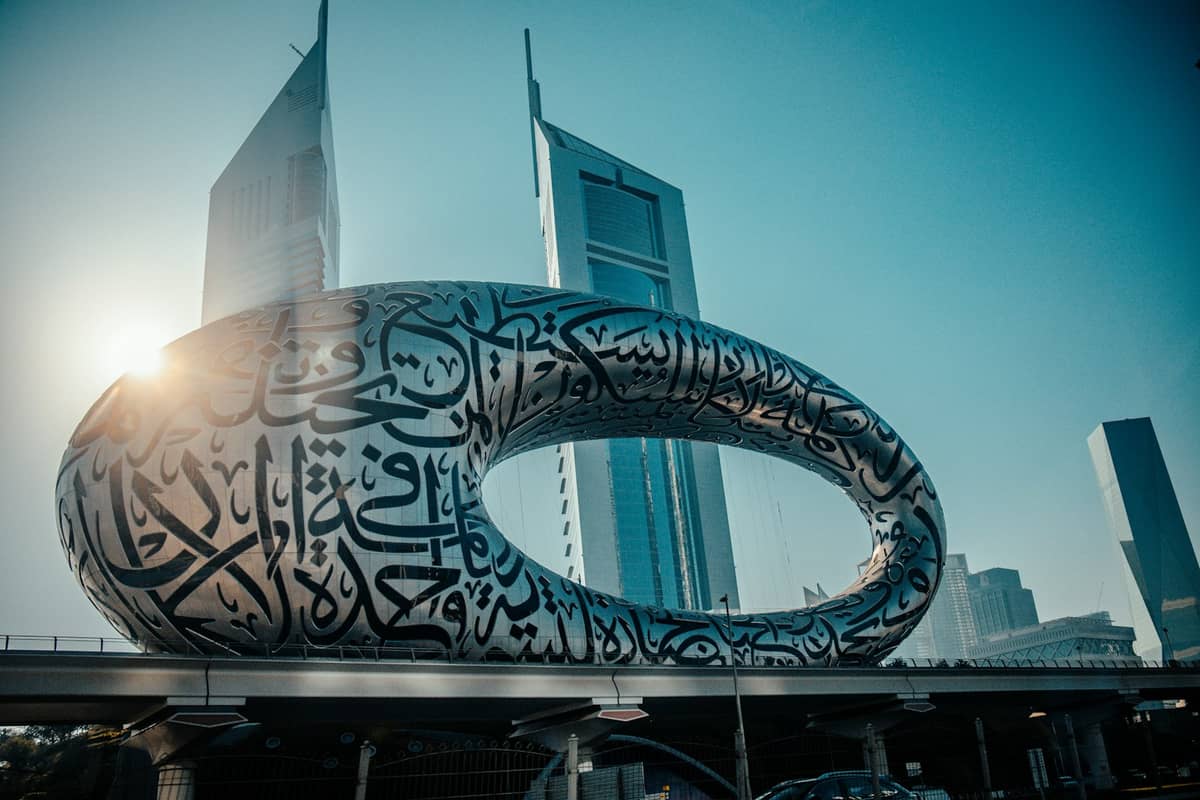
The Museum of the Future opened on 22 February 2022, a date deliberately chosen for its repeating symmetry: 2/22/22. It sits on Sheikh Zayed Road in the heart of central Dubai, positioned between the financial towers of the DIFC corridor and the trade district, and it is impossible to miss. The building is a toroidal structure, essentially a hollow ring tilted on its side, wrapped in a stainless-steel facade engraved with Arabic calligraphy. Those calligraphic panels are not purely decorative: they double as skylights, casting patterned light into the interior throughout the day.
From the outside, it reads as a statement about ambition. From the inside, it functions as a series of immersive, multi-sensory exhibit floors designed to project visitors into imagined futures across ecology, space, health, and human consciousness. It is not a traditional museum in any sense. There are no display cases of historical artifacts, no chronological timelines on the walls. Instead, it operates more like a curated experiential installation, somewhere between a world exposition pavilion and a high-production-value theme park for ideas.
Understanding what kind of experience you are signing up for matters before you buy a ticket. If you are looking for a conventional museum in the way that Dubai's Al Fahidi Fort or the Etihad Museum deliver historical depth, this is not that. The Museum of the Future trades in speculation and sensation, and it delivers both with considerable production polish.
The Architecture: Worth Seeing Even From Outside
The building's exterior is one of the most photographed facades in the UAE. The Arabic script carved into the steel cladding comes from quotes by Sheikh Mohammed bin Rashid Al Maktoum, the Ruler of Dubai, and the panels are backlit from inside, creating a luminous effect after dark that draws crowds to the surrounding Sheikh Zayed Road walkways. The structure has no central core in the traditional sense: the hollow middle frames the sky, and depending on the time of day, the view through that void changes entirely.
At dusk, when the ambient light drops and the internal illumination takes over, the museum becomes genuinely dramatic. Taxi passengers on Sheikh Zayed Road often catch their first view of it from the elevated section of the highway, where it appears to float above its green-landscaped base. For architecture enthusiasts, the building alone justifies a detour, even without entering.
If architectural landmarks in Dubai interest you broadly, the Museum of the Future fits naturally into a wider tour. A dedicated Dubai architecture guide can help you sequence it alongside other structures worth seeing across the city.
Inside: Floors, Exhibits, and What the Experience Feels Like
Entry is timed, which keeps the interior from becoming overwhelming, but it also means you cannot linger indefinitely. Visitors are assigned entry windows and the flow through the building moves broadly from the upper floors downward. The exhibit floors address themes including space exploration, ecological restoration, and the future of human biology, each occupying its own environment with distinct visual identities.
The upper floors tend to be the most visually arresting, with large-scale immersive environments that reward slow exploration. The sound design is deliberate throughout: in the space-themed sections, ambient audio fills the room with something between deep silence and low-frequency resonance, while the ecological zones use softer, layered natural sounds. The production quality is consistent and high. Some visitors find the experience profound; others find it glossy but thin on substantive content. Both reactions are reasonable.
Children fare well here if they are old enough to engage with abstract ideas and large-scale environments, roughly ages eight and above. Very young children may find some sections overstimulating or simply confusing. There is a dedicated floor for younger visitors with more hands-on interactive content, but the museum is not primarily designed as a children's attraction.
💡 Local tip
Book tickets online in advance through the official site. Timed entry slots fill up, especially on weekends and during school holidays. Walk-in availability is not guaranteed.
How It Changes By Time of Day
Morning slots, roughly around opening time, tend to draw smaller crowds and give you more space to move through exhibits at your own pace. Midday slots are busier, particularly on weekends. Late afternoon brings a different energy: the outdoor landscaped area around the base catches soft light, and the transition into early evening is when the exterior lighting begins to shift. If you have flexibility, a visit that starts in the late afternoon and ends near closing allows you to see both the interior exhibits and the building's illuminated night facade.
Weather affects the approach more than the interior. Dubai's summer months, June through September, produce daytime temperatures that frequently exceed 40 degrees Celsius. The walk from Emirates Towers Metro Station is short and partially shaded, but arriving by taxi or rideshare directly to the drop-off point is more comfortable in that heat. From November through March, the outdoor approach is pleasant enough to linger.
Getting There: Transit, Taxis, and Parking
The most straightforward route is the Dubai Metro Red Line to Emirates Towers Station. The station connects to the museum complex via a pedestrian walkway, and the journey from central stations like Union or BurJuman takes roughly 10 to 15 minutes. Metro fares vary by zone and are payable with a Nol card, which you can load at any station. Metro travel from Dubai International Airport (DXB) to Emirates Towers takes approximately 30 to 35 minutes.
Taxis and rideshare apps including Careem and Uber drop off directly at the museum entrance. From Downtown Dubai, the journey is typically 10 to 15 minutes depending on traffic on Sheikh Zayed Road, which can back up significantly during morning and evening rush hours. If you are driving, parking is available in the vicinity, but the museum's location on a major arterial road means that the metro or a rideshare is generally less stressful.
Practical Details: What to Know Before You Go
General admission has been priced at approximately AED 169 for visitors aged 4 and above, though this figure is subject to change. Children under 4 typically enter free. People of Determination and one accompanying caregiver have frequently been admitted free under current and recent promotions. Verify all pricing at the official booking page before purchase.
When the museum is operating, hours have generally run from around 9:30 to 21:00, with last entry typically between 19:00 and 19:30 depending on the day and season. These hours are subject to change, and the current temporary closure makes it essential to check the official site for the latest schedule before planning anything.
The building is fully accessible: step-free routes, elevators connecting all floors, and accessible facilities throughout. Photography is permitted in most areas, though specific exhibit zones may restrict it. The interior has a polished, dark aesthetic in many sections, so phone cameras perform better in the brighter, more open spaces near windows.
ℹ️ Good to know
The calligraphic facade panels are best photographed from across Sheikh Zayed Road or from a slight distance, not directly beneath the building. A wide-angle lens or the ultra-wide mode on a phone camera captures the full toroidal shape. After dark, a slower exposure picks up the internal glow through the calligraphy.
Honest Assessment: Is It Worth Your Time?
The Museum of the Future is one of the more distinctive experiences in Dubai, but it is not for everyone. If you are primarily interested in history, culture, or the older layers of the city, your time is probably better spent in Al Fahidi or exploring the Shindagha Heritage District. The Museum of the Future looks forward almost exclusively: there is no anchor in the past, no curatorial attempt to connect the exhibits to where Dubai or humanity has been.
For visitors who engage with design, speculative thinking, technology, or large-scale immersive art installations, the museum delivers a genuinely unusual experience at high production values. The ticket price is not trivial at AED 149 to 169, but it compares reasonably with other premium Dubai attractions. The time investment of two to three hours is appropriate for the content on offer.
If you are building a multi-day Dubai itinerary and want to pair the Museum of the Future with other viewpoint or landmark experiences, the Burj Khalifa observation deck and the Dubai Frame are both within reasonable distance. A good 3-day Dubai itinerary can help you sequence these without backtracking.
Insider Tips
- Book the first entry slot of the day. The museum's immersive rooms feel more atmospheric with fewer people in them, and the lighting effects in the opening exhibits are best experienced without crowds moving through.
- The exterior of the building is free to view and photograph at any hour. If the ticket price feels steep or you are short on time, walk the landscaped area around the base after dark and see the illuminated facade without going inside.
- Wear comfortable shoes with flat soles. The interior floors are polished and some exhibit transitions involve ramps or uneven surfaces in the dark. Heels are genuinely awkward in several areas.
- If you are visiting Dubai in summer, plan the museum as a midday activity rather than morning or evening. The air-conditioned interior is a practical refuge during peak heat hours, and you can save outdoor attractions for cooler parts of the day.
- The museum currently has no permanent collection in the traditional sense. Exhibits have changed since opening, and the 'next chapter' closure suggests further significant changes are coming. Check recent visitor reviews on booking platforms just before your visit to get a current picture of what is actually on display.
Who Is Museum of the Future For?
- Architecture and design enthusiasts who want to see one of the UAE's most distinctive modern buildings from inside and out
- Tech-oriented travelers interested in how Dubai positions itself in conversations about artificial intelligence, space, and ecological futures
- Families with children aged 8 and above who are curious and engaged with interactive, large-scale environments
- First-time Dubai visitors looking for an experience that feels specific to this city and unlike anything in their home country
- Photographers seeking a building that looks radically different by day versus after dark