Museum für Naturkunde Berlin: Dinosaurs, Deep Time, and 30 Million Specimens
Founded in 1810, the Museum für Naturkunde is one of the world's great natural history institutions. Its centerpiece, a 13-metre Giraffatitan skeleton, towers over a hall filled with some of the most complete dinosaur fossils ever discovered. This guide covers what to expect, when to go, and whether it earns your time.
Quick Facts
- Location
- Invalidenstraße 43, 10115 Berlin (Mitte)
- Getting There
- U6 Naturkundemuseum (approx. 4 min walk)
- Time Needed
- 2 to 3 hours
- Cost
- Adults €11 / Reduced €5 / Some groups free
- Best for
- Families, science enthusiasts, rainy-day visits
- Official website
- www.museumfuernaturkunde.berlin
What the Museum für Naturkunde Actually Is
The full official name is Museum für Naturkunde – Leibniz-Institut für Evolutions- und Biodiversitätsforschung, which signals something important: this is not just a public attraction but an active research institute. The museum holds over 30 million zoological, paleontological, and mineralogical specimens, making it one of the four largest natural history collections in the world. Visitors access only a fraction of that collection, but what is on display is genuinely exceptional.
The building itself, at Invalidenstraße 43 in central Mitte, covers more than 20,000 square metres. It dates to the late 19th century and survived World War II in partial form, with one wing still visibly scarred and deliberately preserved as a ruin. Walking past that east wing before entering sets a reflective tone that the interior's grandeur then shifts dramatically.
ℹ️ Good to know
The museum is closed on Mondays and on December 24, 25, and 31 (but open on December 26 from 10:00 to 18:00). It opens at 09:30 Tuesday through Friday and at 10:00 on weekends and public holidays. Last admission is 30 minutes before closing at 18:00.
The Dinosaur Hall: The Reason Most People Come
The central attraction is the Sauriersaal, the dinosaur hall, and it earns the attention. A fully mounted skeleton of Giraffatitan brancai stands at approximately 13 metres tall, currently recognised as the tallest mounted dinosaur skeleton in the world. The scale of the thing is difficult to prepare for. First-time visitors almost universally stop in the doorway.
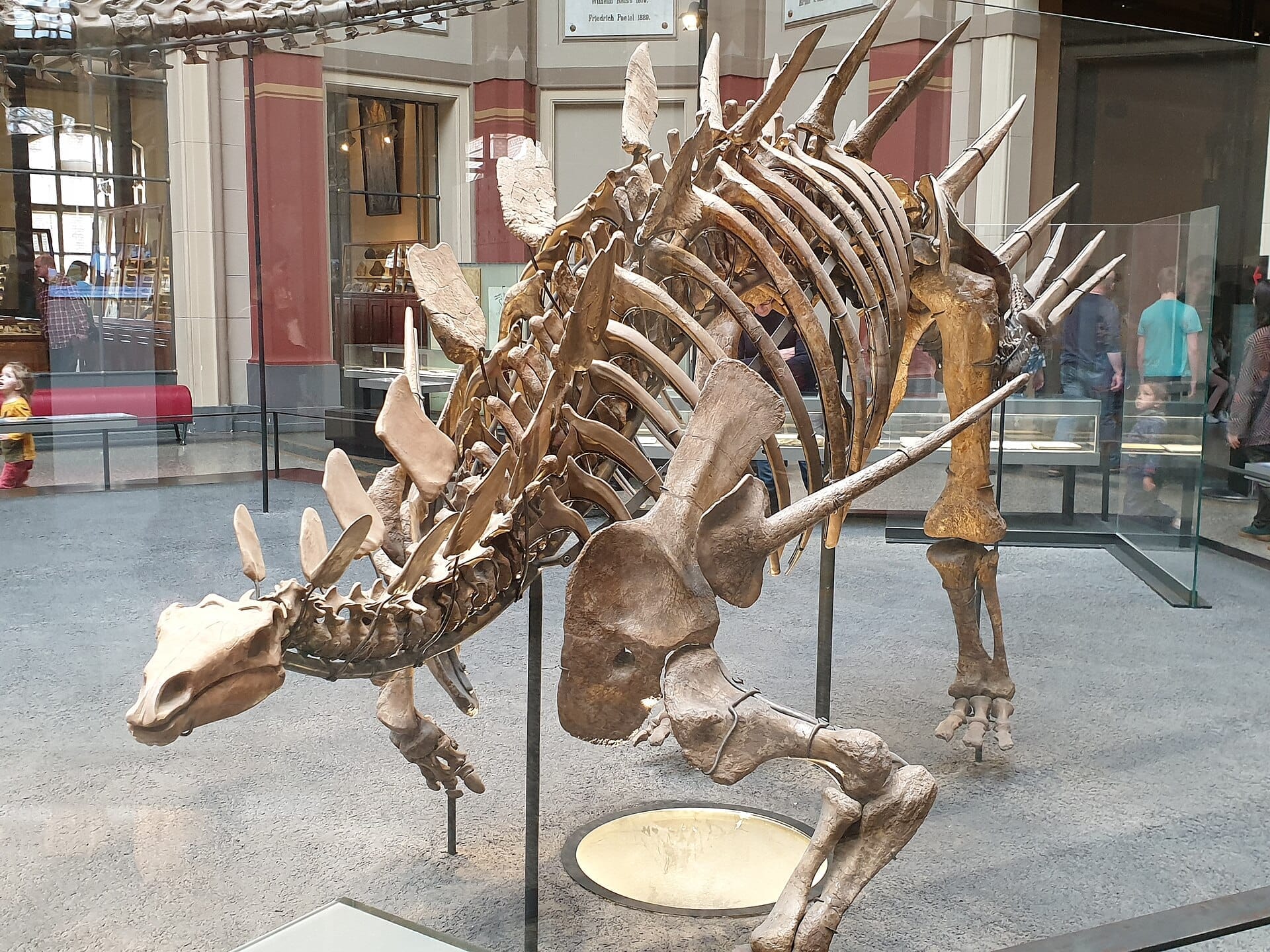
The fossils here came largely from the Tendaguru site in what is now Tanzania, excavated between 1909 and 1913 in one of the largest paleontological expeditions ever mounted. The Giraffatitan is surrounded by other Jurassic giants: a Diplodocus cast, Kentrosaurus, and the near-complete Brachiosaurus skull. For anyone with a genuine interest in paleontology, this room alone justifies the entrance fee.
On weekday mornings before 11:00, the hall is quiet enough that you can stand beneath the Giraffatitan and hear the faint creak of the old building. By early afternoon on weekends, the space fills with school groups and families, and the acoustic character shifts entirely. If you want contemplative time with the fossils, a Tuesday or Wednesday morning visit is worth planning around.
💡 Local tip
Photography is permitted throughout the museum without flash. The dinosaur hall is best lit in the late morning when natural light enters from the high clerestory windows. If you want dramatic shots of the Giraffatitan, arrive between 10:30 and 12:00.
Tickets & tours
Hand-picked options from our booking partner. Prices are indicative; availability and final rates are confirmed when you complete your booking.
Berlin Natural History Museum in-app audio tour
From 10 €Instant confirmationFood and history guided walking tour in East Berlin
From 91 €Free cancellationBerlin history city bike tour with beer garden stop
From 69 €Instant confirmationFree cancellationBerlin's history audio tour with Hamburger Bahnhof access
From 32 €Instant confirmation
Beyond Dinosaurs: What Else the Museum Contains
The zoology galleries hold wet specimens, taxidermy, and skeletal displays covering mammals, birds, fish, and invertebrates from across geological time. The whale skeleton suspended from the ceiling in the marine hall is a crowd stopper second only to the dinosaurs. The mineralogy and meteorite collection is more niche but genuinely rewarding: the iron meteorites in particular carry a tactile weight, literally, that photographs never convey.
One display that surprises many visitors is Bobby, a preserved lowland gorilla who was a famous resident of the Berlin Zoo in the early 20th century. He died in 1935 and was subsequently taxidermied, and his case draws a quiet, slightly unsettled crowd of adults who weren't expecting the emotional register of the encounter.
There is also a dedicated evolution and biodiversity section that uses modern interactive media to explain the research conducted in-house. This section is less visually dramatic than the fossil halls but gives intellectual depth to what you've already seen. Children tend to engage well with the touch-screen timelines; adults with a scientific background will find the detail genuinely substantive.
If you're planning a broader day of Berlin museums, the Natural History Museum pairs naturally with a visit to Humboldt Forum on Museum Island, which also covers global natural and cultural history, though at a very different scale and tone.
Historical and Cultural Context
The museum was founded in 1810 as part of the newly established Humboldt University of Berlin, making it one of the oldest scientific institutions in the city. Its collections grew through the era of European scientific exploration, colonial-era expeditions, and systematic 19th-century taxonomy. That history is present throughout, though the museum's current framing is increasingly self-critical about the provenance of its holdings.
The damaged east wing, left partially in ruins since World War II, was not restored to its original state but instead incorporated into the museum's architectural identity. A large glass installation now covers part of the bombed section, and the visible damage is contextualised as part of the building's history. It is one of the more honest acknowledgments of wartime destruction in Berlin's museum landscape.
Berlin's relationship with its own history is layered throughout the city. If the intersection of science, ideology, and 20th-century history interests you, the Topography of Terror and the German Historical Museum offer different but complementary perspectives.
Getting There, Tickets, and Practical Details
The closest U-Bahn station is Naturkundemuseum on the U6 line, approximately four minutes' walk from the museum entrance. The U6 connects directly to Friedrichstraße and Mehringdamm, making it accessible from most parts of central Berlin without a transfer. Tram lines on Invalidenstraße also stop nearby. The museum's own guidance recommends arriving by public transport or bicycle, as paid parking in the area is limited.
Standard admission is €11 for adults and €5 for reduced-rate visitors. Free entry applies to several groups, including certain children and accompanying persons of visitors with severe disabilities. The official museum website details current exemptions. Timed entry tickets can be booked via visitBerlin and the museum's own site, which is advisable on weekends and during school holidays when walk-up queues form.
Accessibility is well considered. There is a barrier-free entrance with a doorbell to the right of the main portal, stair lift access to the exhibition level, and a second barrier-free entrance with a lift at the building's rear. Almost all exhibition areas are accessible; where they are not, media stations provide equivalent content. Free wheelchair rental is available at the information counter. Tactile guided tours for visually impaired visitors can be arranged in advance.
⚠️ What to skip
The museum does not have a large café. There is a small refreshment area, but it is not a sit-down restaurant. Plan meals before or after, not during. Several cafés and lunch spots are within a 10-minute walk on Invalidenstraße and Chausseestraße.
When to Go and Who Should Reconsider
The museum works in nearly any weather, which makes it one of Berlin's most reliable rainy-day destinations. Summer weekends between 11:00 and 15:00 are the busiest windows, when the dinosaur hall can feel genuinely crowded. Weekday mornings are the quietest and most comfortable for adults who want to move at their own pace.
Visitors who expect the polished interactivity of newer science museums may find some of the older display cases dated. The museum blends genuinely world-class specimens with exhibition design that ranges from contemporary to quite traditional. That contrast is part of its character, but if you're traveling with children under four who are easily overwhelmed or bored by static displays, the experience may be shorter than you anticipate.
For families with children who want a longer interactive day out, our guide to Berlin with kids covers several complementary options across the city.
The museum sits in Mitte, Berlin's central district, which means it is easy to combine with other major sights. The walk south along Invalidenstraße toward the government quarter takes around 20 minutes and passes through an architecturally interesting corridor of 19th-century institutional buildings.
Insider Tips
- The archived specimen drawers in the research wing are not open to the public, but the museum runs occasional behind-the-scenes tours. Check the events calendar on their website at least two weeks before your visit if this interests you.
- The ruined east wing is visible from the courtyard between the building's wings. If you walk around the exterior before entering, you get a cleaner view of the architectural contrast between the restored sections and the preserved bomb damage.
- The meteorite collection on the upper floor is frequently overlooked. The Gibeon meteorite section includes pieces visitors are allowed to touch, which makes it one of the few places in Berlin where you can put your hand on a 4-billion-year-old object.
- Tuesday opening at 09:30 is the single quietest slot of the week. If you are an adult traveler without children and want an unhurried visit, this window gives you close to an hour in the dinosaur hall before the first tour groups arrive.
- The museum shop near the exit stocks genuinely good science books for children and adults in both German and English, alongside fossil replicas. It is worth budgeting 10 minutes there; the quality is higher than most museum shops.
Who Is Museum für Naturkunde (Natural History Museum) For?
- Families with school-age children who have any interest in dinosaurs or animals
- Science and natural history enthusiasts who want to see world-record specimens up close
- Travelers caught in Berlin's rain, looking for a full half-day indoor itinerary
- Photographers interested in dramatic interior natural light and monumental scale
- Anyone who wants a serious museum experience outside the Museum Island circuit
Nearby Attractions
Other things to see while in Mitte:
- Alexanderplatz
Alexanderplatz sits at the geographical and historical heart of former East Berlin, a vast open square with roots going back to the 13th century. Today it's a free, always-open crossroads of transit, Cold War monuments, and everyday Berlin life — chaotic, fascinating, and impossible to avoid.
- Berlin Cathedral (Berliner Dom)
The Berlin Cathedral, or Berliner Dom, is Germany's largest Protestant church and one of the most architecturally striking buildings in the city. Built between 1894 and 1905, it anchors Museum Island with a dome you can climb, a royal crypt below ground, and a nave that rewards slow, unhurried attention.
- Berlin TV Tower (Fernsehturm)
Standing 368 metres above central Berlin, the Berliner Fernsehturm is the tallest structure in Germany and the tallest publicly accessible building in Europe. Its observation deck at 203 metres delivers an unobstructed 360-degree panorama of the city. This guide covers what you actually see up there, when crowds are worst, and whether the ticket price is justified.
- Berlin Victory Column (Siegessäule)
Rising from the centre of the Großer Stern roundabout in Tiergarten, the Siegessäule is one of Berlin's most recognisable monuments. At around 67 metres tall, it offers a sweeping panorama over the city's forest-park heart — but you earn the view with 285 steps and no lift.