Mont-Saint-Bruno National Park: Montreal's Forested Escape
Covering 8.9 km² of forested hills, five lakes, and apple orchards on the Montérégie plain, Mont-Saint-Bruno National Park is the closest true wilderness to Montreal's urban core. Whether you come for autumn colour, winter snowshoeing, or a quiet midweek trail run, the park rewards visitors who understand its rhythms.
Quick Facts
- Location
- 330, rang des 25 Est, Saint-Bruno-de-Montarville, Québec — approximately 30 km southeast of downtown Montreal
- Getting There
- By car, Exit 80 from Hwy 30 or Exits 98/102 from Hwy 20
- Time Needed
- 2–5 hours depending on trail ambitions; a half-day is comfortable for most visitors
- Cost
- Daily access fee applies (adults, verify current rate on Sépaq website); children 17 and under: free
- Best for
- Hiking, trail running, snowshoeing, autumn foliage, family outings, photography
- Official website
- www.sepaq.com/pq/msb
What Mont-Saint-Bruno National Park Actually Is
Mont-Saint-Bruno National Park, officially Parc national du Mont-Saint-Bruno in French, is a Sépaq-managed protected area created in 1985 on the slopes of one of the Montérégie hills, the volcanic intrusions that punctuate the otherwise flat plain south of the St. Lawrence River. At 8.9 km² with a 21-km perimeter, it is compact by national park standards, but that compactness works in its favour: everything is accessible, the trail network is coherent, and you rarely feel lost.
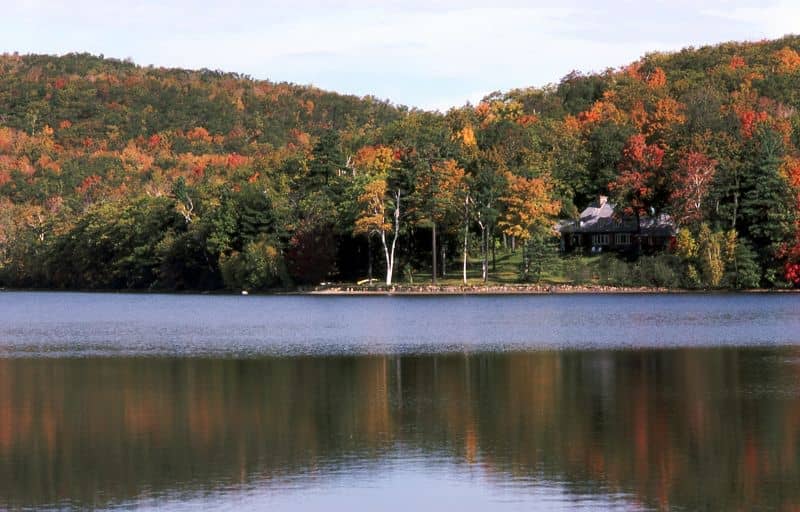
The park's core appeal is a combination of mixed forest, five small lakes (Lac du Moulin, Lac des Bouleaux, Lac Seigneurial, Lac des Atocas, and Lac du Pin-Solitaire), and apple orchards left over from the site's agricultural past. The forest canopy is predominantly maple and beech, which explains why the park draws serious crowds during fall colour season and offers a noticeably cool, shaded corridor in July heat.
💡 Local tip
Admission fees change annually. Always verify the current daily access rate on the official Sépaq tariff page before your visit: sepaq.com/pq/msb/tarifs. Children 17 and under enter free.
Getting There: Car, Bus, and Timing
Most visitors arrive by car. From downtown Montreal, the drive is typically 30 to 40 minutes via the Champlain Bridge and Highway 30 (Exit 80) or Highway 20 (Exits 98 or 102). Parking is available at the main entrance, though weekend morning spaces fill quickly from late September through October.
If you are travelling without a car, confirm current public-transit options with RTL before planning your trip. Longueuil–Université-de-Sherbrooke is on the STM Yellow Line, making car-free access from central Montreal more straightforward when a suitable connection is running. For general advice on navigating greater Montreal by transit, see the guide to getting around Montreal.
⚠️ What to skip
The RandoBus service is seasonal and schedule-dependent. Check RTL's current timetable before building your day around it. If the service is not running, the park is not realistically walkable from public transit stops.
Tickets & tours
Hand-picked options from our booking partner. Prices are indicative; availability and final rates are confirmed when you complete your booking.
3-Course Brunch Cruise in Montreal
From 62 €Instant confirmationFree cancellationMontreal evening cruise on the St. Lawrence River
From 54 €Instant confirmationFree cancellation3-hour e-bike guided tour in Montreal
From 68 €Instant confirmationFree cancellationWalking tour of Old Montreal
From 20 €Instant confirmationFree cancellation
The Trails: What You Will Find Underfoot
The trail network includes multiple routes of varying difficulty. The terrain is hilly rather than mountainous: the summit sits at around 218 metres above sea level, so you are not dealing with alpine conditions, but the climbs are real enough to make your legs feel it by the time you loop back. Paths are generally well-maintained and clearly signed in French, with distances marked in kilometres.
The most popular route for first-time visitors circles past the Vieux-Moulin, a restored 18th-century mill that anchors the park's historical identity, then passes Lac du Moulin before climbing toward the summit viewpoint. This loop takes 2 to 3 hours at a comfortable walking pace. More ambitious visitors can extend through the apple orchard sections, which carry a distinct smell of fermenting windfall fruit in early October.
Trail surfaces shift between packed gravel, exposed root networks, and wooden boardwalks over wet sections near the lakes. Waterproof footwear is not strictly necessary in dry summer conditions, but after rain or during snowmelt in March, muddy stretches near the lakeshores make sturdy shoes or trail runners worthwhile.
How the Park Changes by Season
Spring, roughly late April through May, is the quietest season and arguably the most interesting for naturalists. Migratory birds move through the canopy, wildflowers push through the forest floor before the leaf cover closes in, and the trails are largely empty on weekdays. Temperatures can be unpredictable, ranging from 5°C to 18°C within the same week.
Summer brings dense shade and relatively consistent crowds on weekends, particularly in July and August when Montreal temperatures push past 25°C. The park becomes a legitimate heat refuge: under the mature maple canopy, temperatures drop noticeably compared to the surrounding suburbs. It is a genuinely different experience from the city's more central green spaces. If you are planning an extended summer in Montreal, the Montreal in summer guide covers how to sequence day trips like this alongside urban activities.
Autumn is the park's peak season, full stop. The maple-dominated canopy turns in earnest from late September through mid-October, and on clear October weekends the parking area reaches capacity before 10:00 a.m. If you plan to visit during foliage season, arrive at opening (8:00 a.m.) or accept that you will be sharing the trails with significant numbers of other visitors. Weekday visits in early October are far more pleasant.
Winter extends the park's calendar rather than closing it. Snowshoe rentals are available on-site, and groomed cross-country ski trails operate when conditions allow. On Wednesdays, Thursdays, and Fridays during the winter program, evening access may extend to 9:00 p.m., creating an unusual opportunity for night snowshoeing through a lit section of the park. Check the Sépaq website for the current winter program before visiting. For context on what Montreal winters actually involve and how to dress for them, see the Montreal in winter guide.
The Vieux-Moulin and Historical Context
The park's most architecturally distinctive feature is the Vieux-Moulin, a stone mill dating to the 18th century that once processed grain for the surrounding seigneurial community. It stands near Lac du Moulin and serves as both a waypoint on the main trail circuit and an interpretive site explaining the region's agricultural and seigneurial history. The stone walls and surrounding orchard remnants give the park a layered quality that purely wilderness areas lack.
This agricultural heritage also explains the apple orchards scattered through the park's lower elevations. They are not purely decorative: the fruit trees represent a working landscape that predates the park's 1985 creation, and some sections are still maintained in a semi-productive state. In late summer and early fall, the smell of ripening and fallen apples is noticeable along certain trail sections, and the visual contrast between orchard rows and forest canopy is one of the park's more distinctive features.
Practical Details and Accessibility
The park is open year-round from 8:00 a.m. until sunset, with the gate's closing time varying by season. The main entrance includes a visitors centre, washroom facilities, and a picnic area. The Vieux-Moulin, the Discovery and Visitors Centre, and the picnic zones are accessible to visitors with reduced mobility. Sépaq identifies which specific trails are suitable for mobility-limited visitors, and adapted equipment is available free of charge on request.
Photography in the park is most rewarding in the two hours after opening and in the late afternoon before sunset. Morning light filters through the canopy at low angles in summer, creating distinct shafts above the lake surfaces. In October, early morning visits often catch mist sitting over Lac du Moulin before it burns off by mid-morning.
Mont-Saint-Bruno is one of the more accessible day trips from the city. For a broader look at how it fits into a regional itinerary, including other green spaces and natural areas reachable from Montreal, the guide to day trips from Montreal is worth consulting before you plan.
Who Should Think Twice
Mont-Saint-Bruno is not the right choice if you are looking for dramatic scenery or genuine wilderness solitude. The park is popular, suburban in context, and the summit view is pleasant without being spectacular. Visitors expecting the scale or remoteness of a Laurentian park will be underwhelmed.
If your goal is a big viewpoint rather than a forest trail experience, the city itself offers more striking panoramas. The Kondiaronk Belvedere on Mount Royal and other elevated spots in Montreal proper deliver skyline views that this park cannot match. Mont-Saint-Bruno's value is in the walk itself, not what you see from the top.
Insider Tips
- Arrive at 8:00 a.m. on autumn weekends. The parking lot fills well before 10:00 a.m. in October, and the entrance queue can add 20 minutes to your visit at peak times.
- The Wednesday-to-Friday extended evening access during the winter program (until 9:00 p.m. on qualifying dates) makes for an unusually quiet night snowshoe experience. Verify the schedule on Sépaq's site before going — conditions must be suitable for the program to run.
- If you are visiting during apple season in September and early October, the lower orchard trails carry a distinct fermented fruit smell that is either charming or off-putting depending on your expectations. The higher forest trails are unaffected.
- The park's trail signs are in French only. Screenshot the trail map from the Sépaq website before entering areas with limited mobile coverage, as the on-site paper maps at the entrance are more useful than trying to navigate from memory.
- Weekday visits in mid-October often offer the best combination of peak colour and manageable crowd levels. By late October, the maples are largely bare and the park returns to its quiet off-season state.
Who Is Mont-Saint-Bruno National Park For?
- Hikers and trail runners looking for a proper forest circuit within 40 minutes of Montreal
- Families with children who want more than a city park but less than a full wilderness expedition
- Photographers targeting autumn foliage with early-morning mist over the lakes
- Winter visitors interested in snowshoeing or cross-country skiing on a maintained trail network
- Anyone needing a genuine heat refuge during Montreal's hot July and August weekends
Nearby Attractions
Combine your visit with:
- Eastern Townships
The Eastern Townships (Cantons-de-l'Est) stretch across the rolling hills south of Montreal, reaching the U.S. border. With lavender fields, gorge walks, vineyards, and covered bridges, this is one of the most rewarding escapes from the city, especially in autumn when the hills turn amber and rust.
- Îles-de-Boucherville National Park
Parc national des Îles-de-Boucherville is a five-island nature reserve in the St. Lawrence River, reachable from Montreal in under an hour. Cyclists, kayakers, birdwatchers, and families find quiet trails, shoreline views, and genuine wilderness just minutes from the city's eastern suburbs.
- Maison Saint-Gabriel
Maison Saint-Gabriel is one of the oldest intact structures on the Island of Montreal. Originally a working farm connected to Marguerite Bourgeoys and the Filles du roi, it is now a museum and National Historic Site where guided tours walk visitors through three centuries of Quebec's colonial and religious history.
- Marché Maisonneuve
Marché Maisonneuve is one of Montreal's official public markets and one of its least crowded. Free to enter, open seven days a week, and genuinely rooted in its neighborhood, it rewards travelers who venture beyond the tourist circuit.