Real Monasterio de San Jerónimo: Granada's Overlooked Renaissance Masterpiece
The Real Monasterio de San Jerónimo was the first Christian monastery founded in Granada after the Reconquista, and its church interior ranks among the most elaborately decorated Renaissance spaces in southern Spain. Fewer tourists make the short walk from the city centre, which means you can stand in the main nave in relative quiet and actually absorb what you're looking at.
Quick Facts
- Location
- Calle Rector López Argüeta 9, 18001 Granada (Centro-Sagrario district)
- Getting There
- City bus line 25 (stop: Gran Capitán), then a 3-minute walk; also walkable from the Cathedral in about 10 minutes
- Time Needed
- 60–90 minutes for a thorough visit
- Cost
- Adults €7 / Students & disabled €5 / Children under 12 free
- Best for
- Renaissance architecture, Spanish history, quiet cultural visits away from the main tourist trail
- Official website
- realmonasteriosanjeronimogranada.com
What the Monasterio de San Jerónimo Actually Is
The Real Monasterio de San Jerónimo is a working religious site and a monument of major historical significance, sitting in a quiet pocket of Granada's historic centre that most day-trippers never reach. Founded in 1492 by the Catholic Monarchs after the fall of the Nasrid dynasty, with building work beginning in 1496, it holds the distinction of being the first Christian monastery established in Granada following the Reconquista. The Order of Saint Jerome administered it, and the building that stands today reflects the ambitions of a city being remade as a symbol of Christian Castilian power.
What surprises almost every visitor is the scale. From the street, the entrance gives little away: a modest doorway, worn stone, a neighbourhood that feels lived-in rather than touristy. Inside, the church opens into one of the most exuberantly decorated Renaissance interiors in Andalusia. The contrast is deliberate, but it still catches people off guard.
💡 Local tip
Opening hours are seasonal. Summer hours run approximately Monday–Saturday 10:00–13:00 and 16:00–19:00; winter hours shift the afternoon session to 15:00–18:00. Sundays and public holidays open at 11:00. Verify exact hours at realmonasteriosanjeronimogranada.com or the ticketing site before you go.
The Architecture: Renaissance Ambition in Stone
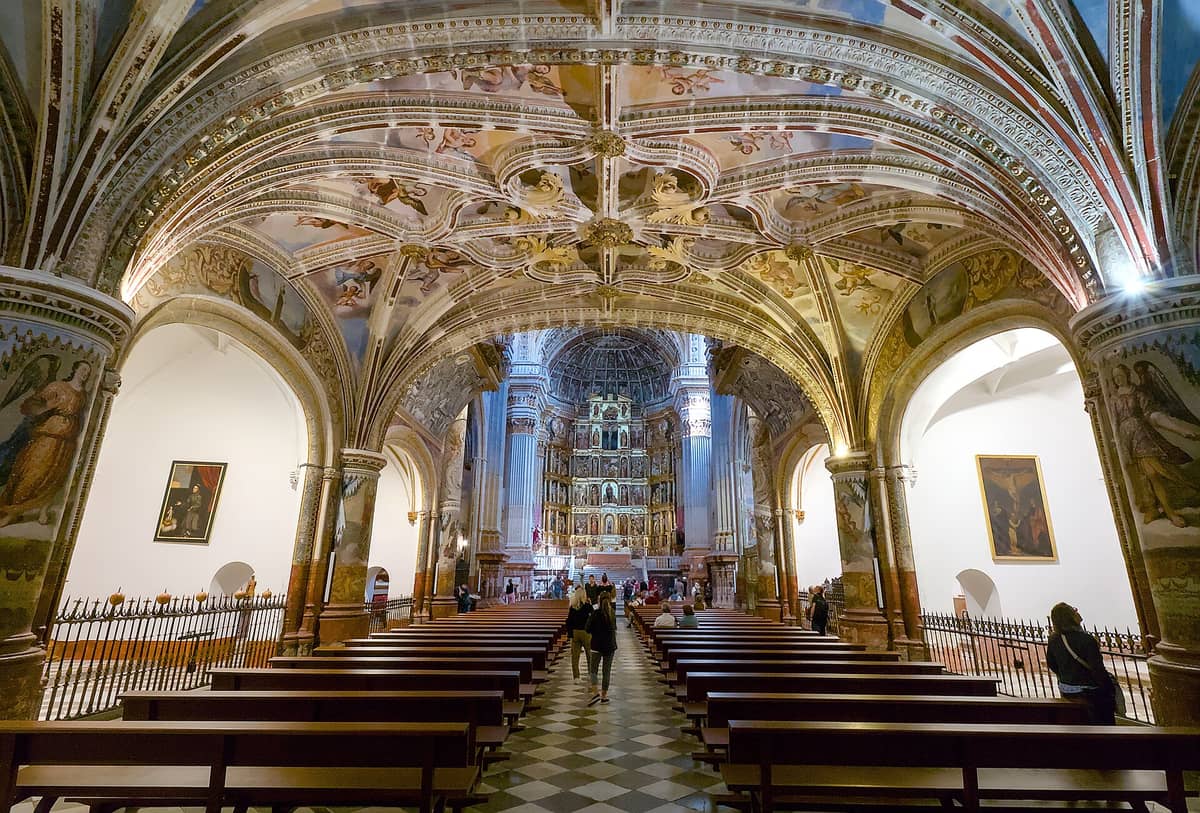
Construction of the current building began in 1505, and the church represents a full commitment to the Spanish Renaissance style known as Plateresque, characterised by densely worked stone surfaces that look almost like silverwork. The main retablo (altarpiece) behind the high altar is the centrepiece: a multi-storey carved structure gilded and painted, covering the entire east wall of the apse. Figures of saints, military commanders, and biblical scenes are stacked in tier after tier, framed by columns and pilasters. Standing at the entrance to the nave and looking toward it, the effect is overwhelming in the best sense.
The church also serves as the mausoleum of Gonzalo Fernández de Córdoba, known as El Gran Capitán, the general who commanded the Spanish forces in the Italian Wars under the Catholic Monarchs. His tomb is here alongside that of his wife María Manrique. The association with El Gran Capitán gives the monastery its second layer of significance: this is not just a religious building but a monument to the military and political project of 15th and 16th-century Spain.
The nave itself is wide and tall, with ribbed vaulting that draws the eye upward before pulling it forward toward the altar. Natural light enters through windows set high in the walls, and in the morning hours it falls obliquely across the carved stonework, sharpening shadows and making the sculptural detail legible in a way that the flatter afternoon light does not. If architecture photography is part of your interest, the first session after opening is by far the better choice.
Tickets & tours
Live prices and dates from our booking partner. If you book, we may earn a commission at no extra cost to you.
Alhambra guided tour in Italian
From 49 €Instant confirmationFree cancellationAlhambra guided group tour with Nasrid Palaces and Generalife Palace
From 40 €Alhambra guided tour with Carlos V Palace, Generalife and Alcazaba
From 35 €Alhambra and Generalife skip-the-line private tour
From 65 €Instant confirmation
The Cloisters: Two Courtyards, Two Scales
The monastery has two cloisters, and the contrast between them is instructive. The larger cloister is Renaissance in proportion: two storeys of round-arched galleries surrounding a rectangular garden with orange trees and a central fountain. The stonework here is plainer than the church, which lets the geometry of the space do the work. It is peaceful in a functional rather than decorative way. Late morning, when the garden gets full sun, the space has a warm, almost Mediterranean quiet. A few cats, resident in the grounds, typically appear around this time.
The smaller cloister is more intimate, with lower ceilings and closer arches. It reads more like a medieval space than a Renaissance one, reflecting an earlier phase of construction. Together the two courtyards give a sense of how the monastery evolved over several decades rather than being built to a single unified plan.
How the Visit Unfolds: A Practical Walkthrough
Entry is through the ticket desk just inside the main door. At €7 for adults, it is one of the more affordable major monuments in Granada. An audio guide is available via app, which is useful given the absence of explanatory panels in several parts of the building. Download it before you arrive if you have limited mobile data.
The standard route takes you through the cloisters first, then into the church. Allow at least 20–30 minutes in the church alone if the retablo interests you. There is no strict one-way system, so it is possible to return to sections you want to revisit. If you are combining this with other sites, the Granada Cathedral and the Capilla Real are both roughly a 10-minute walk to the southeast and make a natural half-day circuit.
The monastery is still an active religious community. Nuns of the Order of Saint Jerome continue to live in the enclosed section, which is not open to visitors. Occasional sounds of prayer or chant can sometimes be heard from behind grilles near the church, which adds an unexpected layer of atmosphere to the visit.
ℹ️ Good to know
Dress code: as an active religious site, modest dress is expected. Covered shoulders and clothing below the knee are the standard guidance for visiting Spanish churches and monasteries. This is rarely enforced strictly, but it is worth respecting.
Best Time to Visit and Crowd Patterns
The Monasterio de San Jerónimo draws a fraction of the visitor numbers that the Alhambra or the Cathedral attract. On most mornings, particularly during the week, you can move through the entire site without feeling crowded. Weekends in summer bring slightly more visitors, and organised school groups occasionally visit in the morning sessions, which can make the cloisters noisier for 20–30 minutes. Even so, this is a genuinely uncrowded site by Granada standards.
The best months to visit Granada for this kind of indoor-outdoor monument are April through June and September through October, when temperatures are moderate and the garden cloisters are pleasant. A full breakdown of when to visit Granada by season can help you plan the wider trip. In July and August, midday temperatures in Granada regularly exceed 35°C, and the afternoon session of the monastery can feel very hot in the cloisters, though the church itself stays relatively cool.
The midday closure (roughly 13:00–15:00 or 16:00 depending on season) follows traditional Spanish hours. Plan around it: either arrive at 10:00 and spend the morning session here, or arrive at 16:00 and visit in the late afternoon when the light shifts and the crowds from the cathedral have largely dispersed.
Historical and Cultural Context
The founding of the monastery in 1492 was a symbolic act as much as a practical one. Granada had been the last Nasrid emirate on the Iberian Peninsula, and the Catholic Monarchs, Ferdinand and Isabella, were determined to establish visible Christian institutions in the newly conquered city. The monastery was one of several such foundations; the Capilla Real, which serves as the royal mausoleum of the Catholic Monarchs themselves, was built at roughly the same time and reflects the same political programme.
The connection to El Gran Capitán anchors the monastery in a specific moment of Spanish imperial expansion. Gonzalo Fernández de Córdoba is a figure who rarely appears in standard European history taught outside Spain, yet his tactical innovations during the Italian Wars of the late 15th and early 16th centuries shaped European warfare for a generation. Seeing his tomb here, in a monastery he chose as his resting place in a city he helped reconquer, gives some texture to what otherwise risks remaining an abstract chapter of history.
For visitors interested in the broader Moorish and Reconquista heritage of Granada, the monastery works well alongside a visit to the Alhambra complex. The contrast between the final Islamic palatial architecture and the first assertive Renaissance Christian building in the same city is one of the more thought-provoking juxtapositions Granada offers. See the Granada Moorish heritage guide for more context on that larger narrative.
Accessibility, Photography, and Practical Notes
Reduced-price tickets at €5 are available for students under 25 with valid student ID and for visitors with disabilities with appropriate accreditation. Detailed information on wheelchair access within the building is not published on the official site, so it is worth confirming directly if this is a concern.
Photography is generally permitted in the church and cloisters. The main challenge for photography is the interior lighting: the church is dark relative to the bright garden courtyard, so moving between the two requires patience with exposure settings. A phone camera will struggle with the retablo unless you are shooting in the morning when side light enters from the upper windows. A compact camera with manual exposure control will manage better.
⚠️ What to skip
The monastery is closed on Good Friday. If you are visiting Granada during Semana Santa (Holy Week), check the schedule carefully. The city hosts significant processions during this week, and several religious sites adjust their hours or close on specific days.
The address is Calle Rector López Argüeta 9. By foot from the Cathedral area, head northwest along Gran Vía de Colón and turn left onto Calle San Jerónimo; the monastery entrance is signposted. City bus line 25 stops at Gran Capitán, a short walk away. There is no dedicated parking at the site, and the narrow surrounding streets make driving impractical.
Insider Tips
- The first 15 minutes after opening (10:00 on weekdays) are the quietest. If you arrive at 10:05, you will often have the church entirely to yourself for a few minutes before any other group enters. The silence in the nave at that hour is something most visitors to Granada never experience.
- Download the audio guide app before you enter; the monastery's interior WiFi is unreliable and the app requires an initial download. Search for it on the official site before your visit.
- The orange trees in the larger cloister are fragrant in spring (roughly March to May). If your visit falls in that window, the combination of the citrus scent and the Renaissance stonework in morning light is the sensory centrepiece of the whole monastery.
- Children under 12 enter free when visiting as a family (not a school group). If you are travelling with kids, this and the Cathedral are the two historic monuments in the centre where the cost-to-experience ratio works well for families.
- The monastery is less than a 5-minute walk from the Mercado de San Agustín, which is worth a quick stop before or after. A late morning visit to the monastery followed by a market lunch makes a logical and unhurried half-day.
Who Is Monasterio de San Jerónimo For?
- Architecture enthusiasts interested in Spanish Renaissance Plateresque style
- History-focused travellers tracing the Reconquista and early Spanish Empire
- Visitors wanting a major monument experience without the Alhambra-level crowds
- Families with children under 12 looking for a free-entry cultural site
- Photographers working on interior religious architecture in natural light
Nearby Attractions
Other things to see while in Centro-Sagrario (City Centre):
- Alcaicería (Arab Bazaar)
The Alcaicería is Granada's reconstructed Arab silk market, a tight labyrinth of narrow lanes packed with craft and souvenir shops steps from the cathedral. Free to enter and open most days, it offers one of the most atmospheric walking experiences in the city centre, though visitors should know its history before they arrive.
- Basílica de San Juan de Dios
The Basílica de San Juan de Dios is Granada's most extravagantly decorated Baroque church, a 18th-century pilgrimage site housing the relics of the saint who founded the Brothers Hospitallers. Most visitors walk past its understated facade without a second glance — which makes the gold-drenched interior all the more astonishing when you step inside.
- Capilla Real de Granada (Royal Chapel)
The Capilla Real de Granada is the funerary chapel commissioned by the Catholic Monarchs to house their remains in the city where they completed the Reconquista. Inside, behind an extraordinary wrought-iron screen, lie the tombs of Isabella I, Ferdinand II, Juana la Loca, and Felipe el Hermoso, alongside a small but remarkable collection of royal art and personal relics.
- Corral del Carbón
The Corral del Carbón is a 14th-century Nasrid alhóndiga — a combined grain warehouse and merchant inn — standing in Granada's historic centre. It is the last surviving Nasrid alhóndiga in the city, admission is free, and most visitors spend around 30 minutes exploring its layered courtyard architecture before continuing to the nearby Alcaicería or Cathedral.
Planning a trip? Discover personalized activities with the Nomado app.