Museum of Modern Greek Art Rhodes: What to Expect and Whether It's Worth Your Time
The Museum of Modern Greek Art of the Municipality of Rhodes is one of the most significant collections of post-independence Greek painting and printmaking in the country. Spread across three buildings in the Old Town and New Town, it rewards visitors who want more than sun and ruins.
Quick Facts
- Location
- Main building: 2 Symi Square (Old Town entrance); Nestorideion Melathron: 100 Palm Trees Square, New Town
- Getting There
- Symi Square is a short walk from the Old Town gates; Nestorideion Melathron is a 10-minute walk north from the Old Town walls
- Time Needed
- 1.5 to 2.5 hours for the main building; allow extra time if visiting multiple sites
- Cost
- Admission fees not confirmed — check the official website before visiting
- Best for
- Art lovers, Greek cultural history, escaping midday heat, rainy-day alternatives
- Official website
- mgamuseum.gr/en/the-museum
What This Museum Actually Is
The Museum of Modern Greek Art of the Municipality of Rhodes (Μουσείο Σύγχρονης Ελληνικής Τέχνης Δήμου Ρόδου) is not a small regional curiosity. It holds one of the most important collections of modern Greek art in the country, with works spanning from the early 19th century through to contemporary Greek artists. The collection focuses on painting, printmaking, sculpture, and ceramics, and traces the development of a distinctly Greek visual identity following independence from Ottoman rule.
What makes this museum unusual is its distributed structure. The institution operates across three separate buildings: the main building at Symi Square on the edge of the Medieval City, the Old Syssitio on Sokratous Street deep within the Old Town, and the Nestorideion Melathron on 100 Palm Trees Square in the New Town. Each building has a different character and focus, and together they amount to a much larger experience than most visitors expect.
ℹ️ Good to know
The museum's three buildings are spread between the Old Town and New Town. If you're planning to visit more than one, confirm which sites are open on your date of travel at mgamuseum.gr, as opening arrangements can vary seasonally.
The Three Buildings: What Each One Offers
Main Building, Symi Square
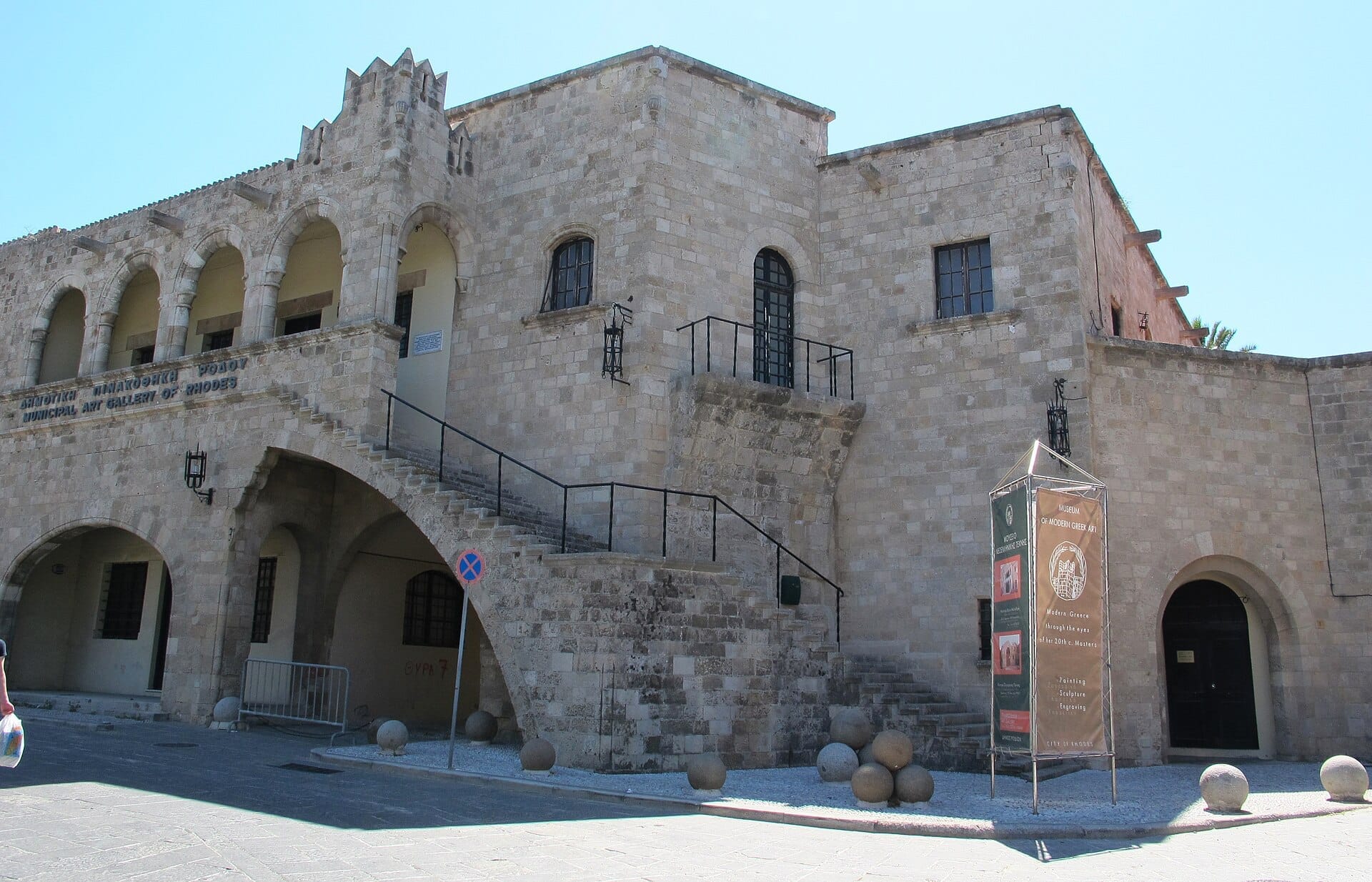
The main gallery sits at 2 Symi Square, right at the entrance to the Medieval City near the harbour gate. The location is striking: you're standing at the threshold between the city's ancient walls and the modern port, with the medieval stonework of the Old Town rising behind you. The building itself is a product of the Italian administration period, which shaped so much of Rhodes New Town's architecture in the early 20th century.
This is where the core permanent collection lives. Expect oils and watercolours from 19th and 20th century Greek painters, many of whom studied in Munich, Paris, or Athens before returning to document Greek landscapes, village life, and national mythology. The light inside is controlled and cool, which is welcome during the high summer months when temperatures outside push past 35°C.
If you're approaching from the Old Town after a morning walk along the Street of the Knights, the museum makes a logical final stop before heading back toward the harbour.
Paleo Syssitio, Sokratous Street
The Old Syssitio at 179 Sokratous Street sits in the commercial heart of the Old Town, a few minutes' walk from the souvenir shops and cafés. The building's name refers to its historical function as a communal dining hall during the Knights' period. It now operates as a secondary exhibition space, used particularly for temporary and seasonal shows. Summer exhibitions here have included prints and graphics that complement the main collection's painting-heavy focus.
The building itself is worth pausing to appreciate. The thick stone walls keep the interior noticeably cooler than the streets outside, and the medieval spatial quality creates an interesting tension with the modern and contemporary works sometimes displayed inside. If you're already exploring the Old Town, this is an easy addition.
Nestorideion Melathron, 100 Palm Trees Square
The Nestorideion Melathron is the museum's main cultural hub in the New Town, located on Gabriel Charitou Square, commonly known as 100 Palm Trees Square, close to the Grande Albergo delle Rose hotel. This building handles a broader cultural role within the museum's program, hosting lectures, events, and larger exhibitions.
The square itself is a pleasant area to be in. The tall palm trees offer shade, and the Italian-era architecture around the perimeter gives the whole space a faded, elegant quality. It's close to Mandraki Harbour and makes a good addition to a New Town walking loop.
Tickets & tours
Hand-picked options from our booking partner. Prices are indicative; availability and final rates are confirmed when you complete your booking.
Rhodes Sunset Cruise with Greek BBQ and Unlimited Drinks
From 65 €Instant confirmationFree cancellationTraditional Greek cooking class with lunch in Rhodes
From 95 €Instant confirmationFree cancellationAll Inclusive Day Cruise with Greek BBQ & Unlimited Drinks from Rhodes
From 85 €Instant confirmationFree cancellationSunset catamaran cruise with dinner in Rhodes
From 70 €Instant confirmationFree cancellation
The Collection in Context
The museum's origins go back to the 1950s, when the Municipality of Rhodes began collecting works to document and celebrate the trajectory of Greek art after independence. The official opening came in 1964, and the institution has grown significantly since: the Old Syssitio was added in 2000, the Nestorideion Melathron in 2002, and a New Wing was incorporated in 2010.
Greek modern art is still underexposed to international visitors, most of whom focus on classical antiquity when they think of Greek cultural heritage. But the 19th and 20th century Greek painters represented here were working in a period of extraordinary political and national transformation. The shift from Byzantine and Ottoman visual traditions to European academic painting, and then to distinctly Greek modernism, is visible across the collection. For anyone interested in how nations construct visual identity, this collection is genuinely illuminating.
If you're already interested in Greek history and want to understand the medieval layer before stepping into the modern collection, the Palace of the Grand Master and the Archaeological Museum of Rhodes together give strong context for what came before the period this museum documents.
When to Visit and How the Experience Changes
The museum is open Monday to Friday, 09:00 to 14:00, according to available information for the main gallery. This makes it a morning institution. Arriving shortly after opening means you'll have the rooms largely to yourself. The light in the main building is best in the mid-morning, when it filters in at an angle without the harsh overhead glare of peak afternoon.
The midday heat in Rhodes from June through August makes outdoor sightseeing genuinely unpleasant between roughly 12:00 and 16:00. The museum fits neatly into this window, offering air-conditioned or naturally cooled gallery space when walking the cobblestone streets becomes uncomfortable. This is one of the practical reasons to prioritize it during summer visits.
⚠️ What to skip
Opening hours and weekend access for all three buildings should be confirmed directly on the official website (mgamuseum.gr) before your visit. Seasonal changes, temporary closures, and event programming can affect availability.
If you're visiting Rhodes in the shoulder months, April through June or September through October, the museum is easier to combine with outdoor sightseeing. You can visit in the morning and continue on to the nearby harbour or Old Town without overheating.
Practical Walkthrough
For most visitors, the logical approach is to start at the Symi Square main building. It's easy to reach on foot from both the Old Town and the port. From the New Town side, you can walk south along the harbour front and reach Symi Square in under ten minutes. From inside the Old Town, exit through the harbour gates and the museum entrance is immediately visible across the square.
Photography inside the museum follows standard Greek public institution norms: personal, non-commercial photography is generally tolerated without flash, but confirm with staff on arrival. For photography outside the building, the square itself frames well, particularly with the Old Town walls in the background. If you're building a broader photography itinerary, the Rhodes photography guide covers timing and locations across the island.
The museum is not designed for children under ten and there are no dedicated family programs listed in available sources. Visitors with mobility limitations should note that the Paleo Syssitio occupies a medieval building on uneven stone flooring; accessibility there may be limited. The main Symi Square building and Nestorideion Melathron are likely more manageable, but confirm specifics directly with the museum before visiting.
Who Might Skip This and Why
If Greek art history is not among your interests and you're working through a packed itinerary, the museum is skippable. Visitors on short stays of two or three days who are primarily drawn to beaches, the medieval city, and sea views are unlikely to find it transformative. The collection is excellent by any regional standard, but it does require some engagement with art history to reward the time invested.
Families with young children, or visitors primarily after outdoor and beach experiences, will find their time better spent at places like Elli Beach or on a Rhodes boat trip. The museum serves a specific kind of traveler well, but it makes no attempt to be a crowd-pleasing attraction.
Insider Tips
- The Symi Square building is easy to miss if you enter the Old Town through the main pedestrian gates. Approach from the harbour-side for the clearest signage and direct access.
- If you're visiting in July or August, use the museum as your 11:00 to 13:00 activity. This is when street temperatures peak and gallery space is most welcome. You'll also find fewer other visitors inside than at the popular medieval monuments.
- The Old Syssitio on Sokratous Street sometimes hosts temporary exhibitions not listed on the main website. Worth a quick look when passing through the Old Town bazaar area, even if only to check the exterior board.
- The Nestorideion Melathron in the New Town is the least visited of the three buildings by tourists, which means it offers a genuinely quieter experience. The 100 Palm Trees Square around it is also a pleasant spot for a coffee break after the visit.
- Admission fees are not widely published in advance. Carry euros in small denominations as many Greek cultural institutions still prefer cash, and ATMs around Symi Square can be busy in summer.
Who Is Modern Greek Art Museum For?
- Art enthusiasts wanting to understand modern Greek visual culture beyond antiquity
- Visitors building a full cultural itinerary across multiple days in Rhodes
- Travelers caught in peak midday heat looking for a cool, substantive indoor activity
- Anyone interested in how post-independence national identity is expressed through painting and printmaking
- Slow travelers who want to go beyond the obvious medieval monuments
Nearby Attractions
Other things to see while in Rhodes New Town:
- Acropolis of Rhodes
Perched on Monte Smith hill 3 km southwest of the city center, the Acropolis of Rhodes is an open-air archaeological site dating to the 5th century BC. It holds the partially reconstructed Temple of Apollo, a 210-meter Hellenistic stadium, an odeon, and broad views over the Aegean. Entry is free, crowds are light, and the site rewards visitors with a genuinely atmospheric sense of ancient Rhodes that the medieval Old Town cannot offer.
- Ancient Stadium of Rhodes
The Ancient Stadium of Rhodes sits on Monte Smith Hill, part of the larger Acropolis of Rhodes complex. Dating to the 3rd century BC, this restored Hellenistic track once hosted the Haleion Games in honor of Helios. Entry is free, the views are exceptional, and the site is far less crowded than the medieval attractions in the city below.
- Colossus of Rhodes (Historical Site)
One of the Seven Wonders of the Ancient World, the Colossus of Rhodes was a 33-metre bronze statue of the sun god Helios, built to celebrate a famous military victory. No physical trace survives today, but understanding its story transforms how you see the harbour, the city, and Rhodes itself.
- Elli Beach
Elli Beach stretches 400 metres along the northern tip of Rhodes Town, sitting between Mandraki Harbour and the Rhodes Aquarium. With free entry, water sports, beach bars, and clear Aegean water, it serves as the island's urban beach hub. It is not a desert island escape, but for convenience and character, few beaches in the city come close.