Mihrimah Sultan Mosque (Üsküdar): The Waterfront Masterpiece That Greets Every Ferry Arrival
Overlooking the waterfront in Üsküdar’s historic center since 1548, the Mihrimah Sultan Mosque was designed by Mimar Sinan for the daughter of Suleiman the Magnificent. It is free to enter, seconds from the ferry pier, and one of the most graceful pieces of Ottoman architecture on the Asian shore.
Quick Facts
- Location
- Waterfront in the historic center of Üsküdar, Asian side of Istanbul
- Getting There
- Üsküdar Marmaray station (2-min walk); ferry from Eminönü or Beşiktaş to Üsküdar Pier (adjacent)
- Time Needed
- 20–40 minutes for the mosque; pair with 1–2 hours exploring Üsküdar
- Cost
- Free entry (active place of worship; donations welcome)
- Best for
- Ottoman architecture, Bosphorus photography, quiet morning visits
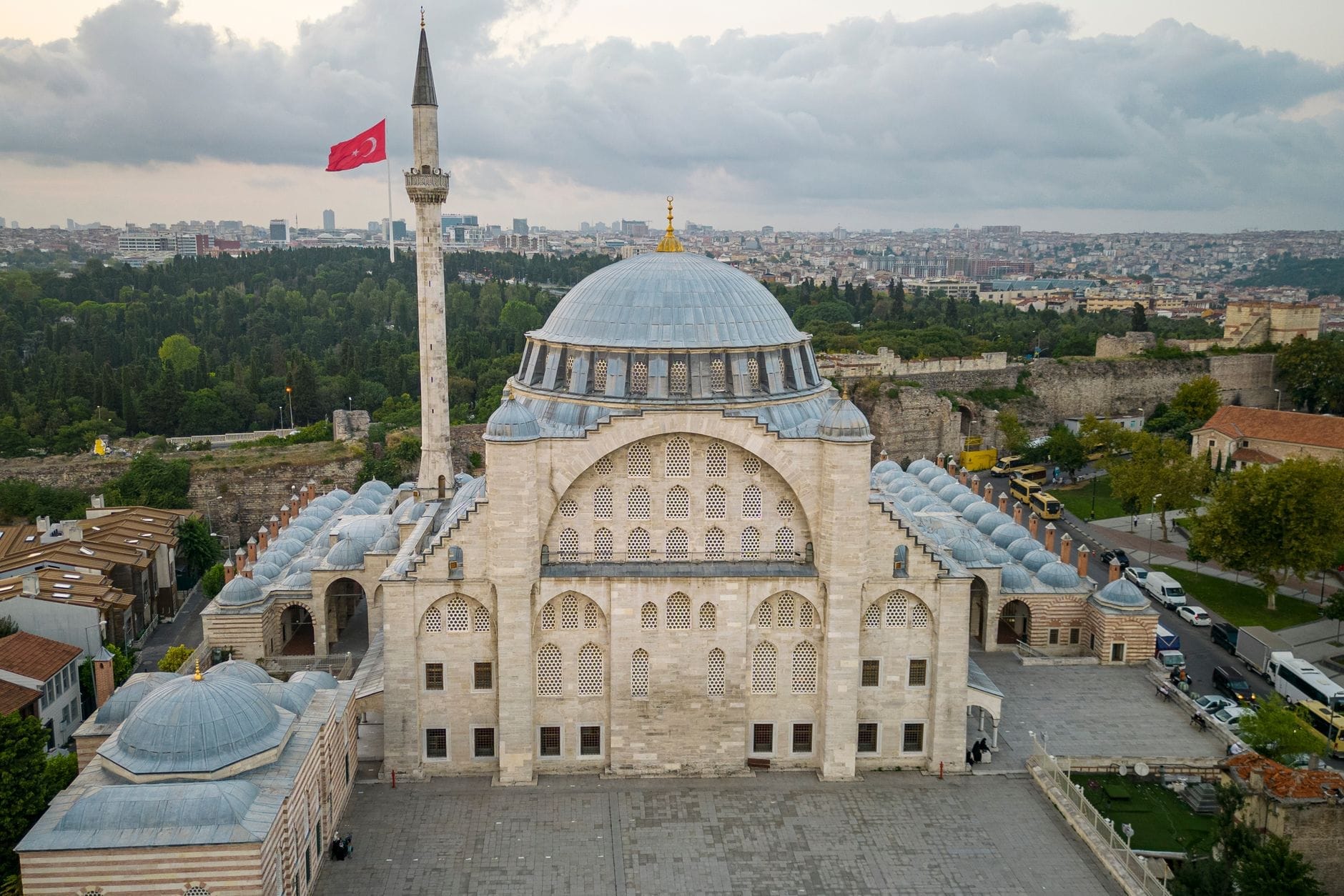
What You See the Moment You Arrive
The Mihrimah Sultan Mosque (Üsküdar) does not wait for you to find it. As the ferry from Eminönü swings into the Üsküdar pier, the mosque appears directly ahead: a single broad dome, one slender minaret, and a colonnaded courtyard overlooking the waterfront beside the pier. Just the mosque, the water, and the sky.
This directness is intentional. Mimar Sinan positioned the complex to function as a visual anchor for the Üsküdar waterfront, a statement that you have arrived somewhere significant. The effect is strongest from the sea. On foot, arriving from the ferry gangway, you walk past the low garden wall and into the courtyard within ninety seconds. The proximity is almost disorienting — the boundary between transit hub and sacred architecture is essentially nonexistent here.
💡 Local tip
The mosque is closed to non-worshippers during the five daily prayer times. Visits are best planned for the intervals between prayers — the mid-morning window between Fajr and Dhuhr prayers is typically the quietest and most relaxed for sightseeing.
A Mosque Built for a Princess: The History Behind the Structure
Built in 1548, the Mihrimah Sultan Mosque was commissioned by Mihrimah Sultan, the only surviving daughter of Sultan Suleiman the Magnificent and his consort Hürrem Sultan. The commission went to Mimar Sinan, then at the height of his powers as chief imperial architect. Sinan would later build a second mosque for Mihrimah at Edirnekapı on the European side of Istanbul, but the Üsküdar complex came first.
Mihrimah Sultan was not a passive patron. She was one of the most politically active women in the Ottoman court, and her mosque complex — which originally included a medrese, a primary school, a caravanserai, a hamam, and a marketplace alongside the mosque itself — reflects the scale of her influence. The Üsküdar complex was designed as a functioning urban center, not merely a place of prayer.
The mosque sits at the intersection of Sinan's classical Ottoman period and the architectural legacy of Hagia Sophia. Sinan spent decades studying the great Byzantine dome and its structural challenges. The Üsküdar mosque shows early evidence of his experiments with single-dome compositions and half-dome supporting structures that would reach full expression in later works. For visitors interested in tracing this architectural evolution, the Süleymaniye Mosque — built in the same decade — offers a direct comparison from the same architect in the same era.
Tickets & tours
Hand-picked options from our booking partner. Prices are indicative; availability and final rates are confirmed when you complete your booking.
Half day Morning Ottoman Splendors tour, including the Blue Mosque
From 48 €Instant confirmationFree cancellationIstanbul Basilica Cistern, Blue Mosque and Hagia Sophia tour
From 83 €Instant confirmationFree cancellationIstanbul mosaics and Blue Mosque 1-day small group tour
From 62 €Instant confirmationFree cancellationIstanbul combo tour of Hagia Sophia and Blue Mosque
From 114 €Instant confirmationFree cancellation
Inside the Mosque: Light, Space, and Details to Notice
The interior is calmer than the surrounding square suggests. The prayer hall is covered by a single dome supported by four large piers, with semi-domes on the lateral sides that give the space a wider, more expansive feel than the exterior footprint implies. The windows are generous by Ottoman standards, and on a clear morning the interior fills with diffused light that makes the pale stone glow without drama.
Look up at the painted medallions on the dome interior — the calligraphic work dates from later restoration periods rather than the 16th century original, but the scale is impressive. The mihrab, indicating the direction of Mecca, is carved in white marble with restrained geometric ornament. The minber (pulpit) sits to its right, also in marble, with a conical canopy. The overall impression is of controlled elegance rather than the more overwhelming decorative programs you find in later imperial mosques.
The courtyard deserves as much attention as the interior. A central ablution fountain sits under a small roof, surrounded by marble paving and a double arcade of columns. On weekday mornings the courtyard is often empty enough that you can hear the fountain and the ambient sounds of the square beyond the wall — ferries, seagulls, the clatter of the nearby market. On Fridays, particularly for noon prayer, expect the space to fill completely.
ℹ️ Good to know
Dress code applies: shoulders and knees must be covered for all visitors entering the mosque. Scarves are available to borrow at the entrance for women who need to cover their hair. Remove shoes before stepping onto the carpeted interior.
How the Experience Changes Through the Day
Early morning is the most atmospheric time. Before 9 a.m., Üsküdar Square is mid-transition: commuter ferries are arriving in waves, the tea sellers near the pier are setting up, and the mosque courtyard holds a few worshippers and almost no tourists. The light from the east catches the dome and the single minaret at a low angle, and the colors in the stone are warm rather than flat. This is the window most photographers seek.
Midday shifts the balance entirely. The square becomes a transit bottleneck — Üsküdar is one of the most-used transport nodes on the Asian side, connecting the Marmaray, multiple bus lines, minibuses heading inland, and the ferry pier. The mosque itself stays relatively calm inside, but navigating the square to reach it requires patience. The afternoon light falls on the western facade, which is less interesting photographically.
Late afternoon before sunset is worth considering if you have flexibility. The Bosphorus light in the final hour before dark turns the water a dense blue-grey, and the white stone of the mosque takes on a warmer tone. From the ferry pier you can photograph the mosque and its minaret with the Bosphorus in the background. The crowd thins slightly after the evening rush hour subsides.
Getting There and Getting Around Üsküdar
The simplest approach is the ferry from Eminönü or Beşiktaş to Üsküdar, operated by Şehir Hatları. The crossing takes roughly 15 minutes from Eminönü and deposits you practically at the mosque's garden wall. Fares are paid with an Istanbulkart. Alternatively, the Marmaray suburban rail stops at Üsküdar station, which is a two-minute walk from the mosque. This is the fastest connection from the European side via the undersea tunnel. For an overview of transport options across the city, the getting around Istanbul guide covers all major networks in detail.
Üsküdar rewards time spent beyond the mosque. The neighborhood's Üsküdar waterfront and backstreets hold several other significant mosques, Ottoman-era fountains, and the covered market that has operated near the ferry pier for centuries. A half-day combining the Mihrimah Sultan Mosque with a walk along the seafront takes in considerably more than most visitors expect from the Asian shore.
💡 Local tip
If arriving by ferry on a clear day, position yourself on the upper deck facing forward. The approach to Üsküdar with the mosque silhouette, the dome of the Yeni Valide Mosque visible behind it, and Çamlıca Hill in the background is one of the better Bosphorus arrival sequences in the city.
Practical Notes: Photography, Accessibility, and What to Bring
Photography is permitted in the mosque outside of prayer times, and most visitors photograph freely in the courtyard at any hour. For interior shots, a wide-angle lens works well given the column spacing and dome height. Avoid using flash during any period when worshippers are present. The exterior is best photographed from the ferry pier approach or from across the courtyard garden wall.
The mosque sits on flat ground in the square, and access from the Marmaray station or the ferry pier involves no significant steps or gradients. The courtyard entrance has a low threshold step, and the interior is fully carpeted. No detailed, independently verified information is available about dedicated wheelchair ramps or accessible restroom facilities, so visitors with specific mobility requirements should check directly with local mosque management before visiting.
The Üsküdar waterfront is also worth noting for travelers building a broader Asian-side day. From the mosque it is an easy walk to the Maiden's Tower ticket pier, and the hill roads behind the square eventually reach Çamlıca Hill — offering the best panoramic views over the Bosphorus and the Historic Peninsula. For those making a day of the Asian side, the Istanbul Asian side guide lays out a practical sequence.
Setting Expectations
The Mihrimah Sultan Mosque in Üsküdar is not the most spectacular interior in Istanbul. It does not have the overwhelming scale of the Süleymaniye Mosque or the historic weight of Hagia Sophia. The decoration is restrained, the space modest by imperial mosque standards, and much of the original complex has been altered over centuries of use.
What it offers instead is context and immediacy. This is a 16th-century Ottoman building that functions exactly as it was designed to: as a neighborhood mosque integrated into a working waterfront, built by the greatest architect of its era for one of the most powerful women of her time. For a visitor with any interest in Ottoman architecture or urban history, it is an instructive thirty minutes that costs nothing. For a visitor primarily motivated by dramatic interiors or major collections, it may feel slight.
If the architectural history of this period is a primary interest, the Ottoman Istanbul history guide provides broader context for how mosques like this one fit into the city's development across four centuries.
Insider Tips
- The best exterior photograph is taken from the ferry as it approaches the Üsküdar pier — you have about 90 seconds of ideal framing as the boat slows before docking. Have your camera ready before you disembark.
- The mosque is commonly called 'İskele Camii' (Jetty Mosque) by locals, referring to its position next to the pier. If you are asking for directions in the neighborhood, 'İskele Camii' will be understood faster than the full formal name.
- The courtyard fountain and arcade are worth sitting in quietly for a few minutes rather than passing through. The proportions of the colonnade are part of what Sinan was experimenting with, and they read differently when you stop moving.
- Friday noon prayer draws a large congregation and the entire square becomes very crowded. If your visit falls on a Friday, come before 11:30 a.m. or after 2 p.m. to avoid the peak.
- The market street immediately behind the mosque sells fresh produce, cheese, and olives from early morning. It is a good place to pick up food for a waterfront walk, and the commercial activity gives some sense of how the original complex's marketplace function has persisted in the neighborhood.
Who Is Mihrimah Sultan Mosque (Üsküdar) For?
- Architecture enthusiasts tracing the development of Mimar Sinan's classical period
- Travelers combining a ferry crossing with an Asian-side half-day walk
- Visitors seeking an active Ottoman mosque without crowds or entrance fees
- Photographers wanting Bosphorus waterfront compositions with historic architecture
- Anyone building a broader understanding of Ottoman Istanbul beyond the Historic Peninsula
Nearby Attractions
Other things to see while in Üsküdar:
- Beylerbeyi Palace
Beylerbeyi Palace is Istanbul's most elegant waterfront royal residence, built in the mid-1860s (completed between 1861 and 1865) as a summer retreat and diplomatic guesthouse for Ottoman Sultan Abdülaziz. Sitting directly on the Asian bank of the Bosphorus, it offers a quieter, more intimate alternative to Dolmabahçe, with 26 rooms, six ceremonial halls, and gardens that frame one of the city's finest waterway views.
- Çamlıca Hill
Büyük Çamlıca Tepesi rises around 280 metres above the Asian shore of the Bosphorus, offering unobstructed views across both sides of Istanbul. Free to enter and accessible from Üsküdar, it rewards visitors who time their visit well and punishes those who arrive without checking the weather.
- Çamlıca Mosque
Rising from Çamlıca Hill above Üsküdar, the Grand Çamlıca Mosque is Turkey's largest place of worship, with six minarets, a 72-metre dome, and sweeping views across both sides of Istanbul. Entry is free, and the complex is open daily to visitors and worshippers alike.
- Maiden's Tower (Kız Kulesi)
Perched on a small rocky islet about 200 meters off the Üsküdar shore, Maiden's Tower is one of Istanbul's most recognizable silhouettes. The tower has served as a customs post, lighthouse, watchtower, and restaurant over its long history, and a 2023 restoration has returned it to sharp condition. Getting there requires a short boat crossing, and the panoramic views of the Bosphorus from the terrace are the real reward.