Çamlıca Mosque: Inside Turkey's Largest Mosque on Istanbul's Asian Shore
Rising from Çamlıca Hill above Üsküdar, the Grand Çamlıca Mosque is Turkey's largest place of worship, with six minarets, a 72-metre dome, and sweeping views across both sides of Istanbul. Entry is free, and the complex is open daily to visitors and worshippers alike.
Quick Facts
- Location
- Çamlıca Hill, Üsküdar, Asian Istanbul
- Getting There
- Kısıklı Station (M5 metro), then taxi or minibus; or buses 11Ç / 11Ü from Üsküdar
- Time Needed
- 1.5 to 2.5 hours including grounds and views
- Cost
- Free entry to mosque and complex
- Best for
- Architecture enthusiasts, panoramic photography, religious tourism
- Official website
- http://www.camlicacami.com
What Is Çamlıca Mosque and Why Does It Matter?
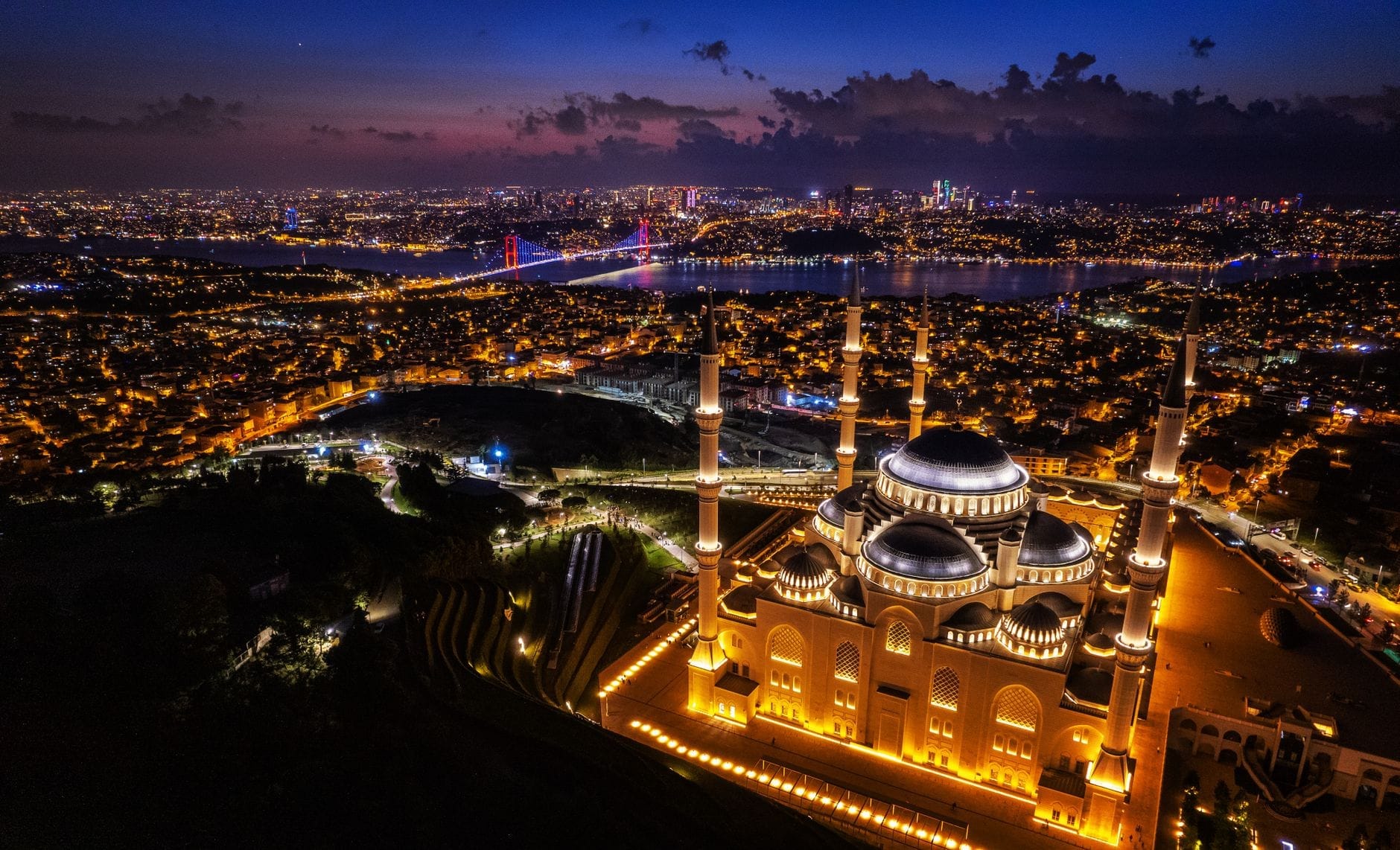
The Grand Çamlıca Mosque, known in Turkish as Büyük Çamlıca Camii, is the largest mosque in Turkey by capacity. Its six minarets and 72-metre central dome are visible from much of Istanbul, rising above the forested slopes of Çamlıca Hill on the Asian side of the city. Foundations were laid on 6 August 2013, and the mosque opened for worship on 7 March 2019, making it a contemporary structure rather than a historical relic.
The complex covers 57,500 square metres and is designed to hold up to 63,000 people across the prayer halls, courtyards, and surrounding grounds. Four of the six minarets reach 107.1 metres, while the main dome spans 34 metres in diameter. These are not approximate figures to marvel at abstractly; standing beneath that dome while afternoon light filters through stained glass panels makes the scale register physically.
Çamlıca Mosque sits within a broader conversation about modern Turkish identity and the role of Islam in public life. Its construction was championed at the highest levels of government, and it has attracted significant international commentary. For a visitor, that political context is present but does not define the experience. What you actually encounter is a serious work of contemporary Ottoman-revival architecture set inside a hilltop park with one of the finest panoramas in Istanbul. For context on how this fits into the city's broader religious landscape, the guide to Istanbul's best mosques helps situate Çamlıca among the city's older and more celebrated houses of worship.
Architecture and Scale: What You Actually See
The exterior arrives before you do. Driving or riding the minibus up the hill, the minarets appear through trees at angles that make them seem taller than they are, which is saying something given they already top 107 metres. The approach along the access road opens onto a vast paved forecourt flanked by manicured gardens, fountains, and rows of young trees. The mood is ordered and calm, particularly on weekday mornings when worshippers move quietly through the space between prayer times.
The architectural language draws from classical Ottoman precedents, referencing the proportions of imperial mosques like Süleymaniye and the Blue Mosque, but without directly copying any single prototype. The dome sits on a drum pierced by arched windows, and the exterior stonework is pale and clean. Critics have noted that the design reads more as a careful synthesis than a bold original statement, and that observation is fair. What it lacks in architectural daring it compensates for in sheer coherent ambition.
Inside, the prayer hall is enormous. The ceiling height and uninterrupted floor space make voices disappear. Calligraphic panels and Iznik-style tilework decorate the qibla wall, and the mihrab is carved from marble. The light quality changes substantially through the day: morning brings cooler blue tones through the eastern windows; mid-afternoon sends warmer shafts across the carpeted floor. Photography inside the prayer hall is generally permitted when worshippers are not present, but use judgment and keep your camera quiet.
💡 Local tip
Visit between morning and midday prayers on a weekday for maximum access to the interior and the quietest courtyards. Friday midday prayer draws large crowds and restricts tourist access to the main hall for an extended period.
Tickets & tours
Hand-picked options from our booking partner. Prices are indicative; availability and final rates are confirmed when you complete your booking.
Istanbul Camlica Tower Entry Ticket with Free Tea or Turkish Coffee
From 25 €Instant confirmationFree cancellationHalf day Morning Ottoman Splendors tour, including the Blue Mosque
From 48 €Instant confirmationFree cancellationIstanbul Basilica Cistern, Blue Mosque and Hagia Sophia tour
From 83 €Instant confirmationFree cancellationIstanbul mosaics and Blue Mosque 1-day small group tour
From 62 €Instant confirmationFree cancellation
The View From Çamlıca Hill: What You Can See
Çamlıca Hill has been one of Istanbul's most valued viewpoints for centuries. The mosque complex sits near the summit at roughly 200 metres above sea level, and on a clear day the panorama is genuinely extraordinary: the Bosphorus Strait runs directly below you, with European Istanbul across the water, the minarets of Sultanahmet, the Galata Tower, and on clear winter mornings, even the snow-capped peaks of mountains to the south.
The viewpoint is at its best in autumn and spring, when the air is clearer and the light more textured. Summer haze can flatten the European shore into an indistinct grey band, while winter overcast sometimes erases the horizon entirely. That said, a grey and misty view from Çamlıca has its own atmosphere. If panoramic views are a priority, the Istanbul viewpoints guide compares this hilltop with other high-ground options across the city.
The gardens surrounding the mosque are planted with roses, cypress trees, and seasonal flowers. Benches face the water. On weekend afternoons, Istanbul families come here less for the mosque itself and more for the air, the views, and a tea from the café near the car park. That local, unhurried atmosphere is one of the more pleasant surprises of the visit.
Dress Code, Etiquette, and Practical Preparation
The dress code follows standard mosque protocol in Turkey. Men should wear long trousers and avoid sleeveless tops. Women are required to cover their hair, arms, and legs; headscarves and long skirts or shawls are available to borrow at the entrance free of charge if you arrive unprepared. Everyone removes shoes before entering the carpeted prayer hall, and bags are provided to carry them.
The complex is large, and the walking distances between the car park, the entrance gates, the prayer hall, and the garden viewpoints add up. Comfortable shoes matter, not as a travel-writer cliché but because the forecourt and garden paths cover real ground. The paved surfaces can be slippery in wet weather, so sturdy soles are advisable in winter or after rain.
ℹ️ Good to know
The main prayer hall is reserved for worshippers during the five daily prayer times. Visitor access is typically restricted for 20-30 minutes around each prayer. The prayer schedule shifts daily with the sun; arriving shortly after a prayer time gives you the longest uninterrupted window for exploration.
The complex also includes a museum, art gallery, library, and a small conference centre within its footprint. These facilities are part of the wider cultural programme attached to the mosque and vary in accessibility to casual visitors. Check the official site before visiting if any of these spaces are a specific objective.
Getting to Çamlıca Mosque
The mosque sits in Üsküdar district on the Asian side of Istanbul, which means crossing the Bosphorus if you are based in European Istanbul. The most straightforward approach is the Marmaray commuter rail or a ferry to Üsküdar, followed by either a short taxi ride up the hill or the 11Ç and 11Ü bus lines that run toward Çamlıca. Minibuses from Üsküdar and Kadıköy also pass near the complex.
By metro, the M5 Üsküdar–Çekmeköy line runs to Kısıklı Station, from which the mosque is a short taxi or minibus journey. A large car park serves visitors arriving by private vehicle. Taxi is often the most straightforward option for the final ascent of the hill. For a broader view of navigating the Asian side, the Istanbul Asian side guide covers Üsküdar and its surroundings in detail.
⚠️ What to skip
Ride-hailing apps and taxis are the most reliable option for the final section of the journey up to the mosque. Public buses run to the area but routes and stops can be confusing for first-time visitors. Allow extra time if using public transport only.
Managing Expectations: Who Will Love This, Who Won't
Çamlıca Mosque rewards visitors who approach it on its own terms: as a large, well-executed contemporary mosque with exceptional views and a calm atmosphere. It does not have the layered historical depth of Süleymaniye or the Byzantine bones of Hagia Sophia. If you have limited time in Istanbul and prioritise sites with centuries of accumulated significance, those mosques should come first.
Visitors who find the commercialisation and crowds of Sultanahmet exhausting will appreciate the relative quiet of Çamlıca, even on weekends. The grounds feel spacious, and there is no ticket queue, no timed entry, and no audio tour sales. Anyone combining this visit with a walk through Üsküdar and a ferry back across the Bosphorus has the bones of a strong half-day on the Asian shore.
Photography enthusiasts should note that the mosque's minarets are best captured from outside the complex, from points lower on the hill, or from the European shore across the Bosphorus. Inside the complex, the challenge is that the scale defeats standard lenses; a wide-angle lens helps considerably in the interior.
Combining Çamlıca With the Surrounding Area
Üsküdar is one of Istanbul's most historically layered districts, with Ottoman-era mosques lining the waterfront and a neighbourhood character quite distinct from the tourist-heavy European side. The Mihrimah Sultan Mosque near the Üsküdar ferry terminal is a 16th-century Sinan masterpiece that rewards comparison with Çamlıca's contemporary interpretation of the same tradition. The contrast between the two buildings, separated by nearly five centuries, is instructive.
From Üsküdar's waterfront you can also see the Maiden's Tower sitting in the strait, and ferries operate to Eminönü and Karaköy on the European side. If you want to extend your time on the Asian shore, Kadıköy's food market and cafe district is a 15-minute ride south along the coast.
Insider Tips
- The best exterior photographs of the mosque are taken from lower on the hill, where all six minarets separate visually against the sky. From within the complex itself, the minarets foreshorten dramatically.
- Arrive at least 30 minutes before a prayer time ends rather than just after one begins; the post-prayer crowd from the main hall files out across the courtyards and temporarily makes the forecourt very busy.
- The tea garden near the car park on the garden side of the complex serves simple refreshments and has benches with unobstructed Bosphorus views. It is frequently overlooked by visitors who turn around after seeing the mosque.
- On Friday afternoons the mosque draws the largest weekly congregations. If seeing an active, fully populated prayer in action interests you, this is the right day; if you want interior access for sightseeing, a Tuesday or Wednesday morning is far quieter.
- The mosque's illumination after dark, when the minarets and dome are lit in warm white light against the night sky, is visible from Sultanahmet and the Bosphorus ferries. It is worth looking for from the water rather than visiting the complex itself at night, when the gardens are less accessible.
Who Is Çamlıca Mosque For?
- Architecture and Islamic art enthusiasts drawn to contemporary Ottoman-revival design at scale
- Photographers seeking elevated panoramic views of both sides of Istanbul
- Travellers combining the visit with a half-day exploration of Üsküdar's waterfront and historic mosques
- Visitors who want the atmosphere of a major mosque without the crowds and ticket logistics of Sultanahmet
- Families looking for open outdoor space, clean facilities, and easy parking on the Asian side
Nearby Attractions
Other things to see while in Üsküdar:
- Beylerbeyi Palace
Beylerbeyi Palace is Istanbul's most elegant waterfront royal residence, built in the mid-1860s (completed between 1861 and 1865) as a summer retreat and diplomatic guesthouse for Ottoman Sultan Abdülaziz. Sitting directly on the Asian bank of the Bosphorus, it offers a quieter, more intimate alternative to Dolmabahçe, with 26 rooms, six ceremonial halls, and gardens that frame one of the city's finest waterway views.
- Çamlıca Hill
Büyük Çamlıca Tepesi rises around 280 metres above the Asian shore of the Bosphorus, offering unobstructed views across both sides of Istanbul. Free to enter and accessible from Üsküdar, it rewards visitors who time their visit well and punishes those who arrive without checking the weather.
- Maiden's Tower (Kız Kulesi)
Perched on a small rocky islet about 200 meters off the Üsküdar shore, Maiden's Tower is one of Istanbul's most recognizable silhouettes. The tower has served as a customs post, lighthouse, watchtower, and restaurant over its long history, and a 2023 restoration has returned it to sharp condition. Getting there requires a short boat crossing, and the panoramic views of the Bosphorus from the terrace are the real reward.
- Mihrimah Sultan Mosque (Üsküdar)
Overlooking the waterfront in Üsküdar’s historic center since 1548, the Mihrimah Sultan Mosque was designed by Mimar Sinan for the daughter of Suleiman the Magnificent. It is free to enter, seconds from the ferry pier, and one of the most graceful pieces of Ottoman architecture on the Asian shore.