Menara Gardens, Marrakech: The Olive Grove, the Basin, and What's Actually Worth Your Time
The Menara Gardens stretch across roughly 100 hectares of ancient olive groves southwest of Marrakech's medina, anchored by a vast reflecting basin and a green-roofed pavilion. Originating in the 12th-century Almohad period, the site offers shade, open skies, and one of the city's most photogenic Atlas Mountain backdrops — all for free.
Quick Facts
- Location
- Avenue de la Ménara, Marrakech 40000 — approx. 2 km west of Jemaa el-Fna, on the road toward Menara Airport
- Getting There
- 10-minute petit taxi from Jemaa el-Fna; walkable from Hivernage district (15–20 min on foot)
- Time Needed
- 45 minutes to 1.5 hours for most visitors; longer if you linger at the basin at sunset
- Cost
- Gardens: free. Pavilion entry: approx. 60 MAD adults / 30 MAD children (verify locally before visiting)
- Best for
- Peaceful walks, photography, families with young children, late-afternoon Atlas Mountain views
- Official website
- menaragardens.com
What the Menara Gardens Actually Are
The Menara Gardens — known locally as Jardins de la Ménara — are not a formal ornamental garden in any European sense. There are no manicured flower beds, no topiaries, and no shaded café terrace waiting at the entrance. What you find instead is an enormous working olive grove, roughly 100 hectares of low, silver-leafed trees planted in long rows, bisected by earthen paths and cut through by historic gravity-fed irrigation channels that once carried water from the Atlas Mountains.
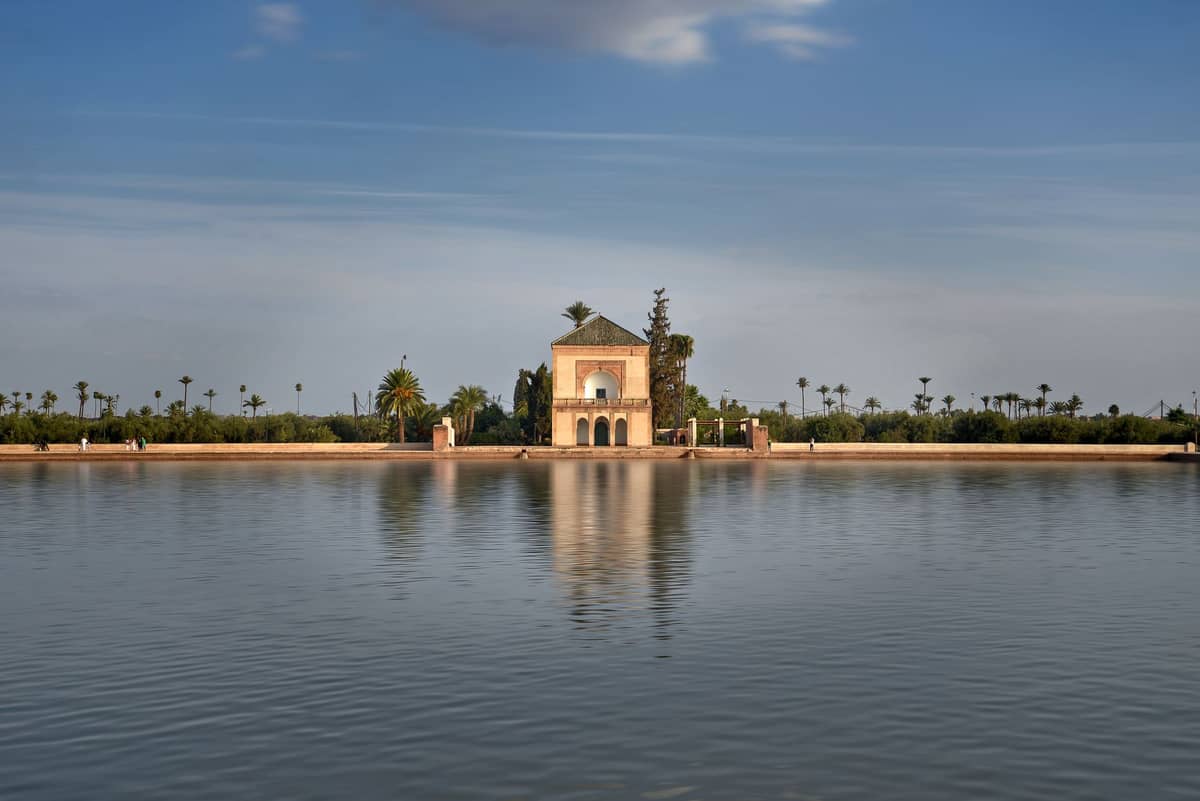
At the heart of the site sits a large rectangular basin, perhaps the most photographed spot in the gardens, that reflects the snow-capped Atlas peaks on clear winter and spring mornings. Beside the basin, a square pavilion topped with a distinctive green-tiled pyramid roof completes the composition. It is the image that appears on half the postcards sold in the medina.
If you are building an itinerary around Marrakech's historic parks and gardens, the Menara Gardens sit alongside the Jardin Majorelle and the Agdal Gardens as one of the city's three main green spaces, though each is a completely different experience in atmosphere and ambition.
💡 Local tip
Arrive in the final 90 minutes before sunset for the clearest Atlas Mountain reflections in the basin. On calm, cloudless afternoons between October and April, the effect is genuinely striking. In summer, midday haze often obscures the mountains entirely.
History and Context: An Almohad Legacy
The origins of the Menara Gardens date to the 12th century, when the Almohad dynasty controlled Morocco and used this site as an agricultural estate and hydraulic system. The basin, historically fed by an elaborate network of khettaras (underground aqueducts) drawing water from the High Atlas, was engineered to irrigate the olive grove at scale. It is not a decorative lake built for beauty alone — it is a functional reservoir, and the irrigation channels running between the trees still structure the grove today.
The pavilion standing at the basin's edge occupies the site of an earlier Saadian pleasure pavilion. The gardens were restored under Sultan Abd al-Rahman, and the present structure was completed around 1870 under his son Sultan Muhammad IV. That rebuild gave the pavilion its distinctive pyramid roof clad in green glazed tiles — a visual signature that became inseparable from how Marrakech presents itself to the outside world.
For visitors interested in Morocco's broader tradition of hydraulic garden design, the Almohad approach at the Menara has much in common with the engineering behind the Agdal Gardens on the south side of the medina, which uses a similar system of underground channels and large open basins. The two sites together give a clear picture of how medieval Moroccan rulers managed water in a semi-arid landscape.
Tickets & tours
Live prices and dates from our booking partner. If you book, we may earn a commission at no extra cost to you.
Anima Gardens and Ourika Valley day trip from Marrakech
From 95 €Instant confirmationFree cancellationSpa Treatment Experience with Lunch at a Riad from Marrakech
From 99 €Instant confirmationFree cancellationFull-day Trip in Ouzoud Waterfalls from Marrakech
From 18 €Instant confirmationFree cancellationCamel ride in Marrakech Palm Grove
From 15 €Instant confirmationFree cancellation
The Experience on the Ground: What Visiting Actually Feels Like
Entry to the garden is through a simple gate on Avenue de la Ménara. There is no formal ticket booth for the gardens themselves — you walk in freely. The first thing you notice is the shade. After the flat, sun-bleached approach from the road, the olive canopy provides immediate relief, even in summer. The trees are old and gnarled, and between them the ground is packed earth, not grass, so dust rises when it is dry.
The basin comes into view after a short walk through the grove. Up close, the water is green and opaque, thick with algae, and there is usually a faint smell of still water and damp earth. Carp and other fish move through the shallows near the bank. Moroccan families occupy the low stone edges on weekends, children throwing bread scraps to the fish while adults sit on the surrounding grass verge. The atmosphere is genuinely local and relaxed — this is a park where Marrakchis come to escape the city, not primarily a tourist attraction.
The pavilion charges a separate entrance fee (approximately 60 MAD for adults). Inside, the rooms are relatively sparse — decorative woodwork, tiled floors, and views across the basin from the upper terrace — but the terrace view itself is the real draw. From the second-floor balcony, the geometry of the scene opens up: the long silver rectangle of the basin in the foreground, olive trees spreading in every direction, and on clear days the High Atlas rising along the southern horizon.
⚠️ What to skip
The pavilion's upper terrace is the best vantage point for Atlas Mountain photography, but it is closed if visitor numbers exceed its capacity, which can happen on weekends. Arrive early on Friday or Saturday to avoid a wait, or skip the pavilion fee entirely and shoot from the basin's north bank, which provides the classic framing at no extra cost.
How the Gardens Change by Time of Day and Season
Early morning, around 8:00–9:00, is the quietest and coolest window. The low angle of the sun catches the silver undersides of the olive leaves, and the basin is usually still, making reflections sharp. You may share the space with joggers, elderly men doing slow circuits of the grove, and the occasional gardener managing the irrigation channels with a long-handled hoe.
Midday in summer (June through August) is genuinely difficult. Temperatures regularly exceed 35°C, shade inside the olive grove is uneven, and there are no food or drink stalls inside the gardens. Bring more water than you think you need, and consider wearing a hat. In winter, midday is actually the most comfortable time to visit, with mild temperatures and the strongest light on the pavilion's green roof.
Late afternoon in autumn and winter produces the gardens at their most cinematic. From roughly 4:00 PM onward, the light turns golden, the Atlas peaks turn pink at their edges as the sun drops, and families arrive in numbers to walk the perimeter path. The basin reflection photography that fills Instagram is almost exclusively taken in this window, between October and March, when the peaks are snow-covered and cloud-free afternoons are common.
Spring visits (March through May) offer a pleasant middle ground: warm but not punishing temperatures, a reasonable chance of snow still visible on the Atlas peaks, and a garden that reads green rather than dusty brown. For a broader sense of when to plan outdoor time in Marrakech, the best time to visit Marrakech guide covers seasonal trade-offs in detail.
Getting There and Practical Logistics
The gardens sit on Avenue de la Ménara, the same road that leads southwest toward Marrakech Menara Airport. From Jemaa el-Fna, a petit taxi takes around 10 minutes and costs roughly 20–30 MAD depending on negotiation. It is worth agreeing on a price before you get in. If you are staying in the Hivernage district, the gardens are a manageable 15–20 minute walk along wide, shaded avenues.
There is no formal parking charge for private vehicles, and a reasonable amount of roadside space exists on the avenue outside the main entrance. The site is also logistically convenient if you are combining it with an airport transfer: it is directly on the route between the medina and Menara Airport, so you could stop here with luggage in a taxi on departure day without significantly affecting journey time.
Accessibility inside the gardens is reasonably good for a historic site. The main paths around the basin are wide and mostly flat, though the surface is compacted earth rather than paved, which may be problematic after rain or for wheelchairs. The pavilion interior involves stairs to the upper terrace, and no lift is present based on current visitor reports. Travelers with specific mobility needs should confirm conditions locally before visiting.
ℹ️ Good to know
Garden hours are typically 08:00–18:00 daily, with occasional extension to around 19:00 in summer. The pavilion usually operates shorter hours, often around 09:00–17:00. Verify current times locally or via the official site before visiting, as these details can shift with season and holidays (including Ramadan).
Photography: What Works and What Doesn't
The single most effective shot at the Menara Gardens — the pavilion reflected in the basin with the Atlas behind it — is taken from the far northern bank of the basin, using a wide-angle or standard lens. For the reflection to work, the water needs to be calm, the mountains need to be visible (not obscured by haze or cloud), and the light needs to be low and warm. That combination occurs reliably in late afternoon between October and April.
Inside the olive grove, the long rows of twisted trunks and dappled light make for strong environmental portraits and street photography. The trees are old enough that their bark has deeply textured patterns, and the contrast between pale silver leaves and red-brown earth looks striking in afternoon light. Avoid shooting inside the grove at high noon — the contrast between bright sky gaps and deep shadow is too harsh to expose cleanly on most cameras.
Drone photography is subject to Moroccan civil aviation regulations and generally requires prior authorization. Do not assume you can fly a drone here without checking current rules and permit requirements.
Who Should Come, and Who Can Skip It
The Menara Gardens are one of the most over-described and under-experienced attractions in Marrakech. The photographs promise something more manicured and monumental than reality delivers. If you arrive expecting a formal botanical garden or a grand palace complex, you will feel underwhelmed. The site is, at its core, a working agricultural estate that happens to have one very good view.
That said, for the right traveler at the right time of day, it delivers something the medina cannot: quiet, shade, open sky, and a glimpse of the Atlas Mountains that contextualizes Marrakech within its remarkable geography. Families with young children find the basin perimeter and open space genuinely useful. Photographers with patience and an afternoon free in winter or spring will find the reflection view worth every minute of waiting for the light.
Travelers short on time who have already seen the Jardin Majorelle and the main medina sites should note that the Menara Gardens are best treated as a supplement rather than a centrepiece. If you have only two or three days in the city, consult the 3 days in Marrakech itinerary to see where it realistically fits.
Insider Tips
- The reflection shot of the pavilion in the basin requires calm water. Even light wind breaks up the surface. Early mornings after still nights (especially in autumn and winter) consistently produce the clearest reflections, well before the afternoon family crowds arrive.
- The gardens share their name with Marrakech Menara Airport, which sits a short distance further along the same road. If you are self-navigating by taxi, be specific: ask for 'Jardins de la Ménara', not just 'Ménara', to avoid being taken to the airport terminal.
- Bring your own water and snacks. There are no food or drink concessions inside the gardens. The nearest cafés are back toward the Hivernage district on Avenue Mohammed VI.
- The olive harvest takes place in autumn, typically October through December, and you may see workers with long poles knocking olives from the trees onto spread sheets below. It does not affect access but adds an authentic layer to the visit that most tourists miss entirely.
- If the pavilion terrace is crowded or the queue is long, the northern bank of the basin gives you the same iconic composition — pavilion, reflection, Atlas peaks — without any entry fee. The pavilion fee is only worth paying if you want the bird's-eye view down onto the basin from above.
Who Is Menara Gardens For?
- Photographers chasing the Atlas Mountain reflection in calm, late-afternoon light between October and April
- Families with young children who need open space and shade away from the medina crowds
- Travelers staying in Hivernage who want a peaceful morning walk before the city heats up
- Anyone combining an airport departure with one last hour of green space in the city
- History and architecture enthusiasts interested in Almohad and Saadian-era hydraulic engineering
Nearby Attractions
Combine your visit with:
- Agafay Desert
Just 30 to 40 kilometres southwest of Marrakech, the Agafay Desert is a rocky plateau of roughly 300 to 400 square kilometres that delivers dramatic open-sky landscapes without a multi-day Sahara expedition. It is not the sand-dune desert many visitors picture, but that distinction is part of its appeal: a raw, mineral terrain framed by the snow-capped peaks of the High Atlas, accessible within an hour of the city.
- Aït Benhaddou
Rising from the southern slopes of the High Atlas, the Ksar of Aït Benhaddou is a UNESCO World Heritage Site and one of Morocco's most architecturally striking places. Built from pisé earth and palm wood, this fortified village has stood at the crossroads of trans-Saharan trade for centuries — and remains partly inhabited today.
- Anima Garden
Set along the Ourika road 27 km south of Marrakech, Anima Garden is a three-hectare art-and-nature space created by Austrian artist André Heller. Sculptures, water features, and carefully curated plantings coexist in a setting that feels both otherworldly and deeply rooted in Moroccan landscape. It rewards slow exploration and offers a genuine contrast to the pace of the medina.
- Essaouira
Essaouira is a UNESCO-listed fortified coastal city on Morocco's Atlantic coast, roughly 2.5 to 3 hours from Marrakech by road. Its 18th-century medina, ocean-facing ramparts, and salt-aired souks offer a complete change of pace from the heat and intensity of the inland city. Entry to the medina is free.
Planning a trip? Discover personalized activities with the Nomado app.