Massey Hall: Inside Toronto's Most Legendary Concert Venue
Opened in 1894 and designated a National Historic Site of Canada, Massey Hall is the spiritual home of live music in Toronto. From its ornate Victorian interior to its reputation-defining acoustics, this is a venue that shapes how artists and audiences alike understand what a concert can feel like.
Quick Facts
- Location
- 178 Victoria Street, Toronto, ON
- Getting There
- Queen Station (TTC Line 1), 5-minute walk east
- Time Needed
- 2–3 hours (event duration varies)
- Cost
- Varies by event; check official site for tickets
- Best for
- Live music lovers, architecture enthusiasts, first-time Toronto visitors
- Official website
- masseyhall.mhrth.com/
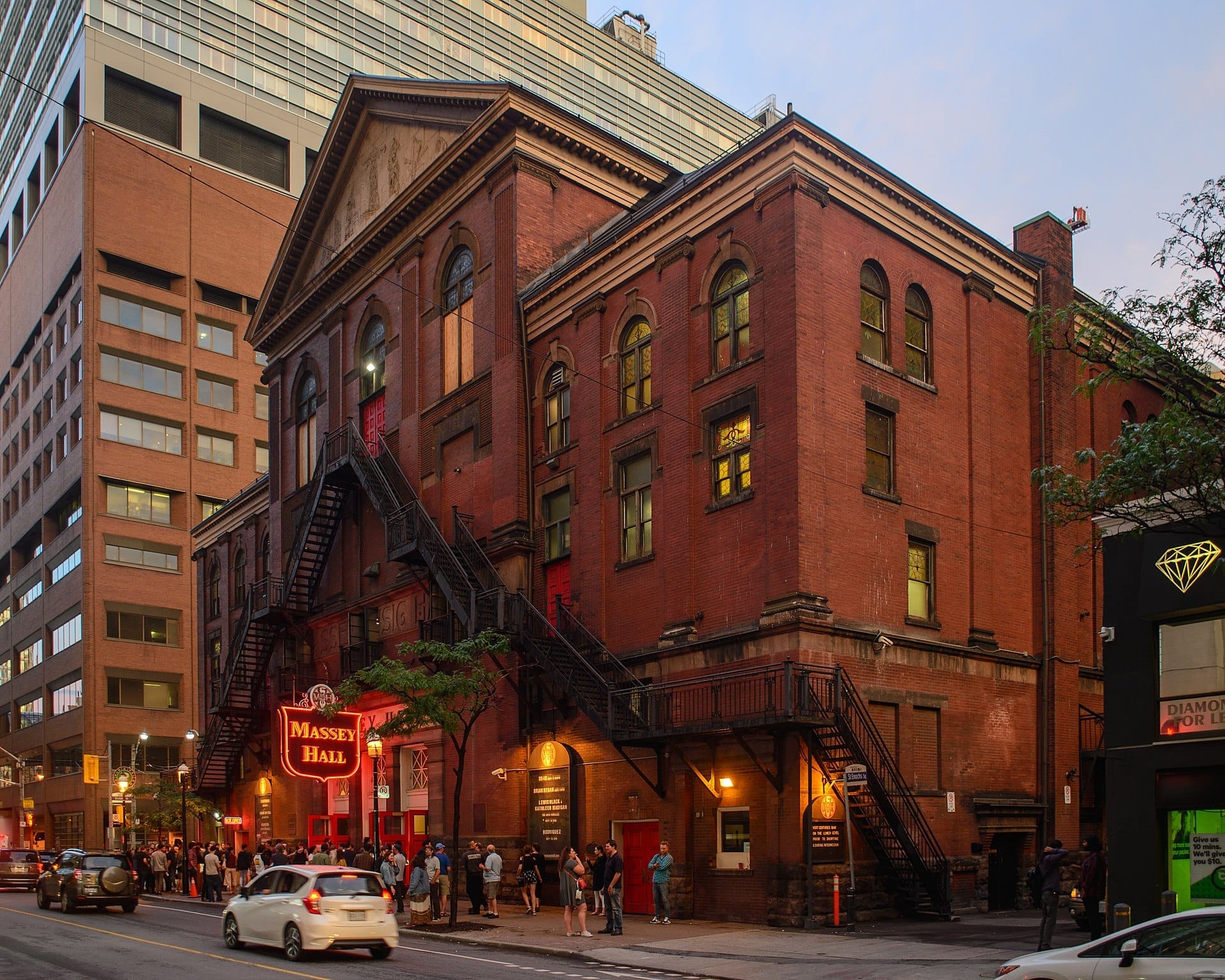
What Is Massey Hall, and Why Does It Matter?
Massey Hall is not simply one of Toronto's older concert venues. Since its opening in 1894, it has occupied a category of its own: a place where the sound, the sightlines, and the accumulated weight of history all converge on a single point. Parliament of Canada debates, religious revivals, heavyweight boxing broadcasts, and landmark performances by Neil Young, Glenn Gould, and countless others have all taken place within these walls.
The hall was designated a National Historic Site of Canada in 1981, a recognition that goes beyond architectural preservation. The designation acknowledges Massey Hall's role as a shared cultural institution across more than a century of Canadian life. That history is legible when you walk in: the layered ornament of the late Palladian-style facade, the steep rake of the balconies, the particular warmth of a room that was designed before amplification existed and has never fully forgotten it.
For visitors deciding how to spend an evening in downtown Toronto, attending an event at Massey Hall is one of the more reliable ways to experience something genuinely specific to the city, rather than something that could happen anywhere.
The Building: Architecture and Atmosphere
The exterior on Victoria Street is relatively understated given what lies inside. The 1894 late Palladian design features arched windows, brick and terracotta detailing, and a modest street presence that gives little away. This is not a building that performs from the outside. Once through the doors, the scale and the decoration become apparent: tiered horseshoe balconies rising above the main floor, ornamental plasterwork, and a ceiling that catches sound in ways that modern rooms rarely replicate.
The hall was originally designed to seat approximately 3,500 people. Following later renovations, the current seating capacity is approximately 2,550. The reduction in seats was matched by improvements in sightlines and comfort, though the room retains a density that keeps the audience close to the stage even in the upper tiers. The horseshoe shape means almost no seat is positioned directly behind the performer, which affects the sense of intimacy in a room of this size.
💡 Local tip
If you have a choice of seats, the front of the first balcony offers one of the best acoustic positions in the room. You get elevation over the main floor crowd while remaining close enough to the stage that the performance feels direct rather than distant.
For visitors with a broader interest in Toronto's architectural heritage, Massey Hall fits naturally into a tour of Toronto's most significant buildings. The surrounding streets in this part of the downtown core include several other heritage structures worth noting.
Tickets & tours
Live prices and dates from our booking partner. If you book, we may earn a commission at no extra cost to you.
90-minute Toronto express city tour with photo stop at City Hall
From 44 €Instant confirmationFree cancellationToronto Old Town: Dark Side Exploration Game and Tour
From 12 €Instant confirmationFree cancellationLEGOLAND Discovery Centre Toronto tickets
From 16 €Instant confirmationFree cancellationToronto 'Little Canada' entrance tickets
From 27 €Instant confirmationFree cancellation
Acoustics and the Live Experience
Massey Hall's acoustic reputation is one of the most substantive claims made about any performing arts venue in Canada. The hall was engineered before electronic amplification, which means the room's shape and materials were designed to carry unamplified sound to every seat. That original engineering still informs how sound moves in the space today, even when amplification is used.
The result is a quality that experienced concertgoers often describe as warmth and presence: a sense that the room is participating in the performance rather than just containing it. Bass frequencies are absorbed rather than muddied. High-end detail carries to the rear balcony without harshness. Mid-range, where the human voice lives, is forward and clear. Not every genre benefits equally from this profile, but acoustic performances, jazz, folk, and orchestral programming consistently reward the room's strengths.
Audiences arriving for the first time often notice that conversation in the hall before a show drops quickly once the performance begins. The room encourages attention. There is very little ambient echo or reverb bleed, which means that when an artist plays quietly, the silence around the notes is audible. This is a relatively rare quality in a large room and it changes how you listen.
Arriving, Navigating, and What to Expect on the Night
The box office at Massey Hall typically opens a few hours before each event and closes around showtime. There are no general visiting hours; access to the interior is tied entirely to ticketed events. If you are hoping to see the hall without attending a show, this is a genuine limitation. The building is not operated as a museum or tourist attraction during the day.
⚠️ What to skip
Massey Hall does not offer public daytime tours or open access outside of event days. Plan your visit around a specific ticketed performance. Check the official schedule at masseyhall.mhrth.com well in advance, particularly for popular shows that sell out weeks ahead.
On event nights, the area around Victoria Street fills steadily in the hour before doors open. The street is narrow and the entrance can feel congested if you arrive close to showtime. Arriving 45 to 60 minutes before the listed start time gives you room to collect tickets, check a coat if needed, and find your seat without the pressure of a crowd pushing in behind you. The coat check is worth using on cold evenings: the main floor can warm significantly during a performance.
The hall is accessible, with wheelchair seating and access available in designated areas of the building. If you have specific accessibility requirements, the official site provides contact information to arrange assistance in advance.
Getting There: Transit, Walking, and Practical Logistics
The most straightforward way to reach Massey Hall by public transit is via TTC Line 1 to Queen Station, which sits on Yonge Street a short five-minute walk from the venue. Exit via the north platform, walk north on Yonge Street, and turn left onto Shuter Street, which brings you directly to Victoria Street. Dundas Station, one stop north on Line 1, is a comparable walk from the north.
From Union Station, take TTC Line 1 north two stops to Queen Station. The full journey takes under 10 minutes. For broader guidance on moving around the city, the Toronto transit and transport guide covers fares, routes, and practical options in detail.
Parking in this part of downtown Toronto is available in commercial garages nearby but fills quickly on event nights, particularly when shows at other nearby venues overlap with Massey Hall programming. If driving, budget extra time and check parking availability before you leave. Ride-hailing drop-off is straightforward on Victoria Street; pick-up after the show can mean a short wait, as multiple venues in the area discharge at similar times.
ℹ️ Good to know
Massey Hall sits within easy walking distance of several other major downtown Toronto landmarks. Yonge-Dundas Square is a five-minute walk north, and the Toronto Eaton Centre is directly adjacent to the square. If you are making an evening of it, the surrounding blocks have restaurants and bars that are well-suited for pre-show dining.
Historical Context: 130 Years in One Room
Massey Hall opened on June 14, 1894, funded by Hart Massey of the Massey-Harris farm equipment manufacturing family. The donation was partly philanthropic and partly reflective of a particular Victorian-era conviction that cities required civic cultural infrastructure to constitute themselves as serious places. Toronto in 1894 was a city asserting its status, and a concert hall of this quality was part of that assertion.
Over the following decades, the hall hosted events far beyond its original musical mandate. Political rallies, trade union meetings, religious gatherings, and prize fight broadcasts all drew crowds. The breadth of the programming reflects something about the building's position in the city: for much of the 20th century, Massey Hall was simply where Toronto gathered for events that mattered.
The recording made at Massey Hall on May 15, 1953, capturing Charlie Parker, Dizzy Gillespie, Charles Mingus, Bud Powell, and Max Roach in what became one of the most celebrated live jazz recordings ever released, was titled "Jazz at Massey Hall." That single evening is enough to place the venue in a global conversation about significant concert spaces. It also points to the programming ambition that the hall sustained across its history, which is worth keeping in mind when planning evenings out in Toronto.
Who Will Enjoy This Most, and Who Might Not
Massey Hall rewards visitors who are attending a performance they care about. The experience of being in the room during a good show, with the acoustics working and the audience engaged, is one of the better things available in Toronto's cultural calendar. The building itself enhances what happens on stage in ways that are noticeable even to people who do not normally think about venue architecture.
Visitors looking for a daytime activity or a casual drop-in experience will find Massey Hall a frustrating destination. It is not open without an event. There is no museum, café, or publicly accessible lobby experience during the day. If your schedule does not coincide with a performance you want to see, there is no meaningful version of a Massey Hall visit available to you.
Concert-goers who prefer standing floor shows, heavily amplified high-volume formats, or large festival-style productions may find the seating-only format and the room's scale limiting. Massey Hall at its best is a room for listening, not for the kinetic energy of a stadium crowd. That distinction matters for some audiences and is worth acknowledging honestly.
Insider Tips
- Check the Allied Music Centre website rather than third-party ticketing platforms first. The official site lists all upcoming events and links directly to ticketing, reducing the risk of inflated resale prices.
- The first balcony row closest to the stage is one of the most sought-after positions in the hall. If those seats are available when you buy, they are generally worth the slight premium over rear main floor positions.
- Pre-show dining within five minutes of the venue includes options on Richmond, Adelaide, and Yonge streets. Book in advance on nights with major shows: the same crowd will be eating nearby.
- If you are attending a sold-out show, arrive at the box office at opening time. Held or returned tickets occasionally become available in person even when the online inventory shows nothing.
- The hall's acoustic character means that quieter, more intimate performances benefit most from the room. If you have flexibility in choosing which Massey Hall show to attend, acoustic or lightly amplified formats will give you the strongest sense of what makes the venue exceptional.
Who Is Massey Hall For?
- Live music lovers who want to hear what a well-designed 19th-century concert hall actually sounds like
- Visitors with an interest in Canadian cultural and architectural history
- Jazz and classical music audiences seeking a room built around acoustic performance
- Couples looking for a genuinely memorable evening out in central Toronto
- Anyone who has listened to 'Jazz at Massey Hall' and wants to sit where it was recorded
Nearby Attractions
Other things to see while in Downtown Toronto:
- Allan Gardens Conservatory
Allan Gardens Conservatory is a free, year-round botanical conservatory at 160 Gerrard Street East in downtown Toronto. Housed in six glass display houses anchored by a 1910 Edwardian Palm House, it holds about 1,500 m² of tropical palms, cacti, orchids, and seasonal blooms. One of the oldest parks in Toronto, it remains one of the city's most underrated green spaces.
- Art Gallery of Ontario
The Art Gallery of Ontario is one of North America's largest art museums, housing over 90,000 works inside a landmark Frank Gehry-renovated building in downtown Toronto. From Indigenous Canadian art to European masters and contemporary photography, the AGO rewards focused visitors and casual explorers alike.
- Brookfield Place (Allen Lambert Galleria)
The Allen Lambert Galleria inside Brookfield Place is a free, publicly accessible arcade designed by architect Santiago Calatrava between 1987 and 1992. Its arching steel-and-glass canopy, rising between two of downtown Toronto's tallest towers, is one of the most impressive interior spaces in Canada.
- Campbell House Museum
Built in 1822 for Upper Canada's Chief Justice, Campbell House Museum is the oldest surviving residence from the original Town of York. Moved to its current downtown corner in 1972 and opened as a museum in 1974, it offers an intimate, unhurried window into early colonial Toronto — a sharp contrast to the glass towers surrounding it.
Planning a trip? Discover personalized activities with the Nomado app.