Maison Cauchie: Brussels' Most Personal Art Nouveau House
Built in 1905 as both home and professional showcase for artist Paul Cauchie, Maison Cauchie stands as one of Brussels' most intimate Art Nouveau buildings. Unlike the grand civic architecture of the era, this is a private house where every surface was designed by a single creative hand. Visits run as guided tours on limited days, making advance planning essential.
Quick Facts
- Location
- 5 Rue des Francs (Frankenstraat 5), 1040 Etterbeek, Brussels
- Getting There
- Merode metro (lines 1 & 5); tram 81; buses 22, 27, 61, 80
- Time Needed
- 1 to 1.5 hours for a full guided tour
- Cost
- €7–€9.50 for adults; discounts for students and seniors. Verify current 2025 fees at cauchie.be
- Best for
- Art Nouveau enthusiasts, architecture lovers, design history buffs
- Official website
- cauchie.be
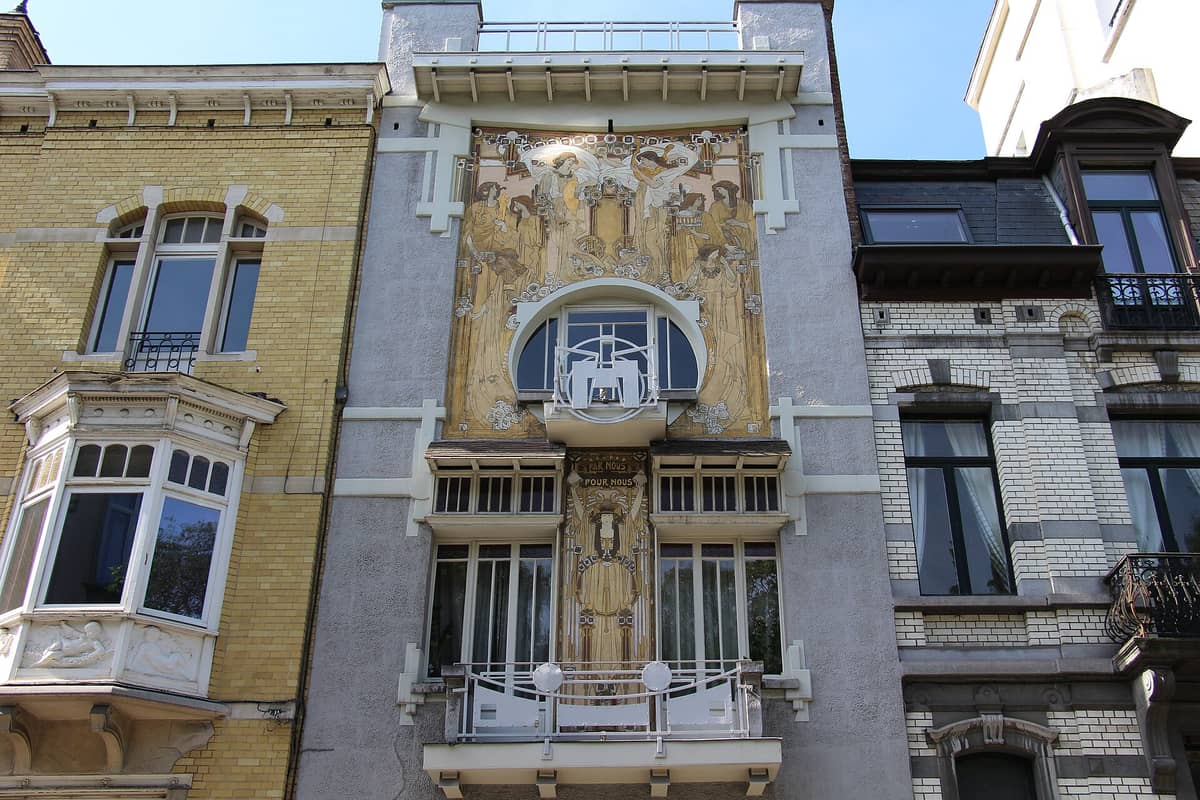
What Is Maison Cauchie?
Maison Cauchie is a three-storey Art Nouveau townhouse at 5 Rue des Francs in the Etterbeek municipality of Brussels, designed and built in 1905 by the Belgian artist and decorator Paul Cauchie in collaboration with an architect. It served simultaneously as his private residence and professional atelier, a combination that explains why the building feels less like a public monument and more like a statement of personal artistic philosophy. Every decorative element, from the sgraffito panels on the facade to the interior wall treatments, was conceived as an integrated whole.
The house has been open to visitors since 1994, offered exclusively through guided tours on limited opening days rather than independent roaming. This format is not a limitation; it is, in practice, the appropriate way to experience a building where context, technique, and biographical detail deepen almost every surface you look at.
If you are building an Art Nouveau itinerary across Brussels, Maison Cauchie pairs logically with the Horta Museum in Saint-Gilles and the Hotel Solvay on Avenue Louise, though each represents a distinct strand of the movement.
The Facade: Brussels' Most Striking Sgraffito Wall
Standing on Rue des Francs, the first thing you register is the facade, and it is genuinely arresting. Sgraffito, the technique of scratching through layers of differently coloured plaster to create images, covers much of the upper face of the building. Cauchie used it to depict a procession of elongated female figures in flowing robes, surrounded by stylised organic motifs. The palette is muted: ochres, greens, and pale terracotta against a grey Brussels sky. In morning light, the relief textures catch shadows that are largely invisible by midday.
The inscription above the figures reads 'Par Nous, Pour Nous' (By Us, For Us), a declaration that the house was entirely the couple's own creative project. Paul Cauchie's wife, Marie Koch, was also an artist and contributed to the decorative programme. That detail, often glossed over in passing references to the building, matters considerably when you look at the interior, where her influence on the textile and applied art elements is visible.
💡 Local tip
Photography of the facade is best in the morning before 10:00, when the low sun from the east catches the sgraffito relief cleanly. By afternoon, the facade falls into relative shadow. If you are arriving for a tour, budget ten minutes on the street before going in.
Tickets & tours
Hand-picked options from our booking partner. Prices are indicative; availability and final rates are confirmed when you complete your booking.
Ghent tour from Brussels
From 43 €Instant confirmationFree cancellationTablet Workshop at Choco-Story Brussels
From 45 €Instant confirmationShared tour of Delft and the Keukenhof Estate from Brussels
From 86 €Instant confirmationFree cancellationOrigins of Brussels exploration game and tour
From 10 €Instant confirmationFree cancellation
The Interior: Decoration as Total Environment
Access to the interior is through guided tours only, conducted in French, Dutch, and English. The format keeps group sizes small, which means you can actually stand close to details rather than viewing them from a rope barrier. The ground floor contains the studio and reception spaces, where the integration of furniture, wall decoration, and architectural elements demonstrates what Art Nouveau designers meant by the Gesamtkunstwerk, the idea of a unified total artwork.
The wall treatments inside use the same sgraffito technique as the facade, creating a visual continuity between exterior and interior that few Art Nouveau buildings achieve at this scale. Colour is handled with unusual restraint compared to some of the movement's more exuberant interiors: the effect is harmonious rather than overwhelming, which suits the domestic scale of the rooms.
The upper floors contain the private living quarters, preserved in a state that communicates how the Cauchies actually inhabited their creation. This lived-in quality distinguishes the house from the more thoroughly museumified Art Nouveau buildings in Brussels. The smell of old plaster and wood is present throughout, and the slightly uneven floors remind you that this is a structure well over a century old.
Paul Cauchie: The Artist Behind the Building
Paul Cauchie (1875-1952) was a painter and decorative artist who also worked to a limited extent as an architect, primarily in Brussels in the early decades of the twentieth century. He was a practitioner of sgraffito at a moment when several Brussels architects, including Adolphe Crespin and Gustave Strauven, were using the technique to enliven building facades across the city. What distinguishes Cauchie is the density and sophistication of his application: the facade of Maison Cauchie is among the finest examples of sgraffito work from the period anywhere in Europe.
Cauchie was also a committed exhibitor, showing his work at the Libre Esthétique and other salons associated with the Belgian avant-garde. The house at Rue des Francs was in part a deliberate advertisement for his skills, designed to be visible and legible from the street to potential clients. This dual purpose, home and portfolio, gives the building its particular character: it was meant to impress professionally while functioning as a genuine domestic space.
For a broader view of Art Nouveau's footprint across Brussels, the Art Nouveau Brussels guide covers the movement's key buildings, designers, and neighbourhoods across the city.
Planning Your Visit: Logistics and Timing
Maison Cauchie operates on restricted public visiting hours. Regular individual visits typically take place on Saturdays, with morning sessions running from 10:00 to 13:00 and afternoon sessions from 14:00 to 17:00, though schedules can vary by season. The house also participates in special event programmes such as Nocturnes Brussels, when evening guided visits are offered on selected dates. Advance reservation is strongly recommended for all visit types, and checking the official website at cauchie.be before planning your trip is essential, as schedules change.
Admission fees for adults are reported in the range of €7 to €9.50, with reduced rates for students and seniors. The official site publishes current 2025 fee information and handles reservations via the info@cauchie.be email address. Group visits can also be arranged outside standard hours with prior booking.
⚠️ What to skip
Do not arrive without confirming current opening hours directly with the house. Maison Cauchie is not open daily and does not function as a conventional museum with walk-in access. Out-of-season closures and schedule changes are common.
Getting there by public transport is straightforward from the city centre. Merode metro station on lines 1 and 5 is the most direct option, placing you a short walk from Rue des Francs. Tram 81 and buses 22, 27, 61, and 80 also stop nearby. The surrounding Etterbeek neighbourhood is quiet on weekend mornings, so the walk from Merode is pleasant and unhurried.
Art Nouveau Context: Where Maison Cauchie Fits
Brussels produced more Art Nouveau buildings per square kilometre than almost any other European city during the period between roughly 1893 and 1914. The movement here was driven by patrons with new money, an unusually permissive building culture, and a cluster of exceptionally talented designers who knew each other and competed fiercely for commissions. Victor Horta is the name most associated with Belgian Art Nouveau internationally, but the reality was a wide field of practitioners working at different scales and price points.
Maison Cauchie sits at the more modest end of that spectrum in terms of footprint, but not in terms of ambition or quality. Where Horta's great private houses were built for wealthy industrialists with large budgets, Cauchie built his house for himself, with a practitioner's knowledge and without an intermediary client to satisfy. The result is arguably more personal and more architecturally coherent than some larger commissions from the same period.
The Art Nouveau facades of Saint-Gilles offer a complementary outdoor experience if you want to see how the style played out at the neighbourhood scale, without the constraint of museum hours.
Accessibility and Practical Notes
Maison Cauchie is a historic private house rather than a purpose-built visitor facility, and mobility access may be limited in certain areas given the building's age and protected status. The official contact page includes a dedicated accessibility section, and the house can be reached by phone at +32 (0)473 64 26 97 during opening days for specific accessibility queries. Visitors with mobility requirements are advised to contact the house in advance to understand exactly which spaces are accessible.
Brussels has an oceanic climate with regular rainfall throughout the year, and weekend mornings in autumn and winter can be genuinely cold and damp. The tour takes place largely indoors, so the weather does not significantly affect the core experience, but the exterior photography conditions vary considerably by season. A light layer is advisable year-round.
ℹ️ Good to know
The house phone is only staffed on opening days. For reservations and accessibility enquiries outside those hours, use the email contact form on the official website at cauchie.be.
Insider Tips
- Ask your guide specifically about the sgraffito restoration work carried out after the house was opened to the public in 1994. The before-and-after documentation illustrates how much of the decoration had deteriorated and makes the current state of preservation considerably more impressive.
- The Nocturnes Brussels programme, which features evening visits to participating museums and heritage sites, typically includes Maison Cauchie on select dates. The artificial lighting changes the palette of the interior considerably and is worth seeking out if your travel dates align.
- Rue des Francs sits within the Etterbeek municipality, which borders the European Quarter to the north. Combining the visit with a walk through the Parc du Cinquantenaire (roughly 10-15 minutes on foot) makes efficient use of a Saturday morning.
- If you are specifically interested in sgraffito technique, tell your guide before the tour begins. The house contains examples at different stages of the technique's execution, and guides with specialist knowledge can direct attention to areas that a general tour might pass quickly.
- Group bookings outside standard hours are possible and can allow more flexibility for photography and extended discussion. If you are visiting with a study group, architecture students, or a design-focused travel party, the private group format is worth the extra coordination.
Who Is Maison Cauchie For?
- Architecture and Art Nouveau enthusiasts who want to understand the movement beyond Horta's canonical buildings
- Design history researchers and students looking at sgraffito technique and the applied arts in early 20th-century Belgium
- Slow travellers who prefer a single carefully experienced site over a rapid tour of multiple landmarks
- Photographers interested in decorative surface detail and the interplay of texture and light on historic facades
- Visitors returning to Brussels who have already seen the major Art Nouveau landmarks and want to go deeper
Nearby Attractions
Combine your visit with:
- AfricaMuseum Tervuren
Set in a grand neoclassical palace 14 km east of Brussels, the AfricaMuseum is one of Europe's largest museums dedicated to Central Africa. Reopened in 2018 after a five-year renovation, it now confronts its own colonial past head-on while housing world-class natural history, ethnographic, and art collections.
- Basilica of the Sacred Heart (Koekelberg)
The National Basilica of the Sacred Heart in Koekelberg is one of the largest Art Deco religious buildings in the world, its green copper dome rising 89 metres above Brussels. Entry to the basilica is free; a paid climb to the dome platform delivers one of the city's most underrated panoramas.
- Cantillon Brewery (Brasserie Cantillon)
Cantillon Brewery (Brasserie Cantillon) is one of the few remaining traditional lambic breweries in Brussels, doubling as the Brussels Museum of the Gueuze since 1978. Located a short walk from Gare du Midi in Anderlecht, it is a working industrial site and a serious destination for anyone wanting to understand why Belgian beer culture earned UNESCO recognition.
- Comic Strip Route (Mural Trail)
Brussels' Parcours BD is a free, self-guided trail of more than sixty large-scale comic murals painted on building walls across the city. Created in 1991, it turns the streets themselves into an open-air gallery celebrating Belgium's most distinctive art form. No ticket required, no opening hours to check.