MacRitchie Treetop Walk: Singapore's Rainforest Canopy Bridge
The MacRitchie Treetop Walk places you 25 metres above the forest floor on a 250-metre free-standing suspension bridge, deep inside Singapore's Central Catchment Nature Reserve. It rewards the effort of a moderate hike with close-up wildlife encounters, a sea of unbroken rainforest canopy, and genuine quiet that is rare in one of Asia's most densely developed cities.
Quick Facts
- Location
- Central Catchment Nature Reserve, MacRitchie Reservoir Park, Singapore
- Getting There
- Bus 167 to Opp Flame Tree Pk stop (Venus Drive entrance); no MRT directly to trailhead
- Time Needed
- 3–5 hours for a full loop including the bridge (7–11 km total)
- Cost
- Free
- Best for
- Nature lovers, hikers, wildlife spotters, anyone needing a genuine break from the city
What the Treetop Walk Actually Is
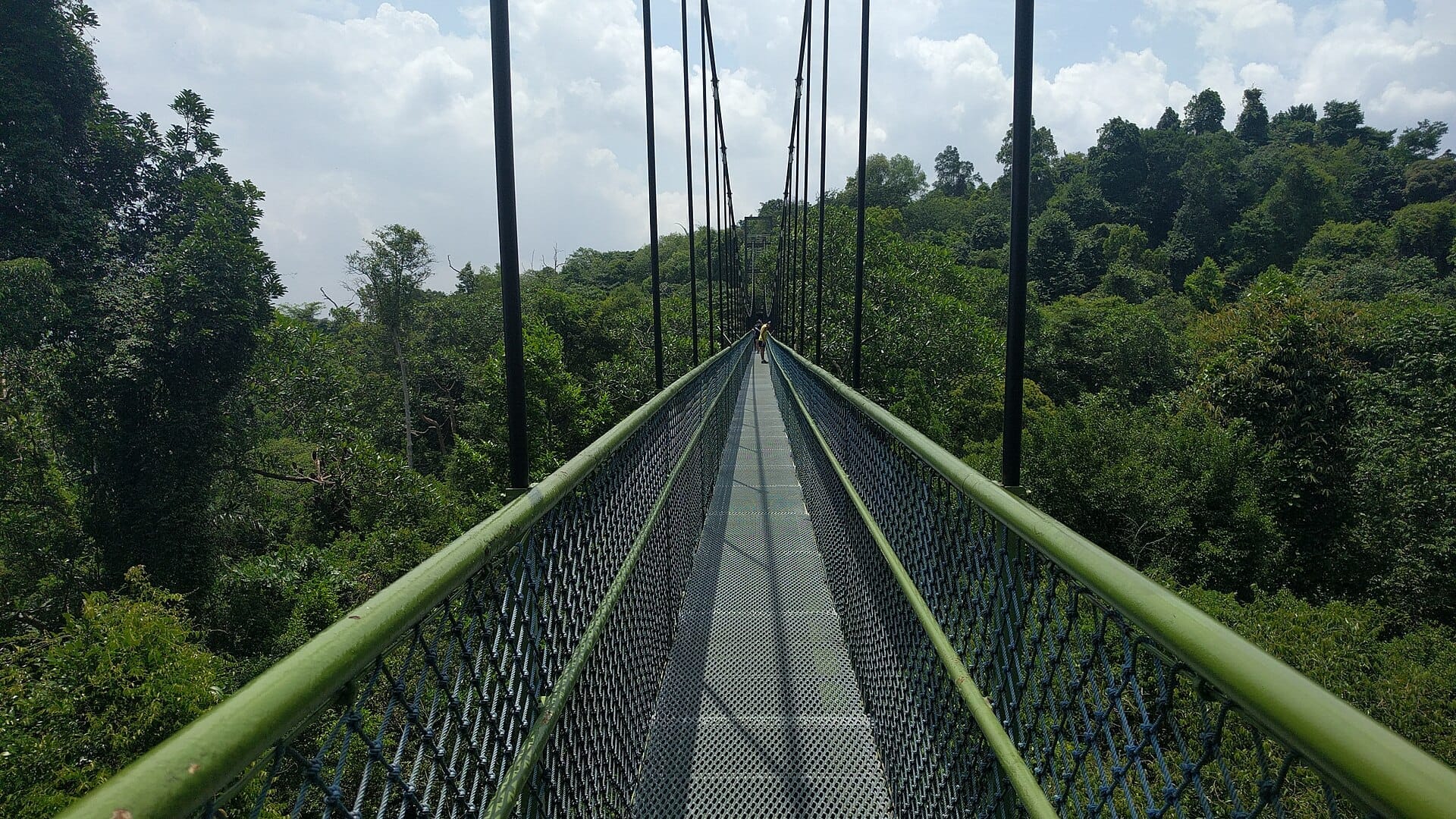
The TreeTop Walk is a 250-metre free-standing suspension bridge that links two of MacRitchie's highest ridges, Bukit Peirce and Bukit Kalang, at up to 25 metres above the forest floor. Opened on 5 November 2004, it was Singapore's first bridge of its kind, built specifically to let visitors experience the rainforest canopy layer rather than just the trail beneath it. It is managed by the National Parks Board (NParks) as part of the Central Catchment Nature Reserve, the largest and most ecologically significant patch of secondary rainforest in Singapore.
The bridge is not a standalone attraction you can pop into for ten minutes. It sits at the far end of a trail network, roughly 4.5 km from the main MacRitchie Reservoir Park entrance (about 1.5 to 2 hours of walking each way) or about 2.5 km from the Venus Drive carpark (45 minutes to 1 hour). Traffic on the bridge moves in one direction only, controlled by a ranger station at the entry point. This design keeps the bridge from becoming a bottleneck and preserves some of the calm that makes it worth visiting.
💡 Local tip
The gate at the Ranger Station closes at 5pm sharp. NParks recommends starting your approach no later than 4:45pm from the Ranger Station side, but if you are coming from MacRitchie Reservoir Park, you need to begin much earlier to avoid a rushed hike back in fading light.
The Hike In: What to Expect on the Trail
Most visitors approach via the Venus Drive carpark off Venus Drive Road, which significantly cuts the walking distance. From there, well-marked NParks trails wind through secondary rainforest that feels immediately different from any urban park. The canopy closes over the path within minutes, dropping the ambient temperature by several degrees compared to the street outside. The ground smells of damp earth and leaf litter, and the calls of birds, most often the Greater Racket-tailed Drongo and various sunbirds, replace traffic noise almost completely.
The terrain is uneven throughout. Roots cross the path constantly, and some sections involve short but steep climbs over exposed rock. The trails are graded moderate to difficult depending on which loop you choose. Proper footwear matters: trail shoes or sturdy sneakers with grip are essential. Sandals or slip-on shoes will make sections of the route genuinely hazardous, particularly after rain when exposed roots become slick.
Long-tailed macaques are common along the trail, especially near the reservoir edges. They are habituated to humans and have learned to associate bags with food. Keep food zipped away and do not make eye contact or feed them. They can become aggressive when they sense a reward is possible. Squirrels, monitor lizards, and occasionally flying lemurs are spotted by patient, quiet walkers.
⚠️ What to skip
Do not bring food that is visible or easily accessible. Macaques along the MacRitchie trails are bold and will approach hikers directly. Incidents of bag-snatching by monkeys are reported regularly.
Tickets & tours
Hand-picked options from our booking partner. Prices are indicative; availability and final rates are confirmed when you complete your booking.
Singapore Little India self-guided walking audio tour
From 13 €Instant confirmationFree cancellationDowntown Singapore self-guided audio walking tour
From 10 €Instant confirmationFree cancellationAdventure Cove Waterpark™ e-ticket
From 27 €Instant confirmationWild Wild Wet Waterpark Entrance Ticket
From 15 €Instant confirmation
On the Bridge: The Canopy Experience
The suspension bridge itself takes most people under ten minutes to cross, but almost nobody crosses it in ten minutes. The structure sways gently underfoot, and looking straight down through the mesh platform reveals a drop into layered foliage: the mid-storey of dipterocarp trees, ferns, and climbers cascading below you. Looking out across the canopy in any direction, you see an unbroken green horizon that makes it easy to forget you are standing in the geographic centre of a city of six million people.
The height of 25 metres puts you level with the upper canopy, where the light is different. On clear mornings, shafts of sunlight break through gaps in the tree crowns and illuminate individual leaves from above rather than below, a complete inversion of the forest-floor perspective. Birders find this vantage point particularly rewarding: raptors such as the Changeable Hawk-Eagle are occasionally spotted riding thermals above the reserve from this elevation.
The bridge has a weight limit and visitor numbers are managed to avoid overcrowding. On busy weekend mornings, there can be a short wait at the ranger station before being admitted. This is worth factoring into your timing, especially if you are combining the walk with other plans later in the day.
Best Time to Visit and How the Experience Changes by Hour
Weekday mornings, particularly Tuesday to Friday before 11am, give you the closest thing to solitude that MacRitchie can offer. The forest is most active in early morning: birds call frequently, the air is relatively cool, and the light filtering through the canopy has a quality that midday sun destroys. By 11am on weekends, the trail from Venus Drive can become noticeably congested at popular junctions, and the bridge itself sees a steady flow of visitors.
Afternoon visits are possible but come with trade-offs. Singapore's equatorial climate means afternoon rainfall is common, especially between November and January during the northeast monsoon season. A rain shower on the trail is manageable if you bring a lightweight rain jacket or a compact umbrella, but the trail surface deteriorates quickly in heavy rain and the bridge can close temporarily in lightning conditions. Check the weather radar before setting out; the Meteorological Service Singapore app provides reasonably reliable short-term forecasts.
ℹ️ Good to know
Opening hours: Weekdays: 9:00 am to 5:00 pm. Weekends and Public Holidays: 8:30 am to 5:00 pm. Closed on Mondays (except Public Holidays). Last entry at 4:45 pm. These hours apply to the Treetop Walk bridge specifically; the broader MacRitchie trail network has different access conditions.
Getting There: Practical Transit and Parking
There is no MRT station within comfortable walking distance of the trailheads. The most practical public transport option is bus 167, which stops at Opp Flame Tree Pk on Venus Drive, close to the Venus Drive carpark entrance. From the city centre, this bus can be boarded along Orchard Road. The journey takes roughly 20 to 30 minutes depending on traffic.
Grab (Singapore's dominant ride-hailing app) is a reliable alternative, particularly useful for the return journey when you may be tired. Ask to be dropped at Venus Drive carpark or at MacRitchie Reservoir Park car park depending on which route you plan. Parking is available at both locations if you are driving, though Venus Drive carpark fills quickly on weekend mornings.
MacRitchie sits at the geographic heart of Singapore, not far from other green spaces worth combining into a day out. If you are interested in more of Singapore's nature side, the Singapore Botanic Gardens and the Southern Ridges trail offer very different but equally rewarding experiences — the Botanic Gardens for manicured tropical horticulture and the Southern Ridges for elevated city views along a connected hillside walk.
Ecological and Historical Context
The Central Catchment Nature Reserve covers approximately 3,000 hectares and contains four reservoirs: MacRitchie, Upper Peirce, Lower Peirce, and Upper Seletar. Together these supply a significant portion of Singapore's water. The forest surrounding them has been protected since the colonial era, first as a water catchment area under the British administration, and subsequently as a nature reserve under the Singapore government. This long protection history is why the reserve contains some of the oldest and tallest secondary rainforest in Singapore, with tree specimens that would be exceptional anywhere in urban Southeast Asia.
The Treetop Walk was designed not just as a visitor attraction but as a research tool, giving NParks and academic partners easier access to the canopy layer for biodiversity monitoring. The Central Catchment Reserve is home to over 840 plant species, more than 500 animal species, and a population of critically endangered species including the Sunda Pangolin. Visitors are unlikely to encounter pangolins, which are nocturnal and extremely shy, but the knowledge that they share this forest is a useful reminder that MacRitchie is a functioning ecosystem, not a theme park.
Who Should Reconsider This Visit
The Treetop Walk is not suitable for visitors with limited mobility. The trails involve significant elevation change, uneven footing, and no paved surfaces. There is no wheelchair access to the bridge itself. Young children can enjoy the hike if they are comfortable walkers and the group has enough time to move slowly, but toddlers will need to be carried for significant portions, which is physically demanding in Singapore's heat and humidity.
Visitors who are primarily interested in Singapore's food, culture, or urban architecture will likely find the two to five hours required here better spent elsewhere. The Chinatown Heritage Centre, the Indian Heritage Centre, and the Malay Heritage Centre offer concentrated, time-efficient cultural depth that suits a shorter itinerary better.
Those who expect a short, easy walk to a dramatic viewpoint may find the experience underwhelming if they are not prepared for the full commitment of a forest hike. The bridge is genuinely impressive, but it is the journey through the reserve that gives it meaning. Approached as a quick detour, it is likely to disappoint. Approached as a half-day immersion in one of Southeast Asia's most surprising urban forests, it consistently delivers.
Insider Tips
- Start from Venus Drive carpark rather than MacRitchie Reservoir Park main entrance. It cuts the one-way distance to the bridge almost in half and lets you complete a satisfying loop without retracing your steps.
- Bring at least 1.5 litres of water per person. There are no water refill points or vending machines along the trail to the bridge. The heat and humidity make dehydration a real risk even on a cloudy day.
- The bridge is one-directional, so plan your loop accordingly. Most hikers enter from Venus Drive, cross the bridge, and exit toward the reservoir side, then loop back along the reservoir boardwalk — check NParks trail maps before setting out to avoid an unplanned backtrack.
- For the best canopy light on the bridge, aim to arrive at the ranger station around 9am on a weekday. The low-angle morning light through the dipterocarp canopy is qualitatively different from the flat overhead light of midday, and the forest is quieter in every sense.
- Wear insect repellent. Mosquitoes are present throughout the reserve, particularly in shaded, humid sections of the trail. Long, light-coloured clothing also helps and keeps you cooler than dark colours in the heat.
Who Is MacRitchie Treetop Walk For?
- Nature and wildlife enthusiasts looking for genuine rainforest immersion within a major city
- Hikers and trail runners wanting a proper workout without leaving Singapore
- Birders, particularly those targeting canopy species like raptors and forest sunbirds
- Travellers on longer Singapore stays who have already covered the main urban attractions
- Anyone who needs a full mental reset from the pace and noise of central Singapore
Nearby Attractions
Combine your visit with:
- Boat Quay
Boat Quay stretches along the south bank of the Singapore River, its two- and three-storey shophouses packed with restaurants, bars, and cafes. Once the beating commercial heart of colonial Singapore, the strip today offers one of the city's most atmospheric settings for an evening meal or a morning walk with history underfoot.
- Clarke Quay
Clarke Quay lines the Singapore River with five blocks of conserved warehouses and shophouses, now packed with restaurants, rooftop bars, and clubs. Free to enter and active from dusk until well past midnight, it rewards visitors who arrive after dark when the neon reflects off the water and the crowds find their rhythm.
- Fort Canning Park
Standing 48 metres above the city centre, Fort Canning Park packs more history per square metre than almost anywhere else in Singapore. From ancient Malay royalty to British colonial command, the hill has shaped this island for over seven centuries — and today offers a genuinely peaceful escape just minutes from Orchard Road.
- Henderson Waves
Henderson Waves is Singapore's tallest pedestrian bridge at 36 metres above Henderson Road, connecting Mount Faber Park and Telok Blangah Hill Park along the Southern Ridges trail. Free to access at any hour, the 274-metre-long structure is equally rewarding at dawn, midday, and after dark.