Macau Tower: Views, Vertigo, and Sky Adventures Above the Pearl River Delta
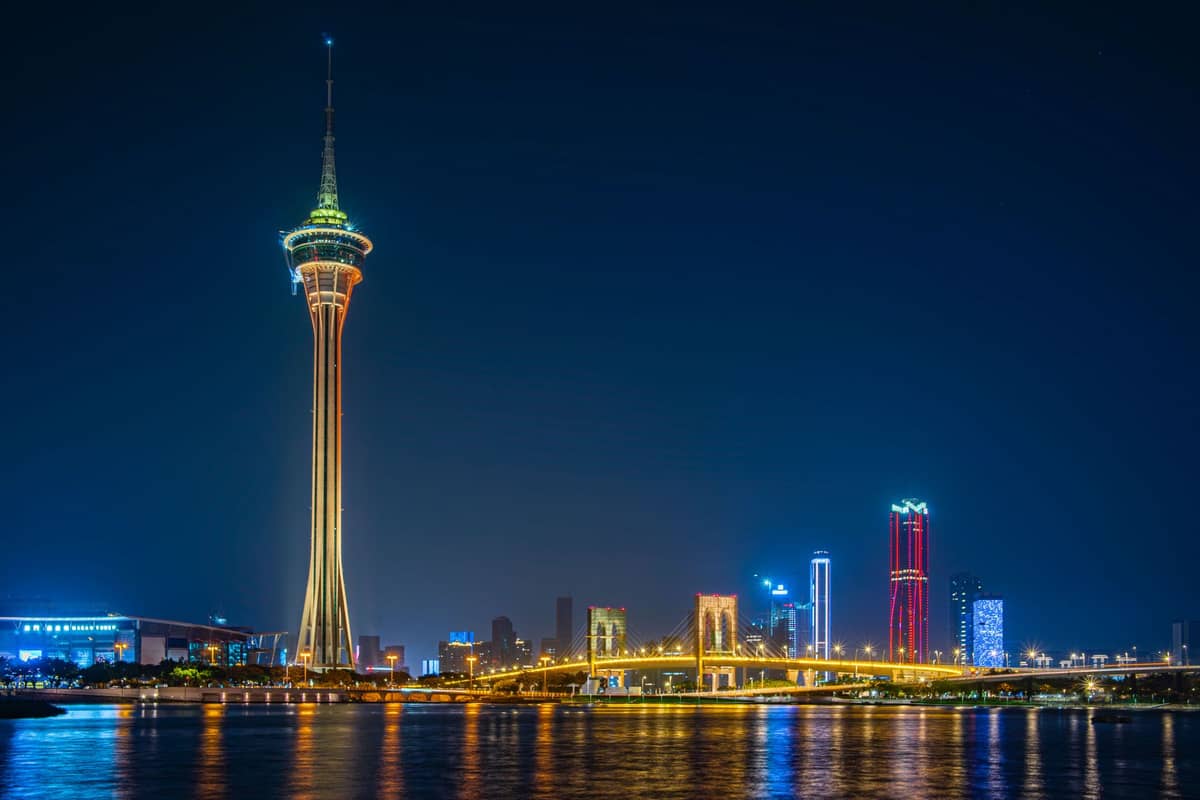
Macau Tower rises 338 metres above Sai Van Lake on the Macau Peninsula, offering panoramic views across the Pearl River Delta alongside some of the highest adrenaline activities on the planet. Whether you climb to the observation deck or step off the edge on a bungy jump, this tower delivers an experience that stands apart from anything else in the city.
Quick Facts
- Location
- Largo da Torre de Macau, Sai Van Lake waterfront, Macau Peninsula
- Getting There
- Bus routes 9A, 18, 23, 26, 32 stop at Macau Tower
- Time Needed
- 1.5–2 hours for the observation deck; half a day if doing adventure activities
- Cost
- Observation deck MOP 208 (adults) / MOP 138 (children 3–11 and seniors 65+); adventure activities from roughly MOP 788, with the bungy jump listed at MOP 3,088
- Best for
- Skyline views, adrenaline activities, sunset photography
- Official website
- www.macautower.com.mo/en
What Macau Tower Actually Is
Macau Tower Convention and Entertainment Centre, known locally as 澳門旅遊塔, officially opened on 19 December 2001 as part of a broader waterfront development along Sai Van Lake. At approximately 338 metres tall (including the antenna mast), it ranks among the taller observation towers in Asia used for public entertainment. The tower combines a conventional observation experience on its indoor and outdoor decks with a suite of commercial spaces below, including restaurants, a theatre, and event facilities.
What distinguishes it from similar towers across Asia is the adventure activity program operated on the exterior of the structure. The bungy jump, skywalk, and tower climb are not novelty add-ons. They run as serious operations with dedicated staff, waivers, and technical briefings, and they attract visitors who fly into Macau specifically for them. If you are coming for the view alone, the observation deck is worth the ticket price on a clear day. If you are coming for the jump, plan your entire day around it.
💡 Local tip
Verify current admission prices on the official site before visiting, as observation deck fees and adventure activity packages have been updated periodically. Prices listed here reflect publicly available 2025–2026 figures.
The Observation Deck: What You See and When
The indoor observation deck sits inside a glass-enclosed ring near the top of the tower. On a clear autumn or winter day, the view extends across the Pearl River Delta far enough to see Hong Kong's Lantau Island. Closer in, you get a textbook aerial map of Macau: the cluttered rooflines of the Peninsula below you, the Cotai Strip's casino towers rising from reclaimed land to the south, and the green hills of Coloane at the far edge. The contrast between old and new Macau is genuinely striking from this altitude.
The outdoor observation deck, one level above the indoor ring, is where the experience sharpens. The deck is open to the elements with a metal grille underfoot and a low railing at the perimeter. On windy days, which are common from October through March, the chill is significant. The sound changes too: you can hear the faint hiss of traffic far below, and when the wind picks up, it carries a low whistle across the deck. It is not a manicured garden terrace. It is a working observation platform at height, and it feels like one.
Lighting conditions matter considerably. Morning visits from around 10:00 to 12:00 produce clean, bright photography if skies are clear, but the haze that builds through the afternoon in humid months, especially May through September, can reduce visibility substantially by midday. The most atmospheric window is the hour before sunset and the 30 to 40 minutes after, when the Pearl River Delta lights up in layers and Cotai's casino towers begin their neon cycles. This timing also aligns with lower crowd pressure than weekend afternoons.
Opening Hours and Ticket Prices
The observation deck is generally open daily, including weekends and public holidays, from 10:00 to 21:00, with last admission typically around 20:30. Some booking platforms list closing at 20:00, so confirm the exact schedule on the official site for your visit date, particularly around public holidays when hours can shift.
As of 2025 to 2026, standard adult admission (ages 13 and over) is typically around MOP 150–165. Children aged 3 to 12 and seniors aged 65 and over usually pay around MOP 105–150. Children under 3 enter free when accompanied by a paying adult. Adventure activity pricing sits in a separate bracket: the bungy jump runs in the region of MOP 3,488 to 3,688 and includes a certificate, tower entry, and a branded T-shirt. The SkyJump and Skywalk packages range roughly from about MOP 788 up to MOP 2,988 depending on inclusions. Tower Climb pricing falls within a similar range. All figures should be confirmed directly with the operator before booking.
⚠️ What to skip
Adventure activities have strict physical and medical requirements. Participants with heart conditions, high blood pressure, pregnancy, or certain mobility limitations will not be permitted to proceed. Review the operator's full terms before traveling specifically for an activity booking.
The Adventure Activities: Bungy, Skywalk, and Climb
The bungy jump operates from a platform at the 233-metre mark of the tower exterior and is certified as one of the highest commercial bungy or skyjump operations in the world. The setup is run by AJ Hackett, the company that pioneered commercial bungy jumping. Participants are weighed, suited up with a full-body harness, given a technical briefing, and walked through the procedure before they step off. The jump itself takes seconds. The preparation and debriefing take considerably longer.
The Skywalk is a more accessible option. You walk around the outer rim of the tower on a narrow ledge, without handrails, secured only by a harness clipped to an overhead rail. The pace is slow and the experience is controlled, but the exposure to open air at that height produces the same psychological effect on most people as a more intense activity. It is open to a wider range of fitness levels and is often the choice for visitors who want the height sensation without the freefall commitment.
The Tower Climb takes guests up the mast above the observation deck via a series of ladders and platforms, reaching even higher than the bungy jump point. This one demands physical fitness and a degree of comfort with confined, vertical spaces. Adventure activities typically open around 10:00, with evening sessions beginning between about 18:00 and 19:30 depending on the season. Evening sessions are popular for the combination of city lights and adrenaline, but they book out quickly.
If the bungy jump is your primary reason for visiting Macau, read the dedicated Macau bungy jump guide before booking, which covers logistics, weight limits, and what to expect in more detail.
Getting There and Practical Logistics
The tower sits at the southern edge of the Macau Peninsula along Sai Van Lake. Several bus routes stop at or immediately adjacent to the tower, including lines 9A, 18, 23, 26, and 32, though route numbers can change and should be verified against current city transport maps. Taxis are widely available across Macau and are the simplest option from the Historic Centre, which is roughly 3 to 4 kilometres north. The ride takes around 10 minutes outside peak traffic hours.
Hotel casino shuttles, which serve most parts of the Peninsula and Cotai, do not stop at the tower directly. For a fuller picture of moving around the city, the getting around Macau guide covers bus routes, taxis, and the light rail in detail.
The tower is accessible for visitors using wheelchairs. Elevators serve the main observation levels, and the indoor deck is navigable without stairs. The outdoor deck and all adventure activities are not accessible for visitors with significant mobility limitations. If you are visiting with children, note that the outdoor edge areas require adult supervision and that younger children may find the height exposure distressing even inside the indoor deck.
When Weather Changes Everything
Macau's subtropical climate makes weather a genuine variable for this attraction. The most reliably clear visits happen between October and February, during the drier season when humidity drops, skies open up, and visibility can reach well beyond the Pearl River. Autumn afternoons, especially in October and November, produce some of the cleanest views the tower offers.
From May through September, the combination of heat, humidity, and frequent afternoon thunderstorms creates unpredictable conditions. Haze and low cloud are common, and the outdoor deck can be temporarily closed during heavy rain or when Macau's typhoon signal system activates. If Typhoon Signal 8 or higher is in force, the tower will be closed and adventure activities suspended. Check the Macau Meteorological and Geophysical Bureau's bulletins during typhoon season before any visit.
ℹ️ Good to know
Autumn (October to December) is broadly the best season for outdoor attractions in Macau. Temperatures sit around 22–26°C, humidity is lower, and visibility from the tower is at its clearest. For more on seasonal timing, see the best time to visit Macau guide.
The tower's best views are also the best views in the city at this height. For a broader comparison of Macau's skyline vantage points, the best views in Macau guide includes ground-level and elevated alternatives.
Photography at Macau Tower
The indoor observation deck shoots through double-glazed glass, which introduces reflections and colour shifts. Pressing your lens or phone directly against the glass eliminates most of the glare. The outdoor deck has no glass barrier, which makes it the better platform for photography, but the grille floor does appear in wide shots taken looking straight down. A wide-angle lens handles the scale well; the Pearl River Delta vista rewards focal lengths between 16mm and 35mm.
At night, the Cotai casino towers produce enough artificial light to photograph clearly without extreme ISO settings. The Macau Peninsula below shows a denser, older urban texture that contrasts sharply with Cotai's uniform resort lighting. Tripods are not prohibited but can be cumbersome in the confined outdoor ring, especially when the space fills up on weekends. A monopod or image-stabilized system is more practical.
What Surrounds the Tower
The tower sits near the southern waterfront of the Peninsula, an area that rewards an easy walk before or after your visit. The Macau waterfront promenade along Nam Van Lake offers a ground-level counterpoint to the aerial view from above, particularly pleasant in the early evening when the tower itself is lit up.
Further north on the Peninsula, the Historic Centre with its UNESCO-listed squares and churches is the natural complement to a tower visit. The Ruins of St. Paul's and Fortaleza do Monte sit within walking distance of each other and represent the older layer of the city that the tower's view helps you map from above.
Insider Tips
- Book adventure activities at least a day in advance during weekends and public holidays. Walk-in slots exist but fill quickly, and you will lose time waiting if the morning session is sold out when you arrive.
- The outdoor observation deck floor is a metal grille. Looking directly through it at the ground far below produces a different physical sensation than looking over the railing. Visitors with a strong fear of heights should factor this in before stepping outside.
- If you are visiting primarily for the view and not the activities, a weekday morning between 10:00 and 12:00 gives you the deck at its quietest. Weekend afternoons between 14:00 and 17:00 are the most crowded.
- Evening adventure sessions offer a genuinely different experience from daytime ones. The city lights below during a dusk skywalk or jump create a visual context that daylight cannot replicate, and the air temperature is more forgiving in summer.
- The 360-degree revolving restaurant in the tower requires a separate reservation and is not included in the observation deck ticket. If you plan to dine there, confirm availability well in advance, particularly for Friday and Saturday evenings.
Who Is Macau Tower For?
- Adrenaline seekers who want one of the world's highest commercial bungy jumps
- First-time visitors to Macau wanting a spatial overview of the entire city before exploring on foot
- Photographers targeting golden-hour and night shots of the Pearl River Delta
- Families with older children who can handle exposure to height on the outdoor deck
- Travellers on a tight schedule who want a single landmark that delivers both culture and spectacle
Nearby Attractions
Other things to see while in Macau Waterfront & NAPE:
- Grand Prix Museum
The Macao Grand Prix Museum dedicates 16,000 square metres across four floors to the history of one of Asia's oldest and most technically demanding street races. Whether you follow motorsport closely or simply want to understand one of Macau's defining annual events, this is the most focused and well-produced museum on the waterfront.
- Kun Iam Statue (Goddess of Mercy Waterfront Statue)
Rising from a lotus-shaped dome on an artificial islet off Avenida Dr. Sun Yat-Sen, the Kun Iam Statue is one of Macau's most distinctive waterfront landmarks. The Kun Iam Ecumenical Centre inside the base is free to enter and offers a rare moment of calm away from the casino corridors. The outdoor park stays open from early morning until late evening, making it one of the few major sights in Macau that rewards visitors at multiple hours of the day.
- Macau Fisherman's Wharf
Macau Fisherman's Wharf is a free-entry, 133,000-square-metre leisure complex on the outer harbour of the Macau Peninsula. Part themed streetscape, part hotel zone, part dining strip, it draws curious walkers and families rather than serious sightseers. Here is what you actually get.
- Macau Museum of Art
The Macao Museum of Art is a major museum in Macau dedicated entirely to the visual arts, with seven exhibition areas across four floors and free admission. Located in the NAPE waterfront district inside the Macao Cultural Centre complex, it offers a genuinely calm alternative to the city's more-trafficked historic sites.