Lyric Opera of Chicago: A Complete Visitor's Guide
One of North America's premier opera companies, the Lyric Opera of Chicago performs at a grand downtown theater steps from the Chicago River. Whether you're a lifelong opera devotee or buying your first ticket, here's what the experience actually looks and feels like.
Quick Facts
- Location
- 20 N. Wacker Drive (corner of Wacker Drive and Madison Street), The Loop, Chicago, IL 60606
- Getting There
- CTA Brown, Orange, Pink, and Purple Lines to Washington/Wells; multiple CTA bus routes on nearby Madison and Washington Streets
- Time Needed
- 2.5 to 4 hours depending on production length; arrive 30–45 minutes early
- Cost
- Varies by production and seat; check lyricopera.org for current pricing. Groups of 10+ receive discounts.
- Best for
- Music lovers, architecture fans, special occasions, and curious first-timers to opera
- Official website
- www.lyricopera.org
Why the Lyric Opera of Chicago Matters
The Lyric Opera of Chicago is one of the largest and most acclaimed opera companies in the United States, with a reputation built over seven decades of production that draws international singers and conductors to its downtown stage. The company performs at the Lyric Opera House, a landmark building on Wacker Drive in the heart of the Loop, and its main opera season typically spans from September through April, anchoring Chicago's performing arts calendar year after year.
For visitors who assume opera is inaccessible or stuffy, the Lyric consistently delivers an experience that surprises. Productions here are staged on a scale that smaller venues simply cannot match, and the company invests seriously in surtitles, accessible programming, and community engagement. Even if you've never sat through an opera, an evening at the Lyric has a way of reorienting expectations.
If you're building a broader performing arts itinerary, note that Chicago's theater scene extends well beyond the Lyric. The Chicago Symphony Center is nearby in the Loop, and the city's theater district offers everything from Broadway touring productions to experimental work. A good overview lives in our Chicago theater guide.
The Building: Lyric Opera House
The Lyric Opera House is a significant piece of Chicago's architectural and civic history. The building at 20 N. Wacker Drive was originally constructed in 1929 as the Civic Opera House, commissioned by utilities magnate Samuel Insull. The architectural firm Graham, Anderson, Probst & White designed it in an Art Deco style with strong Beaux-Arts civic grandeur, and the result is a 45-story office tower that frames a grand performance hall at its base. The building's riverside facade, visible from the Chicago River and from the Wacker Drive corridor, has a quiet authority that rewards a slow look.
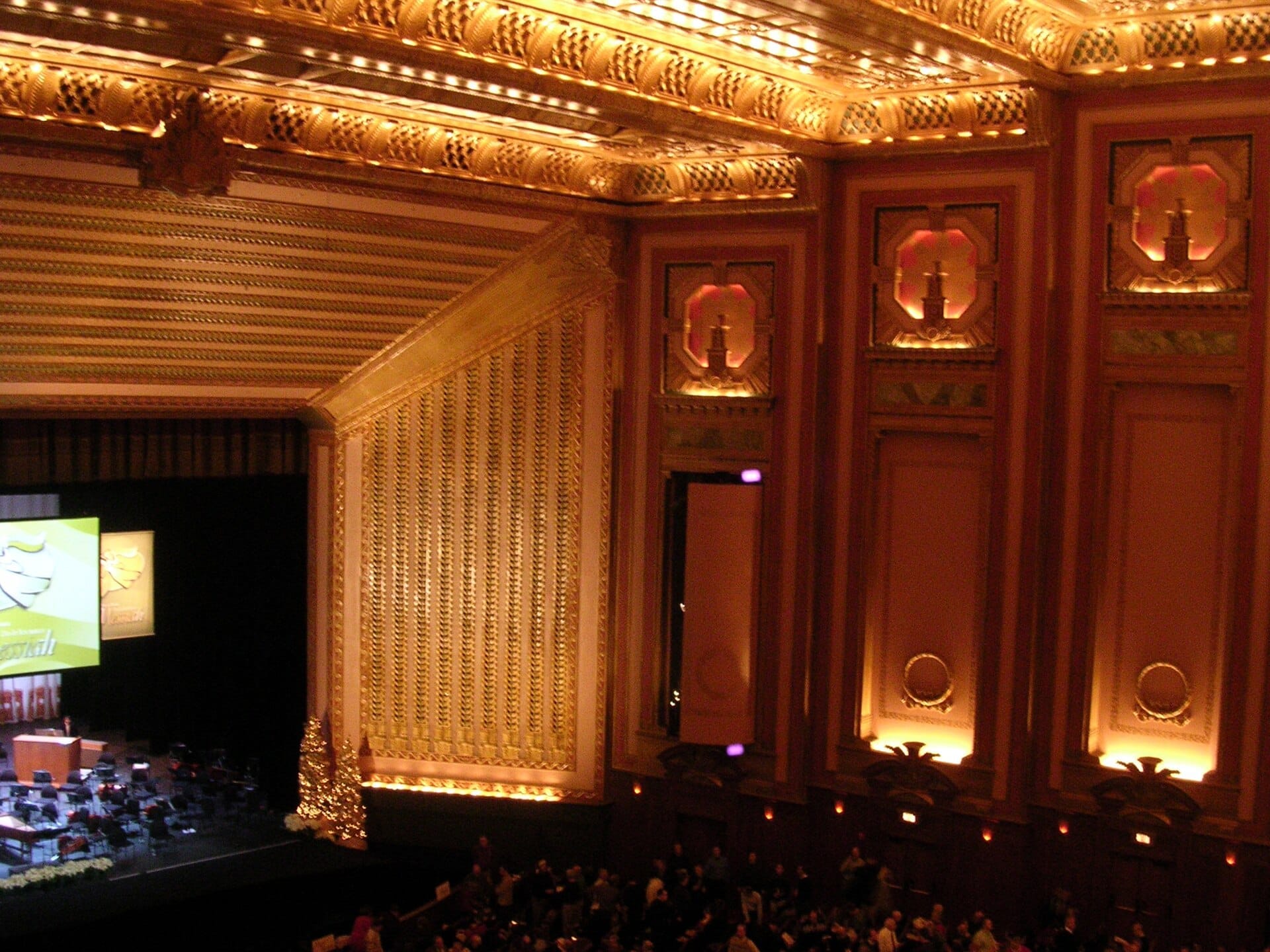
Inside, the main auditorium seats about 3,563 patrons and features soaring gilded ceilings, ornate plasterwork, and a proscenium stage large enough to accommodate full-scale productions with elaborate sets. The lobby spaces have a particular quality in the hour before a performance: the marble floors and sweeping staircases fill with formally dressed regulars, curious tourists, and students attending their first opera on discounted tickets, all moving through the same grand corridors.
💡 Local tip
If you arrive early, spend time in the lobby before the doors open to the auditorium. The building's Art Deco details — elevator doors, plaster reliefs, light fixtures — are worth examining closely. Most visitors walk straight past them.
The building sits directly in the Loop, Chicago's central business district, within walking distance of the Chicago River and the architecture that lines its banks. If you're interested in the broader context of Loop architecture, the Chicago Architecture Center is a short walk east along the river.
Tickets & tours
Hand-picked options from our booking partner. Prices are indicative; availability and final rates are confirmed when you complete your booking.
Go City | Chicago All-Inclusive Pass
From 127 €Instant confirmationFree cancellationiFLY Chicago Lincoln Park indoor skydiving experience
From 126 €Instant confirmationFree cancellationiFLY Chicago Rosemont indoor skydiving tickets
From 117 €Instant confirmationFree cancellationChicago lakefront neighbourhood bike tour
From 18 €Instant confirmationFree cancellation
What a Performance Night Feels Like
Arriving at the Lyric Opera House on a performance evening, typically around 7:00 PM for most productions, the scene outside is calmer than you might expect. Wacker Drive has the low hum of downtown traffic. Patrons stream in steadily from the side entrance on Madison Street and the main Wacker Drive doors. There's a dress code by tradition but not by rule — you'll see tuxedos alongside smart casual, and nobody is turned away for wearing dark jeans.
Inside, the smell is faintly of wood, old upholstery, and whatever the bar in the lobby is serving. The bar areas on multiple levels open early and close during performances. If you want a drink before the curtain, aim to be at the bar 30 minutes before start time — lines form fast in the 15 minutes before the house opens. The auditorium itself is cooler than you might dress for, especially in the upper balconies, so a light layer is worth bringing regardless of season.
Once seated, the scale of the room is immediately apparent. Even seats in the upper tiers have a genuine sense of occasion. English-language surtitles appear above the proscenium arch for non-English productions, meaning the story is always followable. For first-time opera attendees, this is one of the most important practical details: you will understand what is happening on stage.
ℹ️ Good to know
Most productions include one or two intermissions of 20–30 minutes each. These are not just breaks — they're a central part of the social experience. The lobby fills up and conversations happen. Plan to use them to stretch, get a drink, or read the program notes.
The Season and What's On
The Lyric Opera's main season runs from September through April. A typical season includes five to eight main-stage productions, ranging across Italian, German, and French opera canon, with occasional contemporary and American works. The company also presents special events, concert performances, and collaborative productions outside the standard opera season.
Production choices at the Lyric tend toward the canonical end of the repertoire, which makes the company particularly good for newcomers who want to start with the titles they've heard referenced: Verdi, Puccini, Mozart, Wagner. More adventurous programming does appear, but the Lyric is not primarily an experimental house. If you want to see a beloved standard performed with world-class singers and production values, this is exactly the right stage.
Single tickets, subscription packages, and curated series are all available through the official website. Ticket prices vary significantly by production, date, and seat location. Rush tickets and student/youth discounts are sometimes available — check the Lyric's website directly for current offers, as these programs change season to season. For groups of ten or more, contact Group Sales at +1 312-827-5720.
💡 Local tip
If you're flexible on seat location, last-minute single tickets sometimes appear closer to performance dates when subscription holders return seats. Checking the website in the week before a performance is worth doing.
Getting There and Practical Logistics
The Lyric Opera House is straightforward to reach by CTA rail. The Brown, Orange, Pink, and Purple Lines all stop at Washington/Wells, placing the theater about a six-minute walk away. The Blue and Red Lines serve the Loop at nearby stations. On performance nights, the L is the most reliable option — parking in the Loop is expensive, and traffic around Wacker Drive and Madison Street can be congested in the early evening.
If you're driving, several parking garages are within a block or two of the theater, but rates on performance evenings are elevated. Rideshare pickup and dropoff works well on the Madison Street side of the building — designate a specific meeting point with your driver in advance, as downtown blocks can be confusing after dark.
The box office at Wacker Drive is cashless and accepts credit cards only. Box office hours during the opera season typically run Monday through Friday from noon to 6:00 PM, extending until first intermission on days with evening performances; Saturday and Sunday box office hours apply only when a performance is scheduled, and summer hours are reduced, generally Tuesday through Friday, noon to 5:00 PM. For ticketing questions before you arrive, Audience Services can be reached at +1 312-827-5600, Monday through Friday from 10:00 AM to 4:00 PM, and until curtain on performance days.
Accessibility
The Lyric Opera takes accessibility seriously, offering a range of accommodations that go well beyond the minimum. Wheelchair-accessible seating is available. For patrons with hearing impairments, both FM and telecoil loop assistive listening devices are provided, and the company offers SoundShirt vibration technology — a wearable device that translates the music into tactile sensation — which must be reserved in advance through Audience Services.
Touch tours and audio-described performances are offered for select productions, and braille and large-print programs are available. Automatic exterior doors and accessible restrooms serve the building throughout. For any specific accommodation needs, contact Audience Services at audiencesservices@lyricopera.org or +1 312-827-5600 before your visit.
Who Should Think Twice
Opera productions are long. A full-length Verdi or Wagner can run three to four hours with intermissions. If sustained concentration in a quiet, formal setting sounds draining rather than pleasurable, a concert format at the Chicago Symphony Center or a jazz evening might be a better fit for your evening. Young children are generally not a good match for main-stage opera: the length, the volume, and the expectation of silence make it hard for everyone involved. The Lyric does offer family-oriented programming and educational events that are specifically designed for younger audiences, so check the calendar for those if you're visiting with kids.
For families looking for evening entertainment in the Loop, Chicago with kids covers options better suited to mixed-age groups.
Insider Tips
- The Lyric's Lyric Unlimited program offers community programming, educational events, and sometimes free or discounted tickets or events for specific audiences. If you're visiting Chicago on a tight budget, it's worth checking lyricopera.org/lyric-unlimited before your trip.
- Seat location matters more in an opera house than in a typical concert venue. Orchestra center seats give you the best visual and acoustic balance, but second-tier balcony seats, particularly in the center, offer excellent sightlines and often cost less. Avoid the extreme sides of the first balcony if visual immersion matters to you.
- Program books are sold in the lobby and contain cast biographies, production notes, and — for non-English operas — a full libretto translation. Reading the synopsis before you attend is more useful than reading it during the performance. Many are available to preview on the Lyric's website.
- The bar on the main lobby level opens well before curtain and gets crowded in the final 10 minutes. Order early, or wait for intermission when the crush is shorter than it seems. The upper-level bars tend to have shorter lines.
- Photography and video recording are prohibited during performances, and the ushers enforce this consistently. Put the phone away entirely once the house lights dim — even screen glow disrupts other patrons in a dark auditorium.
Who Is Lyric Opera of Chicago For?
- First-time opera attendees who want a full-scale, high-production introduction to the art form
- Travelers on a special occasion or anniversary looking for a genuinely memorable evening
- Architecture enthusiasts interested in Chicago's Art Deco civic buildings
- Music lovers who attend classical concerts but have not yet crossed into opera
- Visitors planning a longer Chicago stay who want to experience the city's serious cultural institutions
Nearby Attractions
Other things to see while in The Loop:
- Art Institute of Chicago
One of the largest and most visited art museums in the United States, the Art Institute of Chicago anchors the eastern edge of the Loop with a collection of over 300,000 works spanning 5,000 years. From Georges Seurat's pointillist masterpiece to Grant Wood's American Gothic, the highlights alone demand the better part of a day.
- Buckingham Fountain
The Clarence Buckingham Memorial Fountain is one of the largest decorative fountains in the world, sitting at the heart of Grant Park since 1927. Free to visit during its seasonal run from spring through mid-October, it puts on hourly water displays and a nightly illuminated show that draws crowds from across the city.
- Chicago Architecture Center
Housed in Mies van der Rohe's One Illinois Center on the Chicago River, the Chicago Architecture Center packs nearly 10,000 square feet of exhibition space, a landmark scale model of the city, and access to some of the country's most informative architecture tours. It's the most comprehensive entry point into understanding what makes Chicago's skyline one of the world's most significant.
- Chicago Architecture Foundation River Cruise
The Chicago Architecture Center River Cruise aboard Chicago's First Lady is the most authoritative way to read the city's skyline. In 90 minutes, trained docents walk you through more than 40 landmark buildings across all three branches of the Chicago River, connecting architectural styles to the human decisions that shaped them.