Lido Beach Venice: Sand, Sea, and Belle Époque Grandeur
Lido di Venezia is the long barrier island that separates the Venetian Lagoon from the Adriatic Sea, offering Venice's only genuine beach experience. A 15-minute vaporetto ride from San Marco delivers you to a different world: tree-lined streets, Liberty-style hotels, and kilometers of sandy shoreline split between free public stretches and well-equipped private beach clubs.
Quick Facts
- Location
- Via Lungomare Guglielmo Marconi, Lido di Venezia, 30126 Venice, Italy
- Getting There
- Vaporetto Line 1 from San Marco Vallaresso to Lido S.M.E. (approx. 20 min), then a short walk down Gran Viale to the beach
- Time Needed
- Half day minimum; a full day if you plan to swim, cycle, and explore the island
- Cost
- Free public beaches (spiagge libere) at San Nicolò and Alberoni; private beach clubs charge approx. €15–40/day for lounger and umbrella (verify locally)
- Best for
- Families, couples seeking a break from sightseeing, architecture enthusiasts, summer visitors
- Official website
- www.visit.venice.it/neighborhoods/lido
What Lido di Venezia Actually Is
Lido di Venezia is an 11 to 12 kilometer barrier island at the eastern edge of the Venetian Lagoon, and the Lido Beach area runs along its Adriatic-facing eastern shore. Most visitors to Venice never cross the water to reach it, which means the beach receives a different crowd from the packed lanes around San Marco: locals on weekend outings, Italian families on summer holidays, and travelers who have deliberately sought something that feels nothing like the historic center.
The contrast is immediate and a little surreal. You arrive by vaporetto into a town with actual roads, bus stops, cycling paths, and front gardens with hedges. There are no canals to cross to get to a café. The streets are quiet enough to hear birds. Ten minutes on foot down the wide, plane-tree-shaded Gran Viale Santa Maria Elisabetta and you are standing in front of the Adriatic, with the open sea horizon that Venice itself never offers.
ℹ️ Good to know
The Venice Access Fee (Contributo di Accesso), which applies to day visitors in the historic center on selected high-attendance days, does NOT apply to Lido di Venezia if you visit the island only. Verify current rules at cda.ve.it before your trip.
The Beach Itself: Public vs. Private
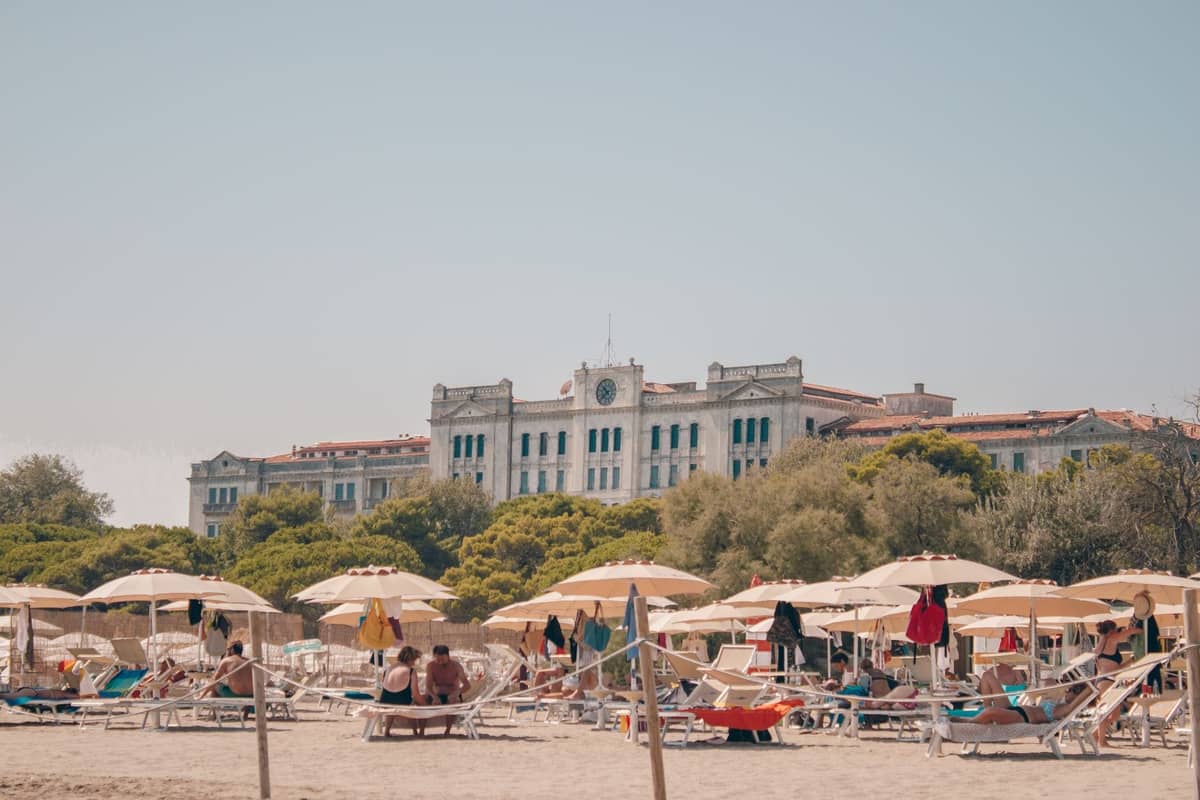
The shoreline is divided into two types of access. Along the central stretch of the Lungomare Guglielmo Marconi, private beach clubs (stabilimenti balneari) occupy the sand in front of the grand hotels. These clubs rent out sun loungers and umbrellas for roughly €15 to €40 per day depending on the establishment, season, and position on the beach. The service is proper: changing cabins, showers, beach bars serving granita and Aperol spritz, and staff who set up your station before you arrive. For a family with young children or anyone who wants a day of structured comfort, the private clubs offer genuine convenience.
The free public beaches (spiagge libere) are at the northern end near San Nicolò and at the southern tip near Alberoni, where the island transitions into a nature reserve. The Alberoni beach in particular draws visitors who want uncrowded sand. It sits at the edge of the Alberoni pine forest, is accessible by bus from the Lido vaporetto stop, and has a noticeably wilder character: the dune vegetation, the sound of the sea without beach music, and the sight of cargo ships on the horizon passing through the Porto di Malamocco channel. Bring everything you need, as facilities are limited.
💡 Local tip
For the free Alberoni beach, take ACTV bus line A from Lido S.M.E. to the southern end of the island. The ride takes around 20 minutes and passes through the quieter interior of Lido, giving a useful glimpse of how residents actually live.
Tickets & tours
Hand-picked options from our booking partner. Prices are indicative; availability and final rates are confirmed when you complete your booking.
Doge's Palace skip-the-line tour
From 67 €Instant confirmationFree cancellationVenice Legends, Anecdotes and Ghost Stories Tour
From 35 €Instant confirmationFree cancellationGhosts and legends tour of Venice
From 29 €Instant confirmationFree cancellationSkip-the-line guided tour of Doge's Palace and Saint Mark's Basilica
From 106 €Instant confirmationFree cancellation
The Architecture: Belle Époque by the Sea
Lido developed as a fashionable seaside resort during the late 19th and early 20th centuries, when wealthy Venetians and European travelers began treating the island as a summer escape. The architectural result is a stretch of Liberty-style (Italian Art Nouveau) and early Rationalist buildings that stand in complete contrast to the Gothic and Byzantine vocabulary of the historic center. The Hotel Excelsior, the Hotel des Bains (now converted to residential use), and the Casino Municipale on the Gran Viale are the most prominent examples, their ornate facades and grand proportions speaking to a moment when Lido was a genuine destination for the European elite.
Thomas Mann set his 1912 novella Death in Venice on this island, drawing directly from the atmosphere of the Hotel des Bains and the beach in front of it. Luchino Visconti adapted the novel into a film shot here in 1971. Each September, the island hosts the Venice Film Festival at the Palazzo del Cinema on the Lungomare, a fact that adds a particular cultural weight to what otherwise looks like a quiet seaside town.
Even if architecture is not your main reason for coming, walking the Gran Viale and the Lungomare with some awareness of the buildings around you transforms the experience. The peeling plaster, the salt-weathered ironwork on balconies, and the shuttered villas all carry a sense of faded grandeur that is specific to Lido and impossible to find anywhere in the historic city.
How the Beach Changes Through the Day
Early morning, before 9am, the Lungomare belongs almost entirely to joggers and dog walkers. The sea is usually glassy and pale, the light flat and salt-hazy. Private beach clubs are setting out equipment but not yet accepting guests. This is the best window for photography: the grand hotel facades glow in the low eastern light, the beach is empty, and the water looks genuinely inviting. The smell at this hour is the clean brine of the open Adriatic rather than the canal-and-stone smell that defines the historic center.
By mid-morning in July and August, the private clubs fill steadily and the Lungomare promenade sees regular foot and bicycle traffic. The beach peaks between noon and 3pm, when Italian families are fully settled with lunch boxes and the beach bars are doing serious business. Afternoons often bring a sea breeze that cools the heat considerably, a genuine relief after the still, humid air of Venice's narrow calli. By early evening, the crowd thins and the light turns golden on the water. This is the moment to walk the Lungomare north toward the Hotel Excelsior, when the promenade takes on the particular relaxed quality of an Italian passeggiata by the sea.
Getting There and Getting Around
The standard route is vaporetto Line 1 from San Marco Vallaresso, which reaches Lido S.M.E. in approximately 15 minutes. Lines 5.1 and 5.2 connect from Fondamente Nove and cover different parts of the city. ACTV tickets and passes purchased for use in central Venice are valid on the vaporetto to Lido. For full fare and pass information, see the getting around Venice guide.
Once on Lido, the island is uniquely suited to cycling within the Venice municipality: flat terrain, proper roads, and dedicated paths along the Lungomare make a rented bicycle the single most efficient way to explore. Several rental shops operate near the Lido S.M.E. vaporetto stop. ACTV bus lines cover the length of the island for those who prefer not to cycle. Cars can reach Lido via the ACTV ferry-boat line 17 from Tronchetto, though bringing a car is rarely necessary for a day visit.
💡 Local tip
Rent a bicycle at the Lido stop and cycle the full length of the Lungomare to Alberoni. The ride takes around 30 to 40 minutes one way, passes through progressively quieter sections of beach, and ends at the pine forest and free beach at the island's southern tip.
Practical Details: Seasons, Weather, and What to Bring
The beach season runs roughly from late May through September, with July and August being the warmest months and the most crowded. Venice in summer is hot and humid, and the sea breeze on Lido provides relief that the historic city simply does not offer. For more on how summer conditions affect your overall visit, see the Venice in summer guide.
Outside the summer season, Lido takes on a quieter, more melancholy character. The private clubs are shuttered, the Lungomare is largely empty, and the hotel facades look more haunted than grand. For visitors who appreciate off-season atmosphere, a November or February walk along the deserted promenade is genuinely atmospheric, but there is little in terms of beach activity. The Adriatic water temperature is cold from October through May.
For a summer beach day, bring sunscreen, water, and a hat. The midday sun on the Adriatic is intense and the reflection off white sand and water amplifies it. Beachside bars and kiosks sell drinks and light food, but prices are higher than in Mestre or on the mainland. Cash is useful for smaller vendors and beach equipment rentals, though most clubs accept cards.
- Sunscreen and sun hat: essential in July and August, the UV exposure on open sand is significantly higher than in shaded Venice streets
- Towel and change of clothes: private clubs provide facilities; free beaches have limited or no changing rooms
- Bicycle lock: if renting, shops provide locks but it is worth confirming
- Water and snacks: prices at beach bars are elevated; bringing your own is a reasonable saving
- ACTV travel pass: valid on the vaporetto to Lido and on island buses
Who Will Not Enjoy Lido Beach
Travelers with only one or two days in Venice and a list of art and architecture priorities will find the transit time to Lido a significant trade-off. The 15-minute vaporetto ride each way, plus time on the island, represents a half-day minimum commitment. That half-day contains no Titians, no Byzantine mosaics, and no Gothic palaces. For anyone on a tight sightseeing schedule, the historic center will offer more return per hour.
Similarly, visitors who come to Venice primarily for its unique urban character — the canals, the bridges, the stone calli — may find Lido oddly disconnected from what makes Venice remarkable. It looks and feels like a pleasant Italian seaside resort, not like Venice. If the lagoon islands appeal more than a conventional beach, the guide to Venice's lagoon islands covers alternatives including Torcello, Burano, and Sant'Erasmo, which offer a more distinctly Venetian character.
Insider Tips
- The stretch of Lungomare directly in front of the Hotel Excelsior is photogenic in the late afternoon when the sea light turns warm and the palazzo-style facade glows. Most visitors photograph it at midday; come back at 5pm for something worth keeping.
- The free San Nicolò beach at the northern end of the island is the closest free option to the vaporetto stop (about 15 minutes on foot or by bicycle), and it receives far fewer visitors than the private club zone in the center.
- Lido has a genuine year-round community and several excellent bacari (wine bars) and trattorias on and around the Gran Viale. Eating on Lido rather than rushing back to Venice for dinner often means better prices and a more relaxed meal.
- During the Venice Film Festival in early September, the Lungomare and the Palazzo del Cinema area become unusually animated. The beach itself is quieter than August, the sea is still warm, and there is a real chance of spotting film industry crowds near the festival venues on an evening walk.
- If you plan to visit the free Alberoni beach, check the ACTV bus schedule before leaving the vaporetto stop. Buses on the southern route run less frequently than central services, and missing the last convenient departure can mean a long wait or a long cycle back.
Who Is Lido Beach For?
- Families with children who need open space and swimming after days of museums and walking
- Couples looking for a quieter, more relaxed day outside the tourist density of the historic center
- Architecture and design enthusiasts interested in Liberty-style and early 20th-century Italian seaside resort buildings
- Cyclists who want flat terrain and the ability to cover meaningful distance without bridges or steps
- Visitors staying three or more days who want variety and a genuine contrast to the canal-city experience
Nearby Attractions
Combine your visit with:
- Burano Island
Eight to nine kilometers north of Venice, Burano Island is a compact, flat island of roughly 21 hectares where fishermen's houses are painted in saturated reds, yellows, and blues. It has a legitimate history in lace-making stretching back to the 16th century, and the 40-minute vaporetto ride across the lagoon is part of the experience.
- Chiesa del Redentore
Built in 1577 as a vow to God after a devastating plague, the Chiesa del Santissimo Redentore is Andrea Palladio's finest church in Venice. Standing on the island of Giudecca across the canal from Dorsoduro, it rewards visitors with serene interiors, important Renaissance paintings, and one of the most dramatic facades in Italian architecture.
- Chioggia
Chioggia is an ancient fishing town at the southern entrance of the Venetian Lagoon, built on a cluster of small islands linked by bridges and crossed by canals. Unlike Venice, it functions as a living, working community, and that distinction shapes everything about a visit.
- Giudecca Island
Giudecca Island sits just minutes from the heart of Venice yet feels like a different city entirely. Flat, walkable, and free to explore, it rewards visitors with Palladian architecture, waterfront promenades, and a glimpse of how Venetians actually live.