Pavillon Le Corbusier: Zurich's Final Masterpiece by the Master of Modernism
The Pavillon Le Corbusier in Zurich's Seefeld district is the last building Le Corbusier designed before his death in 1965 — he never saw it completed. Inaugurated on 15 July 1967, this steel and glass structure of just 315 m² stands on the lakeside as both a museum and an architectural argument. Here is exactly what to expect when you visit.
Quick Facts
- Location
- Höschgasse 8, 8008 Zurich (Riesbach/Seefeld district)
- Getting There
- Tram 11/15 or Bus 33/916 to 'Höschgasse'; ~15-min walk from Stadelhofen station
- Time Needed
- 1 to 2 hours
- Cost
- CHF 15 regular, CHF 10 reduced, under 20 free; free entry Thursdays from 17:00
- Best for
- Architecture enthusiasts, design fans, modernist art lovers
- Official website
- pavillon-le-corbusier.ch/en
What Is the Pavillon Le Corbusier?
The Pavillon Le Corbusier is a small steel and glass pavilion sitting at the edge of Lake Zurich in the residential Seefeld quarter. It is, by most architectural accounts, the last building Le Corbusier designed before his death on 27 August 1965. He never saw it completed. The structure was officially inaugurated on 15 July 1967, two years after he died, fulfilling a commission given to him in 1960 by the Swiss patron and collector Heidi Weber.
At 315 m², this is not a grand institution. It is a tight, precisely assembled demonstration of ideas: modular proportion, primary color, interplay between enclosed and open space, and the conviction that good design belongs in daily life. For decades it operated under Heidi Weber's personal stewardship as the Heidi Weber Museum and later the Centre Le Corbusier. Since 2019 it has been administered by Museum für Gestaltung Zürich on behalf of the City of Zurich, under the official name Pavillon Le Corbusier.
ℹ️ Good to know
The pavilion operates seasonally. For 2026, it is open 17 April to 29 November, Tuesday to Sunday 12:00–18:00, with extended hours on Thursdays until 20:00. It is closed on Mondays. Verify current season dates at pavillon-le-corbusier.ch before your visit.
The Architecture: What Makes This Building Unusual
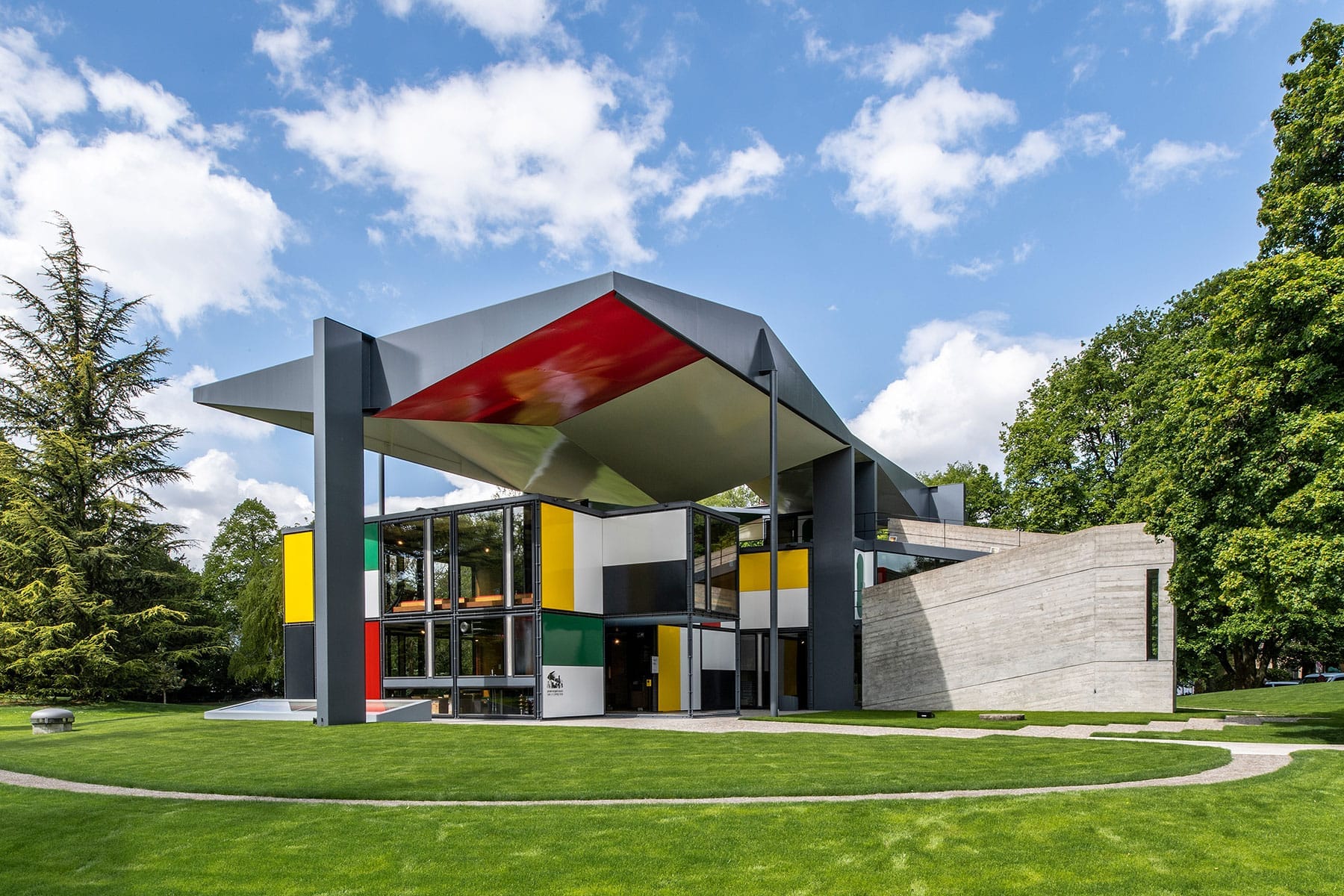
The structure breaks almost every convention of museum architecture. The main body is a lightweight steel frame, prefabricated and bolted together rather than constructed from masonry or poured concrete. The roof is a distinctive double-shell umbrella form in exposed steel, designed to shed rain while keeping the interior shaded from direct Alpine sun. It lifts slightly above the walls, creating a narrow gap that allows light and air to circulate at the perimeter.
What draws the eye immediately are the colored enamel panels inserted into the grid of the facade. Le Corbusier selected pure primary colors, red, yellow, blue, along with black and white, following his Modulor system of proportional harmony. From a distance the building reads almost like a Mondrian painting translated into three dimensions. Up close, the panels have a subtle industrial texture, the enamel slightly reflective in flat northern light, vivid and almost luminous in direct sun.
The building sits on pilotis, the slender concrete supports Le Corbusier championed throughout his career, lifting the structure off the ground. Below the main floor an open terrace and storage areas occupy the ground level, maintaining the idea that the land beneath the building should remain accessible. The interior is organized around a spiral staircase connecting three levels, with the roof terrace functioning as an outdoor room with views toward the lake.
The pavilion represents Le Corbusier's late synthesis of painting, sculpture, and architecture. If you want broader context for his influence on modernist design culture, the Museum für Gestaltung Zürich, which now manages the pavilion, holds extensive design archives and frequently connects both institutions thematically.
Tickets & tours
Live prices and dates from our booking partner. If you book, we may earn a commission at no extra cost to you.
Mount Titlis snow fun for first-time skiers from Zurich
From 212 €Instant confirmationFree cancellationSwiss ski experience from Zurich
From 321 €Instant confirmationFree cancellationBest intro tour of Zurich with a local
From 116 €Instant confirmationFree cancellationZurich Old Town guided walking tour
From 27 €Instant confirmationFree cancellation
Inside the Pavilion: What the Exhibition Covers
The interior holds a permanent collection of works by Le Corbusier drawn from Heidi Weber's original acquisitions: paintings, tapestries, sculptures, drawings, furniture, and architectural models. The collection was assembled over decades by Weber, who began collecting his work in the 1950s and later persuaded him to design this building specifically to house it.
The rooms are small and the ceilings sometimes low, following the Modulor dimensions. This creates an intimacy that larger institutions cannot replicate. Paintings hang close together. The furniture pieces, including chairs and tables designed by Le Corbusier in collaboration with Charlotte Perriand and Pierre Jeanneret, are displayed as functional objects rather than behind barriers. The textures are present: raw steel, lacquered surfaces, woven wool tapestry.
Temporary exhibitions supplement the permanent display each season. These typically extend into the outdoor terrace and the ground-level open space, allowing the building itself to become part of the curatorial argument. Check the official site for the current season's programme before visiting.
💡 Local tip
Thursday evenings offer both free admission from 17:00 and the best natural light. The setting sun hits the colored enamel panels from the west and the lake surface catches reflected light. This is the most photogenic and least crowded window of the week.
How the Experience Changes by Time of Day
The pavilion reads very differently at different hours. At midday in summer the colored panels are intensely saturated and the surrounding lakeside park is active with joggers, cyclists, and families. The building sits within Zurichhorn Park, so the approach through the tree line carries something of a discovery quality: the structure appears somewhat abruptly between the greenery.
Later afternoon, particularly in the hour before closing, the crowd inside shrinks considerably. The quality of light in the interior shifts warmer, and the rooftop terrace becomes genuinely pleasant rather than merely functional. This is when the proportional logic of the building is easiest to understand without distraction.
In overcast weather, the building loses some of its chromatic drama from the outside but gains atmosphere inside, where the diffuse grey light flattens shadows and makes the paintings easier to read. Clear winter-season mornings when the pavilion is closed do allow an exterior circuit of the building, which costs nothing and gives a clean view of the steel frame and pilotis without other visitors in the frame.
Getting There and Practical Logistics
The pavilion is straightforward to reach by tram or bus. Trams 11 and 15, along with bus lines 33 and 916, stop at Höschgasse, a short walk from the entrance at Höschgasse 8. From Zurich's main lakeside hub at Bürkliplatz the tram ride takes around five to seven minutes. If you are coming from Stadelhofen station, the walk along the lake promenade takes roughly 15 minutes and passes through the park, which is itself a pleasant introduction to the area.
The Lake Zurich promenade connects Bürkliplatz to the Seefeld lakefront continuously, making it easy to combine a visit to the pavilion with a walk along the water. The surrounding Seefeld neighborhood has good cafes and restaurants within a few minutes of the building if you need to eat before or after.
For accessibility requirements, the official site directs visitors to contact the museum directly. The pilotis construction and multi-level interior with a spiral staircase present real challenges for visitors with limited mobility. Contact the museum in advance if this is a concern.
⚠️ What to skip
The pavilion is seasonal and closed in winter. It is also closed every Monday during the open season. Do not plan a visit without checking the current opening calendar at pavillon-le-corbusier.ch, as dates shift slightly each year.
Photography, What to Bring, and Honest Expectations
The exterior is one of the more photogenic modernist facades in Zurich. For the colored panel compositions, a position slightly back from the entrance gives you the full grid with the lake or park trees behind it. The double-shell roof reads best from a low angle. Inside, photography is generally permitted for personal use but you should confirm with staff on arrival, as policies can shift with temporary exhibitions.
Bring comfortable shoes. The building is compact but the park surrounding it rewards a slow circuit, and the lakeside path makes an obvious extension to the visit. In summer, the terrace of the pavilion gets warm in the afternoon sun. There is no permanent cafe or restaurant inside the building.
A candid point: this is a specialist attraction. People who arrive without architectural or design interest sometimes find the scale underwhelming and the collection demanding. The building rewards those who approach it with curiosity about how proportion, color, and material relate to one another. Visitors expecting a conventional art museum experience with large galleries and obvious narrative displays may find it frustrating. That is not a criticism of the building. It is just honest about what it is.
If you are building a broader itinerary around Zurich's architectural and cultural landmarks, the Kunsthaus Zurich and the Swiss National Museum offer very different but complementary perspectives on Swiss cultural heritage. For a focused look at what else Zurich's museums offer, the best museums in Zurich guide covers the main options with comparative detail.
Context: Why This Building Still Matters
Le Corbusier completed dozens of major buildings across Europe, India, and the Americas. The Pavillon Le Corbusier is singular among them for several reasons. It was built as a total work: a building designed to house the architect's own paintings, sculptures, and furnishings, conceived as an integrated argument rather than a neutral container. It was also built at the end of his life, when his ideas about prefabrication, standardized proportions, and the democratization of design were fully formed.
The fact that it survived at all is partly due to Heidi Weber's determination. After Le Corbusier's death, maintaining the building and collection required decades of personal advocacy against neglect and bureaucratic indifference. The transition to City of Zurich management in 2019 resolved the long-term preservation question. The building is now protected and professionally managed, but the intimacy of its original conception survives.
In a city that has strong architectural assets across many periods, from Romanesque church towers to contemporary lakeside structures, the Pavillon Le Corbusier occupies a specific place as Zurich's most significant piece of 20th-century architectural heritage. It is the only major work Le Corbusier designed in Switzerland during his mature career — the country where he was born — and the last building he ever designed, completed posthumously in 1967.
Insider Tips
- Thursday free admission from 17:00 is genuinely free, not just a discount. Combine it with a walk along the lakefront before the building closes at 20:00.
- The rooftop terrace is often overlooked. It offers a low, close view over the lake and park canopy that is difficult to find elsewhere in Seefeld without entering a private building.
- The colored enamel panels photograph best in flat morning light or late afternoon when the sun is low. Midday overhead sun washes out the color contrast considerably.
- Walk a full circuit of the exterior before entering. The building reads as a sequence of compositions from different angles, and the pilotis at the corners are most legible from the north side facing the lake.
- If you are visiting with an architectural interest, the Museum für Gestaltung Zürich occasionally runs programmed tours and events connecting to the pavilion. Check both institutions' calendars together when planning your visit.
Who Is Le Corbusier Pavilion (Heidi Weber Museum) For?
- Architecture and design enthusiasts who want to engage with a significant modernist building at close range
- Fans of Le Corbusier's paintings, tapestries, and furniture who rarely see the work in three-dimensional context
- Travelers combining a museum visit with a lakeside afternoon walk through Zurichhorn Park
- Photography-focused visitors looking for geometric modernist compositions against a natural backdrop
- Couples or solo travelers who prefer small, quiet, specialist museums to crowded major institutions
Nearby Attractions
Other things to see while in Riesbach & Seefeld:
- Zurich Botanical Garden (Botanischer Garten)
The Botanical Garden of the University of Zurich (Botanischer Garten der Universität Zürich) is a freely accessible green space in the Seefeld district, home to tropical greenhouses, medicinal plant collections, and curated outdoor beds. It rewards slow, attentive visitors more than it does those rushing through.
- Zurich Opera House (Opernhaus Zürich)
The Opernhaus Zürich has anchored the city's cultural life since 1891, combining a striking Neo-Renaissance facade with world-class opera and ballet. Whether you're a first-time operagoer or a seasoned aficionado, here's what a visit really involves.
- Zürichhorn Park
Zürichhorn Park is a free, open-access green space on the eastern shore of Lake Zurich in the Seefeld quarter. With Alpine views, public sculptures, and lake access, it draws everyone from early-morning joggers to afternoon picnickers. No ticket required, no agenda needed.
Planning a trip? Discover personalized activities with the Nomado app.