Lanna Traditional House Museum: A Living Portrait of Northern Thai Heritage
The Lanna Traditional House Museum in Chiang Mai's Nimman district preserves a collection of historic northern Thai wooden houses transplanted from the countryside and reassembled on a shaded campus. The site offers one of the most grounded introductions to Lanna domestic life, craftsmanship, and spatial culture available in the city.
Quick Facts
- Location
- On Chiang Mai University campus just south of the Nimman area, Chiang Mai
- Getting There
- Songthaew to CMU campus or Huay Kaew Road; 10–15 minute walk from One Nimman / Maya Mall
- Time Needed
- 1 to 2 hours
- Cost
- Around 100 baht for adults; some categories (e.g., students, CMU alumni, certain Thai visitors) free; verify admission at gate
- Best for
- Architecture lovers, culture seekers, slow travelers, photographers
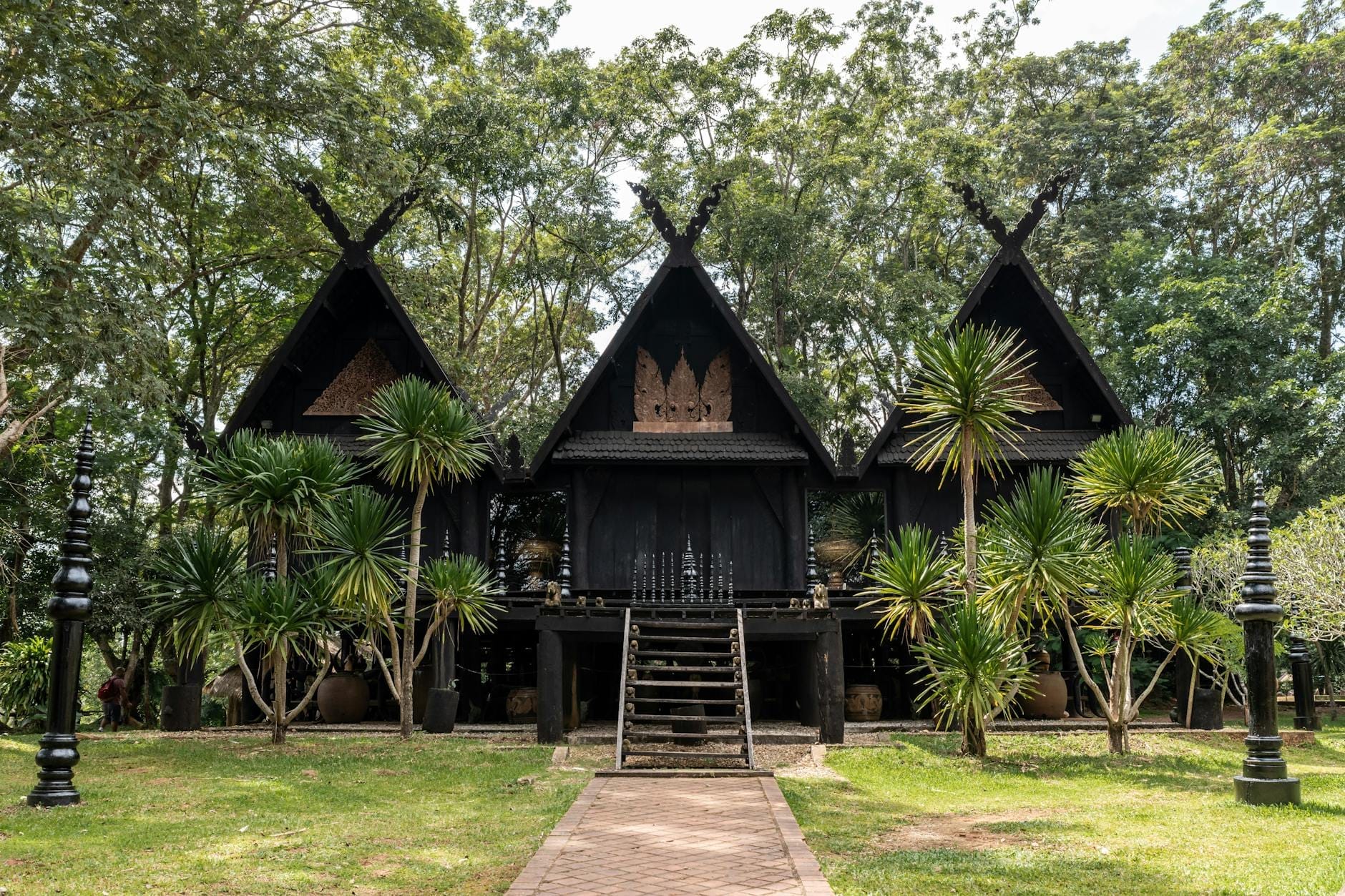
What the Lanna Traditional House Museum Actually Is
The Lanna Traditional House Museum sits on a leafy plot within the Chiang Mai University campus, offering something most museums in Thailand do not: the chance to walk through, around, and beneath genuine historic structures rather than look at objects sealed behind glass. The museum is essentially an open-air campus of reassembled Lanna wooden houses, each relocated from villages across northern Thailand and rebuilt here with their original timber, joinery, and proportions intact.
Lanna architecture has a distinct grammar. Houses are raised on stilts, with steep roofs designed to shed monsoon rain quickly, and wide eave overhangs that create shaded transitional spaces between inside and outside. The wood used, typically teak or hardwoods sourced from northern forests, darkens beautifully with age to the color of strong tea. Walking among these structures gives a far more immediate understanding of how northern Thai families actually organized domestic life than any photograph or diagram can convey.
If you are already planning time in this part of the city, the museum pairs naturally with a stroll down Nimman Road or a stop at nearby One Nimman, both within easy walking distance.
The Architecture: Reading the Buildings
The houses on site represent several distinct Lanna residential typologies. Some are compact single-family structures with a central living platform and sleeping areas partitioned by lightweight screens. Others are larger, demonstrating how extended family compounds were organized around a shared outdoor space, with separate pavilions for cooking, storage, and receiving guests. The spatial logic is clear once you slow down and look: every element serves a climatic or social function.
Details worth examining closely include the carved wooden gable boards called kalae, the distinctive crossed finials found on northern Thai rooftops that differentiate Lanna domestic buildings from those of central Thailand. Some interpretations link the kalae form to buffalo horn symbolism or protective ritual. Whatever their origin, they mark these rooflines immediately and appear throughout rural northern Thailand once you know to look for them.
The joinery throughout the structures is mortise-and-tenon, constructed without nails, and in some cases without a single metal fastener. The fact that these buildings survived long enough to be relocated and are still structurally coherent speaks to the quality of materials and craft that defined Lanna construction before imported industrial materials changed vernacular building practices.
💡 Local tip
Bring a wide-angle lens or step back as far as the compound allows to photograph the rooflines against the sky. Morning light from the east catches the teak surfaces well before 10am.
Tickets & tours
Live prices and dates from our booking partner. If you book, we may earn a commission at no extra cost to you.
Traditional northern Thai dinner with cultural show
From 79 €Instant confirmationFree cancellationChiang Mai Yee Peng Lanna sky lantern festival experience
From 154 €Instant confirmationDoi Inthanon National Park small group guided tour
From 34 €Instant confirmationFree cancellationHalf-day tour to admire elephants and enjoy Thai nature
From 48 €Instant confirmationFree cancellation
The Experience at Different Times of Day
Early morning is the best time to visit. The campus is quiet, the air still carries coolness, and the low-angle light cuts under the eaves in a way that reveals the texture of weathered wood and hand-cut beams. By mid-morning, if there are school groups visiting, the atmosphere shifts. Children move through the structures with more energy than reverence, which is charming but does change the mood. University students from CMU occasionally use the grounds for study or informal photography sessions.
Midday is the hardest time to visit during hot season, roughly March through May. The courtyard areas lack shade cover in the center, and the interiors of the raised houses, while slightly cooler, can become close. If you visit during this window, the dry heat is genuinely intense and the experience is less pleasant. Late afternoon, after around 3:30pm, sees the light shift again and the temperature drop slightly, making for a more comfortable second visit window.
⚠️ What to skip
Chiang Mai's burning season, typically February through April, fills the air with haze that reduces visibility and affects air quality. If photography or comfort outdoors is important to your visit, plan around this period.
Cultural and Historical Context
The Lanna Kingdom flourished across what is now northern Thailand, parts of Yunnan in southern China, and stretches of Myanmar and Laos from the mid-13th century until Burmese conquest of Chiang Mai in 1558. Even after political absorption into the Siamese kingdom in the late 19th century, Lanna maintained a distinct material culture: its own script, temple art, textile traditions, musical forms, and domestic architecture. That distinctiveness is what this museum works to preserve.
The mid-20th century brought rapid change to rural northern Thai villages as concrete and corrugated metal roofing replaced wood and thatch. Many traditional houses were demolished or abandoned. The effort to document and relocate specimens of this architecture parallels what institutions like the Lanna Folklife Museum do with portable artifacts and everyday objects. Together they form complementary lenses on the same cultural world.
The museum's location near Chiang Mai University is not incidental. CMU has historically been a center for northern Thai cultural studies, and several academic projects documenting Lanna domestic architecture were driven by faculty and researchers affiliated with the institution. The campus placement gives the site an academic seriousness that distinguishes it from purely commercial heritage presentations.
Inside the Houses: What to Look For
Some of the structures on site allow entry, letting you climb the wooden steps and stand on the elevated platform floor. The first thing most visitors notice is the floor itself: broad planks of teak worn smooth by decades of bare feet, slightly springy underfoot, warm to the touch even in cool weather. The grain of aged teak is visually striking at close range, with a depth that no modern engineered wood replicates.
Interior furnishings, where present, typically include low tables for communal dining, sleeping mats, woven baskets for storage, and examples of northern Thai textiles. The color palette of traditional Lanna interiors is muted: dark wood, natural fiber, occasional lacquerware in red and black. There are no bright synthetic materials, no plastic. The restraint is striking and almost meditative.
Interpretive signage exists but is variable in quality and completeness. Some panels offer detailed explanation of structural elements and historical context; others are sparse. Independent visitors with a genuine interest in architecture or northern Thai culture will benefit from doing some background reading before arriving, rather than relying entirely on on-site information.
ℹ️ Good to know
Remove shoes before entering any raised structure, as is standard across Thai cultural and religious sites. The steps are typically polished smooth, so be careful in socks on wet days.
Practical Walkthrough and Getting There
The museum is reachable from the Nimman Road area on foot in roughly 10 to 15 minutes, or by a short songthaew ride. If you are coming from the Old City, the most straightforward approach is a red songthaew heading west toward Nimman or CMU. The museum sits close to the Chiang Mai University campus boundary, and most drivers will know it by name. Tuk-tuks and ride-hailing apps such as Grab also serve the area reliably.
Visitors who are building a half-day Nimman and CMU itinerary can combine the Lanna Traditional House Museum with nearby Ang Kaew Reservoir inside the university grounds, which adds a gentle outdoor walk to the cultural content. The two sites together require around three to four hours at a relaxed pace.
For a broader picture of how Chiang Mai's temples and cultural sites connect geographically and historically, the Chiang Mai temples guide provides useful orientation, and the 3-day Chiang Mai itinerary places this type of attraction within a practical day-by-day structure.
Who Will Not Enjoy This Place
Travelers with limited mobility should note that the raised-floor structures require climbing wooden stairs without handrails in many cases. The grounds themselves are generally accessible for walking, but the interiors are not. Those hoping for a polished, air-conditioned, English-language museum experience with interactive displays will find the site underwhelming. It is a quiet academic institution, not a commercial attraction designed around visitor entertainment.
Families with very young children can visit, but small children will not absorb much and may find the site boring after the initial novelty of the wooden stairs. This is fundamentally an adult interest destination, best suited to those who arrive already curious about vernacular architecture, Thai history, or material culture.
Insider Tips
- Visit on a weekday morning to avoid university student photography sessions, which tend to cluster on weekends and can crowd the most photogenic spots.
- The kalae gable finials photograph best from a low angle looking upward. Crouch near the base of the stairs and shoot toward the roofline against open sky rather than against foliage.
- Ask at the entrance or main office about any temporary exhibitions or guided tours connected to CMU's Faculty of Fine Arts, which occasionally uses the campus for academic events open to the public.
- Wear shoes you can slip on and off easily. You will be removing them multiple times as you move between structures, and fumbling with laces breaks the rhythm of exploration.
- Pair this site with the Lanna Folklife Museum in the Old City on the same day if your primary interest is northern Thai cultural heritage. The two cover complementary ground and together give a thorough introduction to the Lanna world.
Who Is Lanna Traditional House Museum For?
- Architecture enthusiasts interested in pre-industrial vernacular building techniques
- Travelers with a serious interest in northern Thai history and Lanna cultural identity
- Photographers looking for warm teak surfaces, geometric rooflines, and natural-light interiors
- Slow travelers who want depth over spectacle and find quiet, uncrowded spaces restorative
- Students and academics researching Southeast Asian material culture or domestic architecture
Nearby Attractions
Other things to see while in Nimmanhaemin (Nimman):
- Ang Kaew Reservoir (CMU Lake)
Tucked inside Chiang Mai University's forested campus, Ang Kaew Reservoir is a serene lake framed by pine and eucalyptus trees with Doi Suthep rising directly behind it. It's the kind of place locals walk before work, students study beside on weekends, and visitors stumble upon while exploring the Nimman area.
- Baan Kang Wat (Artist Village)
Baan Kang Wat is a cluster of low-rise wooden studios and workshops located off Suthep Road, beside Wat Umong on the western side of Chiang Mai. On weekends it hosts a small artisan market; on weekdays it's one of the quietest, most atmospheric corners of the city.
- Jing Jai Farmers' Market
Jing Jai Farmers' Market is Chiang Mai's most beloved weekend market, drawing local farmers, organic producers, and artisan food vendors to a shaded outdoor space near the Nimman neighborhood. It runs Saturday and Sunday mornings and offers a window into how the city actually eats and shops, far removed from the tourist-oriented night markets.
- Nimmanhaemin Road
Nimmanhaemin Road is Chiang Mai's most design-conscious street, lined with independent coffee shops, art galleries, concept boutiques, and some of the best casual restaurants in northern Thailand. It rewards both a quick stroll and a full afternoon of exploration.
Planning a trip? Discover personalized activities with the Nomado app.