La Casa Encendida: Madrid's Most Adventurous Cultural Centre
Housed in a century-old neo-Mudéjar building in Lavapiés, La Casa Encendida offers a genuinely free and inclusive cultural programme spanning contemporary art exhibitions, cinema, workshops, and a rooftop terrace bar. It is one of the few spaces in Madrid where cutting-edge culture, social activism, and community life coexist under the same roof.
Quick Facts
- Location
- Ronda de Valencia 2, 28012 Madrid
- Getting There
- Metro: Embajadores (Lines 3 & 5) or Lavapiés (Line 3); BiciMAD docking station at Ronda de Atocha 34
- Time Needed
- 1–3 hours for exhibitions; longer if attending a film screening or evening event
- Cost
- Free entry to the centre; fees vary for festivals and special activities
- Best for
- Contemporary art lovers, cinema enthusiasts, locals seeking community culture, and travellers curious about Madrid beyond the Prado triangle
- Official website
- www.lacasaencendida.es/en
What La Casa Encendida Actually Is
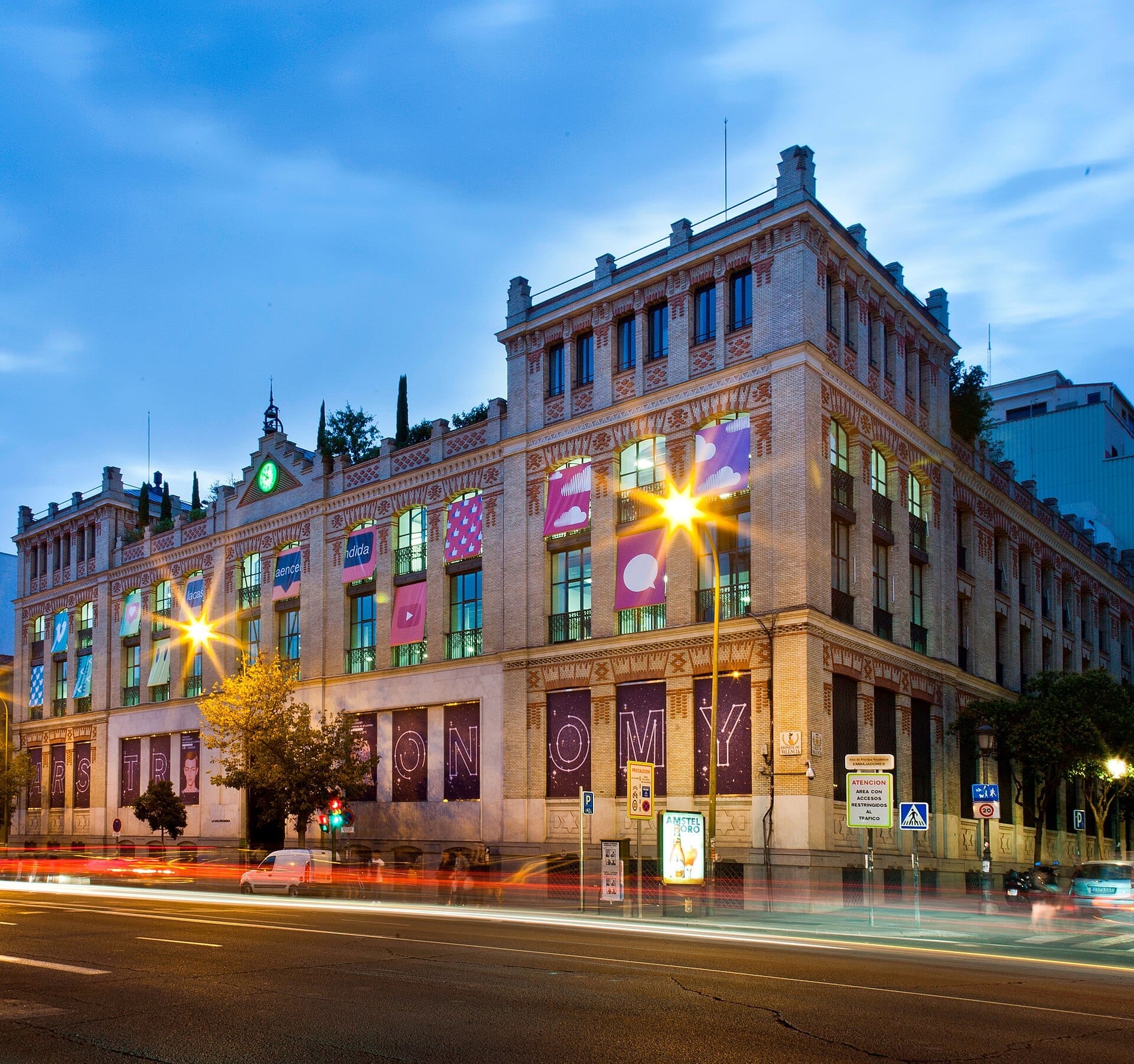
La Casa Encendida is a social and cultural centre operated by the Fundación Montemadrid, occupying a striking neo-Mudéjar building at Ronda de Valencia 2 in the Lavapiés neighbourhood. Inaugurated in its current cultural role on 3 December 2002, it has since become one of Madrid's most boldly experimental arts spaces, programming contemporary art exhibitions, international cinema, music, debates, and hands-on workshops across roughly 6,800 square metres spread over four floors and a roof terrace.
Unlike the grand institutions along the Paseo del Arte, La Casa Encendida does not trade on prestige collections or blockbuster retrospectives. Its identity is deliberately countercultural: the programme frequently foregrounds LGBTQ+ voices, environmental politics, migrant communities, and emerging artists. This is a space where activism and aesthetics are treated as compatible rather than competing interests.
ℹ️ Good to know
Entry to the centre is free. Tickets for festivals, film screenings, and some workshops carry individual prices listed in euros per event. Check the official website before your visit, as the programme changes frequently and some events sell out in advance.
The Building: A Neo-Mudéjar Landmark
The building was designed by architect Fernando Arbós y Tremantí, who also designed the Panteón de Hombres Ilustres. Construction began in 1911 and the structure was officially inaugurated in 1913 as a branch of the Caja de Ahorros y Monte de Piedad de Madrid, a savings bank with a social mission. That philanthropic DNA still shows in the institution's current form.
The neo-Mudéjar style, which borrows from the medieval Iberian tradition of Moorish-influenced Christian architecture, is immediately visible in the building's patterned brickwork, horseshoe-arch details, and the decorative ceramic tilework that lines the interior courtyards. From the street, the façade reads as imposing but intricate, with warm terracotta tones that catch the late-afternoon Madrid sun in a way that glass-and-steel buildings simply cannot.
If you are already developing an interest in this architectural tradition, it fits naturally into a broader look at Madrid's decorative public buildings. A guide to Madrid's architectural highlights covers several other neo-Mudéjar structures worth seeking out across the city.
Tickets & tours
Hand-picked options from our booking partner. Prices are indicative; availability and final rates are confirmed when you complete your booking.
2-hour Private Segway tour of Casa de Campo
From 50 €Instant confirmationFree cancellationCasa del Labrador guided tour
From 14 €Instant confirmationRoyal Monastery of El Escorial and the Valley of the Fallen trip from Madrid
From 64 €Instant confirmationFree cancellationFlexible time Real Madrid: Bernabeu Stadium & Museum Entry
From 42 €Instant confirmation
The Exhibition Floors: What to Expect Inside
The interior unfolds differently from what you might expect from a traditional gallery. The ground floor reception is calm and airy, with natural light filtering through the central patio. Staff are approachable, and the free-entry model means the atmosphere rarely feels precious or hushed. Visitors range from art students sketching in notebooks to families letting children wander through installation spaces.
Exhibitions across the four floors tend toward video art, photography, and large-scale installations rather than painting or sculpture alone. Shows frequently challenge comfortable categories: a single exhibition might blend documentary film, archival objects, and participatory elements in the same room. Wall texts are usually available in both Spanish and English, though the depth of English translation can vary by show.
The building's internal corridors and stairwells are worth lingering in. Tiled surfaces, iron railings, and the play of natural and artificial light across different hours give the space a texture that many purpose-built contemporary art venues lack. Early afternoon, when the upper floors receive direct sunlight through skylights, is particularly good for experiencing the architecture alongside the art.
💡 Local tip
Visit on a Tuesday or Wednesday morning to find the exhibitions at their quietest. Weekend afternoons bring a noticeably younger, local crowd, which changes the social atmosphere of the space completely, not necessarily for the worse, but very differently.
Cinema, Workshops, and the Wider Programme
The cinema programme at La Casa Encendida consistently shows work that does not reach Madrid's commercial multiplex circuit: restored classics, documentary cycles, short film competitions, and international co-productions from underrepresented regions. Festival seasons, particularly in autumn and spring, can fill the screening room well in advance, so booking online before arriving is strongly advisable.
Workshops run the full spectrum from urban gardening on the terrace to digital music production, printmaking, and creative writing. Many are free or low-cost, and some are explicitly designed to be accessible to people with disabilities, consistent with the centre's compliance with Spain's UNE 170001 universal accessibility standard. The rooftop urban garden is itself a quiet oddity worth checking on your way up to the terrace: productive growing beds on a historic Madrid rooftop, tended with genuine care.
La Casa Encendida's approach to community culture sits well alongside what makes Lavapiés one of Madrid's most remarkably diverse and culturally active neighbourhoods. The surrounding streets are worth exploring before or after your visit.
The Rooftop Terrace: Friday and Saturday Evenings
The terrace café-bar normally opens on Friday and Saturday evenings from 19:00 to 23:00, but at present it is temporarily closed; check the official website for the latest status before planning an evening visit. By around 20:00, it becomes one of the more unusual evening spots in the city: an open-air platform on top of a century-old building, with views across the Lavapiés roofscape, a relaxed drink-in-hand atmosphere, and occasional live music or DJ sets depending on the season and programme.
The crowd is reliably local and unpretentious. This is not a rooftop bar designed for social media performance or tourist checkboxes. Expect a mix of artists, students, neighbourhood regulars, and a handful of visitors who have done their homework. Drinks are priced reasonably by Madrid standards. Arrive between 19:30 and 20:00 to claim a good spot before it fills, particularly in warm months.
💡 Local tip
In summer, the terrace can get warm even into the evening. Madrid's elevated position at around 650–670 metres means nights cool down faster than you might expect after a hot day, so bring a light layer if you plan to stay past 21:30.
Getting There and Practical Logistics
The centre opens Tuesday through Saturday from 10:00 to 21:00 and Sunday from 10:00 to 16:00. It is closed on Mondays. Exhibition rooms are cleared 15 minutes before the building closes. Check the official website for any closures during August or public holidays, as these are announced seasonally.
The closest metro stations are Embajadores on Lines 3 and 5, and Lavapiés on Line 3. Both are a short, flat walk from the building. A BiciMAD public bicycle docking station sits at Ronda de Atocha 34, very close to the building. The area is navigable on foot from Atocha station in under ten minutes, making it a logical cultural stop if you are already visiting the Reina Sofía or the botanical garden.
If you are structuring a full day in the south of Madrid's cultural corridor, the Museo Reina Sofía and Real Jardín Botánico are both within comfortable walking distance.
Accessibility is taken seriously here. The entire building meets the UNE 170001 universal accessibility standard, with lift access between floors, accessible toilets, and staff trained to support visitors with diverse needs. This is not a retrofitted concession: the standard is built into how the institution presents itself.
⚠️ What to skip
The neighbourhood around Ronda de Valencia is generally straightforward to navigate, but some of the narrower side streets in Lavapiés can be poorly lit at night. Stick to the main streets after dark, and note that the area attracts a notably mixed and lively crowd on weekend evenings.
Who Should and Should Not Visit
La Casa Encendida rewards visitors who come with genuine curiosity and a tolerance for art that asks questions rather than offers easy pleasures. If your Madrid itinerary is built around canonical collections, this will feel like a deliberate departure from that world, which is precisely the point. Travellers who found the Reina Sofía's permanent collection more interesting than the Prado's golden centuries will find the cultural DNA here familiar and appealing.
Visitors looking for a polished tourist experience with multilingual audio guides and gift shop staples will be disappointed. The institution does not cater to passive consumption. Equally, if your time in Madrid is limited to two or three days and you have not yet seen the major permanent collections, this is probably not where to prioritise.
For those building a broader Madrid itinerary, it is worth consulting a guide to Madrid's best museums to understand how La Casa Encendida fits within the city's wider cultural offer before committing an afternoon to it.
Insider Tips
- The programme publishes roughly a month in advance on the official website. Check it before finalising your travel dates if attending a specific film cycle or festival matters to you; these events can shape an entire evening very effectively.
- The internal courtyards on the upper floors are often overlooked by visitors moving quickly through exhibitions. Slow down in these tiled transitional spaces, particularly when afternoon light hits the brickwork at an angle.
- Friday evening is the optimal visit: you get the full building hours, the terrace bar opens at 19:00, and the crowd transitions from afternoon gallery-goers to a neighbourhood evening mix that gives the whole space a different energy.
- Lockers are available near the entrance for bags and coats. Use them: the exhibitions often involve large installations where bags become awkward, and this provision is a thoughtful detail the building merits using.
- If you are visiting Lavapiés more broadly, time your arrival at La Casa Encendida for mid-morning, explore the neighbourhood and Mercado de Antón Martín around midday, and return for the terrace in the evening. It structures the whole neighbourhood into a single coherent day.
Who Is La Casa Encendida For?
- Contemporary art and photography enthusiasts who want programming beyond blue-chip names
- Cinema lovers seeking international and independent film outside the commercial circuit
- Travellers curious about Madrid's social and activist cultural scene
- Visitors spending more than three days in the city and ready to explore beyond the Paseo del Arte
- Anyone who wants a distinctly local Friday or Saturday evening that does not feel designed for tourists
Nearby Attractions
Other things to see while in Lavapiés:
- Matadero Madrid
Matadero Madrid is a sprawling contemporary arts centre built inside a neo-Mudéjar slaughterhouse complex dating from 1908. Free to enter for most exhibitions, it hosts digital art, theatre, cinema, and outdoor events on the southern edge of Madrid along the Manzanares River.
- Mercado de Antón Martín
Mercado de Antón Martín is a working municipal market on Calle Santa Isabel in Embajadores, Madrid. Open since 1941, it mixes traditional food stalls with a ground-floor gastro area and — unusually — a celebrated flamenco dance school on the third floor. Entry is free.
- Museo del Ferrocarril de Madrid
Housed in the magnificent 1880 Delicias station, the Museo del Ferrocarril de Madrid is one of Spain's most atmospheric industrial heritage sites. Vintage locomotives, sleeper cars, and a working model railway fill a soaring iron-and-glass nave that few tourists ever discover. Here is everything you need to plan a visit.